Navigating the Judicial Review Process: When the Home Office Receives Your Challenge
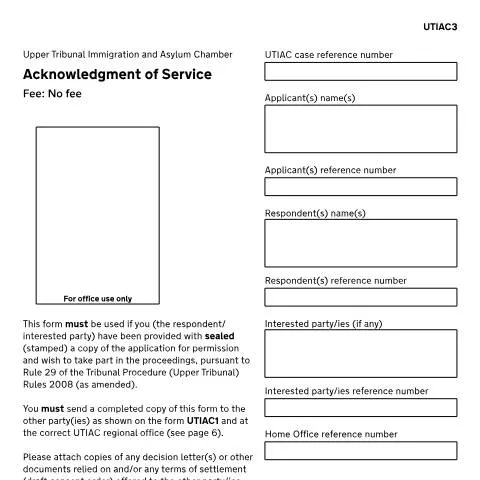
When an individual submits form UTIAC1 to challenge an immigration or asylum decision through judicial review, the machinery of justice begins to turn. The Upper Tribunal Immigration and Asylum Chamber must ensure that all parties—particularly the respondent Home Office and any interested parties—have their opportunity to respond. This is where form UTIAC3 becomes crucial: it serves as the formal acknowledgment mechanism that brings all relevant parties into the judicial review proceedings.
The UTIAC3 form represents more than administrative housekeeping. It establishes the battleground for what may become a complex legal contest over an individual's right to remain in the UK, their asylum claim, or their immigration status. Each completed UTIAC3 form signals that the respondent—typically a government department—intends to defend their decision or that an interested party wishes to participate in the outcome.
Understanding this form's role becomes particularly important when considering that judicial review proceedings in immigration and asylum cases often involve multiple stakeholders. The original applicant seeks to overturn a decision, while the Home Office must justify its reasoning, and sometimes third parties—such as local authorities or other government bodies—may have legitimate interests in the case's outcome.
The 21-Day Window: Critical Timing in Immigration Appeals
The most unforgiving aspect of the UTIAC3 process lies in its rigid timeframe. Once a respondent or interested party receives their sealed copy of the UTIAC1 application, they have exactly 21 days to submit their acknowledgment of service. This deadline operates with the precision of a legal guillotine—missing it can severely compromise a party's ability to participate in the proceedings.
The clock starts ticking from the date the sealed UTIAC1 copy was provided, not necessarily when it was received or read. This distinction matters significantly in practice. A Home Office caseworker might receive the sealed application on a Friday but not process it until the following Monday. The 21-day period, however, begins counting from that Friday.
| Scenario | Sealed Copy Provided | UTIAC3 Deadline | Consequence of Late Filing |
|---|---|---|---|
| Standard case | Day 1 | Day 21 (by close of business) | Potential exclusion from proceedings |
| Bank holiday period | Before bank holiday | 21 days from provision date | Extension application required (UTIAC6/7) |
| Postal delays | Date on delivery confirmation | 21 days from confirmed delivery | Must prove delivery date if disputed |
The Upper Tribunal does not automatically grant extensions for missed deadlines. Respondents who find themselves outside the 21-day window must complete additional forms (UTIAC6 or UTIAC7) and pay the appropriate fee to request an extension of time. The tribunal will consider factors such as the reason for delay, the strength of the proposed defence, and the potential prejudice to other parties.
Strategic Choices: Opposition, Participation, and Settlement Options
Section 2 of the UTIAC3 form presents respondents with crucial strategic decisions that will shape their entire approach to the proceedings. The checkbox options might appear straightforward, but each carries significant implications for how the case will unfold.
Choosing to "oppose the whole application for permission" signals a full-scale defence of the original decision. This approach requires the respondent to prepare comprehensive grounds demonstrating why the judicial review should not proceed. The Home Office, for instance, might argue that their immigration decision was correctly made, properly reasoned, and falls within their lawful discretionary powers.
Alternatively, selecting "oppose only part of the application" allows for a more nuanced response. A respondent might accept that certain procedural errors occurred while maintaining that the substantive decision remains sound. This partial opposition strategy can be particularly effective when the original decision contained minor flaws that don't undermine its overall validity.
The option to "not intend to oppose the application" doesn't necessarily mean surrender. Sometimes, respondents recognise that their original decision was flawed and prefer not to defend it vigorously. This approach can lead to swifter resolution and potentially reduced legal costs for all parties.
When the Immigration and Asylum Chamber of the First Tier Tribunal appears as respondent—typically when the judicial review challenges their own decision—they face additional considerations about whether to make active submissions or simply provide their case file for the Upper Tribunal's review.
Crafting the Defence: Section 3 and the Art of Legal Argumentation
Section 3 of the UTIAC3 form demands the most sophisticated legal thinking. Here, respondents must articulate their grounds for opposing the judicial review application, transforming complex immigration law into persuasive legal argument. The quality of this section often determines whether the case proceeds to a full hearing or gets resolved at the permission stage.
Effective grounds typically address several key areas. Procedural compliance arguments demonstrate that the original decision followed proper administrative procedures, considered relevant evidence, and provided adequate reasoning. Substantive merits arguments show that the decision was correct on the facts and law as they stood at the time.
Immigration and asylum cases frequently involve challenging factual assessments about country conditions, credibility, or family relationships. Respondents must carefully distinguish between areas where administrative discretion applies and those governed by strict legal requirements. A decision about whether someone faces persecution in their home country involves different legal standards than a determination about visa application completeness.
The grounds must be specific enough to address the applicant's complaints while avoiding unnecessary admissions that might strengthen their case. This delicate balance requires thorough understanding of both the original decision-making process and the legal principles governing judicial review.
Respondents can include their grounds directly in the form's text box or attach separate documents. Complex cases often warrant detailed attachments, particularly when defending decisions involving extensive country guidance, medical evidence, or family relationship assessments. The key lies in ensuring that every significant challenge raised in the UTIAC1 application receives appropriate response.
Beyond Opposition: Directions, Orders, and Case Management Requests
Section 4 of the UTIAC3 form opens opportunities for respondents to shape how the case proceeds through the tribunal system. Rather than merely responding to the applicant's judicial review, respondents can proactively request directions and orders that serve their strategic interests.
Common directions requests include applications for anonymity orders when cases involve sensitive security information, requests for expedition when ongoing detention or removal directions create urgency, and applications for case management conferences when complex factual or legal issues require detailed discussion.
Costs orders represent another significant consideration. While the Upper Tribunal generally doesn't award costs in immigration and asylum cases, exceptional circumstances can justify departure from this rule. Respondents might seek protective costs orders if they believe the judicial review application lacks merit or represents an abuse of process.
- Disclosure orders: Requiring applicants to provide complete case files or medical records
- Witness orders: Compelling attendance of decision-makers or expert witnesses
- Consolidation orders: Joining related cases for more efficient hearing
- Transfer orders: Moving cases between tribunal regions for administrative convenience
The question about extension of time requirements (Section 4.2) serves as a final safety net. Even respondents who meet the initial 21-day deadline might need additional time for specific aspects of their response, particularly when complex disclosure requests or expert evidence become necessary.
Digital Transformation: E-Filing and Modern Tribunal Practice
The UTIAC3 form's submission process reflects the Upper Tribunal's embrace of digital case management. The mandatory use of HM Courts and Tribunals E-Filing service represents more than technological modernisation—it fundamentally changes how immigration and asylum judicial reviews operate.
The e-filing system requires respondents to register for digital accounts, upload documents in specific formats, and navigate online case management interfaces. While this digital approach offers advantages in terms of speed and accessibility, it also creates new challenges for respondents unfamiliar with electronic court systems.
Successful e-filing demands attention to technical requirements that don't exist in traditional paper submissions. Document file sizes, acceptable formats (typically PDF), and digital signature requirements all become relevant considerations. The system's 24/7 availability allows for last-minute submissions that might save cases from missing crucial deadlines, but it also removes the traditional safety net of postal submission timing.
The e-filing service maintains comprehensive audit trails showing exactly when documents were submitted, received, and processed. This electronic record-keeping eliminates many disputes about timing that previously complicated tribunal proceedings. However, it also means that technical failures or user errors become more consequential—the system provides precise timestamps that leave little room for interpretation.
Legal Professional Requirements and the Statement of Truth
Section 5 of the UTIAC3 form imposes strict professional requirements that reflect the serious nature of judicial review proceedings. The statement of truth requirement means that legal representatives must verify the accuracy and completeness of their submissions, with potential contempt of court consequences for false statements.
The form specifically requires that representatives be authorised to conduct litigation in the High Court under the Legal Services Act 2007. This requirement excludes many immigration advisers who might handle other aspects of immigration cases but lack High Court litigation rights. The restriction ensures that judicial review proceedings maintain appropriate professional standards while potentially limiting respondents' choice of legal representation.
For government respondents, this requirement typically poses fewer challenges since Government Legal Department solicitors routinely possess the necessary authorisation. However, interested parties—such as local authorities or other public bodies—might need to engage specialist legal representation specifically for judicial review proceedings.
The statement of truth extends beyond the form's contents to encompass any attached grounds of opposition or supporting documents. Legal representatives must satisfy themselves about the accuracy of factual assertions, the completeness of disclosed information, and the honesty of any explanations provided for the original decision-making process.
Immediate Next Steps: Distribution and Case Progression
Once the Upper Tribunal receives and processes the UTIAC3 form, respondents face immediate obligations to share their submission with all other parties. This distribution requirement ensures transparency and allows applicants to understand the case they must meet if their judicial review proceeds to full hearing.
The sealed copy that respondents must provide to other parties carries the tribunal's official stamp, confirming that the acknowledgment of service has been properly filed and accepted. This sealing process validates the document's legal status and triggers various procedural timescales for subsequent stages of the judicial review process.
The tribunal's administrative review of submitted UTIAC3 forms can identify deficiencies requiring correction or additional information. Common issues include incomplete contact details, insufficient grounds of opposition, or problems with legal representative authorisation. Respondents must remain alert for tribunal communications requesting clarification or additional documentation.
Following successful UTIAC3 submission, the case typically moves toward the permission stage where a tribunal judge decides whether the judicial review should proceed to full hearing. The respondent's acknowledgment of service and grounds of opposition become crucial documents in this permission assessment, potentially determining whether the case continues or gets refused at this preliminary stage.
The interplay between UTIAC3 submissions and subsequent case management demonstrates the form's pivotal role in shaping judicial review outcomes. A well-crafted acknowledgment of service can strengthen the respondent's position throughout proceedings, while deficient submissions may create lasting disadvantages that prove difficult to remedy in later stages.
Understanding the Legal Framework: Immigration and Asylum Act 1999 and Tribunal Procedures
The Immigration and Asylum Act 1999 and subsequent legislation establish the statutory foundation for judicial review proceedings in immigration matters. When completing Form UTIAC3, you're operating within this complex legal framework where the Upper Tribunal (Immigration and Asylum Chamber) exercises supervisory jurisdiction over First-tier Tribunal decisions.
The Tribunal Procedure (Upper Tribunal) Rules 2008 specifically govern how acknowledgment of service must be handled. Rule 24 sets out detailed requirements for responding parties, including government departments like the Home Office. These rules distinguish between mandatory grounds where acknowledgment is automatic and discretionary cases where the Upper Tribunal retains flexibility in case management.
Understanding your position within this framework is crucial. If you're a statutory respondent - typically the Secretary of State for the Home Department - your obligations differ significantly from an interested party who might be affected by the judicial review outcome. The Home Office Immigration Enforcement directorate, for instance, must acknowledge service even in cases where they dispute jurisdiction, whereas a local authority providing support services might only need to respond if directly implicated.
The procedural timeline reflects the urgent nature of immigration cases. Unlike standard judicial review proceedings in the Administrative Court, immigration judicial reviews often involve individuals facing imminent removal or detention. This explains why Form UTIAC3 must be filed within 14 days of service rather than the standard 21 days, and why extensions are granted sparingly.
Recent case law has clarified that acknowledgment of service constitutes formal entry of appearance in proceedings. This means once you file UTIAC3, you're bound by subsequent case management directions even if you later wish to challenge the tribunal's jurisdiction. The Court of Appeal confirmed in R (on the application of Kiarie) v Secretary of State for the Home Department that procedural compliance cannot be treated as admission of substantive liability.
For asylum cases specifically, additional considerations apply under the Refugee Convention 1951 and European Convention on Human Rights. When acknowledging service in asylum judicial reviews, respondents must consider whether the case engages Article 3 (prohibition of torture) or Article 8 (right to family life) grounds. These human rights dimensions can affect both the urgency of proceedings and the scope of evidence required.
Fill in your form directly online
No printing: type your details into the boxes of the official form, tick, then download the PDF ready to send.
- 1Type into the form boxes
- 2Tick in one click
- 3Save and download the PDF
The data protection implications under UK GDPR are particularly acute in immigration cases involving vulnerable applicants. Form UTIAC3 may reference sensitive personal data including medical records, country of origin information, or details of past persecution. Respondents must ensure their acknowledgment complies with data minimisation principles while providing sufficient detail for effective case management.
Strategic Considerations: When and How to Contest Jurisdiction
Filing Form UTIAC3 requires careful strategic analysis, particularly when considering whether to contest the Upper Tribunal's jurisdiction. This decision can fundamentally alter the trajectory of proceedings and shouldn't be taken lightly without proper legal analysis of the underlying First-tier Tribunal decision and grounds for judicial review.
The most common jurisdictional challenges arise in cases involving mixed immigration and human rights claims. Where an applicant challenges both an immigration decision and related human rights determinations, respondents must assess whether the Upper Tribunal has jurisdiction over all aspects or whether some elements should properly be heard in the High Court's Administrative Court division.
Consider cases involving EU Settlement Scheme decisions post-Brexit. These often straddle immigration law and retained EU rights, creating potential jurisdictional complexity. If you're acknowledging service of a judicial review challenging an EU Settlement Scheme refusal, you might argue that certain aspects fall outside the Upper Tribunal's immigration jurisdiction, particularly where fundamental rights under the Withdrawal Agreement are engaged.
Another strategic consideration involves timing and procedural irregularities. If the judicial review application was filed outside the standard time limits, or if there are questions about whether mandatory reconsideration processes were properly completed, these issues should be flagged in your acknowledgment. The Upper Tribunal takes a strict approach to procedural compliance, but extensions may be granted in exceptional circumstances involving vulnerable applicants or legal aid delays.
When completing Section 4 of Form UTIAC3 regarding summary grounds for opposing the application, avoid detailed legal argument while providing sufficient indication of your position. Focus on identifying the key legal and factual disputes rather than fully developing your case. Remember that this summary will be disclosed to the applicant and may influence their decision to pursue or withdraw the application.
For cases involving country guidance determinations, special considerations apply. If the judicial review challenges a First-tier Tribunal decision that relied on established country guidance from the Upper Tribunal, your acknowledgment should reference the relevant country guidance cases. This helps the tribunal assess whether the case raises genuinely arguable points of law or merely seeks to re-argue factual determinations already covered by authoritative guidance.
The question of interim relief often arises in immigration judicial reviews, particularly where removal directions are imminent. While Form UTIAC3 doesn't directly address interim applications, your acknowledgment should indicate whether you oppose any interim relief sought and on what grounds. Common grounds include lack of arguable case, balance of convenience favouring the public interest, or availability of alternative remedies.
Consider also the wider policy implications of the case. If the judicial review challenges a decision that reflects broader policy guidance or operational instructions, this may affect how vigorously you contest the application. Cases with potential to establish important precedents warrant more detailed acknowledgment and early engagement with specialist legal teams.
Practical Challenges: Managing Complex Multi-Party Proceedings
Immigration judicial reviews frequently involve multiple interested parties beyond the primary applicant and Secretary of State, creating complex procedural scenarios that require careful coordination when acknowledging service. Understanding how to navigate these multi-party dynamics is essential for effective case management and avoiding unnecessary duplication of effort.
In family immigration cases, you might encounter situations where multiple family members have related applications under judicial review, each requiring separate acknowledgment but raising overlapping legal issues. For instance, a family challenging refusal of spouse visas and dependent child applications may file consolidated proceedings. Your Form UTIAC3 should clearly identify which aspects of the challenge you're responding to and whether you're seeking consolidated case management directions.
Local authority involvement adds another layer of complexity, particularly in cases involving unaccompanied asylum-seeking children or families with social services support. When a local authority is named as an interested party, coordination between the Home Office and local authority legal teams becomes crucial. Both parties should file separate acknowledgments, but these should be consistent regarding factual background and avoid contradictory positions on key legal issues.
Cases involving NHS trusts or other public bodies present similar coordination challenges. If an applicant challenges immigration decisions alongside related healthcare or education decisions, multiple public sector respondents may need to acknowledge service. The Upper Tribunal expects early identification of common issues and may direct joint case management conferences to avoid duplicated preparation and hearing time.
The role of legal representatives and litigation friends in complex cases requires particular attention in your acknowledgment. Where applicants lack capacity or are represented by litigation friends, service requirements become more stringent. Your Form UTIAC3 should confirm proper service has been achieved and identify any concerns about representation arrangements that might affect proceedings.
Detention cases create additional urgency and complexity. Where applicants are in immigration detention, the Upper Tribunal expects expedited case management and may list cases for urgent consideration. Your acknowledgment should indicate the applicant's current detention status and any relevant factors affecting case management, such as scheduled removal directions or medical considerations requiring urgent tribunal attention.
Consider the implications of parallel proceedings in other courts or tribunals. Immigration judicial reviews sometimes run alongside criminal proceedings, family court cases, or employment tribunal claims. Your acknowledgment should identify any such parallel proceedings and their potential impact on the immigration judicial review timeline or substantive issues.
When dealing with representative actions or group litigation, special procedures apply for acknowledgment of service. If multiple applicants with similar cases seek to consolidate their judicial reviews, the Upper Tribunal may direct lead case management with other cases stayed pending resolution of common issues. Your Form UTIAC3 should indicate your position on any proposed consolidation and identify case-specific factors that might distinguish individual applicants from the proposed lead case.
The increasing complexity of digital evidence and social media materials in immigration cases also affects acknowledgment procedures. Where judicial reviews challenge decisions based on social media evidence or digital communications, your acknowledgment should indicate any technical issues with evidence disclosure or data protection concerns that might affect case management directions.