Navigating the N210(LCC): A Critical Step in Commercial Litigation
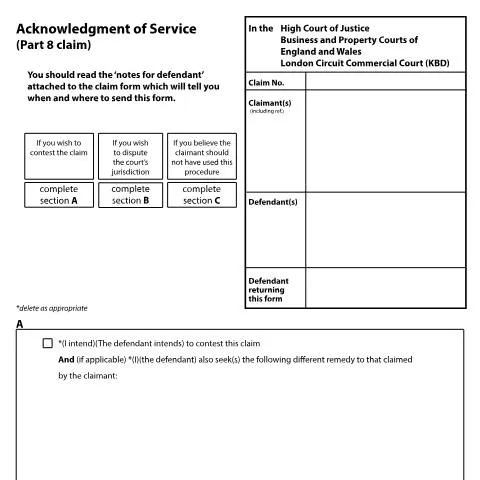
When facing a claim in the London Commercial Court, understanding the procedures and requirements of the legal system is crucial. One of the most essential documents in this process is the Acknowledgment of Service of a CPR Part 8 claim, known by its form code N210(LCC). This article delves into the particulars of the N210(LCC) form, elucidating its significance, the parties involved, and the detailed process of completion and submission.
Understanding the Context: Who Engages with the N210(LCC)?
The N210(LCC) form is primarily utilized by defendants in commercial disputes that fall under Part 8 of the Civil Procedure Rules (CPR). This section is designed for claims that do not require a full trial, making it essential for individuals or businesses engaged in commercial litigation. The profiles of the individuals or entities that might need to file this form can be diverse, encompassing:
- Individual defendants: These could be sole traders or individuals being sued personally.
- Limited companies: A corporation facing a claim or a business dispute.
- Partnerships: Businesses operated by two or more individuals who share profits and responsibilities.
- Public sector entities: Local authorities or government organizations involved in contractual disputes.
Each of these profiles may present unique considerations when filing the N210(LCC). For instance, an individual may need to provide personal details and proof of identity, while a corporation must provide information regarding its registered office and company registration number. It’s important for defendants to familiarize themselves with their specific obligations and rights under the CPR to ensure compliance and protect their interests.
Form Distinctions: Differentiating the N210(LCC) from Similar Documents
Within the realm of court proceedings, several different forms exist for various purposes, leading to potential confusion. The N210(LCC) is distinct in its focus on acknowledging service of a Part 8 claim, which is designed to address straightforward issues that can be resolved without extensive litigation. Here’s how it differs from other similar forms:
| Form | Purpose | Key Differences |
|---|---|---|
| N210(LCC) | Acknowledge service of a CPR Part 8 claim | Used specifically for non-complex claims without the need for a full trial |
| N9 | Acknowledgment of Service in general claims | Applicable to a broader range of civil claims, including those requiring a defence |
| N244 | Application Notice | Used to request a court order or relief, not solely for acknowledgment |
Understanding these distinctions is critical for defendants to ensure they are using the correct form for their specific situation, thereby avoiding unnecessary complications in the proceedings.
Breaking Down the N210(LCC): Sections and Key Information
Completing the N210(LCC) accurately is vital for defendants to assert their positions effectively. The form is structured into several key sections, each requiring careful attention. Below is a detailed breakdown of each section:
Section A: Claim Details
The first section of the N210(LCC) requires basic information related to the claim, including the claim number and the names of the claimant and defendant. Accuracy in this section is paramount, as any discrepancies can delay proceedings. Common pitfalls include:
- Misstating the claim number, which can lead to confusion regarding the correct case.
- Incorrectly identifying the claimant or defendant, especially in corporate cases where registered names may differ from operational names.
Section B: Intention to Dispute
This portion allows the defendant to indicate whether they intend to dispute the claim or the court's jurisdiction. Choices here include:
- Disputing the claim: If the defendant contests the claim, they must select the appropriate option to indicate this.
- Disputing jurisdiction: If applicable, the defendant can assert that the court should not have jurisdiction over the matter, and they must do so within 28 days of filing the N210(LCC).
Defendants must be cautious when selecting responses in this section, as incorrect assertions can lead to adverse outcomes, including the potential loss of the right to contest.
Section C: Objections and Remedies
In this part, the defendant can outline any objections to the claimant's use of the CPR Part 8 procedure. This may include specific reasons why the defendant believes that the claim is inappropriate for this streamlined process. Additionally, the defendant should articulate any different remedies sought, diverging from what the claimant has requested. Careful phrasing is critical here, as it sets the tone for subsequent legal arguments.
Section D: Contact Information
The final part of the N210(LCC) requires the defendant or their legal representative to provide a reliable address for correspondence relating to the case. This is particularly important for the court and the claimant to communicate effectively, ensuring that no notices or documentation are missed. Essential considerations in this section include:
- Providing a complete address, including postcode, to avoid delays in correspondence.
- Including a telephone number or email address, if available, can facilitate quicker communication regarding the proceedings.
Submission Channels: Navigating the Filing Process
Once the N210(LCC) form is completed, the next step involves submitting it to the appropriate court. There are several methods available for filing, each with distinct advantages and processes:
Online Submission
For those who prefer a digital approach, the N210(LCC) can often be submitted through the court's online service. This method is both efficient and allows for immediate confirmation of receipt, reducing the anxiety associated with potential delays in processing. However, it requires an account with the court’s online system, and users must be familiar with navigating this digital interface.
Postal Submission
Defendants may also opt to send the completed N210(LCC) via postal mail to the court. When using this method, it is advisable to:
- Send the form via recorded delivery to ensure proof of mailing.
- Retain a copy of the completed form for personal records.
In-Person Filing
Another option is to deliver the N210(LCC) directly to the court’s office at the Admiralty and Commercial Registry. Doing so allows for immediate confirmation of filing and the opportunity to address any potential issues on the spot. The court office is open from 10 am to 4:30 pm, Monday to Friday.
Post-Submission: Monitoring Your Case Progress
After submitting the N210(LCC), defendants may wonder about the next steps and how to monitor the progress of their case. The court has established protocols to ensure that all parties are kept informed:
Tracking Your Submission
When filing online, defendants can log into their court account to check the status of their claim. For postal submissions, keeping a record of the postal service tracking number can provide insights into when the court receives the form.
Communication from the Court
The court typically sends notifications regarding the next steps in the process following the acknowledgment of service. This could involve the claimant responding to any objections made by the defendant or scheduling hearings if necessary. It is crucial for defendants to stay vigilant and responsive during this period, ensuring they do not miss any court communications.
Potential Follow-Up Actions
Depending on the nature of the claim and the responses from the claimant, defendants may need to take further actions, such as:
- Preparing for potential hearings if the matter escalates.
- Engaging legal representation to navigate more complex disputes.
By understanding the full scope of the N210(LCC) process, defendants can better prepare themselves for the challenges of commercial litigation, ensuring their voices are heard within the legal framework.
Fill in your form directly online
No printing: type your details into the boxes of the official form, tick, then download the PDF ready to send.
- 1Type into the form boxes
- 2Tick in one click
- 3Save and download the PDF
Understanding CPR Part 8 Claims and Their Specificities in the London Commercial Court
CPR Part 8 provides a streamlined process for dealing with certain types of claims where the facts are largely undisputed, and the parties seek a court's determination on a specific legal issue. This process is notably different from standard litigation under CPR Part 7, which is typically more adversarial and comprehensive. In the London Commercial Court, the focus is on commercial disputes that can be decided quickly and efficiently.
One key feature of CPR Part 8 is that it is often employed in cases where the claimant seeks a declaration, an injunction, or seeks the court’s decision on a point of law rather than a monetary award. This means that before proceeding with your acknowledgment of service using Form N210(LCC), it is crucial to understand the nature of the claim being made and how it fits into the broader context of commercial litigation.
Common examples of CPR Part 8 claims include cases related to the interpretation of contracts, issues of jurisdiction, or requests for specific performance. Therefore, having a clear grasp of whether the claim falls within this category can significantly affect your response and strategy moving forward.
Practical Steps for Acknowledging Service of the N210(LCC) Form
Acknowledging service of the N210(LCC) form is not merely a procedural step; it can influence subsequent court proceedings significantly. Here’s a breakdown of key practical steps you should consider when acknowledging service:
- Review the Claim Form Thoroughly: Before filling out the N210(LCC), ensure you understand the claim's details. Take note of the specific legal issues raised and any evidence provided. This understanding will inform your response and potential defenses.
- Prepare Your Acknowledgment Promptly: The acknowledgment must be filed within 14 days of being served. Delays can lead to default judgments, which could have serious ramifications for your case. Therefore, set reminders and allocate sufficient time for this step.
- Consider Legal Advice: Depending on the complexity of the claim, it may be wise to seek legal advice. A solicitor with experience in commercial disputes can provide invaluable insights into your options and obligations under the CPR.
- Complete the N210(LCC) Form Accurately: As you fill out Form N210(LCC), ensure that all sections are completed accurately. This includes your name, address, any relevant reference numbers, and a concise acknowledgment of the claim. Any errors could delay proceedings or worsen your legal standing.
- File and Serve the Acknowledgment: After completing the form, file it with the court and serve a copy to the claimant as required under CPR 10.1. Keep proof of service as this may be needed later in the proceedings.
Implications of Not Acknowledging Service of the N210(LCC) Form
Failing to acknowledge service of the N210(LCC) form can have serious consequences in the context of the London Commercial Court. This section aims to elucidate the potential implications of non-compliance.
One immediate repercussion is the risk of a default judgment being entered against you. This means the court may automatically rule in favour of the claimant, resulting in them obtaining the relief they sought without contestation. This can lead to significant financial liabilities and may necessitate further legal action to rectify the situation.
Additionally, if you fail to respond appropriately, the court may take adverse views of your intentions or position in future proceedings. This could influence the court’s approach to any subsequent hearings or applications you may make.
Moreover, not acknowledging service can limit your ability to present a defence. In the commercial context, where time is often of the essence, any delays in acknowledging service can adversely impact your business operations and relationships, especially if the claim pertains to vital contracts or ongoing negotiations.
Consequently, it is crucial not only to acknowledge the service in a timely manner but also to do so with a strategic understanding of the claims involved. Early and effective communication with the claimant and the court can create a more favourable environment for resolution.