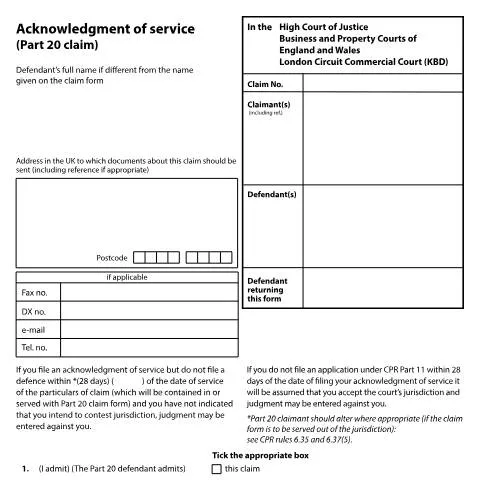
Understanding the N213(LCC) Form: A Vital Step in Commercial Legal Proceedings
In the intricate landscape of commercial disputes, the N213(LCC) form, formally known as the Acknowledgment of Service of a CPR Part 20 claim, plays a critical role in ensuring that defendants respond appropriately to claims filed against them in the London Commercial Court. This legal document marks the beginning of the defendant's interaction with the court, establishing their intention regarding the claim and signalling the next steps in the judicial process.
When the N213(LCC) Comes Into Play
The N213(LCC) form is typically triggered when a defendant is served with a Part 20 claim, which often arises in situations where a party wishes to make a counterclaim or bring another party into an existing claim. This could happen, for instance, in scenarios involving complex commercial contracts, partnership disputes, or issues surrounding torts related to business practices.
The Timeline of Events Leading to the N213(LCC)
- Claim Issued: A claimant files a Part 20 claim with the court.
- Service of Claim: The defendant receives the particulars of the claim, typically served alongside the claim form.
- Filing of Acknowledgment: The defendant must submit the N213(LCC) to the court, acknowledging receipt of the claim.
- Response Required: The defendant must either admit the claim, contest the jurisdiction, or indicate intentions to defend.
Key Responsibilities Upon Receiving the N213(LCC)
Upon receiving the N213(LCC), the defendant faces specific obligations that can significantly affect the outcome of the case. It is paramount to understand the implications of each option available on this form. Failure to act within the allotted time frame can lead to serious repercussions.
Options Available on the N213(LCC)
- Admitting the Claim: This signifies acceptance of the claim's validity, potentially leading to a quicker resolution.
- Intending to Defend: By selecting this option, the defendant indicates their desire to challenge the claim, requiring further legal steps.
- Contesting Jurisdiction: This option allows the defendant to dispute whether the court has the authority to rule on the case.
Each choice carries different consequences and deadlines, notably that a defence must be filed within 28 days of submitting the N213(LCC) if the defendant intends to contest the claim.
The Structure of the N213(LCC) Form: A Breakdown
Understanding how to complete the N213(LCC) is crucial for all parties involved. The form is structured to capture essential details about the defendant and their response to the claim.
Essential Sections of the N213(LCC)
| Section | Details Required |
|---|---|
| Defendant's Full Name | Provide the complete name as per the claim document, especially if it differs from the claimant's details. |
| Address for Correspondence | Include a UK address where all legal documents regarding the claim should be sent. |
| Intentions Regarding the Claim | Select options to admit, defend, or contest the jurisdiction. |
| Signature | Must be signed by the defendant or their legal representative, including a date. |
Potential Consequences of Inaction or Mistakes
Failing to respond to the N213(LCC) in a timely manner can lead to a default judgment against the defendant. This means that the court may automatically side with the claimant, resulting in a loss of legal rights and potential financial consequences.
What Happens If You Miss the Deadline?
If the 28-day period is not adhered to, the following consequences may occur:
- Default Judgment: The court may grant judgment in favour of the claimant without further proceedings.
- Limited Recourse: The defendant may lose the right to challenge the claim, severely limiting their options.
Rectifying Errors on the N213(LCC)
Accurate completion of the N213(LCC) is vital. However, mistakes can occur. If you discover an error after submission, it’s crucial to act swiftly.
Steps to Correct Mistakes
- Notify the Court: Contact the court immediately to inform them of the error.
- Submit a Revised Form: If applicable, submit a corrected version of the N213(LCC) along with an explanation of the mistake.
- Follow Up: Ensure to follow up with the court to confirm the receipt and acceptance of the corrected form.
The Importance of Timeliness: Filing the N213(LCC)
Timing is essential in submitting the N213(LCC). This form must be filed promptly to avoid default judgments and maintain the option to defend against the claim.
Filing Methods
- In-Person Submission: The form can be delivered directly to the court office at the Royal Courts of Justice during business hours.
- Postal Submission: If opting for postal dispatch, ensure that it is sent early enough to arrive before the deadline.
- Electronic Filing: Check with the court for any provisions regarding electronic submissions.
Understanding the Wider Context: N213(LCC) vs Other Legal Forms
The N213(LCC) is often misconstrued with similar forms such as the N9 (Acknowledgment of Service) or N265 (Response Pack) which pertain to different aspects of civil claims. Understanding these distinctions is crucial for a smooth legal process.
Comparative Overview of Acknowledgment Forms
| Form | Purpose | Applicable Claims |
|---|---|---|
| N213(LCC) | Acknowledgment of a Part 20 claim | Commercial disputes in London |
| N9 | General acknowledgment of service | General civil claims |
| N265 | Response to a claim | Used when a defendant responds to a claim in a specific format |
Preparation of Supporting Documents
While the N213(LCC) focuses primarily on the acknowledgment of service, it is often accompanied by other documentation that may be necessary to present a comprehensive response to the claim.
Potential Supporting Documents
- Evidence of Claim: Any documents supporting your acknowledgment or denial.
- Previous Correspondence: Letters or emails exchanged with the claimant that may clarify the situation.
- Legal Representation Details: Relevant information if a solicitor is handling the case.
Final Thoughts: Engaging with the N213(LCC)
Dealing with the N213(LCC) form is a significant step in the legal process for defendants in commercial disputes. Understanding its implications, responsibilities, and related requirements can mean the difference between a successful defence and a default judgment. Being proactive and informed is essential to navigate this aspect of legal proceedings effectively.
Understanding the CPR Part 20 Claim Process
The Civil Procedure Rules (CPR) Part 20 provides a framework for the introduction of third-party claims or counterclaims in civil proceedings. Understanding the intricacies of these rules is essential for any party involved in a dispute, particularly in the high-stakes environment of the London Commercial Court. When a claim is issued, the defendant has a specific timeframe within which to acknowledge the service of the claim, which is crucial for the progression of the case.
In the context of a CPR Part 20 claim, it is important to recognize that the defendant may wish to bring in third parties who may hold liability, or may wish to make a claim against the claimant, thereby creating a multi-faceted legal scenario. This not only complicates the legal proceedings but also necessitates meticulous adherence to procedural rules. The timely completion of Form N213(LCC) is required to ensure that the court is aware of all parties involved and that proper notice has been given. It is also imperative to understand the implications of failing to acknowledge the claim accurately or within the stipulated timeframe, as this could lead to default judgments or other adverse consequences in the legal proceedings.
Fill in your form directly online
No printing: type your details into the boxes of the official form, tick, then download the PDF ready to send.
- 1Type into the form boxes
- 2Tick in one click
- 3Save and download the PDF
Key Considerations When Completing Form N213(LCC)
When filling out Form N213(LCC), there are several key factors that parties must consider to ensure compliance with the procedural rules and to avoid potential pitfalls:
- Accuracy of Information: It is essential that all details provided on Form N213(LCC) are accurate and reflect the current status of the proceedings. This includes providing the correct case number, the particulars of the claim, and the names of all parties involved. Errors or omissions can lead to significant delays or complications in the court process.
- Timeliness: The CPR mandates a strict timeline for acknowledging service. Generally, the defendant must acknowledge the claim within 14 days of receiving the claim form. If the claim is served outside the jurisdiction, the period may extend depending on the circumstances. It is critical to be aware of any specific rules that apply to the case at hand.
- Legal Representation: Depending on the complexity of the claim, parties may consider obtaining legal advice or representation when completing Form N213(LCC). Legal professionals can provide insight into the implications of the claim, assist with drafting the form, and represent the party in subsequent court proceedings. Engaging legal counsel can help ensure that all procedural requirements are met efficiently.
- Understanding the Impact of Counterclaims: If a defendant intends to file a counterclaim, it is important to articulate this clearly in Form N213(LCC). The implications of a counterclaim can significantly influence the course of the litigation, and all parties must be made aware of these developments to ensure due process is followed.
Completing Form N213(LCC) thoroughly and accurately is not just a procedural formality; it is a strategic step in the litigation process that can significantly influence the outcome of the case.
Consequences of Failing to Acknowledge Service
Failure to acknowledge service of a CPR Part 20 claim using Form N213(LCC) can have serious consequences. Should a defendant neglect to respond within the prescribed time limits, they may face a default judgment, where the court rules in favor of the claimant by default. This can lead to the claimant being awarded damages without the defendant having the opportunity to present their side of the case.
Moreover, a default judgment can have broader implications beyond the immediate case. It can affect the defendant's credit rating and may become a matter of public record, which could hinder future business opportunities or even lead to enforcement actions, such as wage garnishments or property seizures. In the context of commercial litigation, such outcomes could be devastating, affecting not only the parties involved but potentially impacting their business relationships and credibility within the market.
Additionally, if a party wishes to contest a default judgment, they would need to apply to the court to set it aside, which may involve demonstrating a valid reason for the failure to acknowledge service and providing supporting evidence. This process can be time-consuming and costly, further complicating the legal landscape.
In conclusion, acknowledging service of a CPR Part 20 claim via Form N213(LCC) is a critical step in the litigation process. Understanding the nuances of the form, the implications of counterclaims, and the consequences of failing to respond in a timely manner are essential for any party navigating the London Commercial Court.