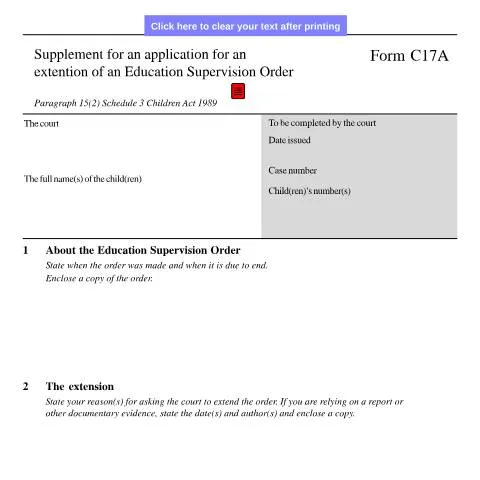
Navigating the C17A Form in Education Supervision Orders
When dealing with the complexities of child welfare and legal obligations, the Form C17A becomes a critical tool for applicants seeking an extension of an Education Supervision Order (ESO). This form serves a unique purpose within the legal framework established by the Children Act 1989, enabling local authorities and relevant stakeholders to petition for an extension when necessary. Understanding its role, requirements, and submission processes is essential for any party involved in a child's education and well-being.
The Context of Education Supervision Orders
Education Supervision Orders are designed to ensure that a child receives the necessary education and welfare support. Issued by a court, these orders allow local authorities to supervise a child’s educational arrangements when the child's needs require additional oversight. Key to the effectiveness of an ESO is the timely extension of the order, which the Form C17A specifically addresses.
Real-Life Scenarios and Justifications for Form C17A
Different scenarios may prompt an application to extend an ESO. Here are a few examples:
- Child's Educational Needs: If there are continuing concerns about a child's educational progress, the local authority may find it necessary to extend the supervision.
- Family Circumstances: Changes in family dynamics, such as the illness of a primary caregiver or a recent separation, may necessitate ongoing supervision.
- Behavioural Issues: Persistent behavioural challenges that impact a child's ability to engage in a standard educational setting could also warrant an extension.
The Distinction Between C17A and Other Related Forms
While various forms deal with child welfare and educational matters, the C17A has unique characteristics that set it apart:
| Form | Purpose | Primary Use |
|---|---|---|
| C17A | Extension of Education Supervision Order | To request additional time for supervision based on specific needs |
| Form C1 | Application for a Child Arrangements Order | To address living arrangements for a child |
| C22 | Application for a Parenting Order | To ensure parental responsibilities are met |
Preparing the C17A Form: Key Considerations
Completing the C17A form requires consideration of various factors. Here are the essential elements:
- Information on the Current Order: When filling out the form, you must clearly state the date the current ESO was issued and its expiration date.
- Rationale for Extension: The applicant must provide compelling reasons for requesting the extension. This could involve attaching reports from educational professionals or social workers that underscore the need for ongoing supervision.
- Documentation: Be sure to include copies of relevant documents, including the original ESO and any supporting evidence that strengthens the case for extension.
Common Documentation to Include
When submitting the Form C17A, consider enclosing the following:
- Copy of the existing Education Supervision Order.
- Reports from educational professionals detailing the child's progress.
- Any other documentation that supports the need for an extension, such as medical records if applicable.
Steps to Submit Form C17A
Once the C17A form has been thoroughly completed, applicants must follow a specific submission process:
- Review: Double-check all information for accuracy and completeness. An overlooked detail can lead to delays.
- File with the Court: Submit the form to the appropriate court that issued the original ESO. This may be done in person or, in certain cases, via mail.
- Await Response: After submission, the court will review the request and may schedule a hearing if deemed necessary.
Understanding the Court's Role and Process
The court plays a pivotal role in the extension of an Education Supervision Order. When a Form C17A is filed, the court assesses the merits of the request based on the information provided. Here’s what to expect:
- Initial Review: The court evaluates the application and determines whether it requires further investigation or a hearing.
- Hearing Scheduling: If a hearing is deemed necessary, both the applicant and any other relevant parties will be notified of the date and time.
- Final Decision: The court will make a ruling based on the evidence presented. If the extension is granted, a new order will be issued with the updated supervision timeline.
Possible Outcomes of the Application
After the court reviews the application, several outcomes may occur:
- Extension Granted: The ESO is extended, and a new timeframe is established for supervision.
- Extension Denied: The court may reject the application if insufficient evidence is provided.
- Modification Suggested: The court might suggest modifications to the existing order rather than granting a full extension.
Challenges and Considerations for Applicants
Filing a Form C17A is not without its challenges. Here are some considerations that applicants should keep in mind:
- Complex Cases: In situations where multiple stakeholders are involved, gathering consensus on the need for an extension may prove challenging.
- Legal Representation: Although legal representation is not required, consulting with a solicitor who specializes in family law can enhance the application’s effectiveness.
- Time Constraints: Be mindful of deadlines associated with the original order. Delays in filing the C17A can result in gaps in supervision.
Responding to Court Decisions
Understanding your options following a court decision is crucial:
- If an extension is granted, adhere to the new regulations set forth by the court.
- In the event of a denial, applicants may consider gathering additional evidence and reapplying, if appropriate.
- If the decision suggests modifications, engage with the court or relevant authorities to ensure compliance.
Broader Implications of Education Supervision Orders
Education Supervision Orders are part of a larger framework aimed at safeguarding children's educational needs. By utilizing the C17A form effectively, applicants contribute to a collaborative effort that prioritizes the welfare and development of children. It is essential to recognize the interconnectedness of these orders with other legal frameworks, such as custody arrangements and child welfare assessments.
The legal landscape surrounding child welfare is continually evolving, prompting stakeholders to stay informed about changes that may affect Education Supervision Orders and related processes. Engaging with community resources, local authorities, and legal experts can provide additional insights into navigating this complex terrain.
Key Takeaways for Applicants
To navigate the complexities surrounding the Form C17A and Education Supervision Orders, consider the following key points:
- Timeliness is crucial; ensure applications are made well before deadlines.
- Thoroughly prepare documentation to support your case, emphasizing the child's ongoing needs.
- Consult with professionals, including social workers and educational staff, to fortify your application.
Ultimately, the C17A form is more than just a piece of paperwork; it is a vital instrument that plays a role in safeguarding a child's educational journey, demonstrating the importance of community and legal support in fostering healthy, nurturing environments for children.
Understanding the Education Supervision Order (ESO)
An Education Supervision Order (ESO) is a legal framework within the UK designed to support children and young people who are considered to be at risk of not receiving an adequate education. Typically initiated by local authorities, an ESO aims to ensure that the educational needs of the child are met while providing necessary interventions when a child is not attending school regularly.
It is vital that the application for an ESO demonstrates the child's current educational circumstances and the reasons behind the concern. The local authority, along with educational professionals, will assess the child’s needs before any application is made. This often involves a detailed evaluation of the child’s home environment, school attendance records, and any existing support systems that might be in place.
The ESO remains in effect for a specific period, usually up to a year, but can be renewed or extended based on the child's ongoing educational needs. This is where Form C17A comes into play, as it serves as the supplementary document required for extensions, aiming to provide robust evidence to justify the need for continued supervision.
Filling Out Form C17A: Detailed Guidelines
Completing Form C17A correctly is crucial for the successful extension of an Education Supervision Order. Here, we outline the essential sections of the form and provide tips on how to approach each part.
Section 1: Personal InformationIn this section, you will need to provide the child's full name, date of birth, and any relevant identification numbers, such as their National Insurance number (if applicable). This information is necessary for identifying the child within the education system and must match their official records.
Fill in your form directly online
No printing: type your details into the boxes of the official form, tick, then download the PDF ready to send.
- 1Type into the form boxes
- 2Tick in one click
- 3Save and download the PDF
Section 2: Current Educational StatusThis segment requires you to detail the child’s current educational setting. Include the school name, address, and the name of the headteacher. It’s vital to describe the child’s attendance record, academic performance, and any special educational needs (SEN) assessments that have been undertaken. Highlighting issues such as low attendance and academic struggles will provide context for the extension request.
Section 3: Reasons for ExtensionClearly articulate why an extension of the Education Supervision Order is necessary. This could include ongoing issues with attendance, lack of engagement with schoolwork, or specific challenges in the home environment that affect the child’s education. Strong evidence, such as reports from teachers, social workers, or psychologists, should be cited. Make sure to include any steps already taken to address these issues and the outcomes of those interventions.
Section 4: Support SystemsIt’s important to demonstrate what support systems are currently in place for the child. This might involve tutoring arrangements, mentoring from teachers, or family support mechanisms. If there are relevant professionals working with the child, such as educational psychologists or social workers, include their names, contact information, and an overview of their involvement.
Section 5: Signatures and DatesFinally, ensure that the form is signed by the appropriate parties, including any professionals involved in the child's education or welfare. Dates are crucial, as they establish the timeline for the application. Remember to check that all information is accurate and up-to-date before submission.
Submission Process and Follow-up Actions
Once Form C17A is completed, the next step is the submission process. This is typically done through the local authority responsible for the Education Supervision Order. Each local authority may have a slightly different procedure, so it’s essential to check their specific guidelines on how to submit the form.
Generally, the completed form can be submitted via post or, in some cases, electronically. Ensure that you keep a copy of the submitted form for your records. The local authority will then review the application and may request additional information or clarification. It is advisable to follow up with the authority after a few weeks to inquire about the status of your application, especially if you have not received any communication.
After the review, you will receive a decision regarding the extension of the ESO. If the extension is granted, there will typically be a review date set, allowing for ongoing monitoring of the child's educational progress. If the request is denied, you have the right to appeal the decision. Guidance on how to appeal can usually be found on the local authority's website or through the appropriate legal channels.
Lastly, remember that communication is key throughout this process. Regularly engage with the local authority, educational professionals, and any support networks involved in the child's education to ensure that everyone's efforts are aligned and that the child receives the best possible support.