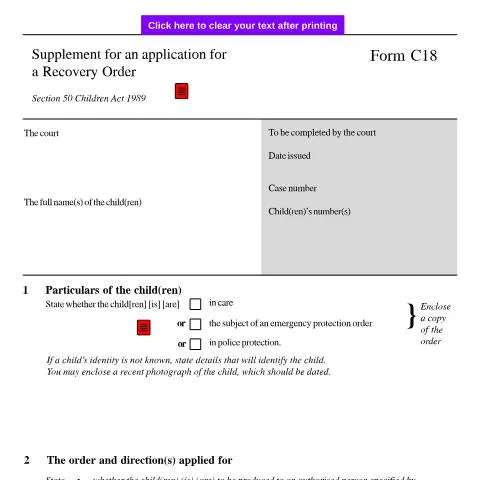
Understanding the Critical Role of Form C18 in Child Recovery Proceedings
When a child goes missing or has been unlawfully removed from their lawful guardian, time becomes the most precious commodity. Form C18 serves as the essential supplement to Recovery Order applications under Section 50 of the Children Act 1989, providing courts with the detailed information needed to authorise immediate action for a child's safe return. Unlike standard court applications that may take weeks to process, Recovery Orders demand urgent judicial intervention, often within hours of submission.
This specialised form bridges the gap between emergency child protection measures and formal court proceedings. While the main Recovery Order application establishes the legal framework, Form C18 delivers the operational details that enable enforcement agencies to act swiftly and effectively. The form's design reflects the urgent nature of these situations, requiring precise information that can mean the difference between a child's swift recovery and prolonged absence.
Distinguishing Recovery Orders from Other Child Protection Measures
Form C18 operates within a unique legal framework that sets Recovery Orders apart from other child protection mechanisms. Understanding these distinctions prevents confusion and ensures appropriate use of this powerful legal tool.
Recovery Orders versus Emergency Protection Orders
While both instruments serve child protection purposes, they address fundamentally different scenarios. Emergency Protection Orders respond to immediate risk of significant harm, whereas Recovery Orders specifically target situations where a child has already been removed from lawful care or has gone missing. Form C18 explicitly requires applicants to specify whether the child is already subject to an Emergency Protection Order, as this affects the court's approach and the powers it may grant.
Police Protection Powers and Court-Ordered Recovery
Police protection under Section 46 of the Children Act 1989 provides immediate, time-limited intervention lasting up to 72 hours. Recovery Orders, supplemented by Form C18, offer more comprehensive and durable solutions. The form requires detailed justification for court intervention beyond existing police powers, particularly when requesting authority for constables to enter specified premises.
| Measure | Duration | Entry Powers | Court Involvement |
|---|---|---|---|
| Police Protection | Up to 72 hours | Limited circumstances | Post-action notification |
| Emergency Protection Order | Up to 8 days (extendable) | With specific court direction | Prior judicial approval |
| Recovery Order | Until child recovered | Detailed premises search | Comprehensive court oversight |
Navigating the Three Pathways to Recovery Order Applications
Form C18 recognises three distinct grounds for Recovery Order applications, each requiring specific evidentiary approaches and documentation strategies.
Unlawful Removal or Retention Cases
When completing Section 3 for unlawful taking or keeping, applicants must demonstrate both the responsible person's lawful authority and the unlawful nature of the removal. This pathway typically involves situations where non-custodial parents, estranged relatives, or other parties have taken a child without proper legal authority. Documentation must clearly establish the applicant's legal relationship to the child, whether through care orders, parental responsibility, or emergency protection measures.
The form requires specific details about when and how the unlawful removal occurred. Courts scrutinise these circumstances carefully, as they must distinguish between legitimate family disputes and genuine child protection concerns. Supporting evidence might include care orders, parental responsibility agreements, or witness statements detailing the circumstances of removal.
Runaway or Staying Away Scenarios
Children who run away or refuse to return present different challenges for Form C18 completion. These cases require careful consideration of the child's age, capacity, and circumstances surrounding their departure. The form must address whether the child left voluntarily and their current vulnerability, as courts balance child protection concerns against emerging autonomy rights for older children.
Applicants must provide comprehensive background information explaining why the child's absence constitutes grounds for a Recovery Order rather than standard missing person procedures. This includes details about the child's care status, any protection concerns that prompted their departure, and evidence of current risk or vulnerability.
Missing Child Situations
The 'missing' category encompasses circumstances where a child's whereabouts are unknown through no fault of their own or the responsible person. Form C18 requires detailed information about the last known location, circumstances of disappearance, and efforts already undertaken to locate the child. This pathway often involves complex factual scenarios requiring extensive supporting documentation.
Courts expect applicants to demonstrate that standard missing person procedures have been initiated and that a Recovery Order offers additional benefits beyond existing search efforts. The form must articulate specific reasons why court-ordered powers are necessary for the child's safe recovery.
Decoding the Premises Search and Entry Provisions
Section 2 of Form C18 addresses one of the most significant powers available under Recovery Orders: authorising constable entry to specified premises. This provision requires careful justification and precise geographical specification.
Establishing Reasonable Belief
Applicants must provide compelling grounds for believing the child is present at specified premises. Section 4 of the form demands detailed reasoning, including specific evidence supporting this belief. Courts apply rigorous scrutiny to these applications, as they authorise significant interference with property rights and privacy.
Evidence supporting premises searches might include witness observations, electronic communications indicating the child's presence, or intelligence from other agencies. The form requires applicants to specify the date and source of all information, enabling courts to assess its reliability and currency.
Proportionality and Necessity Considerations
Form C18 implicitly requires applicants to demonstrate that entry powers are proportionate to the circumstances. Courts consider factors including the child's age, vulnerability, length of absence, and potential risks associated with delay. The more intrusive the proposed intervention, the stronger the justification must be.
Applications must address whether less intrusive alternatives could achieve the same outcome. This might include voluntary cooperation from premises occupiers, standard police inquiries, or other investigative approaches that don't require court-ordered entry powers.
Critical Documentation and Evidence Assembly
Form C18's effectiveness depends heavily on the quality and comprehensiveness of supporting documentation. The form explicitly requires copies of relevant orders and reports, but successful applications typically include much more extensive evidence packages.
Mandatory Attachments and Court Orders
When children are subject to care orders, Emergency Protection Orders, or police protection, Form C18 requires certified copies of these documents. Courts use these attachments to understand the child's current legal status and the authority structure governing their care. Missing or incomplete order copies can delay proceedings significantly, particularly in urgent situations.
The form allows for situations where a child's identity is uncertain, permitting photograph attachments with dating requirements. These provisions recognise that missing children cases sometimes involve incomplete identification, requiring courts to work with available information while maintaining procedural safeguards.
Expert Reports and Professional Assessments
Section 4 specifically references reliance on reports or documentary evidence, requiring date and author specification. Social work assessments, police intelligence reports, and medical evaluations often provide crucial context for Recovery Order applications. The form's structure emphasises that courts expect professional analysis rather than purely factual submissions.
Effective applications typically include chronological narratives explaining the child's circumstances, risk assessments outlining potential harm from continued absence, and professional recommendations about appropriate recovery methods. These documents must be current and directly relevant to the Recovery Order application.
Procedural Complexities and Court Processing Requirements
Form C18 operates within strict procedural frameworks that applicants must navigate carefully to ensure effective processing and judicial consideration.
Urgent Application Protocols
Recovery Order applications often require out-of-hours court consideration, reflecting their emergency nature. Form C18 must be completed with sufficient detail to enable judicial decision-making without oral hearings or additional information requests. The form's design anticipates that judges may need to make critical decisions based solely on written submissions.
Courts typically require applicants to explain why the matter cannot await standard court hours and what specific harm might result from delay. This information doesn't appear explicitly on Form C18 but must be addressed in supporting documentation or covering letters.
Multi-Agency Coordination Requirements
Recovery Order implementation typically involves multiple agencies, including local authority children's services, police constables, and sometimes specialist child protection units. Form C18 must provide sufficient detail to enable effective coordination between these agencies once the order is granted.
The form's specification requirements for premises searches and authorised persons reflect this multi-agency approach. Courts need precise information about who will execute the order, where they will search, and what authority they will exercise. Vague or incomplete specifications can render orders ineffective or legally vulnerable.
Post-Application Scenarios and Enforcement Realities
Understanding what happens after Form C18 submission helps applicants prepare for various outcomes and potential complications that may arise during the recovery process.
Conditional Grants and Modified Orders
Courts may grant Recovery Orders with conditions or modifications that differ from the original Form C18 request. Common modifications include geographical limitations on search powers, time restrictions on order validity, or requirements for additional agency involvement. Applicants should be prepared to work within these parameters while maintaining focus on the child's safe recovery.
Some orders may require regular reporting back to the court about recovery efforts and outcomes. This creates ongoing obligations for applicants to monitor and document their activities under the order's authority.
Unsuccessful Recovery Attempts and Next Steps
When initial recovery efforts fail, applicants may need to return to court with updated information and revised strategies. Form C18 applications should anticipate this possibility by creating comprehensive records of all recovery efforts and maintaining detailed case files.
Subsequent applications may require fresh Form C18 submissions if circumstances have changed significantly or if new premises need to be searched. Courts expect applicants to demonstrate that they have exhausted the powers granted in previous orders before seeking additional authority.
Safeguarding Considerations and Child Welfare Primacy
Throughout the Form C18 process, courts maintain unwavering focus on child welfare considerations, requiring applicants to demonstrate that Recovery Order implementation serves the child's best interests.
The form's structure implicitly requires consideration of how recovery efforts will affect the child psychologically and emotionally. Successful applications often include plans for post-recovery support and assessment, demonstrating that applicants have considered the child's needs beyond immediate physical recovery.
Recovery Orders granted on Form C18 applications typically include provisions for immediate welfare assessments once the child is located. This ensures that the recovery process addresses not only the child's physical safety but also their emotional and psychological wellbeing following what may have been traumatic experiences during their absence.
The form's emphasis on detailed justification reflects courts' recognition that Recovery Orders represent significant interventions in family life and child welfare. By requiring comprehensive information about circumstances, evidence, and proposed actions, Form C18 ensures that these powerful legal tools are used appropriately and effectively in genuine child protection situations.
When Multiple Recovery Orders Are Required
Complex family situations may necessitate multiple Form C18 supplements when seeking recovery orders for different children or across various jurisdictions. The Family Procedure Rules 2010 acknowledge that parents may need to pursue concurrent recovery proceedings, particularly in cases involving international parental child abduction or where children have been moved to different locations within the UK.
Fill in your form directly online
No printing: type your details into the boxes of the official form, tick, then download the PDF ready to send.
- 1Type into the form boxes
- 2Tick in one click
- 3Save and download the PDF
If you're applying for recovery orders concerning siblings who have been taken to different addresses, you'll need to complete separate Form C18 supplements for each child, even if filing under a single C3 application. Each supplement must contain location-specific information, including the precise address where each child is believed to be held, local police station details, and any jurisdiction-specific considerations that might affect enforcement.
International recovery cases present additional complexities. When children have been taken abroad, your Form C18 must demonstrate compliance with the Hague Convention on International Child Abduction or Brussels IIa Regulation, depending on the destination country. Include details of any parallel proceedings initiated in foreign jurisdictions, central authority communications, and evidence of the child's habitual residence before removal.
The court may consolidate multiple applications or order separate hearings depending on the circumstances. If children are in different local authority areas, you might encounter varying approaches to enforcement, as each area's police force and social services may have different protocols for executing recovery orders. Your supplement should anticipate these variations by providing comprehensive contact details for all relevant local agencies.
Sequential applications sometimes arise when initial recovery attempts fail or when new information emerges about a child's whereabouts. In such cases, your subsequent Form C18 should reference previous applications, explain why earlier attempts were unsuccessful, and detail any changed circumstances that warrant a fresh recovery order.
Special Circumstances and Vulnerable Parties
Form C18 applications involving vulnerable parties require careful consideration of additional safeguarding measures and procedural accommodations. The court's paramount consideration remains the child's welfare, but specific circumstances may demand enhanced protection protocols during recovery operations.
When the child or abducting parent has documented mental health issues, your supplement must include relevant medical information and proposed safeguards. This might involve specifying that recovery should occur in the presence of qualified mental health professionals or ensuring that appropriate medical facilities are immediately accessible. The court may require expert assessments before authorising recovery, particularly if there's evidence of self-harm risks or severe psychological distress.
Domestic violence cases demand heightened security measures. If the abducting parent has a history of violence, your Form C18 should request police escort during recovery and specify any non-molestation or occupation orders already in place. Include details of any panic alarms, safe houses, or other protective measures that might be relevant to the recovery operation's planning.
Cases involving children with special educational needs or disabilities require additional consideration. Your supplement should detail any specific medical equipment, medications, or care requirements that the child needs. If the child attends specialist schools or receives particular therapies, include this information to ensure continuity of care post-recovery. The court may order that recovery occurs with social services involvement to ensure appropriate placement and support.
Religious or cultural considerations sometimes influence recovery procedures. If removing the child from their current environment might conflict with religious practices during significant periods (such as Ramadan or major festivals), the court may consider timing adjustments. However, such factors rarely override urgent child protection concerns or clear breaches of existing court orders.
Immigration status complications can arise when the abducting parent or child lacks settled status in the UK. Your Form C18 should address any potential immigration enforcement issues that might arise during recovery, particularly if there's risk that the abducting parent might be detained by immigration authorities, leaving the child without immediate care arrangements.
Post-Recovery Arrangements and Enforcement Considerations
The effectiveness of recovery orders often depends on carefully planned post-recovery arrangements detailed in Form C18. The court requires assurance that recovery won't simply result in further abduction attempts or place the child in unsuitable circumstances.
Immediate placement arrangements must be clearly specified in your supplement. If you're seeking the child's return to your care, demonstrate your ability to provide appropriate accommodation, schooling, and day-to-day care. Include evidence such as school places, registered childminder details, or nursery arrangements. If the child has been away for extended periods, you may need to show how you'll help them readjust, including any counselling or support services you've arranged.
Contact arrangements with the other parent require careful consideration. The court may impose conditions on the recovery order that govern future contact, particularly if there's ongoing risk of re-abduction. Your Form C18 should propose realistic contact arrangements that balance the child's right to maintain relationships with both parents against protection from further removal risks.
Prevention of future abduction attempts often involves surrendering passports, reporting requirements, or restrictions on travel. If you're requesting such measures as part of the recovery order, specify exactly what restrictions you seek and provide evidence justifying their necessity. The court may require the abducting parent to report regularly to police stations or surrender travel documents to court officials.
Enforcement mechanisms vary depending on the recovery order's specific terms. Some orders authorise police to enter premises and remove children, whilst others may require bailiff assistance or social services involvement. Your Form C18 should specify which enforcement methods you consider appropriate and necessary, considering factors such as the likelihood of cooperation, potential for violence, and the child's emotional wellbeing during recovery.
Monitoring and review arrangements should be addressed when ongoing risks exist. The court may order regular review hearings to assess compliance with recovery order terms and the child's welfare. If you anticipate needing ongoing court supervision, your supplement should explain why such oversight is necessary and propose appropriate review intervals.
Cross-border enforcement within the UK involves coordination between different legal systems. If recovery requires enforcement in Scotland or Northern Ireland, your Form C18 should address any additional procedural requirements for recognition and enforcement in those jurisdictions. This might involve parallel applications or specific court directions for inter-jurisdictional cooperation.