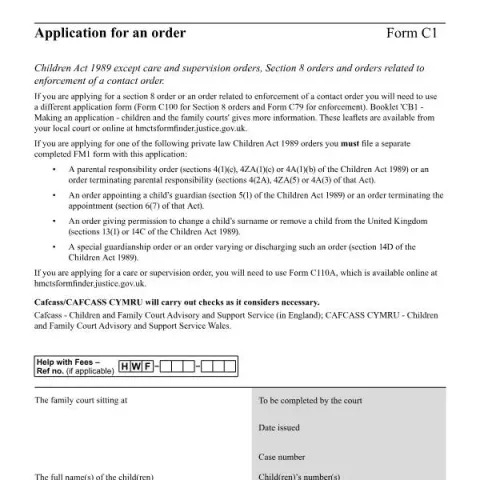
Understanding the Application for an Order Form C1: A Guide for Citizens and Legal Practitioners
The Application for an order Form C1 is an official document issued by the HM Courts and Tribunals Service (HMCTS) in the United Kingdom. This form is used within the context of family law proceedings under the Children Act 1989, specifically for applications excluding care and supervision orders, Section 8 orders, and orders related to enforcement of contact orders. Its primary purpose is to facilitate applications for a range of private law orders concerning children, such as parental responsibility, guardianship, and permission to change a child's surname or remove a child from the UK.
Who Should Complete the Form C1?
The form is intended for individuals seeking legal orders concerning children, whether they are parents, guardians, or other individuals with a vested interest in the child's welfare. The applicant is typically the person initiating the legal process, and must provide comprehensive personal details, including their relationship to the child(ren) involved. Legal practitioners may also assist in completing the form on behalf of their clients.
It is important to note that if the application involves specific orders such as care or supervision orders, or enforcement of contact orders, different forms (e.g., Form C110A, C100, or C79) are required. Additionally, for applications related to parental responsibility or guardianship, a separate FM1 form must be filed alongside the C1.
How to Fill Out the Form C1
Section 1: About the Applicant
This section requires detailed personal information, including your full name, address, date of birth, and relationship to the child(ren). If you are represented by a solicitor, their contact details and reference number should also be included. To protect your privacy, you can opt to keep your contact details confidential by submitting a Confidential Contact Details Form C8, which is available from HMCTS or online.
Section 2: Details of the Child(ren)
Here, you must specify each child's full name, date of birth, and sex. You will also indicate the specific order(s) you are applying for, such as parental responsibility orders or guardianship orders.
Section 3: Other Court Cases Concerning the Child(ren)
If there are any existing or pending court cases involving the child(ren) or related parties, you should provide details of the court, relevant orders, and contact information for any appointed guardians, reporters, welfare officers, or solicitors involved. Attach copies of relevant court orders to support your application.
Section 4: Respondent(s) Details
For each respondent (the individual(s) against whom the application is made), you need to provide their full name, address, date of birth or age, and their relationship to the child(ren). If any respondent's contact details are confidential, complete the Confidential Contact Details Form C8 and ensure these details are not disclosed in the application documents.
Supporting Documents and Filing Procedures
Applicants should attach all relevant supporting documents, such as previous court orders, reports, or evidence pertinent to the application. When submitting the form, it is advisable to do so through the local family court, either in person or via postal services, following the court's specific procedures.
Fill in your form directly online
No printing: type your details into the boxes of the official form, tick, then download the PDF ready to send.
- 1Type into the form boxes
- 2Tick in one click
- 3Save and download the PDF
It is crucial to ensure that all sections of the form are completed accurately and truthfully to avoid delays or rejection. Incomplete or incorrect forms are common sources of error and can lead to procedural setbacks.
Conclusion
The Application for an order Form C1 is a vital legal document that facilitates applications concerning children's welfare within the family justice system. Proper completion, accompanied by relevant supporting documents, ensures that the court has a clear understanding of the applicant's case, enabling a fair and efficient process. If in doubt, consulting a legal professional or seeking guidance from the court can help ensure that the application is correctly prepared and submitted.