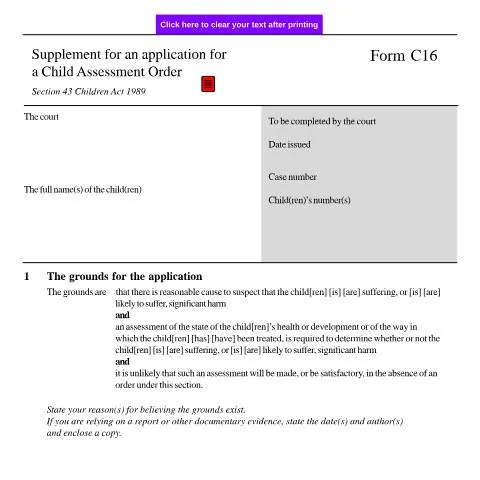
Navigating the Terrain of Child Assessment Orders: Understanding Form C16
When the safety and well-being of a child are at stake, the need for intervention becomes critical. The Form C16, formally known as the Supplement for an Application for a Child Assessment Order, plays an essential role in the judicial process designed to protect vulnerable children. This form is a crucial request to the court, enabling professionals to assess a child's health or development when there are serious concerns regarding potential harm. Understanding its significance is paramount for applicants, particularly in sensitive situations involving children.
The Legal Framework Behind Form C16
To grasp the necessity of Form C16, one must consider the legal context established by the Children Act 1989. This legislation outlines the responsibilities and powers granted to local authorities and courts concerning child welfare. Under Section 43 of the Act, a Child Assessment Order can be issued when there is reasonable cause to suspect that a child is suffering or is likely to suffer significant harm.
The importance of this form cannot be overstated; it serves as a legal mechanism that enables authorities to conduct necessary assessments without the prior consent of the parents or guardians under specific conditions.
Criteria for Issuing a Child Assessment Order
The grounds for submitting Form C16 are multifaceted. Applicants must provide detailed information that demonstrates:
- Reasonable Cause: Illustrating substantial concerns over the child's safety or health.
- Assessment Necessity: Establishing that the situation is serious enough to warrant an assessment.
- Inaccessibility of Other Assessments: Explaining why a satisfactory assessment cannot be conducted without a court order.
Being thorough and precise in addressing these criteria is crucial, as the court heavily relies on this information to make an informed decision.
Breaking Down Form C16: Section by Section
Completing Form C16 requires special attention to detail. Each section of the form is designed to elicit specific information relevant to the application. Let's delve into the form’s components:
Section 1: Grounds for Application
In this section, applicants are required to articulate their reasons for believing that the grounds for a Child Assessment Order exist. It’s essential to substantiate claims with clear examples or evidence, such as:
- Reports from health professionals or educators
- Documentation from social services
- Witness statements that corroborate concerns
One common pitfall is failing to include sufficient detail regarding the concerns. Applicants should aim to provide a narrative that paints a clear picture of the child's situation.
Section 2: Directions Sought in Respect of Assessment
This section prompts the applicant to specify what they are requesting concerning the assessment itself. They should consider the scope and nature of the evaluation required. For instance, assessing physical health, psychological well-being, or developmental milestones may require different approaches.
Section 3: Directions Sought in Respect of Contact
Section 3 focuses on potential contact arrangements between the child and their parents or guardians, which may need to be re-evaluated depending on the findings of the assessment. Here, clarity is crucial; vague directives might lead to confusion and delays in the process.
Common Missteps in Completing Form C16
Despite the importance of accuracy, several common errors can lead to complications in processing the application:
- Incomplete Information: Not all sections are filled out, which can result in delays. Ensure all relevant fields are addressed.
- Lack of Supporting Evidence: Failure to attach required documents can hinder the court’s ability to make a decision. Always ensure that any referenced reports or evidence are included.
- Poor Clarity: Ambiguous language can lead to misinterpretations. Be straightforward and precise in your wording.
What Happens After Submission of Form C16?
Upon submission, the court will review the application. Several outcomes are possible:
- If the court is satisfied, an assessment order may be granted, allowing the specified evaluation to proceed.
- In some cases, the court may request additional information or clarification before making a decision.
- If the application is denied, the applicant will receive a notification explaining the reasons behind the rejection.
Next Steps After an Order is Granted
Once the assessment order is granted, professionals will be appointed to conduct the assessment. It is essential to cooperate fully with these professionals to facilitate a thorough examination of the child's circumstances.
Handling Refusals: What to Do Next?
If your application for a Child Assessment Order is denied, it’s natural to feel disheartened. However, there are steps you can take:
- Understand the Refusal: Review the court’s rationale carefully. Understanding the specific reasons can help you make a stronger case in future applications.
- Gather Additional Evidence: If the court required more substantial evidence, work to compile this before submitting a new application.
- Consult with Legal Experts: Legal counsel can provide insights on strengthening your case and navigating complex legal frameworks.
Contextualizing Form C16: Distinguishing from Similar Forms
Form C16 is often confused with other child welfare forms, leading to misapplications. It’s crucial to distinguish between these forms to ensure you are using the correct process. For instance:
| Form | Purpose | Key Differences |
|---|---|---|
| Form C16 | Application for a Child Assessment Order | Focus on assessment necessity due to suspected harm |
| Form C100 | Application for a Child Arrangement Order | Addresses contact arrangements post-separation |
| Form C2 | Application for Permission to Apply | Used when permission is needed to proceed with an application |
Understanding these differences ensures that applicants are filing the correct forms according to their specific circumstances.
Preparing Your Supporting Evidence: A Checklist
Effective preparation involves gathering adequate supporting evidence. Here’s a checklist to assist you:
- Medical Reports: From GP or specialists highlighting any health issues.
- School Reports: Documentation regarding educational attainment and behavioral concerns.
- Social Services Records: Any previous involvement with social services.
- Witness Statements: Personal testimonies from individuals who have observed concerning behavior.
Ensuring all relevant documentation is organized and accessible will facilitate a smoother application process.
Final Thoughts: The Impact of Your Application
The submission of Form C16 is a significant step for any applicant concerned about a child's welfare. It’s a process laden with emotional weight, underscored by the responsibility to advocate for a child’s best interests. Taking care to complete the form accurately, understanding the legal framework, and preparing comprehensive supporting evidence can make a difference in outcomes. Every detail matters, and your thoroughness could be instrumental in safeguarding a child's future.
Understanding the Child Assessment Order Process
When navigating the complexities of child welfare in the UK, understanding the Child Assessment Order (CAO) process is paramount. A Child Assessment Order allows local authorities to assess a child’s needs if there's reason to believe that they are at risk of harm or need intervention. The application for such an order typically requires the completion of Form C16, which must be submitted to the Family Court. Here, the legal framework surrounding child assessments, the criteria for applying, and the roles of various professionals become essential to grasp.
Fill in your form directly online
No printing: type your details into the boxes of the official form, tick, then download the PDF ready to send.
- 1Type into the form boxes
- 2Tick in one click
- 3Save and download the PDF
The Judicial Guidance suggests that before a CAO is issued, the court will consider whether all alternative avenues have been exhausted. Factors considered may include the involvement of social services, previous assessments, and whether voluntary interventions have been attempted. This is where the importance of detailed documentation comes into play, showcasing the rationale behind the application. Be prepared to provide comprehensive evidence that outlines the child's presenting issues, the risks they face, and why a formal assessment is necessary at this juncture.
Furthermore, understanding the roles of social workers, legal representatives, and the child themselves during the assessment process enhances the clarity for all parties involved. The local authority's social worker is often the initial point of contact, and they carry the responsibility to conduct the assessment once the CAO is granted. This includes a thorough evaluation of the child's living circumstances, developmental needs, and existing support systems.
Preparing Your Application: Key Considerations
Submitting a Form C16 is not merely a checklist task; it involves careful consideration and preparation. One must reflect on the potential impact of the assessment on the child and family dynamics. Here are several considerations to bear in mind:
- Evidence Collection: Collecting relevant documentation is crucial. This may include previous assessments, reports from local authorities, or healthcare professionals highlighting concerns about the child's wellbeing.
- Clear Justifications: It is important to clearly articulate the reasons for the assessment. The court requires convincing justifications that demonstrate the child's needs cannot be met through voluntary support services.
- Legal Representation: Consider obtaining legal advice before submitting your application. A solicitor with experience in family law can help navigate the complexities of the application and represent your interests effectively at court hearings.
Additionally, one should consider the timing of the application. For instance, if there are ongoing safety concerns or a recent escalation in troubling behaviour, timely intervention may be critical. Each case is unique, and the local authority will act in the best interest of the child; thus, presenting a well-prepared application can significantly influence the court's decision.
Potential Outcomes and Next Steps
Upon submission of Form C16 and acceptance of your application for a Child Assessment Order, several outcomes may arise. The court may grant the order, request further information, or deny the application. Each outcome has distinct implications for the child and family.
If the CAO is granted, the local authority will proceed with the assessment, which typically involves interviews with the child, parents, and relevant professionals. It’s important to understand that this assessment can be far-reaching, exploring various aspects of the child's life, including emotional, psychological, and educational needs. The findings from this assessment will ultimately guide the local authority on necessary interventions or support services.
In the case of a denied application, it’s essential to reflect on the reasons provided by the court. This can serve as a basis for any subsequent applications. In some instances, the court may recommend alternate resolutions, such as mediation or family counselling, which could provide the necessary support without formal interventions.
Lastly, staying engaged and proactive is crucial throughout the process. Following through on any recommendations or engaging with offered services will not only demonstrate your commitment to the child's welfare but could also impact any future decisions regarding the child's care.