When Legal Aid Boundaries Fall Short: Navigating the Exceptional Case Funding Process
In the complex landscape of UK civil legal aid, certain cases fall through the cracks of the Legal Aid, Sentencing and Punishment of Offenders Act 2012 (LASPO). When statutory legal aid isn't available but fundamental rights hang in the balance, the Legal Aid Agency's exceptional case funding (ECF) mechanism serves as a crucial safety net. The CIV ECF1 application form represents more than administrative paperwork—it's often the last resort for individuals facing legal proceedings that could fundamentally alter their lives, liberty, or safety.
This funding route addresses situations where withholding legal aid would breach an individual's human rights or European Union law obligations. Whether you're facing imminent homelessness proceedings, complex family law matters involving vulnerable children, or judicial review challenges against public bodies, the ECF process demands meticulous preparation and compelling justification.
Understanding Exceptional Circumstances: Who Qualifies and When
The exceptional case funding framework operates on a strict interpretation of necessity and human rights obligations. The Legal Aid Agency doesn't simply consider cases that are difficult or complex—they evaluate whether denying legal aid would create a fundamental breach of your right to a fair trial or other protected rights under the Human Rights Act 1998.
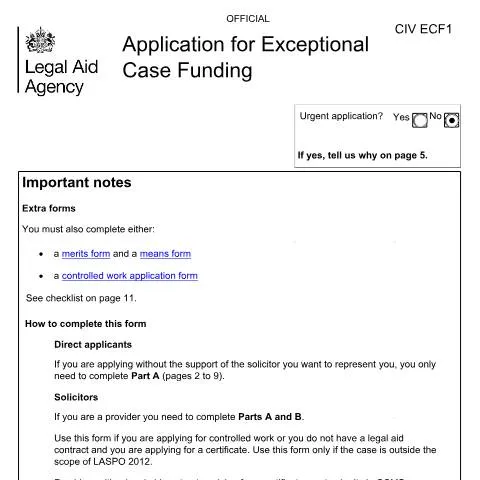
Direct applicants—those applying without existing solicitor representation—face particular challenges. You must demonstrate not only that your case merits exceptional funding but also that you cannot effectively represent yourself. This dual burden requires careful articulation of both the legal complexities involved and your personal limitations in handling such matters.
For legal practitioners, the ECF route applies when you lack a legal aid contract or when contracted providers encounter cases outside LASPO's scope. Importantly, providers with existing legal aid contracts pursuing certificate work must use the Client and Cost Management System (CCMS) rather than the paper-based CIV ECF1 process.
Priority Categories for Exceptional Funding
Certain case types consistently meet the exceptional funding threshold:
- Housing cases involving immediate risk of homelessness, particularly where vulnerable individuals or families face possession proceedings
- Immigration matters where removal would breach Article 3 or Article 8 rights, especially involving torture survivors or separated families
- Mental health proceedings under the Mental Health Act 1983, where capacity issues prevent effective self-representation
- Judicial review challenges against public body decisions affecting fundamental rights
- Family proceedings involving domestic violence, child abduction, or complex contact disputes where safety concerns predominate
Dissecting the Application Architecture: Part A Essentials
The CIV ECF1 form's Part A contains deceptively straightforward sections that demand strategic completion. Your personal details section, whilst appearing routine, establishes your identity for all subsequent Legal Aid Agency interactions. Ensure consistency with any existing legal aid files—discrepancies in names, particularly maiden names or previous surnames, can trigger unnecessary delays.
The case complexity description in section 1 requires careful calibration. Avoid overwhelming detail whilst ensuring you capture the legal intricacies that necessitate professional representation. Reference specific areas of law—whether housing law, immigration law, or public law—and highlight procedural requirements that would challenge unrepresented litigants. Mention relevant court rules, statutory frameworks, or precedent cases that shape your proceedings.
Articulating Personal Stakes and Consequences
Section 2's requirement to explain why issues matter "for you" demands personal rather than abstract justification. The Legal Aid Agency seeks understanding of how case outcomes directly impact your fundamental rights, safety, or wellbeing. Generic statements about "stress" or "worry" carry little weight—focus instead on concrete consequences such as homelessness, family separation, or removal from the UK.
This section should connect legal outcomes to human rights implications. For instance, in housing cases, explain how possession would affect children's education, medical care continuity, or support networks. In immigration matters, detail specific risks you'd face in your country of origin, supported by country guidance or expert evidence where available.
Self-Representation Capacity Assessment: The Critical Evaluation
Section 3 represents the application's cornerstone—your capacity assessment for self-representation. The Legal Aid Agency applies the "obvious unfairness" test established in case law, examining whether proceeding without legal aid would fundamentally compromise your ability to present your case effectively.
Structure your response around specific procedural requirements your case demands. Detail court deadlines, evidence gathering obligations, witness examination procedures, or legal argument construction that exceed typical litigant capabilities. Reference complex legal tests—such as proportionality assessments in human rights cases or best interests evaluations in family proceedings—that require professional legal knowledge.
| Factor Category | Evidence to Include | Supporting Documentation |
|---|---|---|
| Educational Background | Highest qualification achieved, literacy levels, English language proficiency | Certificates, assessment reports |
| Disability/Health Issues | Mental health conditions, learning difficulties, physical limitations affecting court participation | Medical reports, capacity assessments |
| Previous Legal Experience | Any prior court involvement, understanding of legal procedures | Previous case documentation |
| Case-Specific Requirements | Expert evidence needed, complex legal arguments, procedural complexities | Court directions, case management orders |
Addressing Disability and Capacity Considerations
Where disability or mental health issues affect your self-representation capacity, provide detailed medical evidence. The Legal Aid Agency recognises that conditions such as depression, anxiety, PTSD, or learning difficulties can fundamentally impair your ability to navigate complex legal proceedings. Include specific examples of how your condition affects concentration, memory, communication, or decision-making in stressful situations.
Attach relevant medical reports, but ensure they directly address legal proceeding participation rather than general health status. A GP's letter stating you suffer from "anxiety and depression" carries less weight than a psychiatrist's report explaining how these conditions would prevent effective court advocacy or case preparation.
Urgency Protocols and Emergency Applications
The urgency section serves dual purposes: prioritising your application for faster processing and justifying why exceptional funding decisions cannot await standard timeframes. The Legal Aid Agency recognises three primary urgency categories, each requiring specific evidence and justification approaches.
Imminent court hearings create the most straightforward urgency claims. Provide precise hearing dates, court references, and explain why adjournment isn't feasible. Include court correspondence showing fixed hearing dates and any judicial directions emphasising the importance of legal representation. Remember that courts increasingly expect parties to be represented in complex matters—judicial comments to this effect strengthen urgency arguments.
Emergency proceedings, including injunction applications or urgent possession hearings, require immediate Legal Aid Agency response. Detail the emergency's nature, immediate risks if proceedings aren't properly defended, and why delay would cause irreparable harm. In domestic violence cases, explain how inadequate representation could expose victims to continued abuse. In housing matters, detail how possession would render families homeless with limited alternative accommodation options.
Limitation Period Pressures
Limitation period urgency demands careful legal analysis. Identify the specific limitation period applying to your case—whether statutory time limits for judicial review (typically three months from decision), immigration appeal deadlines, or civil claim limitation periods. Explain why earlier application wasn't possible and how missing the deadline would permanently prejudice your position.
The Legal Aid Agency prioritises applications where delay would cause "increased risk to safety, freedom or housing" or create "unreasonable hardship or irretrievable problems." These aren't merely inconveniences—they represent fundamental threats to your basic rights and wellbeing that emergency funding should address.
Supporting Documentation Strategy and Evidence Assembly
Exceptional case funding applications succeed or fail largely on supporting evidence quality. The Legal Aid Agency requires substantial documentation proving both case merit and funding necessity. Your evidence strategy should address three core areas: legal merit, personal circumstances, and financial eligibility.
Legal merit evidence includes all court documents, legal advice received, and expert reports relevant to your case. Provide chronological case summaries, highlighting key legal issues and procedural requirements. Include any judicial comments about case complexity or representation necessity—judges increasingly recognise that certain proceedings require professional legal assistance for fair resolution.
Personal circumstance evidence must demonstrate why self-representation would create obvious unfairness. Medical reports, educational assessments, and capacity evaluations provide objective evidence of representation necessity. Include specific examples of how your circumstances would prevent effective case presentation—inability to cross-examine witnesses due to trauma, difficulty understanding complex legal concepts due to learning difficulties, or communication barriers affecting court participation.
Financial Documentation Requirements
Exceptional case funding applications must include either means and merits forms or controlled work applications, depending on your funding type sought. These financial assessments follow standard legal aid criteria, examining both income/capital levels and case prospects.
Gather comprehensive financial documentation: recent payslips, bank statements, benefit award letters, and asset valuations. The Legal Aid Agency applies standard legal aid financial eligibility criteria—exceptional case funding doesn't override these thresholds. However, they may consider exceptional financial circumstances where standard calculations don't reflect your true financial position.
Submission Pathways and Processing Realities
The Legal Aid Agency processes exceptional case funding applications exclusively through email submission to [email protected]. This centralised approach ensures consistent assessment but requires careful attention to submission requirements and follow-up procedures.
Prepare your submission package methodically. The application form represents just one element—supporting documentation often proves more crucial for decision-making. Create a comprehensive submission checklist including the completed CIV ECF1 form, financial assessment forms, all supporting evidence, and a covering letter summarising your application's key points.
Email submissions should use clear subject lines identifying your case and urgency level. Include all documents as PDF attachments with logical file naming conventions. Large submissions may require multiple emails—coordinate with the Legal Aid Agency to ensure complete receipt. Request email delivery receipts to confirm submission completion.
Processing Timeframes and Decision Expectations
Standard exceptional case funding decisions typically take 4-6 weeks from complete application receipt. Urgent applications receive prioritised processing, potentially reducing timeframes to 1-2 weeks depending on urgency severity. However, incomplete applications or requests for additional information can significantly extend processing periods.
The Legal Aid Agency may request additional information during assessment. Respond promptly and comprehensively—delays in providing requested documentation restart processing timeframes. Maintain regular contact with assigned caseworkers, particularly for urgent applications where circumstances may evolve rapidly.
Appeal Routes and Challenge Mechanisms
Exceptional case funding refusals aren't final—robust appeal mechanisms exist for challenging negative decisions. The Legal Aid Agency operates a two-tier review system: internal review by senior caseworkers, followed by independent review by the Independent Funding Adjudicator if internal review fails.
Internal reviews must be requested within one month of decision notification. Focus your review request on specific decision errors rather than general disagreement with outcomes. Identify factual mistakes, legal misinterpretations, or procedural failures in the original assessment. Provide additional evidence addressing deficiencies highlighted in the refusal decision.
The Independent Funding Adjudicator provides final administrative review before judicial review becomes necessary. This independent assessment can overturn Legal Aid Agency decisions where legal or procedural errors occurred. However, the Adjudicator cannot substitute their judgement for reasonable Legal Aid Agency assessments—they review decision-making processes rather than re-deciding applications on merit.
Judicial review remains available for exceptional case funding decisions, particularly where human rights obligations are at stake. The Administrative Court has recognised that systematic failures in exceptional case funding provision can breach Article 6 rights to fair trial. However, judicial review should be considered only after exhausting administrative appeal routes and where strong legal grounds exist for challenging the decision-making process itself.
Complex Case Scenarios and Documentation Requirements
Exceptional case funding applications often involve intricate legal situations where standard documentation may not adequately capture the complexity of your circumstances. Understanding how to present these scenarios effectively can significantly impact your application's success rate.
For cases involving multiple jurisdictions—such as international child abduction under the Hague Convention or cross-border commercial disputes—you'll need to demonstrate how the lack of legal aid would create genuine hardship beyond typical financial constraints. The Legal Aid Agency requires evidence showing that your case involves jurisdictional complexities that cannot be resolved through standard legal processes or alternative funding mechanisms.
Mental capacity cases present particular documentation challenges. If you're applying for exceptional funding to challenge a deprivation of liberty authorisation or seeking representation for complex Court of Protection matters, you must provide detailed medical evidence demonstrating the vulnerable person's inability to participate meaningfully in proceedings without specialist legal support. This includes recent psychiatric assessments, care home reports, and evidence of how the legal outcome directly affects the individual's fundamental rights.
Immigration cases with human rights implications require especially robust evidence packages. Beyond standard Home Office correspondence, successful applications typically include country-specific expert reports, medical evidence of trauma or persecution, and detailed witness statements from credible sources. The Legal Aid Agency scrutinises these applications particularly carefully, as they must demonstrate that removal would breach Article 3 or Article 8 of the European Convention on Human Rights in ways that couldn't be adequately argued through standard immigration legal aid provisions.
Commercial cases affecting vulnerable individuals—such as elderly people facing possession proceedings involving complex financial products—demand evidence showing both the individual's vulnerability and the wider public interest in establishing legal precedent. You'll need financial expert reports, evidence of misselling or unfair practices, and demonstration that the case could benefit others in similar circumstances.
For cases involving children's rights outside the family court system—such as challenging local authority decisions on special educational needs or healthcare provision—your application must clearly articulate why judicial review or alternative dispute resolution mechanisms are insufficient. This often requires independent expert evidence on the child's specific needs and detailed analysis of how the public body's decision-making process was fundamentally flawed.
Strategic Timing and Procedural Considerations
The timing of your exceptional case funding application can be as crucial as its content, particularly given the strict procedural deadlines governing most legal proceedings. Understanding these temporal constraints helps ensure your application aligns with court timetables and doesn't inadvertently prejudice your underlying case.
For urgent applications—such as those involving imminent removal directions or emergency child protection measures—the Legal Aid Agency operates an expedited assessment process. However, 'urgent' has a specific meaning in this context: you must demonstrate that delay would cause irreparable harm that couldn't be mitigated through interim measures or emergency legal aid provisions. Emergency applications require immediate telephone contact with the Legal Aid Agency's duty scheme, followed by same-day submission of core documentation.
In judicial review cases, the interaction between the three-month time limit for bringing proceedings and exceptional funding decisions requires careful coordination. If you're challenging a public body's decision that affects fundamental rights—such as healthcare rationing or housing allocation policies—you should submit your exceptional funding application as early as possible in the judicial review process. The Legal Aid Agency will not extend statutory deadlines, and late applications that cite funding delays as reasons for procedural non-compliance are routinely rejected.
Appeals present particular timing challenges because you're often working within tight Court of Appeal or Supreme Court deadlines while simultaneously arguing that your case raises points of general public importance. For criminal appeals involving potential miscarriages of justice, your exceptional funding application must demonstrate not only the strength of your appeal prospects but also why the Criminal Cases Review Commission route is inappropriate or insufficient.
Multi-stage proceedings require strategic thinking about when to apply for funding. In cases involving preliminary hearings, case management conferences, and substantive hearings, you may need to apply for funding at each stage separately. This is particularly relevant for complex commercial disputes where early funding might cover disclosure and expert evidence gathering, while later applications address trial representation needs.
The Legal Aid Agency's decision-making timeframes vary significantly based on application complexity and supporting evidence quality. Standard applications typically receive responses within 20 working days, but complex cases involving multiple expert reports or novel legal points can take substantially longer. Planning your application timeline around these realities ensures you're not left without representation at crucial procedural stages.
Financial Thresholds and Contribution Calculations
The financial assessment process for exceptional case funding differs markedly from standard legal aid eligibility calculations, involving sophisticated means and merits testing that accounts for the unique circumstances driving your funding request.
Your disposable income calculation follows modified parameters that recognise exceptional cases often involve individuals facing extraordinary circumstances. While standard legal aid uses fixed allowances for housing, childcare, and essential living costs, exceptional funding assessments can account for disability-related expenses, medical costs associated with your legal case, and travel expenses for accessing specialist legal representation. You'll need to provide detailed evidence of these additional costs, including medical prescriptions, care agency invoices, and specialist equipment expenses.
Capital assessments involve particular complexity where your legal case directly affects your property or business interests. If you're defending possession proceedings against your family home, or challenging compulsory purchase orders, the Legal Aid Agency applies modified capital disregards that prevent your home's value from automatically disqualifying you from funding. However, you must demonstrate that accessing this capital would cause disproportionate hardship or defeat the purpose of your legal challenge.
Business assets require careful presentation where your commercial interests are integral to your legal case. Sole traders facing regulatory challenges or partnership disputes cannot simply liquidate business assets to fund legal representation if this would destroy their livelihood. Your application must include business valuations, cash flow projections, and evidence that asset disposal would cause irreparable damage to your income-generating capacity.
Contribution calculations follow a sliding scale that considers both your financial capacity and the public interest elements of your case. Even where you exceed standard financial thresholds, contributions may be capped at levels that don't prejudice your ability to pursue your case effectively. This is particularly relevant for challenges to public body decisions where individual litigants are effectively enforcing collective rights.
Joint financial assessments apply where multiple parties seek funding for related proceedings. Family members challenging the same local authority decision, or business partners facing joint regulatory action, undergo combined financial evaluation that prevents artificial separation of resources. The Legal Aid Agency examines beneficial ownership of assets, informal financial support arrangements, and cross-guarantees that might affect your genuine financial position.
Exceptional hardship provisions allow for financial threshold modifications where rigid application would create manifest unfairness. These apply in cases involving domestic violence survivors whose financial independence has been compromised, refugees with complex immigration status affecting employment rights, or individuals whose medical conditions prevent standard employment. Supporting evidence must demonstrate both the connection between your circumstances and financial constraints, and why these constraints cannot be addressed through other support mechanisms.