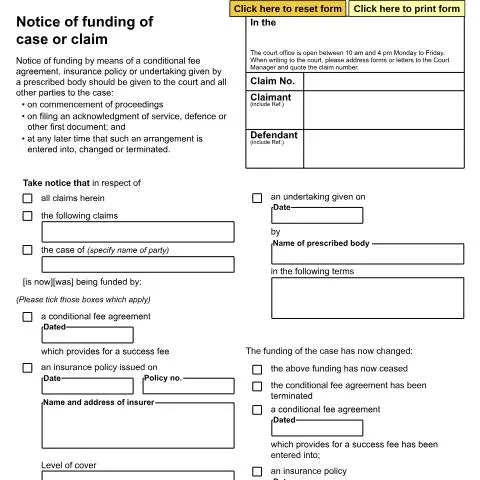
The Strategic Role of Form N251 in Litigation Funding Transparency
When legal proceedings commence in England and Wales, parties often rely on alternative funding arrangements to manage the financial risks of litigation. Form N251 serves as the formal mechanism for declaring these funding arrangements to the court and opposing parties. This notice requirement fundamentally shapes how litigation costs are managed and calculated, particularly when cases involve conditional fee arrangements (CFAs), after-the-event insurance policies, or third-party funding undertakings.
The form's significance extends beyond mere procedural compliance. It directly impacts cost recovery calculations, settlement negotiations, and the court's case management decisions. Understanding when and how to deploy Form N251 effectively can determine whether additional costs associated with funding arrangements become recoverable from the losing party.
Decoding the Three Pillars of Litigation Funding
Form N251 addresses three distinct funding mechanisms, each with specific disclosure requirements and strategic implications. The form's structure reflects the complex interplay between these arrangements, which may operate simultaneously or evolve throughout proceedings.
Conditional Fee Agreements and Success Fee Declarations
The conditional fee agreement section requires declaration of arrangements where legal representatives accept reduced or no fees during proceedings, with enhanced fees payable upon success. The form specifically captures whether the CFA includes a success fee – an additional percentage charged when the case succeeds.
The dating requirement proves crucial for cost recovery purposes. Courts scrutinise whether CFAs were entered into before or after specific procedural milestones, as this affects the recoverability of associated costs from unsuccessful opponents.
After-the-Event Insurance Coverage
The insurance policy section demands comprehensive details including policy numbers, insurer information, and coverage levels. The form distinguishes between staged premium arrangements – where insurance costs increase at predetermined litigation milestones – and fixed premium policies.
This distinction matters significantly for cost budgeting and recovery. Staged premiums may become disproportionate if cases extend beyond anticipated timelines, whilst fixed premiums provide cost certainty but may prove insufficient for complex proceedings.
Third-Party Funding Undertakings
The undertaking section covers arrangements where prescribed bodies – typically specialist litigation funders or trade unions – provide financial support. These arrangements often involve the most complex terms, including success fees, adverse costs protection, and case control provisions.
Critical Timing Requirements and Procedural Milestones
Form N251's effectiveness hinges on precise timing compliance. The notice requirements operate across three distinct phases, each carrying different implications for cost recovery and case management.
Commencement and Initial Response Deadlines
The form must be filed simultaneously with case commencement or first responsive documents. For claimants, this means filing alongside the claim form or particulars of claim. Defendants must include N251 notices with acknowledgments of service or defences.
This synchronised filing requirement prevents parties from concealing funding arrangements during early case assessment, ensuring transparent cost exposure evaluation from proceedings' outset.
Ongoing Disclosure Obligations
The "at any later time" requirement creates continuing obligations throughout proceedings. Parties must file fresh N251 notices whenever funding arrangements are entered into, modified, or terminated. This includes seemingly minor changes such as premium adjustments or coverage extensions.
| Funding Change | N251 Requirement | Strategic Impact |
|---|---|---|
| New CFA entered | Immediate notice | Affects future cost recovery calculations |
| Insurance policy cancelled | Notice within reasonable time | May trigger security for costs applications |
| Success fee percentage changed | Updated notice required | Impacts proportionality assessments |
| Third-party funding terminated | Immediate disclosure | Could affect case continuation ability |
Navigating the Form's Structural Complexity
Form N251's design accommodates multiple scenarios within a single document, requiring careful section selection and completion. The form's checkbox system allows parties to declare multiple funding types simultaneously whilst maintaining clarity about each arrangement's specific terms.
Multi-Party and Multi-Claim Considerations
The form addresses complex litigation structures through its "all claims herein" versus "following claims" distinction. Parties can specify whether funding arrangements apply comprehensively or to particular aspects of multi-track proceedings.
In group litigation or multi-party disputes, this granularity proves essential. Different claimants may have distinct funding arrangements, or defendants might secure coverage for specific counterclaims whilst remaining uninsured for primary defences.
Change Documentation Requirements
The form's second page specifically addresses funding modifications, requiring detailed explanation of changes rather than simple replacement notices. This approach maintains an audit trail of funding evolution, crucial for subsequent cost assessments and case management decisions.
Cost Recovery Implications and Strategic Considerations
Form N251 disclosures directly influence whether additional costs associated with funding arrangements become recoverable from unsuccessful parties. The form serves as the foundation for subsequent detailed cost assessments where funding-related expenses are scrutinised.
Proportionality and Reasonableness Assessments
Courts use N251 information to evaluate whether funding arrangements demonstrate proportionate case management. Excessive insurance premiums or disproportionate success fees may indicate poor case evaluation or inflated risk assessment.
The form's staged premium declarations prove particularly significant during proportionality reviews. Courts examine whether premium increases correlate with genuine case development or reflect inadequate initial risk assessment.
Security for Costs Applications
N251 disclosures often trigger security for costs applications from opposing parties. Insurance policy details help courts assess whether claimants can meet adverse cost orders, whilst funding undertakings may provide alternative security mechanisms.
The form's termination notices can prompt immediate security applications, as funding withdrawal may leave parties unable to meet potential adverse cost orders.
Common Compliance Challenges and Interpretative Issues
Form N251's apparent simplicity masks several interpretative challenges that frequently arise in practice. Courts have developed specific guidance on disclosure obligations, particularly regarding hybrid funding arrangements and partial coverage situations.
Hybrid Arrangement Complications
Many modern funding arrangements combine elements of CFAs, insurance, and third-party funding. Form N251 requires separate disclosure of each component, but parties often struggle to categorise complex arrangements that don't fit neatly into the form's structure.
For instance, arrangements where third-party funders provide both case funding and adverse costs insurance require careful completion of multiple form sections, with cross-referencing to avoid confusion about coverage overlaps.
Partial Coverage Disclosure
The form doesn't explicitly address situations where funding arrangements cover only specific aspects of cases or particular cost categories. Courts have indicated that comprehensive disclosure remains required, with clear explanation of coverage limitations in the undertaking terms section.
Administrative Processing and Court Management
Form N251 submissions integrate into the court's case management system, influencing directions orders, cost budgeting decisions, and trial preparation. Court staff use the information for early case assessment and resource allocation decisions.
Case Management Conference Implications
Judges routinely review N251 notices during case management conferences, using funding information to shape directions orders and cost budgeting decisions. Comprehensive funding arrangements may justify expedited timetables, whilst limited coverage might prompt security discussions.
The form's details also influence costs budgeting exercises under the Civil Procedure Rules, where additional costs associated with funding arrangements require specific justification and proportionality assessment.
File Management and Cross-Referencing
Court offices maintain N251 notices as ongoing reference documents, updating case files whenever fresh notices are filed. This administrative process ensures that current funding positions remain visible to judges and court staff throughout proceedings.
The form's claim number and party reference requirements facilitate accurate file management, particularly in complex multi-party litigation where multiple funding arrangements may operate simultaneously across different parties and claims.
Strategic Deployment in Different Litigation Contexts
Form N251's utility varies significantly across different types of proceedings and litigation strategies. Understanding these contextual applications helps parties maximise the form's strategic value whilst ensuring compliance with disclosure obligations.
Commercial Litigation Applications
In high-value commercial disputes, Form N251 often reveals sophisticated funding structures involving multiple insurers, staged premium arrangements, and complex third-party funding agreements. These disclosures can influence settlement negotiations by demonstrating parties' financial commitment to pursuing claims.
The form's insurance details prove particularly valuable in intellectual property disputes or professional negligence claims where specialist coverage may be required for expert evidence and technical assessments.
Personal Injury and Clinical Negligence Contexts
In personal injury proceedings, Form N251 typically addresses more straightforward CFA arrangements with standard after-the-event insurance policies. However, the form's staged premium provisions become crucial in complex clinical negligence cases where proceedings may extend across multiple years.
The form's timing requirements prove particularly challenging in cases where initial funding arrangements prove inadequate as medical evidence develops, requiring mid-proceedings funding modifications and fresh N251 notices.
Form N251 represents a critical intersection between procedural compliance and strategic litigation management. Its proper completion and timely filing can determine cost recovery outcomes, influence settlement dynamics, and shape court case management decisions. Parties who understand the form's nuances and strategic implications gain significant advantages in managing litigation risks and maximising potential cost recoveries.
Understanding the Financial Implications and Strategic Timing
The financial landscape surrounding Form N251 extends far beyond the simple notification requirement. Understanding when and how to deploy this form strategically can significantly impact both the procedural efficiency and the ultimate outcome of your case. The timing of funding arrangements often correlates directly with critical case milestones, making the N251 submission a tactical decision rather than merely an administrative obligation.
When third-party funding enters the equation, the court's perspective on case management fundamentally shifts. Judges and case management officers view funded litigation through a different lens, particularly regarding proportionality assessments under the Civil Procedure Rules. The presence of litigation funding can influence decisions on case allocation, timetabling, and even the approach to costs management orders. Courts may expedite certain procedural steps when they understand that commercial funders are monitoring timelines and milestone achievements.
The financial disclosure requirements within Form N251 serve multiple strategic purposes beyond mere transparency. Commercial litigation funders typically structure their agreements around specific performance indicators and case progression markers. By notifying the court of these arrangements, parties can align judicial case management with funder expectations, potentially avoiding conflicts that might arise from mismatched timelines or procedural approaches.
Fill in your form directly online
No printing: type your details into the boxes of the official form, tick, then download the PDF ready to send.
- 1Type into the form boxes
- 2Tick in one click
- 3Save and download the PDF
Conditional fee arrangements present a particularly nuanced scenario when completing Form N251. The form must distinguish between traditional CFA structures and newer 'damages-based agreement' models. Each carries different implications for costs recovery and procedural handling. Courts pay particular attention to CFA notifications because they affect potential costs exposure for opposing parties and influence decisions on security for costs applications.
The interaction between Form N251 and costs budgeting procedures requires careful consideration. When litigation funding is disclosed, courts often scrutinise proposed costs budgets more intensively, examining whether funding arrangements might incentivise disproportionate expenditure. Conversely, well-structured funding arrangements can actually support more ambitious case strategies by providing courts with confidence in the party's ability to meet adverse costs orders.
After-the-event (ATE) insurance arrangements disclosed through Form N251 create additional layers of strategic consideration. Courts distinguish between ATE policies taken out before proceedings commence and those arranged subsequently. The timing and scope of ATE coverage can influence judicial decisions on interim applications, particularly those involving disclosure obligations or expert evidence requirements where substantial costs might be incurred.
Compliance Monitoring and Ongoing Obligations
The submission of Form N251 triggers a series of ongoing compliance obligations that extend throughout the litigation lifecycle. These responsibilities go significantly beyond the initial notification, creating a framework of continuous disclosure that parties must navigate carefully to avoid procedural penalties or adverse costs consequences.
Courts expect prompt notification of any material changes to funding arrangements disclosed in the original N251 submission. This includes modifications to funding caps, changes in funder identity, alterations to success fee structures, or amendments to ATE insurance coverage levels. The definition of 'material change' isn't precisely codified, requiring parties to exercise judgment about which modifications warrant formal court notification versus internal case management adjustments.
The monitoring obligations become particularly complex in multi-party litigation where different defendants or claimants may have varying funding arrangements. Courts require clear identification of which funding arrangements apply to which parties and claims, especially in cases involving multiple causes of action or where parties might be jointly and severally liable for costs. Form N251 submissions in such scenarios must clearly delineate the scope and application of each funding arrangement.
Regular compliance reviews should examine whether the disclosed funding arrangements remain accurate and complete. Commercial litigation funding agreements often contain provisions allowing funders to withdraw support under specific circumstances. Parties must monitor these conditions continuously and notify the court promptly if funding withdrawal becomes likely or actual. Failure to provide timely notification can result in case management sanctions or adverse inferences about the party's conduct.
The relationship between Form N251 compliance and privilege considerations requires ongoing attention. While the form itself provides certain protections for commercially sensitive information, parties must be cautious about inadvertently waiving privilege over funding agreement terms through overly detailed disclosure. The balance between transparency requirements and commercial confidentiality often requires legal advice, particularly where funders demand extensive case information access.
Courts may order periodic updates on funding arrangements, particularly in long-running commercial disputes or cases approaching trial. These update requirements can arise through formal case management directions or informal judicial requests during hearings. Parties should maintain systems for tracking funding arrangement changes and be prepared to provide updated N251 submissions when requested.
The intersection between Form N251 compliance and costs management procedures creates ongoing obligations throughout the case lifecycle. When courts make costs management orders, they often reference disclosed funding arrangements to ensure proportionality between available resources and proposed expenditure. Changes to funding arrangements may trigger applications to vary costs budgets or case management directions.
Cross-Border Considerations and International Funding
The globalisation of litigation funding has created complex scenarios where Form N251 must accommodate international funding arrangements that may not align neatly with English procedural expectations. These cross-border considerations require sophisticated analysis of both domestic disclosure obligations and international commercial realities.
International litigation funders often operate under different regulatory frameworks and commercial structures compared to their English counterparts. Form N251 must capture these arrangements accurately while ensuring compliance with English procedural requirements. This includes identifying the jurisdiction of incorporation for funding entities, the governing law of funding agreements, and any regulatory oversight that might affect the funder's ability to maintain support throughout the litigation.
Currency considerations present practical challenges when completing Form N251 for international funding arrangements. Funding caps, premium obligations, and success fees may be denominated in foreign currencies, requiring parties to determine appropriate disclosure approaches. Courts generally expect disclosure in sterling equivalents, but parties should also indicate the original currency terms to provide complete transparency about potential exchange rate risks.
Regulatory compliance issues become particularly complex when international funders are subject to oversight regimes that differ from English expectations. Some jurisdictions impose specific disclosure requirements on litigation funders that might conflict with English procedural rules or commercial confidentiality expectations. Form N251 submissions must navigate these potential conflicts while ensuring full compliance with English court requirements.
The enforcement implications of international funding arrangements require careful consideration in Form N251 submissions. Courts need to understand whether funding agreements contain provisions that might affect their ability to make effective costs orders or whether international funders have sufficient assets within the jurisdiction to meet potential adverse costs awards. This information influences decisions on security for costs applications and case management approaches.
Multi-jurisdictional disputes where parallel proceedings exist in different countries create additional complexity for Form N251 compliance. Funding arrangements might cover multiple jurisdictions with different cost allocation rules and procedural requirements. The form must clearly identify which aspects of international funding arrangements apply specifically to the English proceedings versus broader dispute resolution strategies.
Professional privilege considerations become more complex in cross-border funding scenarios. Different jurisdictions have varying approaches to lawyer-client privilege and commercial confidentiality, potentially affecting what information can or must be disclosed through Form N251. Parties should seek specialist advice on privilege implications, particularly where funding agreements involve legal advice from multiple jurisdictions.
The impact of international sanctions regimes and anti-money laundering requirements adds another layer of complexity to cross-border funding disclosure. Courts may require additional information about international funders' ownership structures and regulatory compliance status, particularly where funders are incorporated in jurisdictions with developing regulatory frameworks or where ultimate beneficial ownership is unclear.