When Debt Enforcement Reaches Your Doorstep: The EX140 Examination Process
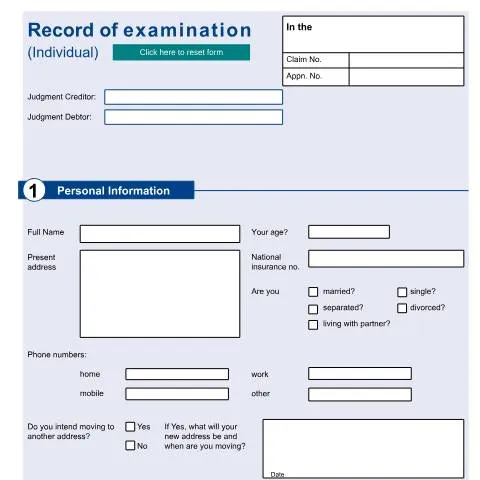
The moment a judgment creditor requests an oral examination, debtors find themselves facing one of the most intrusive aspects of the English enforcement system. Form EX140 serves as the comprehensive record of this examination, capturing every detail of a debtor's financial circumstances under oath. This document transforms what might be private financial information into court evidence, creating a detailed snapshot that can determine the future course of debt recovery proceedings.
Unlike standard financial disclosure forms, the EX140 emerges from a live court proceeding where judgment debtors must answer questions about their income, assets, and financial obligations in real-time. The examining officer or district judge uses this form to systematically record responses, creating an official record that carries significant legal weight in subsequent enforcement actions.
The Examination Landscape: Who Faces the EX140 Process
Oral examinations typically arise when judgment creditors struggle to recover debts through standard enforcement methods. The creditor must demonstrate to the court that they require information about the debtor's means to identify viable enforcement options. This procedural gateway means that reaching the EX140 stage indicates a debt recovery process that has already progressed through several preliminary steps.
Individual debtors subject to examination orders represent diverse circumstances. Self-employed individuals often face particular scrutiny, as their variable income streams and business assets require detailed exploration. Employed persons might assume their situation is straightforward, yet the examination delves into secondary employment, benefits, and household contributions that can significantly impact enforcement strategies.
The examination process particularly affects debtors who have been evasive about their circumstances or where previous enforcement attempts have yielded limited information. Property owners, business operators, and individuals receiving multiple income streams typically face more extensive questioning, as reflected in the form's detailed sections covering employment, self-employment, and residential arrangements.
Timing and Procedural Prerequisites
The examination order must specify the examination date, typically allowing at least 14 days' notice unless the court orders otherwise. Debtors cannot simply ignore the summons – failure to attend constitutes contempt of court, potentially resulting in committal proceedings. The examining process usually occurs during standard court hours, though emergency or out-of-hours examinations may be ordered in exceptional circumstances involving flight risk or asset dissipation.
Navigating the Form's Architecture: Section-by-Section Analysis
The EX140's structure reflects the systematic approach courts take to financial investigation. Each section builds upon previous disclosures, creating a comprehensive financial profile that leaves little room for omission or evasion.
Personal Information Foundation
Section 1 establishes basic demographic and contact details, but these seemingly routine questions carry enforcement implications. The address information directly impacts future enforcement actions – bailiff attendance, charging orders, and correspondence all depend on accurate residential details. The marital status inquiry isn't mere curiosity; it affects potential third-party claims and household income considerations.
Dependant information influences both the debtor's available income and potential enforcement limitations. Children living at the property may restrict bailiff powers, while elderly dependants could indicate additional financial obligations reducing available funds for debt repayment.
Employment Status Determination
Section 2's branching structure reflects the complexity of modern employment relationships. The form recognises that traditional employment categories increasingly blur, with individuals maintaining multiple income streams or transitioning between employment types.
Employed individuals proceed to Section 3, where the examination explores not just basic salary information but also the practical mechanics of payment. Direct bank payment details become crucial for potential attachment of earnings orders, while cash payments might indicate informal employment arrangements that complicate enforcement.
The Working Tax Credit inquiry reflects the benefits system's interaction with employment income. These payments, while supporting low-income workers, also indicate potential vulnerability to enforcement action and may affect the calculation of available income for debt repayment.
Self-Employment Complexities
Section 4 represents perhaps the form's most challenging area, reflecting the difficulties of assessing self-employed debtors' true financial position. The distinction between turnover and profit becomes critical, as creditors and courts must distinguish between gross business income and funds available for personal use.
| Business Structure | Assessment Focus | Key Vulnerabilities |
|---|---|---|
| Sole Trader | Personal drawings vs business needs | Business assets accessible for enforcement |
| Partnership | Individual share and partnership obligations | Joint and several liability issues |
| Limited Company | Director's loan accounts and benefits | Corporate veil piercing potential |
The form's inquiry into future contracts and outstanding payments serves a dual purpose: identifying immediate recovery prospects and assessing ongoing business viability. Debtors operating successful businesses face different enforcement strategies compared to those experiencing declining trade.
Unemployment and Retirement Considerations
Sections 5 and 6 address debtors outside traditional employment, but these situations don't necessarily indicate enforcement futility. Unemployed debtors may possess assets, receive undisclosed benefits, or have prospects for future employment that justify continued enforcement efforts.
Retired individuals often present complex financial pictures combining state and private pensions, investment income, and potentially substantial assets accumulated over working lifetimes. The examination explores not just current income but also the sustainability and growth potential of retirement funding.
Asset Investigation and Residential Arrangements
Section 8's property inquiry represents one of the form's most consequential areas. Property ownership opens numerous enforcement avenues, from charging orders to orders for sale, making accurate property assessment crucial for creditors' strategic planning.
The distinction between freehold and leasehold ownership affects enforcement approaches, as does joint ownership which may complicate or delay property-based enforcement. Mortgage details help establish available equity, while rental income from lodgers or tenants indicates additional income streams that might support debt repayment.
Rental arrangements receive detailed attention not merely for housing benefit calculations but because rental agreements can indicate lifestyle costs and potentially undisclosed income sources. High rental payments might suggest hidden income, while housing benefit dependency could indicate limited enforcement prospects.
The Lodger and Tenant Dimension
The inquiry into subletting arrangements serves multiple enforcement purposes. Rental income provides obvious debt repayment potential, but the presence of tenants or lodgers also affects bailiff powers and property enforcement strategies. Courts must balance creditors' rights against third parties' legitimate occupation rights.
Completing the Examination: Practical Considerations and Tactical Approaches
The examination process demands careful preparation from debtors, as the sworn nature of responses creates perjury risks for false or misleading statements. However, debtors retain certain rights and protections that experienced legal representatives can effectively utilise.
Documentation requirements vary depending on the examination's scope and the debtor's circumstances. Bank statements, employment contracts, business accounts, and benefit award letters typically support oral testimony. Debtors should organise these materials systematically, as confused or contradictory documentation raises suspicion and may prompt more intensive questioning.
The examining officer or judge possesses considerable discretion in questioning scope and depth. Cooperative debtors who provide clear, comprehensive answers often face shorter examinations, while evasive responses typically prompt more detailed investigation and potential follow-up examinations.
Rights and Limitations During Examination
Debtors maintain privilege against self-incrimination regarding criminal matters, though this protection doesn't extend to civil debt obligations. Legal representation is permitted and often advisable, particularly for business owners or individuals with complex financial arrangements.
The examination's scope, while broad, isn't unlimited. Questions must relate to the debtor's ability to satisfy the judgment debt, and fishing expeditions into irrelevant personal matters may be challenged. However, determining relevance often requires detailed financial exploration, giving examining officers substantial latitude.
Post-Examination Outcomes and Strategic Implications
The completed EX140 becomes a powerful tool in creditors' enforcement arsenal, providing detailed intelligence for targeted recovery actions. The information gathered directly influences subsequent enforcement strategy selection, from attachment of earnings orders for employed debtors to charging orders for property owners.
Creditors analyse the examination record to identify optimal enforcement timing and methods. Seasonal employment patterns, business cash flow cycles, and upcoming financial changes all influence enforcement tactical decisions. The examination might reveal hidden assets or income streams, but it can also demonstrate genuine inability to pay, potentially leading to more realistic settlement negotiations.
Follow-up examinations may be ordered where circumstances change significantly or where the initial examination reveals incomplete information. The court retains ongoing jurisdiction to monitor the debtor's financial situation, particularly where substantial assets or business interests are involved.
Impact on Future Financial Relationships
The examination record's existence affects debtors beyond immediate enforcement consequences. Credit applications, mortgage applications, and business financing arrangements may be influenced by the court record of financial difficulties. However, successful debt resolution following examination can demonstrate financial rehabilitation to future lenders.
For business debtors, the examination process may affect trade credit relationships and supplier arrangements. The detailed business information disclosed can influence commercial partners' confidence and willingness to extend credit terms.
Enforcement Strategy Evolution Following EX140 Completion
The examination's conclusion marks a transition from information gathering to targeted enforcement action. Creditors armed with comprehensive financial intelligence can pursue multiple enforcement avenues simultaneously or sequentially, maximising recovery prospects while minimising costs.
Property owners face potential charging order applications, supported by detailed property valuation and mortgage information gathered during examination. Employed debtors may face attachment of earnings applications, with the examination providing precise employment and income details necessary for effective wage garnishment.
Business debtors confront various enforcement options depending on their business structure and asset base. Third-party debt orders against business debtors' customers become viable where the examination reveals outstanding contract payments or regular commercial relationships.
The examination record also informs enforcement timing decisions. Creditors may delay immediate action where the examination reveals temporary financial difficulties that are likely to resolve, preferring to maintain the judgment debt for future enforcement when the debtor's circumstances improve. Alternatively, urgent enforcement action may be necessary where the examination suggests asset dissipation or flight risk.
Ultimately, the EX140 process represents the enforcement system's most comprehensive investigative tool, transforming vague judgment debts into detailed recovery roadmaps. For debtors, understanding this process and preparing appropriately can significantly influence both the examination experience and subsequent enforcement outcomes, while creditors gain the detailed intelligence necessary for effective debt recovery in an increasingly complex financial landscape.
Evidence Requirements and Documentation Standards
Form EX140 demands rigorous documentation standards that align with the Civil Procedure Rules (CPR) Part 31 and Practice Direction 31A regarding disclosure of documents. The court expects evidence that meets the threshold of relevance and proportionality established under CPR Rule 1.1, ensuring that submitted materials directly support your case whilst avoiding unnecessary administrative burden.
When compiling financial evidence, original documents carry significantly more weight than photocopies or digital printouts. Bank statements must display the financial institution's official letterhead, account holder details, and sequential page numbering. If providing electronic statements, ensure they include security features such as digital watermarks or authentication codes that verify their authenticity. Missing pages or gaps in sequential dating will prompt the court to request clarification, potentially delaying proceedings.
Employment documentation requires particular attention to detail. P60 certificates from HMRC provide annual earnings summaries that courts readily accept, whilst P45 forms demonstrate employment cessation dates crucial for establishing income timelines. Self-employed individuals must provide SA302 calculations directly from HMRC's online portal, as these carry official authentication that manually prepared accounts cannot match. Universal Credit statements from your DWP online account should span the relevant assessment period, typically six months preceding the application date.
Property valuations present unique challenges in EX140 submissions. Estate agent valuations, whilst readily available, may lack the detailed analysis required for contested proceedings. RICS-qualified surveyors provide more robust assessments, particularly for unusual property types or those in volatile markets. Local authority council tax banding offers baseline valuations, though courts recognise these may not reflect current market conditions, especially in areas experiencing significant regeneration or decline.
Debt documentation must demonstrate clear chains of liability. Original credit agreements, particularly those predating the Consumer Credit Act 2006 amendments, may contain terms that affect enforceability. Subsequent variations, payment holidays, or restructuring arrangements require comprehensive documentation showing how they modified original obligations. Default notices issued under Section 87 of the Consumer Credit Act must comply with strict formatting requirements – courts will examine whether these notices properly informed you of your right to remedy defaults within specified timeframes.
Medical evidence supporting financial hardship claims requires careful consideration of data protection requirements under UK GDPR. GP letters should address specific functional limitations affecting earning capacity rather than providing general health overviews. Occupational health assessments carry particular weight when demonstrating inability to perform previous employment roles. Mental health documentation from NHS services should clearly link diagnosed conditions to financial decision-making capacity during relevant periods, though courts remain sensitive to avoiding discrimination whilst acknowledging genuine impairment effects.
Strategic Timing and Court Interaction Protocols
The timing of EX140 submissions can significantly influence case outcomes, particularly when coordinated with other procedural steps in enforcement proceedings. Courts expect parties to demonstrate reasonable attempts at resolution before seeking judicial intervention, reflecting the overriding objective under CPR Rule 1.1 of dealing with cases justly and proportionately.
Pre-action protocols established under Practice Direction – Pre-Action Conduct require creditors to provide reasonable time for debtors to seek advice and respond to demands. If a creditor has initiated enforcement action without following these protocols, your EX140 submission should highlight these procedural failures. Courts may stay proceedings or make adverse cost orders against creditors who have rushed to enforcement without allowing proper consideration time.
When enforcement agents have already visited or threatened to visit, the timing of your EX140 application becomes critical. Regulations 13-15 of the Taking Control of Goods Regulations 2013 specify minimum notice periods that enforcement agents must observe. If agents have failed to provide the required seven clear days' notice before first attendance, or have not allowed proper time for you to seek advice, these procedural breaches strengthen your position significantly.
Court listing practices vary considerably between different hearing centres, with some experiencing delays of several weeks for debt-related applications. County courts in urban areas typically operate with fuller lists than those in rural locations, though this may be offset by higher case volumes. When completing EX140, consider whether urgent circumstances justify expedited hearing requests – courts will accommodate genuine emergencies but require compelling evidence of immediate risk to essential goods or services.
The interaction between EX140 applications and concurrent insolvency proceedings requires careful navigation. If you're considering a Debt Relief Order through the Insolvency Service, or have already initiated bankruptcy proceedings, these factors materially affect how courts approach enforcement applications. Individual Voluntary Arrangements (IVAs) supervised by licensed insolvency practitioners create automatic stays on most enforcement action, though secured creditors retain certain rights that may complicate the position.
Courts increasingly utilise telephone and video hearings for procedural applications, particularly following changes implemented during the COVID-19 pandemic. When your EX140 application is listed for hearing, the court will typically specify the format. Remote hearings can present challenges when referring to documentary evidence – ensure you have organised your papers clearly and can navigate them efficiently during proceedings. Technical difficulties are not generally accepted as grounds for adjournment unless they fundamentally prevent participation.
Regional Variations and Specialist Considerations
Court practices surrounding EX140 applications vary notably across different regions of England and Wales, reflecting local case management approaches and resource constraints. The Business and Property Courts in London handle higher-value matters with more complex evidence requirements, whilst county courts in smaller towns may adopt more flexible approaches to documentation standards, particularly for unrepresented litigants.
Northern circuit courts often encounter cases involving former industrial workers facing pension-related debt issues, requiring specialist understanding of occupational pension scheme regulations and the Pension Protection Fund's role. These cases frequently involve complex calculations of pension credit rights that may not be immediately apparent from standard financial documentation. Courts in these regions typically show greater familiarity with such issues, though comprehensive evidence remains essential.
Welsh county courts operate under additional linguistic considerations, with parties entitled to conduct proceedings in Welsh under the Welsh Language Act 1993. If you require Welsh-language proceedings, indicate this clearly on your EX140 form, as courts need adequate time to arrange translation services. This may affect listing timescales but cannot be used as grounds to refuse or delay your application.
Specialist debt types require tailored approaches to EX140 evidence compilation. Student loan obligations administered by the Student Loans Company present unique challenges, as standard enforcement procedures may not apply to these government-backed debts. Similarly, tax debts owed to HMRC carry preferential status in insolvency situations and may be subject to different enforcement procedures under the Taxes Management Act 1970.
Council tax arrears represent a significant proportion of EX140 applications, particularly given local authorities' extensive enforcement powers under the Council Tax (Administration and Enforcement) Regulations 1992. These proceedings often involve liability disputes concerning student exemptions, single person discounts, or council tax support entitlements. Evidence requirements may include university enrollment certificates, benefit award notifications, or household composition declarations that standard debt cases would not require.
Commercial rent arrears cases involving residential tenants require careful consideration of both landlord and tenant legislation. The Coronavirus Act 2020 and subsequent regulations temporarily modified enforcement procedures for rent arrears accrued during specific periods, creating complex evidential requirements for establishing which debts fall under which regulatory regime. Courts expect clear chronological breakdowns showing how different legislative provisions apply to different portions of outstanding arrears.
Cross-border enforcement issues arise frequently in cases involving debtors who have moved between England, Wales, Scotland, or Northern Ireland. Each jurisdiction maintains distinct court systems and enforcement procedures, though reciprocal arrangements facilitate cross-border recognition of judgments. If your circumstances involve elements from multiple jurisdictions, your EX140 evidence must clearly establish which court has appropriate jurisdiction and whether any conflicting proceedings exist elsewhere.
Vulnerable debtor provisions under various regulations require courts to consider additional factors when assessing EX140 applications. The Financial Conduct Authority's Consumer Credit Sourcebook contains specific requirements for creditors dealing with customers in vulnerable circumstances, including those experiencing mental health difficulties, learning disabilities, or severe financial hardship. Evidence of creditor failures to comply with these requirements can significantly strengthen your position, though such evidence must be properly documented and presented according to court standards.