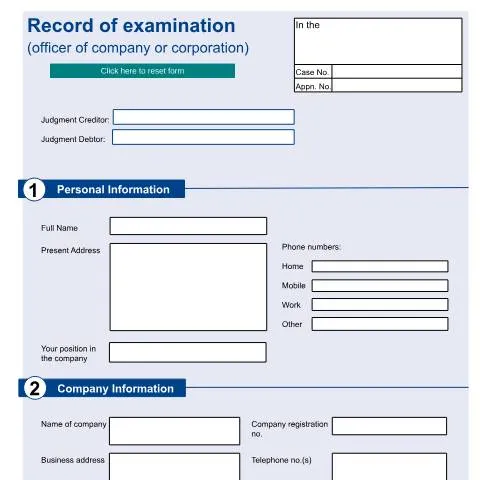
The Court's Investigation Tool for Company Financial Scrutiny
When a judgment creditor finds themselves unable to recover what they are owed from a company, the judicial system provides a powerful investigative mechanism through Form EX141. This comprehensive examination record enables courts to compel company officers to disclose detailed financial information under oath, creating a complete picture of the debtor company's assets, liabilities, and operational status. The process represents one of the most thorough debt enforcement tools available through HM Courts & Tribunals Service, often serving as the critical bridge between obtaining a judgment and actually securing payment.
The examination procedure under EX141 carries significant legal weight, as company officers face potential contempt of court proceedings if they fail to attend or provide incomplete information. This enforcement mechanism has proven particularly valuable in cases where judgment debtors attempt to conceal assets or claim inability to pay without proper substantiation.
Company Officers Under the Microscope: Who Faces Examination
Form EX141 targets specific individuals within the judgment debtor company who possess intimate knowledge of its financial affairs. The primary candidates for examination include company directors, both executive and non-executive, who bear statutory responsibilities for the company's financial management and strategic direction. Company secretaries frequently find themselves summoned, given their role in maintaining statutory records and often handling day-to-day administrative functions that provide insight into financial operations.
Senior financial personnel represent another key category, encompassing finance directors, chief financial officers, and senior accountants who have direct involvement in preparing accounts, managing cash flow, and overseeing financial reporting. In smaller companies, this might extend to bookkeepers or office managers who handle the practical aspects of financial record-keeping.
The court also has discretion to examine shadow directors – individuals who, while not formally appointed as directors, exercise significant influence over the company's affairs. This can include major shareholders who effectively control company decisions, consultants with extensive involvement in financial matters, or family members who play influential roles in family-owned businesses.
For larger corporate structures, the examination might focus on officers of subsidiary companies or holding companies where there are concerns about asset stripping or inter-company transactions designed to frustrate creditors. The court can also examine officers of related companies where there is evidence of trading through multiple corporate vehicles or where assets may have been transferred between connected entities.
Special Circumstances and Officer Categories
Recently appointed directors may still face examination if they have access to current financial information, though their knowledge of historical transactions may be limited. Conversely, recently resigned directors can be compelled to attend if their departure coincides suspiciously with the judgment creditor's enforcement efforts.
In cases involving professional service companies, the examination might extend to senior partners or principals who, while not technically directors, exercise management control. Similarly, in cooperative or mutual organisations, the relevant officers might include committee members or trustees with financial oversight responsibilities.
Dissecting the Financial Anatomy: EX141's Comprehensive Scope
The examination record systematically dissects every aspect of the company's financial structure, beginning with fundamental operational details. The form requires comprehensive disclosure of the company's current trading status, including whether it continues to operate, when it ceased trading if applicable, and how any assets were disposed of upon cessation. This information proves crucial in cases where companies claim to have wound down operations while potentially continuing to trade through other vehicles.
Contract disclosure forms a significant component, with officers required to detail all current contractual commitments, their total values, and any staged payment arrangements. This extends to future contracts already agreed but not yet commenced, providing creditors with insight into potential future income streams that might be available for debt satisfaction.
Banking and Financial Facilities Under Scrutiny
The banking section demands exhaustive detail about all financial facilities, including current account balances, overdraft arrangements, and the security underpinning these facilities. Officers must disclose not only current overdraft limits but also whether they have approached banks for increases and the responses received. The form specifically addresses the nature of security provided, distinguishing between fixed charges, floating charges, and personal guarantees, along with identifying which assets are affected by each type of security.
Cash holdings receive particular attention, with requirements to specify amounts held and their locations, whether in named banks, building societies, or other financial institutions. This granular approach helps prevent the concealment of readily available funds that could satisfy judgment debts.
Asset Investigation and Ownership Structures
The asset disclosure requirements extend far beyond simple ownership, exploring the complex arrangements that characterise modern business operations. Officers must distinguish between assets owned outright, those subject to hire purchase agreements, lease purchase arrangements, and standard leasing agreements. For each category, the form requires details of values, payment schedules, and outstanding liabilities.
Vehicle assets receive specific treatment, requiring registration numbers alongside descriptions and values – information that enables creditors to trace and potentially seize these readily identifiable assets. The form also addresses more complex assets such as livestock and investment portfolios, including shareholdings in other companies.
| Asset Category | Required Information | Additional Details |
|---|---|---|
| Owned Assets | Description, value, registration numbers | Full ownership verification |
| Hire Purchase | Value, last payment date | Outstanding balance, payment schedule |
| Lease Purchase | Value, last payment date | Lease terms, purchase options |
| Leased Assets | Description, lease terms | Lessor details, renewal options |
Property Holdings and Real Estate Complications
Real property disclosure represents one of the most complex sections of EX141, reflecting the significant value typically associated with commercial property holdings. The form requires comprehensive details of all property owned by the company, including current valuations and the original purchase prices to establish equity positions.
Mortgage arrangements receive detailed treatment, with requirements for lender identification, amounts borrowed and outstanding, borrowing dates, and details of any subsequent charges or security interests. This information proves vital for creditors attempting to understand the realistic prospects of recovering funds through property-based enforcement action.
The examination extends to rental arrangements where the company occupies premises as a tenant, requiring disclosure of rent levels, council tax obligations, service charges, and any arrears. This information helps creditors assess the company's ongoing operational commitments and potential vulnerabilities in its property arrangements.
Complex Property Structures
Modern business operations often involve sophisticated property arrangements that the form must capture. These might include sale and leaseback arrangements where the company has sold property but continues to occupy it under lease terms, or complex sub-letting arrangements where the company both pays rent to a head landlord and receives rent from sub-tenants.
Shared occupancy situations require careful disclosure, particularly where the judgment debtor company shares premises with related entities or where property ownership involves multiple corporate vehicles within the same business group. Such arrangements often indicate potential asset protection strategies that creditors need to understand and potentially challenge.
Debtor-Creditor Relationships and Outstanding Obligations
The examination of amounts owed to the company provides crucial intelligence about potential recovery sources, with the form requiring detailed schedules of all outstanding debts. This includes debtor identification, invoice references, total amounts owing, and crucially, whether these amounts are disputed by the debtors concerned.
Retention of title clauses receive specific attention, as these can significantly affect the recovery prospects for goods supplied by the judgment debtor company. Officers must identify goods subject to such clauses and quantify the amounts owed by customers for these goods, information that might reveal valuable recovery opportunities or alternatively, explain why certain apparent assets are not available to general creditors.
Recent asset disposals within the preceding twelve months require comprehensive disclosure, including disposal dates, asset descriptions, purchaser details, and prices achieved. This information enables creditors to identify potentially undervalue transactions that might be challenged under insolvency legislation or as transactions defrauding creditors.
Investment Portfolios and Complex Financial Instruments
Share ownership in other companies can represent substantial hidden value, and the form requires disclosure of all such investments along with their current valuations. This extends to more complex financial instruments such as bonds, debentures, or derivative products that might not be immediately apparent from standard company accounts.
Professional investment management arrangements also require disclosure, including details of investment advisers, portfolio managers, and any investment funds or trusts in which the company participates. These relationships can reveal additional assets or income streams not immediately obvious from the company's primary trading activities.
Liability Landscape and Creditor Hierarchies
The comprehensive creditor schedule demanded by EX141 creates a complete picture of the company's financial obligations, extending beyond simple monetary amounts to include the nature of each debt and any security arrangements. Officers must detail not only amounts owed but also the actions being taken by various creditors to recover their debts, providing insight into the company's overall financial pressure and the likelihood of formal insolvency proceedings.
Security arrangements require particular attention, with distinctions between fixed charges, floating charges, and personal guarantees affecting the priority of various creditors' claims. The form specifically addresses whether debts are disputed, as this can significantly impact recovery prospects and the company's negotiating position with creditors.
Existing court orders against the company receive detailed treatment, including judgment dates, court details, case numbers, creditor identification, and current payment arrangements. The disclosure of payment arrears provides immediate insight into the company's compliance with existing court orders and its general approach to debt management.
Operational Creditor Relationships
Trade creditors often represent the largest category of unsecured debt, and their treatment can indicate the company's operational viability and management priorities. The form requires identification of key suppliers and service providers, along with any special arrangements or payment terms that might affect their priority status.
Employment-related liabilities, while not explicitly detailed in the basic form structure, often emerge during examination as officers must address all creditor categories. These can include outstanding salaries, pension contributions, and potential redundancy obligations that carry statutory priority in insolvency situations.
Court Procedure and Examination Mechanics
The EX141 examination process begins with the judgment creditor's application to the court for an order compelling attendance of the relevant company officer. The court will specify the examination date, time, and location, with the order typically requiring the officer to bring relevant company documents and records to support their testimony.
During the examination, the officer answers questions under oath, with their responses recorded on Form EX141. The questioning typically follows the form's structure but can extend beyond its specific requirements if the circumstances warrant additional investigation. Legal representatives for both the judgment creditor and debtor company may be present, though the examined officer must answer personally rather than through counsel.
The completed form becomes a court record, admissible in subsequent proceedings and potentially forming the basis for further enforcement action. Officers who fail to attend face potential committal proceedings for contempt of court, while those who provide false or misleading information may face perjury charges.
Post-Examination Consequences and Follow-Up Actions
Information obtained through EX141 examination often triggers additional enforcement measures, including third-party debt orders against the company's bank accounts, charging orders against property, or applications for the appointment of receivers over specific assets. The comprehensive financial picture created by the examination enables creditors to target their enforcement efforts more effectively.
In cases where the examination reveals evidence of asset dissipation or fraudulent trading, creditors may initiate separate proceedings to recover transferred assets or pursue company officers personally. The detailed record created by EX141 often provides the foundation evidence for such claims.
Where multiple creditors are pursuing the same debtor company, the examination results may prompt discussions about collective enforcement action or formal insolvency proceedings. The comprehensive financial disclosure can help creditors assess whether the company has sufficient assets to justify the costs of formal insolvency procedures or whether alternative recovery strategies might prove more effective.
The examination process also serves an important deterrent function, as the prospect of detailed financial scrutiny under oath can encourage settlement negotiations or voluntary disclosure of assets that might otherwise remain concealed. This psychological pressure often proves as valuable as the formal legal powers underpinning the examination process itself.