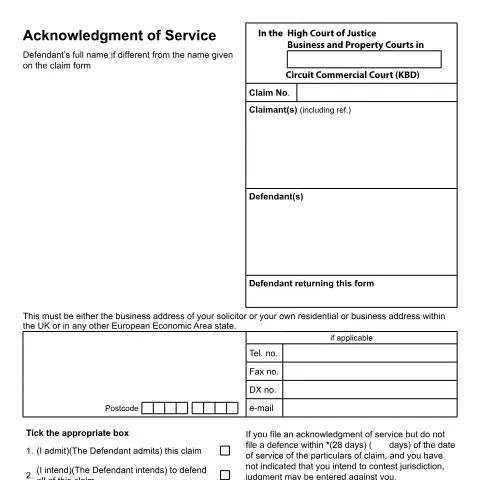
Navigating the Acknowledgment of Service in the Regional Commercial Court (N9 RCC)
Imagine receiving a claim that could potentially alter the course of your business operations. The responsibility of responding to such a claim falls upon you, the defendant. In the Regional Commercial Court, the Acknowledgment of Service (N9 RCC) plays a pivotal role in ensuring that your response to the claim is documented and recognized by the court system. This essential document serves as the first step in the legal process, helping to establish the framework for any impending legal battles.
Understanding the Unique Position of the N9 RCC Document
The Acknowledgment of Service (N9 RCC) is distinct from other forms encountered in the realm of court proceedings. Unlike the issue of the claim form itself, which initiates legal proceedings, the N9 RCC acts as your official notice to the court that you have received the claim and are prepared to respond. It's crucial to distinguish this from similar forms like the defence forms, as the N9 RCC does not require you to provide a comprehensive defence but rather indicates your intention regarding the claim.
In other words, while other forms may delve directly into the specifics of your case, the N9 RCC operates at a preliminary stage, allowing you to stipulate your position without entering the fray of detailed arguments just yet. This document can be a lifesaver, providing crucial timelines and options for defendants as they navigate through potentially tumultuous legal waters.
Who Should Be Completing the N9 RCC?
The N9 RCC targets a very specific audience: defendants who have been served with a claim in the Regional Commercial Court. However, understanding who qualifies as a defendant requires a closer examination of various scenarios.
Categories of Defendants
- Individual Defendants: If you are being personally sued, you are the primary defendant. Make sure to provide accurate personal details, including your full name and address.
- Corporate Defendants: In cases where a business entity is being sued, it is essential to provide the official business address and registration details.
- Representatives: If a legal representative is filing on behalf of a defendant, they must include their details along with the defendant's information.
Each of these profiles carries its nuances. For instance, individual defendants must consider the implications of personal liability, while corporate defendants must ensure compliance with corporate governance requirements when submitting their acknowledgment.
The Role of the N9 RCC in the Legal Procedure
When a claim is lodged against you, the N9 RCC is your initial response, and its importance cannot be overstated. Completing and submitting this document correctly is critical, as it influences the next steps in your legal journey. It serves multiple purposes:
- Admission or Defence: By ticking the appropriate box within the N9 RCC, you can either admit the claim or indicate your intention to defend all or part of it. This decision shapes the court’s subsequent actions and timelines.
- Jurisdiction Issues: If you believe the court does not have jurisdiction over your case, you can indicate this in your acknowledgment. It's worth noting that failing to contest jurisdiction may result in a default judgment against you.
- Establishing Timelines: The N9 RCC sets specific deadlines for filing a full defence. If you submit your acknowledgment but do not follow through with a defence, the court may enter judgment against you in default.
The N9 RCC, thus, is not just a formality; it shapes the trajectory of your case, establishing crucial timelines and obligations that must be adhered to.
Preparing to Complete the N9 RCC
Filling out the N9 RCC accurately is paramount. Here are the critical pieces of information required:
Essential Information to Gather
- Claim Information: Ensure you have the claim number and details of the claimant(s) as they appear on the claim form.
- Defendant’s Information: If the defendant's name differs from that on the claim form, make sure to include full details.
- Contact Information: Provide a reliable phone number, email address, and, if applicable, fax number, which the court may use to contact you.
Failure to provide accurate and complete information can lead to complications or delays in your case, potentially affecting your legal standing.
What Happens After Submission? Timelines and Next Steps
Once you have completed and submitted the N9 RCC, it triggers a series of actions within the court system. Understanding these next steps is essential for effective case management.
Timeline of Events
- Submission Confirmation: Upon filing the N9 RCC, you should receive a confirmation from the court, further establishing that the process is underway.
- 28-Day Window: You have 28 days from the date you acknowledge the service of the claim to file a full defence. If you do not submit a defence during this time, a judgment may be entered against you.
- Potential for Defaults: If you fail to act appropriately, the claimant can request a default judgment. This can have severe ramifications for your business or personal affairs.
Staying vigilant and proactive during this period is crucial. Missing a deadline could severely undermine your position in the case.
Handling Issues, Errors, or Missing Documents
In the legal realm, problems can arise at any juncture. Understanding how to address issues with your N9 RCC submission is indispensable.
Common Problems and Solutions
- Missing Deadline: If you suspect that you have missed the 28-day deadline, consult with a legal advisor immediately to explore options for rectifying the situation.
- Errors in Submission: If you discover an error after submission, promptly inform the court of the mistake and seek guidance on how to amend it.
- Lack of Documentation: If required documentation was not included with your N9 RCC, contact the court to determine the next steps and any implications this may have.
Having a proactive approach to potential errors can help mitigate adverse effects and ensure you remain compliant with court proceedings.
Understanding the Importance of Jurisdiction in Your Response
One often-overlooked aspect of the N9 RCC is the implications of jurisdiction. Acknowledging and contesting jurisdiction is a crucial element of your response.
Jurisdiction Considerations
If you believe that the claim has been filed in the wrong court or that the court lacks jurisdiction over the case, you must indicate this on your N9 RCC. Failing to contest jurisdiction can lead to a presumption of acceptance, effectively surrendering your ability to challenge the claim's validity.
Courts have specific rules surrounding jurisdiction, and understanding these can save you from severe repercussions. It is advisable to consult legal counsel if you have concerns regarding the jurisdiction of your case.
Final Thoughts: Proactive Management of Your Legal Affairs
Engaging with the N9 RCC is more than a mere administrative task; it's a critical component of your legal strategy. By approaching this process with diligence and attention to detail, you can better position yourself in the face of litigation. Always consider seeking advice from a solicitor specialising in commercial law to navigate complex situations effectively. Whether admitting the claim or preparing to contest it, being informed and proactive is your best defence.
Understanding the Role of the Regional Commercial Court
The Regional Commercial Court (RCC) serves a vital function within the UK judicial system, particularly for businesses engaged in commercial disputes. This court is designed to provide a specialized forum where complex commercial cases can be heard more efficiently than in the mainstream courts. The RCC deals with various matters, including contract disputes, corporate disputes, and issues surrounding commercial leases. Understanding its structure, jurisdiction, and procedural nuances is essential for any claimant or defendant looking to navigate the complexities of commercial litigation.
Fill in your form directly online
No printing: type your details into the boxes of the official form, tick, then download the PDF ready to send.
- 1Type into the form boxes
- 2Tick in one click
- 3Save and download the PDF
The RCC operates under the framework of the High Court but with a focus on smaller claims, typically with values less than £250,000. This allows it to handle cases that might otherwise become bogged down in the higher courts, ensuring quicker resolutions. It also offers judges with specific expertise in commercial law, which can be a significant advantage when it comes to the interpretation of such cases. Each RCC is situated within the designated regional courthouse, making it more accessible for local businesses.
When you’re involved in a case in the RCC, understanding how to properly acknowledge service of a claim is vital. This includes being aware of the timelines and requirements specified by the court, which can vary depending on the jurisdiction. Familiarizing yourself with the court's procedures, including mediation options and preliminary hearings, can also significantly impact the outcome of your case.
Common Pitfalls When Acknowledging Service of a Claim
While acknowledging service in the Regional Commercial Court seems straightforward, there are several common pitfalls that litigants should be mindful of to avoid complications down the line. One common error involves misunderstanding the timelines associated with acknowledgment. According to the Civil Procedure Rules (CPR), you have 14 days from the date of service to acknowledge a claim. Failing to do so can result in a default judgment being entered against you.
Another pitfall arises from the method of acknowledgment. Many individuals assume that sending an email suffices, but it's critical to follow the specific procedures laid out by the court. Acknowledgment must typically be made using the appropriate form (N9) and filed with the court. This can be done in person, by post, or via the court's online system, but each method requires adherence to specific guidelines to ensure that the acknowledgment is valid.
Errors in providing essential information can also lead to complications. For example, if you do not include your National Insurance number or the claim number, the court may reject your acknowledgment. Ensuring all information is accurate and complete helps prevent unnecessary delays and potential disputes over service. Additionally, it is worth noting that if you require additional time to respond to the claim, you may apply for an extension. However, this must be done before the initial 14-day period elapses.
Implications of Not Acknowledging the Claim
Failing to acknowledge service of a claim in the Regional Commercial Court can have significant implications for your legal standing and rights. When a claim is served, the clock begins ticking on your obligation to respond. If you neglect to acknowledge the claim, the claimant can apply for a default judgment. This means that the court may grant the claimant everything they seek without your input, severely limiting your ability to contest the claims made against you.
Furthermore, a default judgment can have far-reaching consequences for your business. It may result in enforcement actions such as wage garnishments, the freezing of bank accounts, or even the seizure of assets. Such actions can disrupt your business operations and adversely affect your reputation. Additionally, once a default judgment is in place, it can be challenging to appeal or overturn it unless you can show that the judgment should not have been granted. This often requires additional legal steps, which can incur additional costs and time.
It’s also important to note that a default judgment can negatively impact your credit rating, making it more difficult to secure financing or engage in other important business transactions. Therefore, understanding the importance of timely acknowledgment and the potential consequences is imperative for anyone involved in proceedings within the RCC.