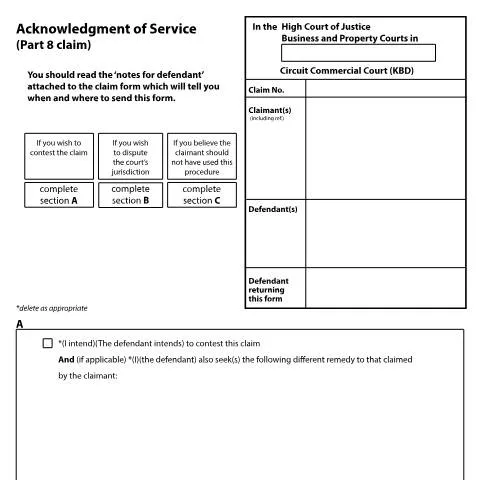
The Crucial Importance of Acknowledging Service in the Regional Commercial Court
Imagine a scenario where a business entity finds itself the target of a formal claim in the Regional Commercial Court. The next steps are paramount; one misstep could lead to significant legal consequences. At the heart of this process lies the Acknowledgment of Service (CPR Part 8) – N210 RCC form. It’s not just a bureaucratic hurdle; it is a pivotal document that can shape the outcome of the case. Failing to properly complete or submit this form can result in default judgments or the inability to contest the claim, profoundly affecting the defendant’s rights and responsibilities.
Navigating the Acknowledgment Process: Who Needs to Engage?
The individuals and entities required to submit the N210 RCC are typically defendants in the claim who have received a claim form under Part 8 of the Civil Procedure Rules. This includes various categories:
- Individual Defendants: Any person named in the claim.
- Business Entities: Limited companies, partnerships, or sole traders facing allegations.
- Litigation Friends: In cases involving minors or protected parties, a litigation friend must submit the acknowledgment on their behalf.
Understanding the profile of the parties involved is essential, as each has distinct obligations. For instance, while a limited company may appoint a board member or a secretary to fill out the form, an individual defendant must do it themselves or designate someone they trust.
Understanding Claim Types in Part 8
The claims brought under Part 8 of the Civil Procedure Rules are designed for cases where there is no significant dispute of fact. This might include issues like:
- Declarations of rights
- Claims for a specific remedy that does not require a detailed examination of facts
- Applications for interim injunctions
It’s crucial for defendants to confirm whether their case falls under this umbrella as it influences how they complete the N210 RCC and what subsequent steps they must take.
Filling Out the N210 RCC: A Detailed Walkthrough
Completing the N210 RCC may seem daunting, yet it comprises straightforward sections. Each must be meticulously filled out to avoid future complications:
- Section A: This is where the defendant identifies themselves. Essential information includes the full name and address.
- Section B: Here, the defendant must indicate their intention regarding the claim. They can either acknowledge the claim, dispute the court's jurisdiction, or contest the claim entirely. Each option has specific implications for how the case will proceed.
- Section C: If the defendant intends to dispute the claim, they need to articulate their objections clearly. This may include arguments regarding the appropriateness of the claim or specific legal grounds for contestation.
- Section D: This section is to provide contact information, ensuring that any correspondence from the court is directed appropriately.
Keep in mind that all statements made in the acknowledgment must be truthful as false declarations can lead to charges of contempt of court.
Deadlines and Timing: Key Considerations
Timeliness is critical in legal proceedings. The defendant must submit the N210 RCC within 14 days of receiving the claim form. The implications of missing this deadline are serious; a defendant risks losing the opportunity to contest the claim altogether, leading to potential default judgments. Hence, it is advisable to act swiftly upon receipt of the claim.
Consequences of Not Submitting the Form
Neglecting to submit the N210 RCC can have severe ramifications:
- Default Judgment: The claimant may apply for a default judgment against the defendant, leading to an automatic ruling in favour of the claimant.
- Inability to Contest: Failure to respond limits the defendant's ability to present their case, significantly affecting their rights.
- Increased Costs: The defendant may incur additional costs related to enforcement measures that the claimant might pursue.
Understanding these potential consequences reinforces the necessity of prompt and accurate acknowledgment of service.
What to Do in Case of Errors or Missing Pieces
Errors in filling out the N210 RCC or missing information can be rectified, but the process must be handled judiciously. If the form contains inaccuracies:
- Identify the Mistake: Quickly pinpoint the error or omission. Is it a simple typo, or is essential information missing?
- Contact the Court: It’s vital to inform the court of the issue, preferably before the deadline for submission expires. This can often be done via a phone call or written communication.
- Submit Corrections: If the acknowledgment has already been submitted, consider filing a supplemental acknowledgment or correcting statement as guided by court officials.
In situations of complexity or uncertainty, seeking legal advice can help navigate the process and mitigate further complications.
Special Circumstances: Navigating Complexity
Certain situations warrant special attention when dealing with the N210 RCC:
- International Defendants: Those based outside the UK must ensure compliance with international service requirements and may have differing timelines for acknowledgment.
- Involvement of Minors: In cases involving children, a litigation friend must file the acknowledgment, adding a layer of complexity in ensuring the child's rights are safeguarded.
- Complex Commercial Disputes: High-stakes small claims might require detailed attention to contested matters, necessitating legal representation to ensure all aspects are accurately presented.
Understanding these nuances is crucial for defendants to protect their interests and ensure compliance with all procedural requirements.
Administration's Response and Case Progress Tracking
Once the N210 RCC is submitted, defendants may wonder about the next steps. The HM Courts & Tribunals Service (HMCTS) will process the acknowledgment and may provide updates on the case status. It’s essential to:
- Keep Records: Maintain copies of all submitted documents, including the N210 RCC and any correspondence with the court.
- Monitor Timelines: Stay aware of the court's expected timelines for responses and subsequent actions required from both parties.
- Engage with the Court: Should there be any delays or unresponsiveness, contact the court for updates and clarification on the next steps.
This proactive approach ensures defendants are well-informed and can effectively engage in the ongoing legal process.
Differentiating the N210 RCC from Other Similar Forms
While the N210 RCC has a specific purpose, it is often confused with other forms. Understanding these differences can help avoid misfiling:
| Form | Purpose | Key Difference |
|---|---|---|
| N210 RCC | Acknowledgment of Service for Part 8 claims | Specifically for claims where no significant dispute of fact is presented |
| N9 (Acknowledge Service) | Acknowledgment of Service for Part 7 claims | Used for claims where there is a dispute of fact |
| N244 | Application Notice for various requests | Used when the defendant wishes to make a specific application to the court |
Understanding these distinctions is vital, as filing the incorrect form can lead to procedural delays and complications.
Exploring Filing Channels: Online vs Paper Submissions
With the evolution of technology, defendants have options in how they submit their N210 RCC:
Fill in your form directly online
No printing: type your details into the boxes of the official form, tick, then download the PDF ready to send.
- 1Type into the form boxes
- 2Tick in one click
- 3Save and download the PDF
- Online Submission: The HMCTS offers online services for submitting forms, providing immediate confirmation of submission, which can be advantageous for tracking.
- Paper Submission: Traditional mailing remains an option, though it can lead to longer processing times and requires careful attention to ensure that documents are correctly sent and received.
- Court Visits: For those preferring face-to-face interactions, submitting the form at the local court can be done, but be aware of operating hours and the necessity for prior appointments in some jurisdictions.
Choosing the correct channel can save time and prevent administrative hiccups, ensuring the process flows more smoothly.
Understanding the Structure of CPR Part 8 Claims
Before delving into the specifics of acknowledging service for CPR Part 8 claims in the Regional Commercial Court, it is essential to understand the structure and nature of these claims. The Civil Procedure Rules (CPR) Part 8 is primarily designed for claims that do not relate to the determination of a substantive dispute or where the issue can be resolved without a full trial. This is particularly relevant in cases regarding matters such as the construction of a will, questions of legal rights, or other specified issues where an expedited resolution is desirable.
A CPR Part 8 claim is typically used when the parties are seeking the court's decision on a specific question of law or fact without the need for extensive evidence or a full-blown trial. As such, these claims are often seen in commercial contexts, where time is of the essence, and parties prefer a swift resolution. For practitioners, understanding the procedural nuances of Part 8 is crucial, as it requires a different approach than ordinary litigation.
Step-by-Step Process for Acknowledging Service of CPR Part 8 Claims
Acknowledging service of a CPR Part 8 claim specifically in the Regional Commercial Court involves several key steps that must be followed meticulously to ensure compliance with the court's requirements. Below is a detailed, step-by-step guide to the process:
- Review the Claim Form and Accompanying Documents: Once you receive the claim form, it is vital to thoroughly review the particulars of claim, which outline the basis of the claim and the relief sought. This will help you understand the context and frame your response appropriately.
- Prepare the Acknowledgment of Service: The Acknowledgment of Service form (N210 RCC) must be completed correctly. This includes providing necessary information such as your name, address, and the details of the claim. It's important to indicate whether you intend to contest the claim or if you are simply acknowledging the service.
- Submit the Acknowledgment of Service: The completed form must be submitted to the court within 14 days of receiving the claim form, as mandated by CPR Rule 8.4. Timeliness is critical, as failing to acknowledge within this period could result in the claimant seeking a default judgment against you.
- Keep a Copy of Your Submission: Ensure that you retain a copy of the filed acknowledgment for your records. This will serve as proof of compliance and may be necessary for future proceedings.
- Await Further Instructions from the Court: Once the acknowledgment is submitted, the court will provide further directions, which may include a timetable for submitting evidence, if applicable. Ensure you follow these instructions closely to avoid potential setbacks.
Throughout this process, it’s advisable to seek legal advice, especially if you are unsure about your position or the implications of the claim.
Common Challenges and How to Overcome Them
When acknowledging service of a CPR Part 8 claim, litigants often encounter various challenges that can hinder the process. Recognizing these potential pitfalls and being prepared can make a significant difference in how the case progresses.
Some common challenges include:
- Misunderstanding the Nature of CPR Part 8: Many parties coming from a different litigation background may not fully grasp that Part 8 does not engage with factual disputes in the same manner as a standard trial. To overcome this, parties should thoroughly familiarize themselves with the rules surrounding Part 8 claims and consider consulting legal professionals who specialize in commercial litigation.
- Timely Submission of Documents: The strict timelines under CPR Part 8 mean that delays can have serious repercussions. To mitigate this risk, litigants should establish a procedural calendar immediately upon receiving the claim documents and set reminders for key deadlines.
- Lack of Clarity in the Claim: If the claim form lacks clarity, it can be challenging to respond appropriately. In such cases, it is permissible to file a request for clarification or seek directions from the court regarding ambiguities in the particulars of claim.
- Complexity of Legal Issues: Some claims may involve intricate legal principles that require a deeper understanding. Engaging with a legal expert who has experience in commercial claims can provide valuable insight and potentially improve outcomes.
By anticipating these challenges and preparing accordingly, parties can navigate the CPR Part 8 claim process more effectively and increase their chances of a satisfactory resolution.