When Commercial Court Claims Land on Your Desk: The Critical First Response
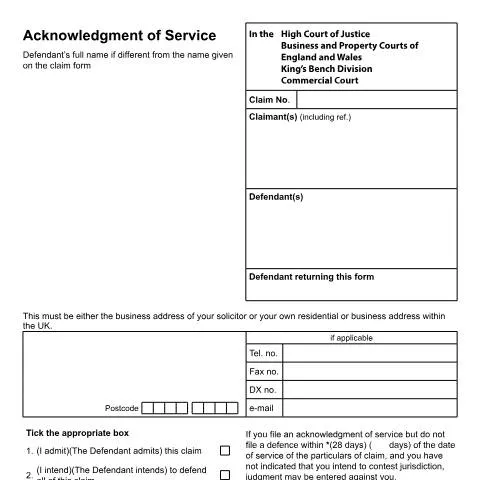
Receiving a claim form from the Commercial Court can be a jarring experience, whether you're a multinational corporation or a smaller business entity. The moment that official envelope arrives, marked with the distinctive seal of HM Courts & Tribunals Service, the clock starts ticking. The Form N9(CC) Acknowledgment of Service represents your first formal opportunity to respond to the court and establish your position in what could become a complex commercial dispute.
Unlike standard county court proceedings, Commercial Court claims typically involve substantial sums—often exceeding £200,000—and complex commercial relationships. The acknowledgment of service in this specialist jurisdiction carries particular weight, as it not only confirms receipt of the claim but also signals your intended strategy to both the court and your opponent. This document serves as your procedural anchor point, buying you crucial time whilst preserving your rights to mount a full defence or challenge the court's authority to hear the case.
The Commercial Court's streamlined procedures demand precision and timeliness. Missing the acknowledgment deadline doesn't just risk default judgment; it can undermine your credibility in subsequent applications and potentially limit your options for challenging jurisdiction or seeking extensions of time.
Navigating the Four Strategic Pathways
Form N9(CC) presents defendants with four distinct tactical options, each carrying different implications for the litigation ahead. Understanding these choices is crucial, as your selection will shape the entire trajectory of the proceedings.
Admission: The Clean Slate Approach
Ticking box 1 to admit the claim represents the most straightforward path, though it's rarely appropriate in substantial commercial disputes. This option effectively concedes liability and moves proceedings directly to quantum assessment or agreed settlement discussions. Businesses typically choose this route only when liability is unequivocal and the primary concern is minimising legal costs whilst negotiating damages.
Full Defence: Preparing for Battle
Box 2, indicating intention to defend the entire claim, is the most common selection in Commercial Court proceedings. This preserves all your options whilst signalling robust resistance to the claimant's allegations. Crucially, this choice commits you to filing a full defence within the prescribed timeframe—typically 28 days from service of the particulars of claim, though this can vary for overseas defendants.
Partial Defence: Strategic Compartmentalisation
Selecting box 3 allows defendants to concede certain aspects whilst disputing others. This approach can be particularly effective in multi-faceted commercial disputes where some claims are clearly sustainable whilst others are spurious. However, this strategy requires careful consideration, as partial admissions can complicate settlement negotiations and may be used against you in subsequent proceedings.
Jurisdictional Challenge: Questioning the Court's Authority
Box 4 represents perhaps the most sophisticated option—contesting the court's jurisdiction to hear the case. This might arise where contracts contain foreign jurisdiction clauses, where proper service hasn't been effected, or where the Commercial Court lacks subject matter jurisdiction. Importantly, filing this acknowledgment doesn't constitute submission to jurisdiction, but you must follow through with a formal application within 28 days of filing the N9(CC).
| Response Option | Next Step Required | Deadline | Strategic Considerations |
|---|---|---|---|
| Admit claim | Settlement negotiations | Immediate | Minimises costs but concedes liability |
| Defend all | Defence filing | 28 days (typically) | Preserves all options |
| Defend part | Defence + admission details | 28 days (typically) | May complicate proceedings |
| Contest jurisdiction | Jurisdiction application | 28 days from N9(CC) | Can halt proceedings entirely |
The Solicitor's Address Dilemma: More Than Administrative Detail
The requirement to provide an address for service within the UK might appear mundane, but it carries significant practical and strategic implications. For defendants represented by solicitors, the business address of the legal firm typically serves this function. However, the form's emphasis on UK addresses reflects the Commercial Court's need to ensure effective service of future documents and orders.
Overseas defendants face particular challenges here. While the form accommodates international parties, any address provided must facilitate reliable communication with the English court system. Many international corporations maintain a registered office or subsidiary in the UK specifically to satisfy such requirements, though this isn't mandatory provided alternative arrangements ensure effective service.
The inclusion of modern communication methods—email addresses, DX numbers, and fax details—reflects the Commercial Court's embrace of electronic communication. Providing comprehensive contact information not only ensures compliance but can expedite proceedings and reduce administrative delays that might otherwise prejudice your position.
Timing Imperatives and the Consequences of Delay
The Commercial Court operates on compressed timescales that reflect the business community's need for swift resolution of disputes. The standard 14-day period for filing an acknowledgment of service begins from the date of service of the claim form, not from when you actually receive it. This distinction can be crucial where service is effected through solicitors or where postal delays occur.
The Defence Deadline Pressure
Filing an N9(CC) doesn't pause the clock entirely. The form explicitly warns that failure to file a defence within the specified period—typically 28 days from service of the particulars of claim—can result in default judgment. This creates a cascading series of deadlines that defendants must manage carefully.
For international defendants, these periods may be extended under CPR rules 6.35 and 6.37(5), but such extensions aren't automatic. The claimant should indicate any modified timeframes on the claim form itself, though defendants shouldn't assume such variations apply without careful verification.
Jurisdictional Challenge Timelines
The 28-day deadline for jurisdictional challenges is particularly unforgiving. Unlike defence deadlines, which might be extended by agreement or court order, the time limit for contesting jurisdiction is generally absolute. Failure to file the necessary application within this window typically results in deemed acceptance of the court's jurisdiction, even if substantive grounds for challenge existed.
International Defendants and Cross-Border Complications
Commercial Court proceedings frequently involve international parties, creating layers of complexity that domestic defendants don't face. The acknowledgment of service process must accommodate these realities whilst maintaining the court's efficiency requirements.
Service outside the jurisdiction triggers specific procedural protections under the Civil Procedure Rules. Defendants served abroad typically receive extended time periods, though the exact extensions depend on the country of service and whether service occurred with or without the court's permission. The asterisked note on Form N9(CC) acknowledges these variations, though defendants should never rely solely on the form's general language without seeking specific legal advice.
Currency considerations also arise in international cases. While the form itself doesn't address monetary thresholds, Commercial Court claims involving foreign defendants often include currency conversion issues that can affect both the substantive dispute and procedural questions about court fees and security for costs.
Diplomatic and State Immunity Considerations
Foreign state entities and international organisations may enjoy immunity from English court proceedings under the State Immunity Act 1978 or relevant international agreements. Such defendants face the delicate task of challenging jurisdiction without inadvertently submitting to it—a balance that the N9(CC) process must carefully navigate.
Corporate Defendants and Authority Issues
The signature section of Form N9(CC) requires careful attention when corporate defendants are involved. The person signing must have appropriate authority to bind the company in legal proceedings, and their position must be clearly stated. This seemingly administrative requirement can create significant complications if challenged later in proceedings.
Directors, company secretaries, and senior executives typically possess implied authority to file acknowledgments of service, but overseas corporations or those with complex management structures may need to document such authority explicitly. The Commercial Court has encountered cases where improperly filed acknowledgments created procedural disputes that delayed substantive proceedings for months.
Insolvency and Administration Complications
Companies in financial distress face particular challenges when Commercial Court claims arrive. Administrators, liquidators, and receivers must determine whether acknowledging service serves the creditors' interests and whether they possess authority to bind the company in new proceedings. These decisions often require court approval or creditor consultation, creating time pressures that the standard N9(CC) deadlines don't accommodate.
Electronic Filing and the Modern Commercial Court
While Form N9(CC) exists in traditional paper format, the Commercial Court increasingly operates through electronic systems that streamline case management and improve efficiency. The court's embrace of technology affects how acknowledgments are filed, served, and processed.
Electronic filing through the court's online systems offers several advantages: immediate confirmation of receipt, automatic deadline calculations, and integration with the court's case management systems. However, technical issues or system maintenance can create filing complications that defendants must anticipate and plan around.
The court maintains strict policies about file formats, document naming conventions, and electronic signatures that can trap unwary litigants. A perfectly drafted acknowledgment might be rejected for technical non-compliance, potentially causing deadline breaches with serious consequences.
Hybrid Proceedings and Document Management
Modern Commercial Court practice increasingly involves hybrid proceedings where some documents are filed electronically whilst others require physical submission. Understanding which category applies to acknowledgments of service—and any accompanying applications—requires familiarity with current practice directions that evolve regularly.
Strategic Considerations Beyond the Form
Filing Form N9(CC) represents just the opening move in what may become extended commercial litigation. Experienced defendants use this initial filing to signal broader strategic intentions whilst preserving maximum flexibility for the battles ahead.
The acknowledgment creates opportunities for early case management discussions with opponents. Many Commercial Court disputes benefit from pre-action protocols and early neutral evaluation processes that can resolve matters more efficiently than full litigation. However, engaging in such discussions requires careful coordination with the acknowledgment filing to avoid prejudicing formal procedural positions.
Insurance considerations also intersect with acknowledgment timing. Commercial policies often require prompt notification of claims and may impose specific procedural requirements that defendants must coordinate with court deadlines. Failure to properly notify insurers within policy timeframes can create coverage disputes that complicate the underlying commercial litigation.
Costs and Security Implications
The Commercial Court's approach to costs management means that early procedural steps like acknowledgment filing can influence later costs orders. Courts increasingly scrutinise whether defendants' initial responses were proportionate and reasonable, using these assessments to inform costs decisions at trial or settlement.
Foreign defendants may face applications for security for costs that require careful coordination with acknowledgment strategies. Contesting jurisdiction whilst simultaneously providing security creates procedural tensions that require sophisticated legal management to navigate successfully.
Time Limits and Consequences of Late Acknowledgment
The 14-day time limit for filing Form N9(CC) is calculated from the date of deemed service, not necessarily when you physically received the claim. Understanding how the Commercial Court calculates service dates is crucial to avoid inadvertent default.
For claims served by first-class post within the UK, service is deemed to occur on the second business day after posting, unless the contrary is proved. If the claim form bears a Monday postmark, service is deemed to have occurred on Wednesday, making the acknowledgment deadline the following Wednesday. However, if that Wednesday falls on a bank holiday, the deadline extends to the next business day.
Where claims are served by document exchange (DX), a common method for commercial litigation, service occurs on the second business day after the document was left at or posted to the DX address. Email service, increasingly prevalent in commercial disputes, creates deemed service at 4:30pm on the business day the email was sent, provided it was transmitted before 4:30pm on a business day.
International service involves more complex calculations. If you're a foreign company served through your UK solicitors or at your registered UK address, standard domestic service rules apply. However, service on overseas defendants through diplomatic channels or alternative service methods can involve significantly longer deemed service periods, potentially giving you more time to respond.
Missing the 14-day deadline doesn't automatically result in default judgment, but it severely limits your options. The claimant may apply for default judgment under CPR Part 12, though they cannot do so if they've already served a request for summary judgment or if the claim is for a remedy other than money or goods.
If default judgment is entered against you, applying to set it aside under CPR 13.3 requires demonstrating either that you have a real prospect of successfully defending the claim or that there is some other good reason why judgment should be set aside. The court will also consider whether you acted promptly once you became aware of the judgment and whether granting the application would cause prejudice to the claimant.
Fill in your form directly online
No printing: type your details into the boxes of the official form, tick, then download the PDF ready to send.
- 1Type into the form boxes
- 2Tick in one click
- 3Save and download the PDF
Late acknowledgment applications under CPR 10.3(2) require court permission and must be supported by evidence explaining the delay. The Commercial Court takes a pragmatic approach to such applications, particularly where the delay is minimal and the defendant demonstrates a genuine intention to defend. However, unexplained delays of several weeks or months face much stricter scrutiny.
Strategic Considerations for Multi-Defendant and Complex Commercial Claims
Commercial disputes frequently involve multiple defendants, creating strategic considerations that extend beyond simply filing Form N9(CC). When several parties are sued jointly, each defendant must file their own acknowledgment, but coordination between defendants can be crucial for mounting an effective defence.
Joint defendants often benefit from aligning their procedural steps to avoid giving claimants tactical advantages. If one defendant acknowledges service but indicates an intention to defend while another seeks to contest jurisdiction, the claimant might focus their efforts on the seemingly more vulnerable defendant. Conversely, coordinated acknowledgments that uniformly contest jurisdiction or indicate strong defences can strengthen all defendants' positions.
Third party proceedings add another layer of complexity. If you anticipate bringing a third party into the proceedings through a Part 20 claim, this should influence your acknowledgment strategy. Indicating an intention to defend gives you time to investigate potential third party claims, while a jurisdiction challenge might prevent you from later bringing third parties into proceedings you've argued the court shouldn't hear.
Group litigation and representative actions require careful consideration of how your acknowledgment affects other potential defendants. In commercial cases involving alleged cartel behaviour, product liability, or professional negligence affecting multiple parties, your acknowledgment decisions can have implications beyond your own case.
For claims involving insolvency practitioners, administrators, or liquidators, special considerations apply. If you're a company in administration and the claim relates to pre-administration conduct, the administrator may need to decide whether defending serves the company's interests and those of creditors. The acknowledgment should reflect who has authority to conduct the defence and whether personal liability issues affect the decision-makers.
International commercial disputes often involve questions about parallel proceedings in other jurisdictions. Your acknowledgment strategy must consider whether defending in England risks undermining stronger proceedings elsewhere or whether a jurisdiction challenge might be more effectively mounted in the foreign court. The Commercial Court's approach to forum non conveniens and anti-suit injunctions can be influenced by how defendants approach their initial response to claims.
Coordinating with Insurance and Indemnity Providers
Many commercial defendants have insurance coverage or indemnity arrangements that affect acknowledgment decisions. Professional indemnity, directors' and officers' liability, and commercial general liability policies often include specific notification requirements and may give insurers rights to control proceedings.
Policy terms typically require prompt notification of potential claims, and acknowledging service before notifying insurers can create coverage disputes. However, failing to acknowledge within the court deadline while awaiting insurer instructions can result in default judgment. The practical solution often involves acknowledging service while simultaneously notifying insurers and reserving rights regarding coverage.
Indemnity clauses in commercial contracts create similar tensions. If you have indemnity rights against another party for the subject matter of the claim, that party may have obligations to provide a defence or at least contribute to defence costs. Coordinating acknowledgment with indemnity providers ensures that procedural steps don't inadvertently prejudice indemnity rights or create disputes about defence strategy.
Interaction with Alternative Dispute Resolution and Settlement Negotiations
Commercial disputes often involve ongoing settlement discussions or ADR processes that must be balanced against court procedural requirements. The 14-day acknowledgment deadline doesn't pause for settlement negotiations, creating potential tactical dilemmas for defendants engaged in parallel dispute resolution efforts.
Acknowledging service while simultaneously engaging in mediation or arbitration discussions sends mixed signals but may be procedurally necessary. The key is ensuring that your acknowledgment doesn't undermine settlement leverage or create inconsistent positions. If settlement discussions are advanced, you might acknowledge service but indicate willingness to stay proceedings pending ADR outcomes.
Pre-action protocols in commercial disputes emphasise early engagement and ADR consideration. If the claimant has bypassed these requirements by issuing proceedings prematurely, this can form part of your response strategy. However, the court's case management powers mean that even procedural criticisms rarely result in claims being struck out entirely.
The Commercial Court actively encourages ADR and has specific provisions for ADR orders and stays. Your acknowledgment can indicate willingness to participate in court-ordered ADR while preserving your right to defend if ADR proves unsuccessful. This approach often resonates well with Commercial Court judges who prioritise efficient dispute resolution.
Expert determination clauses in commercial contracts sometimes overlap with court proceedings. If your contract requires expert determination of certain issues, this might form part of your defence or could support an application to stay proceedings pending the expert process. Your acknowledgment should preserve these rights without committing to positions that might prejudice the expert determination.
International arbitration adds further complexity. If you have arbitration agreements covering the dispute, you must decide whether to acknowledge service and apply for a stay under the Arbitration Act 1996, or whether to ignore the court proceedings and rely on the arbitration clause. The latter approach risks default judgment, while the former might be seen as submitting to the court's jurisdiction. The Commercial Court's sophisticated approach to arbitration issues means that acknowledging service purely to apply for a stay under section 9 of the Arbitration Act typically doesn't constitute submission to jurisdiction, but the procedural steps must be carefully managed.
Settlement agreements reached after acknowledging service but before filing a defence can be incorporated into consent orders, providing enforceable resolution without the need for continued proceedings. However, the terms of any settlement should address costs incurred to the point of resolution, including the costs of acknowledgment and any interim applications.