Navigating Strategic Withdrawals in Land Registration Disputes
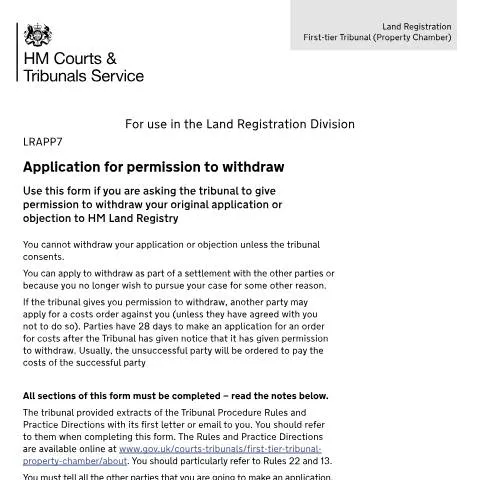
When tribunal proceedings involving land registration matters reach a crossroads, parties sometimes find themselves needing to step back from their original position. Whether due to an unexpected settlement opportunity, changed circumstances, or a reassessment of the case's merits, the LRAPP7 form serves as the formal gateway for requesting permission to withdraw from the First-tier Tribunal (Property Chamber)'s Land Registration Division.
The withdrawal process isn't simply a matter of walking away. The tribunal system requires explicit permission before any party can abandon their application or objection to HM Land Registry decisions. This controlled approach protects all parties' interests and ensures that partial withdrawals don't leave proceedings in an unclear state. The LRAPP7 form structures this critical juncture, demanding transparency about motivations, settlement terms, and the proposed impact on ongoing cases.
The Landscape of Land Registration Tribunal Cases
Land Registration Division cases typically emerge from disputes over HM Land Registry decisions, ranging from boundary determinations to adverse possession claims and easement registrations. These proceedings can involve multiple parties with competing interests, making withdrawal requests particularly sensitive to timing and procedural fairness.
The tribunal's jurisdiction encompasses both original applications challenging Land Registry decisions and objections raised against pending applications. Each category requires different considerations when withdrawal becomes necessary. Original applicants might discover that their challenge lacks the strength they initially believed, while objectors may find that settlement negotiations have resolved their concerns outside the formal process.
Settlement-Driven Withdrawals Versus Strategic Retreats
The form explicitly distinguishes between withdrawals forming part of settlements and those driven by other considerations. Settlement-based withdrawals typically involve negotiated agreements between parties, often including specific terms about costs, future conduct, or property arrangements. These cases generally proceed more smoothly through the tribunal's assessment process, particularly when all parties consent to the withdrawal terms.
Conversely, unilateral withdrawals where parties simply no longer wish to pursue their case require more detailed justification. The tribunal must understand whether the withdrawal stems from genuine changed circumstances, new legal advice, or strategic considerations that might affect other parties' positions.
Dissecting the LRAPP7 Structure and Critical Decision Points
The form's architecture reflects the tribunal's need to understand both the scope of the proposed withdrawal and its implications for the broader proceedings. Each section builds toward the tribunal's ultimate decision on whether to grant permission and what directions to issue to the Chief Land Registrar.
Reference Numbers and Party Identification
Section 1 requires the tribunal case reference number, following the format REF/20/ or REC/20/ depending on the case type. These references link directly to the tribunal's case management system and determine which procedural rules apply to the withdrawal request.
Section 2's party identification matrix accommodates the complex relationships often found in land registration disputes. The distinction between applicants, respondents, and their representatives becomes crucial for determining who has standing to request withdrawal and what consents may be required from other parties.
Partial Versus Complete Withdrawal Strategies
Section 4 presents one of the form's most strategic choices: whether to withdraw completely or partially. Complete withdrawals offer clean resolution but may expose the withdrawing party to full costs liability. Partial withdrawals allow parties to abandon weaker elements of their case while maintaining viable claims, but require precise articulation of which specific issues are being abandoned.
| Withdrawal Type | Tribunal Direction | Costs Implications | Strategic Considerations |
|---|---|---|---|
| Complete application withdrawal | Cancel application entirely | Full exposure to costs orders | Clean break, no ongoing obligations |
| Partial application withdrawal | Cancel specified elements only | Proportionate costs exposure | Maintains viable claims, complex boundaries |
| Complete objection withdrawal | Give effect to application | Potential costs liability | Allows opponent's application to proceed |
| Partial objection withdrawal | Give effect to uncontested elements | Limited costs exposure | Focuses dispute on core issues |
Justification Requirements and Tribunal Expectations
Section 5 demands detailed explanation of withdrawal motivations, and the tribunal's assessment often hinges on the quality and transparency of this justification. The tribunal expects parties to demonstrate that withdrawal requests aren't tactical manoeuvres designed to frustrate proceedings or avoid adverse decisions.
Settlement-Based Justifications
When withdrawals form part of settlements, parties should outline the key terms that render continued proceedings unnecessary. The tribunal particularly values evidence that settlements address the underlying property dispute, not merely the immediate procedural issues. Comprehensive settlement agreements that resolve boundary disputes, establish easement terms, or clarify title positions generally receive more favourable consideration than narrow procedural accommodations.
Changed Circumstances and New Information
Non-settlement withdrawals require demonstration of genuinely changed circumstances or newly discovered information that undermines the original case. Examples might include:
- Discovery of previously unknown title documents that clarify disputed boundaries
- Changes in property ownership that affect standing to pursue claims
- New legal precedents that significantly weaken the case's prospects
- Practical developments that render the dispute academic
The tribunal scrutinises these justifications carefully, particularly where withdrawal might prejudice other parties who have invested time and resources in preparing their response.
The Costs Dimension and Strategic Calculations
Sections 6 and 8 address the critical relationship between withdrawal permissions and costs orders. The tribunal's approach reflects the principle that unsuccessful parties should generally bear the costs of successful parties, but settlement contexts may justify different arrangements.
Standard Costs Exposure
Rule 13 of the Tribunal Procedure Rules establishes the framework for costs orders in Property Chamber proceedings. Parties withdrawing applications or objections typically face potential liability for other parties' costs, subject to the tribunal's discretion and any settlement terms limiting such exposure.
The 28-day window for costs applications begins when the tribunal gives notice of permission to withdraw. This creates a critical period where withdrawing parties remain exposed to costs claims unless protected by settlement agreements or specific tribunal directions.
Settlement-Protected Withdrawals
Section 8 allows parties to request specific costs orders where withdrawals form part of settlements. The most common request involves "no order as to costs" directions, which prevent any party from subsequently applying for costs orders related to the withdrawn proceedings.
These protective orders prove particularly valuable in complex multi-party disputes where settlement negotiations have involved compromises on costs liability. The tribunal generally respects genuine settlement agreements that include costs provisions, provided they don't create unfair prejudice to non-settling parties.
Procedural Compliance and Inter-Party Communication
Sections 10 and 11 establish the crucial procedural safeguards that prevent parties from blindsiding opponents with withdrawal applications. The requirement to provide copies to other parties before submission ensures that all affected parties can respond appropriately to withdrawal requests.
Consent Versus Opposition Dynamics
Where other parties consent to withdrawal, the tribunal's assessment focuses primarily on whether the proposed directions to the Chief Land Registrar appropriately dispose of the proceedings. Written confirmation of consent carries significant weight and often expedites the tribunal's decision-making process.
Opposed withdrawals require more detailed tribunal consideration. Other parties must be given opportunity to object in writing, addressing both the withdrawal request itself and any proposed costs arrangements. Common objections include:
- Concerns that withdrawal timing prejudices prepared defences or counterclaims
- Disputes over proposed costs arrangements or directions to the Land Registry
- Arguments that partial withdrawals leave proceedings in an unworkable state
- Claims that withdrawal requests represent tactical abuse of process
Practical Implications of Chief Land Registrar Directions
Section 6's focus on directions to the Chief Land Registrar highlights the practical consequences that flow from successful withdrawal applications. These directions don't merely end tribunal proceedings; they actively shape the state of the land register and affected parties' property rights.
Application Cancellations and Their Effects
When the tribunal directs cancellation of applications to HM Land Registry, the practical effect often restores the pre-application status quo. However, parties should understand that cancellation doesn't automatically reverse any interim measures or notices that may have been registered during the application's pendency.
For boundary determination applications, cancellation typically means that disputed boundaries remain unresolved by official determination, potentially leaving parties to resolve disputes through alternative means. For adverse possession applications, cancellation preserves existing registered ownership but doesn't prevent fresh applications based on additional periods of adverse possession.
Giving Effect to Applications Despite Objections
Where objection withdrawals lead to directions giving effect to applications, the Chief Land Registrar typically proceeds as if no objection had been raised. This can result in significant changes to registered titles, easement registrations, or boundary determinations that objectors originally sought to prevent.
Parties contemplating objection withdrawals should carefully consider whether they can accept these practical consequences, particularly where settlements involve compromises that differ from the original application terms.
Timing Strategies and Procedural Considerations
The tribunal's case management approach means that withdrawal applications can significantly impact hearing schedules, evidence preparation deadlines, and other procedural matters. Parties should consider these broader implications when determining whether and when to seek withdrawal permission.
Early Withdrawal Versus Late-Stage Retreats
Early withdrawal applications, submitted soon after proceedings commence, generally face less resistance from tribunals and other parties. Costs exposure remains limited, and other parties haven't typically invested substantial resources in case preparation.
Late-stage withdrawals, particularly those submitted close to hearing dates, face heightened scrutiny. The tribunal must balance the withdrawing party's legitimate reasons against potential prejudice to other parties who may have prepared extensive evidence, engaged expert witnesses, or cleared hearing dates from busy schedules.
Settlement Negotiation Timing
The form's emphasis on settlement-based withdrawals reflects the tribunal's preference for negotiated resolutions over contested hearings. However, parties should be aware that settlement negotiations don't automatically justify delays in procedural compliance or excuse failures to meet case management directions.
Effective settlement discussions often occur in parallel with continued case preparation, allowing parties to maintain procedural compliance while exploring resolution opportunities. This approach preserves options if settlement negotiations fail while demonstrating good faith engagement with the tribunal process.
Common Scenarios Requiring Withdrawal Permission
Understanding when you might need to use Form LRAPP7 helps clarify whether your situation genuinely requires tribunal permission or falls under automatic withdrawal provisions. Several distinct scenarios typically arise in practice, each with specific procedural considerations.
Change in personal circumstances represents one of the most frequent grounds for withdrawal applications. This might include unexpected illness preventing you from pursuing your case effectively, bereavement affecting your ability to concentrate on proceedings, or significant changes in employment status that alter your capacity to fund representation. When citing personal circumstances, you'll need to provide sufficient detail to demonstrate how these changes materially affect your ability to continue with your original application or objection.
Financial hardship often emerges as proceedings progress, particularly where legal costs escalate beyond initial expectations. If you're facing mounting expenses that weren't anticipated when you first submitted your application, this can constitute valid grounds for seeking withdrawal permission. However, you'll need to distinguish between general financial concerns and specific hardship directly related to continuing your case.
Settlement negotiations frequently prompt withdrawal applications, though timing becomes crucial here. If you've reached an agreement with the opposing party outside the tribunal process, you may need permission to withdraw to formalise this settlement. The tribunal will typically want assurance that any settlement is genuine and that withdrawal isn't being used to circumvent proper procedures.
Discovery of new evidence that fundamentally undermines your position can also justify withdrawal. This might include documentation that wasn't available when you initially submitted your case, or expert opinions that significantly alter your understanding of the legal position. When citing new evidence, you'll need to explain why this information wasn't available earlier and how it affects your prospects of success.
Legal advice changes sometimes prompt withdrawal applications, particularly where initial legal guidance proves incorrect or where a different legal representative provides substantially different counsel. However, simply changing lawyers or receiving advice that your case is weaker than initially thought won't automatically justify withdrawal – you'll need to demonstrate material changes in legal understanding.
Procedural complications can also warrant withdrawal applications. If you've discovered that your original application contains fundamental errors that can't be corrected through amendment, or if you've missed crucial deadlines that compromise your case, withdrawal might represent the most practical option. The tribunal will consider whether these procedural issues genuinely prevent fair determination of your case.
Strategic Considerations and Alternative Options
Before submitting Form LRAPP7, careful consideration of strategic alternatives often reveals options that might better serve your interests while avoiding the potential complications of withdrawal applications.
Fill in your form directly online
No printing: type your details into the boxes of the official form, tick, then download the PDF ready to send.
- 1Type into the form boxes
- 2Tick in one click
- 3Save and download the PDF
Amendment possibilities should be thoroughly explored before considering withdrawal. Many issues that initially appear to require withdrawal can actually be addressed through formal amendment procedures. If your original application contains errors or omissions, check whether these can be corrected through standard amendment processes, which typically face less scrutiny than withdrawal applications.
Adjournment requests represent another alternative worth considering, particularly where temporary circumstances are affecting your ability to proceed. If illness, bereavement, or other personal circumstances are preventing you from engaging effectively with proceedings, seeking an adjournment might provide the breathing space needed without the finality of withdrawal. Adjournments can often be granted more readily than withdrawal permission, especially where circumstances are clearly temporary.
Conditional withdrawal strategies sometimes offer more flexibility than outright withdrawal. In some cases, you might seek permission to withdraw contingent on specific conditions being met, such as successful completion of settlement negotiations or resolution of related proceedings. This approach can provide protection against adverse cost consequences while maintaining some control over the process.
Settlement discussions merit particular strategic consideration. Even where settlement appears likely, precipitous withdrawal can sometimes weaken your negotiating position. The opposing party might interpret withdrawal applications as desperation, potentially leading to less favourable settlement terms. Careful timing of withdrawal applications in relation to settlement negotiations requires delicate judgment.
Cost implications demand thorough analysis before proceeding with withdrawal applications. While withdrawal might seem like a way to limit ongoing legal costs, unsuccessful withdrawal applications can actually increase expenses through additional tribunal fees and potential adverse cost orders. Calculate the total cost implications of different strategies, including the possibility that withdrawal permission might be refused.
Alternative dispute resolution mechanisms sometimes provide pathways that avoid both continued tribunal proceedings and formal withdrawal applications. Mediation, arbitration, or direct negotiation might resolve underlying disputes more efficiently than either continuing with tribunal proceedings or seeking withdrawal permission.
Timing considerations significantly affect both the likelihood of withdrawal permission being granted and the strategic value of different approaches. Early withdrawal applications, submitted shortly after initial proceedings commence, often face less scrutiny than applications made well into the process. However, early withdrawal might also suggest inadequate preparation of your original case.
Future implications of withdrawal decisions require careful thought. Withdrawn applications might affect your ability to bring similar claims in future, particularly where withdrawal is granted on grounds that could apply to related matters. Consider whether withdrawal definitively resolves your concerns or merely postpones them to a later date.
Post-Submission Procedures and Tribunal Response Management
Once you've submitted Form LRAPP7, understanding the tribunal's internal procedures and response mechanisms helps you navigate the subsequent process more effectively and respond appropriately to different outcomes.
Initial processing procedures typically involve administrative screening to ensure your application meets basic requirements before substantive consideration begins. The tribunal registry will check that you've completed all mandatory sections, provided required supporting documentation, and paid any applicable fees. Deficiencies at this stage usually result in requests for additional information rather than outright refusal, though significant omissions might delay processing considerably.
Case allocation procedures determine which tribunal member or panel will consider your withdrawal application. Simple cases with clear grounds and no opposition might be determined by a single tribunal member through paper-based review. More complex cases, particularly those involving disputed facts or significant cost implications, might require full panel consideration or oral hearings.
Opposition procedures allow other parties to respond to your withdrawal application, and understanding these timelines helps you anticipate potential delays or complications. Opposing parties typically receive copies of your withdrawal application and supporting documents, with specified periods for submitting counter-arguments. Strong opposition can significantly affect both the timeline and likelihood of permission being granted.
Interim directions might be issued while your withdrawal application is pending, particularly in cases where ongoing tribunal proceedings need coordination with withdrawal considerations. These directions might include stays of substantive proceedings, deadlines for additional submissions, or requirements for case management conferences to explore settlement possibilities.
Decision notification procedures vary depending on the complexity of your case and the tribunal's current workload. Simple withdrawal applications might receive written decisions within weeks, while contested cases could take several months. Understanding typical timelines helps you plan accordingly and identify when follow-up enquiries might be appropriate.
Conditional permissions require particular attention to implementation procedures. Where withdrawal permission is granted subject to specific conditions, you'll typically face strict deadlines for fulfilling these requirements. Failure to meet conditional requirements within specified timeframes might result in permission being revoked, potentially leaving you in a worse position than before applying.
Appeals procedures apply where withdrawal permission is refused, though the grounds for challenging such decisions are typically limited. You might be able to appeal refusal decisions where the tribunal has made errors of law or failed to consider relevant factors, but disagreement with the tribunal's judgment on factual matters rarely provides grounds for successful appeals.
Cost consequences follow different procedures depending on whether permission is granted or refused. Successful withdrawal applications might still result in cost orders covering the opposing party's expenses incurred before withdrawal, while refused applications often lead to directions for continued proceedings with potential cost implications for the unsuccessful withdrawal attempt.
Case management implications extend beyond the immediate withdrawal decision, particularly where permission is granted conditionally or where withdrawal applications are refused. Understanding how withdrawal decisions affect ongoing case management helps you prepare for subsequent procedural requirements and avoid further complications.
Record-keeping requirements continue after withdrawal decisions, particularly where conditions attach to granted permissions or where appeals might be considered. Maintaining comprehensive records of all communications, decisions, and compliance with any conditional requirements protects your position and facilitates any necessary future proceedings.