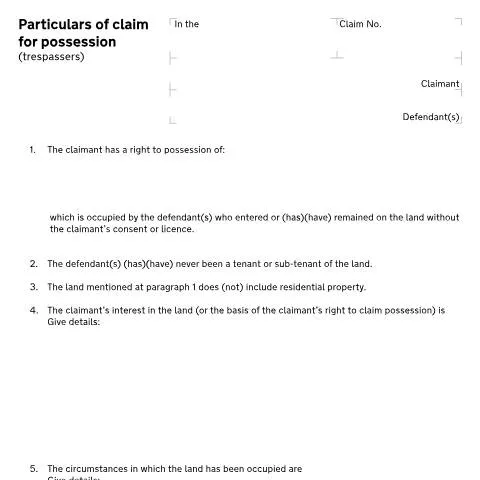
When Unwanted Occupiers Refuse to Leave: The Legal Framework of Form N121
Property disputes involving trespassers present some of the most pressing challenges for landowners across England and Wales. Unlike tenant evictions, which follow established landlord-tenant procedures, removing unauthorised occupiers requires a distinct legal pathway through the courts. Form N121 serves as the cornerstone document for initiating possession proceedings against individuals who have entered or remained on property without permission, creating a formal legal record that distinguishes genuine trespass cases from more complex occupancy disputes.
The form's significance lies not merely in its function as a court document, but in its role as a legal demarcation tool that clearly establishes the nature of the occupation. When completed correctly, it provides HM Courts & Tribunals Service with the essential framework needed to assess whether fast-track possession procedures apply, potentially saving months in legal proceedings compared to standard possession claims.
Understanding the nuances of Form N121 becomes crucial when considering that trespass proceedings operate under fundamentally different rules from those governing tenanted properties. The burden of proof, the speed of resolution, and the available remedies all differ significantly, making proper form completion essential for successful outcomes.
Establishing the Legal Foundation: Who Can Initiate Trespass Proceedings
The claimant's legal standing forms the bedrock of any trespass action, and Form N121 requires detailed specification of this foundation in section 4. Freehold ownership provides the most straightforward basis, but the form accommodates various other legitimate interests that confer the right to seek possession.
Leaseholders with sufficient remaining terms can pursue trespass proceedings, provided their lease grants exclusive possession rights over the affected area. Commercial leaseholders frequently encounter situations where unauthorised occupiers establish themselves in loading areas, car parks, or unused portions of leased premises, necessitating swift legal action to prevent adverse possession claims from developing.
Mortgagees in possession represent another significant category of potential claimants. When mortgage lenders exercise their right to take possession following borrower default, they inherit the authority to remove trespassers from the secured property. This scenario often arises during lengthy foreclosure proceedings where abandoned properties attract unauthorised occupiers.
| Claimant Type | Basis of Right | Common Scenarios |
|---|---|---|
| Freehold Owner | Absolute title | Squatters in vacant buildings, unauthorised campers on private land |
| Leaseholder | Exclusive possession under lease | Trespassers in commercial premises, unauthorised subletters |
| Mortgagee | Security interest exercised | Occupiers remaining after borrower eviction |
| Licensed Occupier | Contractual right to exclude others | Property managers, agents with possession rights |
Local authorities and housing associations frequently utilise Form N121 when dealing with unauthorised occupiers in properties earmarked for demolition or renovation. Their right to claim possession typically derives from compulsory purchase orders or statutory housing powers, though the specific legal basis must be clearly articulated within the form's framework.
Corporate and Trust Ownership Complexities
Corporate claimants must demonstrate their legal capacity to hold property and initiate proceedings. Companies House registration details and board resolutions authorising legal action often form part of the supporting documentation, though these don't appear on Form N121 itself. Trust-owned properties present additional complexity, as trustees must establish both their appointment validity and their authority to act on behalf of beneficiaries.
Partnerships require careful consideration of whether all partners consent to the proceedings or whether partnership agreements grant individual partners sufficient authority. Limited liability partnerships typically face fewer complications, as their corporate structure provides clearer lines of authority for property-related decisions.
The Critical Distinction: Trespassers Versus Former Tenants
Section 2 of Form N121 addresses one of the most fundamental aspects of trespass law: confirming that defendants have never held tenancy rights over the property. This seemingly simple checkbox carries profound legal implications, as mischaracterising the relationship between claimant and defendant can derail entire proceedings.
Former tenants whose tenancies have been properly terminated through notice procedures or court orders cannot be pursued as trespassers if they remain in occupation. Such cases require separate possession proceedings under Housing Act provisions or common law landlord and tenant procedures, depending on the tenancy type and termination circumstances.
However, individuals who initially entered as tenants but whose occupation subsequently became unauthorised may fall within Form N121's scope under specific circumstances. Tenants who remain after lease expiry without landlord consent transform from lawful occupiers to trespassers, provided no statutory protection extends their occupation rights.
Licensees and Permitted Occupiers
The distinction between licences and tenancies continues to generate litigation, particularly in shared accommodation and temporary housing situations. Licensees whose permission has been withdrawn generally fall within trespass procedures, but establishing that a genuine licence existed rather than a tenancy requires careful legal analysis.
Family members who remain in property following the owner's death present particularly complex scenarios. Adult children living in parental homes may have no formal tenancy rights, making them potential trespassers if estate executors withdraw permission. However, claims for beneficial interests under trust law or proprietary estoppel can complicate seemingly straightforward trespass actions.
Contractors and workers who remain on site beyond their authorised periods typically qualify as trespassers, though employment law considerations may influence the practical approach to removal. Construction workers who establish temporary accommodation on building sites without express permission often find themselves subject to Form N121 proceedings when projects conclude.
Residential Property Implications and Procedural Variations
Section 3's identification of whether the trespassed property includes residential accommodation triggers distinct procedural requirements under Civil Procedure Rules. Residential trespass cases often proceed more slowly than commercial ones, reflecting the courts' recognition of the human consequences involved in removing people from their homes, even when that occupation lacks legal foundation.
When residential property is involved, courts frequently require additional evidence demonstrating that alternative accommodation arrangements have been considered or that the trespass creates genuine hardship for the claimant. Vulnerable occupiers, including families with young children or individuals with disability support needs, may benefit from extended notice periods even in clear-cut trespass situations.
Commercial property trespass typically proceeds more expeditiously, particularly where business operations suffer disruption from unauthorised occupation. Retail premises occupied by squatters during peak trading periods can generate substantial loss claims, supporting applications for expedited hearings and interim possession orders.
Mixed-Use Property Challenges
Properties combining residential and commercial elements require careful analysis of which areas are actually occupied without permission. Shop premises with residential flats above may involve trespass in commercial areas while maintaining lawful occupation of residential portions, necessitating precise geographical descriptions in Form N121 submissions.
Agricultural land with residential cottages presents similar complexity, particularly where historical arrangements blur the boundaries between different occupation rights. Farm workers' cottages occupied beyond employment termination may involve both trespass and employment law considerations, affecting the choice of legal procedure.
Documenting the Occupation: Evidence Requirements in Section 5
The circumstances of occupation detailed in section 5 provide courts with essential context for assessing both the strength of the trespass claim and appropriate remedies. Peaceful occupation by vulnerable individuals receives different judicial consideration from aggressive occupation involving property damage or threatening behaviour toward neighbouring residents.
Photographic evidence documenting the occupation's extent and impact often supplements Form N121, though the form itself requires only narrative description. Damage assessments, security reports, and witness statements from neighbours or property managers typically form part of the broader evidence bundle rather than being incorporated into the form's limited space.
Timeline documentation proves particularly crucial when adverse possession claims might arise. Continuous occupation exceeding ten years on registered land, or twelve years on unregistered land, can potentially create ownership rights for trespassers, making swift legal action essential for property owners.
Seasonal and Intermittent Occupation
Traveller communities and other groups practising seasonal occupation patterns require careful documentation to establish whether current occupation constitutes fresh trespass or continuation of previous unauthorised presence. Annual returns to the same site may indicate established patterns requiring different legal approaches from first-time trespass incidents.
Holiday properties and seasonal businesses often experience intermittent trespass during off-peak periods when regular monitoring decreases. Documentation must clearly establish occupation dates relative to the claimant's intended use periods, as courts may consider whether the trespass actually interferes with legitimate property enjoyment.
Unknown Defendants and Service Challenges
Section 6's acknowledgment that claimant's don't know all defendants' names reflects the practical reality of trespass proceedings, where occupiers often remain anonymous or provide false identities. Alternative service methods become essential when traditional personal service proves impossible, requiring court applications for substituted service orders.
Posting notices on the property itself represents the most common alternative service method, though courts require evidence that reasonable attempts at identifying defendants have been made. Local authority housing departments and police community liaison officers sometimes assist in establishing occupier identities, particularly in cases involving vulnerable individuals requiring support services.
Fill in your form directly online
No printing: type your details into the boxes of the official form, tick, then download the PDF ready to send.
- 1Type into the form boxes
- 2Tick in one click
- 3Save and download the PDF
The legal fiction of "persons unknown" allows proceedings to continue against unidentified occupiers, but requires precise property descriptions to ensure that court orders can be effectively enforced. Interim possession orders against persons unknown typically include provisions for removing anyone found on the premises, regardless of whether they were specifically named in original proceedings.
Corporate and Multiple Occupier Situations
Commercial trespass sometimes involves organised groups using premises for unauthorised business activities, creating complex defendant identification challenges. Pop-up retail operations in vacant shops may involve multiple individuals with varying levels of responsibility for the trespass, requiring careful consideration of which parties to pursue.
Protest occupations often involve shifting groups of participants, making defendant identification particularly challenging. Courts recognise that political demonstrations may involve individuals entering and leaving occupied premises throughout the occupation period, requiring flexible approaches to defendant specification and service requirements.
Statement of Truth Requirements and Legal Consequences
The Statement of Truth section carries significant legal weight, as contempt of court proceedings may follow false statements made without honest belief in their accuracy. This requirement extends beyond mere factual accuracy to encompass the signatory's genuine belief in the truth of all assertions within Form N121.
Legal representatives signing on behalf of clients must ensure they have sufficient instructions to verify all factual claims. Solicitors and barristers cannot simply rely on client assertions without making reasonable inquiries about the accuracy of key facts, particularly regarding the defendant's occupation history and the claimant's property rights.
Corporate claimants must ensure that individuals signing statements of truth have appropriate authority and knowledge. Property managers signing on behalf of landlord companies should possess direct knowledge of the occupation circumstances rather than relying solely on second-hand reports from maintenance staff or security personnel.
Professional Liability Considerations
Legal representatives face potential professional conduct implications if statements of truth later prove inaccurate due to inadequate client instruction-taking or insufficient fact verification. Solicitors Regulation Authority guidance emphasises the importance of maintaining detailed file records demonstrating reasonable steps taken to verify client information before court submission.
Insurance implications also arise from statement of truth signatures, as professional indemnity policies may exclude coverage for claims arising from knowingly false court statements. Legal expense insurance covering litigation costs may similarly exclude coverage where proceedings are based on materially inaccurate pleadings.
Strategic Timing and Enforcement Pathways
The speed advantage offered by trespass proceedings makes timing considerations crucial for maximising legal effectiveness. Immediate action following discovery of unauthorised occupation prevents trespassers from establishing routines or making improvements that could complicate later removal efforts.
Interim possession orders, available in suitable trespass cases, can provide relief within days rather than weeks, though strict procedural requirements must be met. Emergency applications during court vacation periods may be possible where trespass involves immediate threats to property security or public safety.
Enforcement following successful possession orders typically involves court bailiff services, though private enforcement companies may assist with post-order property securing. Coordination between legal representatives and enforcement agents ensures that possession orders translate into actual property recovery rather than merely theoretical court victories.
The interplay between civil possession proceedings and potential criminal trespass charges requires careful coordination with police services. While civil courts focus on property recovery, criminal proceedings may run parallel where trespass involves aggravating factors such as property damage or threats toward lawful occupiers.