Understanding the Part 8 Claim Procedure: When Standard Civil Action Isn't the Right Path
When legal disputes arise that don't fit the conventional mould of claiming damages or seeking standard remedies, the civil courts provide an alternative route through CPR Part 8 proceedings. Form N208 serves as the gateway to this specialised procedure, designed for cases where the primary need is judicial determination rather than factual dispute resolution. Unlike ordinary claims that follow the Part 7 route with detailed pleadings and potentially lengthy disclosure processes, Part 8 claims offer a streamlined path for specific types of legal questions.
The Part 8 procedure proves particularly valuable when dealing with construction of documents, seeking declarations about legal rights, or pursuing remedies that don't involve substantial factual disputes. Typical scenarios include challenging the validity of wills, seeking court approval for certain trustee actions, or obtaining declarations about the proper interpretation of contracts or statutory provisions. The procedure's efficiency stems from its focus on legal argument rather than extensive fact-finding missions.
What distinguishes Part 8 claims is their emphasis on written evidence and legal submissions rather than witness testimony and cross-examination. This makes them particularly suitable for cases where the facts are largely agreed or can be established through documentary evidence, but where expert legal interpretation is required to resolve the dispute.
Navigating the Essential Components of Form N208
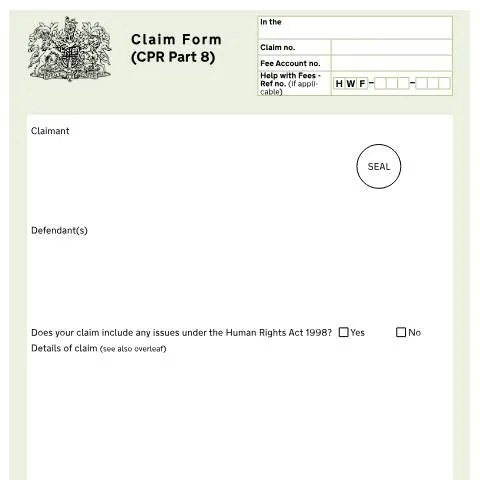
The claim form itself appears deceptively straightforward, but each section requires careful consideration to ensure your application meets the court's requirements and sets the proper foundation for your case.
Court Selection and Administrative Details
The opening section requires specification of which court will handle your claim. For Part 8 proceedings, this decision carries particular significance as different courts have varying experience with the types of matters typically brought under this procedure. The Chancery Division frequently handles trust and estate matters, while the Queen's Bench Division might be more appropriate for contractual interpretation issues.
The claim number field remains blank initially—the court will assign this upon issue. However, you must include any relevant fee account number if your legal representatives maintain such arrangements with HM Courts & Tribunals Service. The Help with Fees reference becomes crucial for those seeking fee remission based on financial circumstances, requiring completion of form EX160 beforehand.
Defining Parties with Precision
Identifying claimants and defendants accurately proves critical in Part 8 proceedings, particularly given their often complex nature involving trusts, estates, or corporate entities. For individual parties, full names and addresses must be provided, ensuring any aliases or trading names are properly identified to avoid later complications with service or enforcement.
When dealing with deceased estates, proper identification of personal representatives becomes essential. Similarly, trust matters require clear identification of trustees in their official capacity, not merely as individuals. Corporate defendants need their full registered names and addresses, which can be verified through Companies House records.
| Party Type | Required Information | Common Pitfalls |
|---|---|---|
| Individual | Full name, address, date of birth if known | Using nicknames or incomplete names |
| Company | Registered name, registered office address | Using trading names instead of legal entity |
| Trust | Trust name, trustees' names and capacity | Failing to identify all current trustees |
| Estate | Deceased's name, personal representatives | Not updating for changes in representation |
Human Rights Act Considerations
The form specifically enquires whether your claim raises any Human Rights Act 1998 issues. This seemingly simple yes/no question carries significant procedural implications. Positive responses trigger additional case management requirements and may influence court allocation, particularly for matters involving Article 6 (fair trial rights), Article 8 (privacy rights), or Article 1 of Protocol 1 (property rights).
Even indirect human rights implications should be carefully considered. For instance, trust disputes involving family homes might engage Article 8 rights, while cases affecting business interests could implicate property rights. When in doubt, seeking specialist advice proves prudent, as human rights arguments can substantially affect both the procedural route and potential remedies available.
Crafting Effective Claim Details: The Heart of Your Application
The "Details of claim" section represents the most critical component of Form N208, requiring clear articulation of what you're seeking and why the court should grant it. Unlike Part 7 claims that can rely on subsequent statements of case to develop arguments, Part 8 proceedings place primary emphasis on the initial claim form.
Structuring Your Claim for Maximum Impact
Begin with a concise statement of the relief sought—whether declaratory, mandatory, or prohibitory. The court needs immediate clarity about what you're asking them to decide or order. For example, rather than stating "the claimant seeks relief in relation to the defendant's conduct," specify "the claimant seeks a declaration that the defendant's actions on [date] constituted a breach of the trust deed dated [date]."
Follow this with the essential factual background, focusing on undisputed or easily provable facts rather than contentious allegations requiring extensive evidence. Part 8 proceedings work best when the factual matrix is clear and the dispute centres on legal interpretation or the proper exercise of discretion.
The legal basis for your claim should be clearly identified, referencing relevant statutory provisions, case law, or contractual terms. This helps the court understand immediately what legal principles apply and enables efficient case management directions.
Common Categories of Part 8 Claims
Different types of Part 8 claims require different approaches in the details section:
- Trust matters: Identify the trust deed, relevant provisions, the trustees' proposed action, and the legal question requiring resolution
- Probate disputes: Specify the will or intestacy, the disputed provision or interpretation, and the practical consequence of different interpretations
- Contractual interpretation: Quote the relevant contractual language, identify the competing interpretations, and explain why judicial determination is necessary
- Statutory interpretation: Reference the specific statutory provision, explain how it applies to your circumstances, and identify the interpretative question
Evidence Requirements and Supporting Documentation Strategy
Part 8 proceedings rely heavily on written evidence rather than oral testimony, making the preparation and presentation of supporting documents crucial to success. The evidence strategy should be developed from the outset, as it influences both the drafting of the claim form and subsequent case management.
Primary Documentary Evidence
The foundation of most Part 8 claims rests on key documents whose interpretation or application requires judicial determination. These might include trust deeds, wills, contracts, statutory instruments, or corporate documentation. Each document should be carefully reviewed to ensure you have the most recent and complete version, as courts frequently encounter problems with superseded or incomplete documentation.
For trust matters, ensure you have the original trust deed plus any subsequent deeds of variation or appointment. Corporate disputes require up-to-date articles of association and any relevant board resolutions. Probate cases need the original will and any codicils, plus evidence of due execution if this might be challenged.
Expert Evidence Considerations
While Part 8 proceedings generally avoid extensive factual disputes, expert evidence may prove necessary in certain circumstances. This commonly arises in cases involving technical interpretation of professional standards, valuation questions where the methodology rather than specific figures is disputed, or foreign law questions.
The court's permission is required for expert evidence in Part 8 proceedings, making early identification of expert issues crucial. The application for permission should clearly explain why expert evidence is necessary and how it will assist the court's determination of the legal issues.
Service Requirements and Defendant Response Procedures
Service of Part 8 claim forms follows the standard Civil Procedure Rules, but the nature of these proceedings often creates particular challenges in identifying and serving all necessary parties. The court cannot make binding determinations affecting parties who haven't been properly served, making comprehensive service planning essential.
Identifying All Necessary Parties
Part 8 claims frequently involve situations where the full range of interested parties isn't immediately obvious. Trust disputes might require service on all beneficiaries, including those with contingent interests. Estate matters could involve unknown creditors or beneficiaries. Corporate disputes might affect shareholders or creditors not immediately apparent from the primary dispute.
The court has power to order service on additional parties discovered during proceedings, but early identification proves more efficient and avoids later complications. Consider whether any parties might have contingent interests affected by the court's determination, even if they're not directly involved in the immediate dispute.
Defendant Response Options
Defendants in Part 8 proceedings have different response options compared to ordinary claims. Rather than filing a defence, they may:
- File an acknowledgment of service indicating they wish to contest the claim
- Submit evidence in response to the claim
- Apply for the proceedings to be transferred to the Part 7 procedure if substantial factual disputes emerge
- Take no action if they don't oppose the relief sought
The acknowledgment of service proves particularly important as it determines whether defendants receive notice of future hearings and have the right to participate in proceedings. Defendants who fail to acknowledge service risk having the matter determined in their absence.
Court Fees, Cost Implications, and Financial Planning
Part 8 proceedings involve specific fee structures that differ from ordinary claims, reflecting their distinct nature and typically shorter procedural path. Understanding these costs from the outset enables proper financial planning and ensures compliance with court requirements.
Initial Court Fees
The court fee for issuing a Part 8 claim form depends on the nature of the relief sought rather than any monetary value claimed. Most Part 8 claims attract the standard application fee, currently set according to HM Courts & Tribunals Service's published fee schedule. This differs from Part 7 claims where fees are calculated based on the monetary value of the claim.
For claims seeking declarations or other non-monetary relief, the fee structure provides certainty from the outset. However, some Part 8 claims that include monetary elements may attract higher fees, particularly those involving substantial trust funds or estate assets.
Fill in your form directly online
No printing: type your details into the boxes of the official form, tick, then download the PDF ready to send.
- 1Type into the form boxes
- 2Tick in one click
- 3Save and download the PDF
Ongoing Cost Considerations
Part 8 proceedings typically involve fewer procedural steps than ordinary claims, potentially reducing overall costs. However, the concentration on legal argument and documentary evidence can create substantial legal costs for specialist advice and representation.
The court has broad discretion over costs orders in Part 8 proceedings, often taking account of factors such as:
- Whether the proceedings were necessary to resolve genuine uncertainty
- The conduct of parties in attempting to resolve matters before litigation
- The complexity of legal issues involved
- Whether parties acted reasonably in their positions
Case Management and Procedural Directions Following Issue
Once Form N208 has been issued, Part 8 proceedings follow a streamlined case management track designed to bring matters to determination efficiently. The court takes an active role in managing the procedural timetable, typically giving specific directions for the filing of evidence and legal submissions.
Standard Directions and Timetabling
The court will usually make case management directions shortly after issue, establishing deadlines for the filing of evidence by both claimants and defendants. These directions typically require the claimant to file and serve their evidence within a specified period, followed by defendant's evidence, and potentially reply evidence if necessary.
The timetable for Part 8 proceedings is generally shorter than ordinary claims, reflecting the reduced scope for factual dispute. However, complex legal issues may require extended periods for preparation of detailed legal submissions and authorities.
The Final Hearing Process
Part 8 claims typically culminate in a final hearing focused on legal argument rather than witness testimony. The hearing may be conducted with or without oral argument, depending on the complexity of issues and the court's assessment of what's necessary for proper determination.
Preparation for the final hearing involves detailed legal submissions supported by authorities, often with agreed bundles of relevant documents. The court expects comprehensive written arguments that enable efficient oral advocacy focused on the key legal issues in dispute.
Strategic Considerations: Maximising Your Chances of Success
Success in Part 8 proceedings depends heavily on proper case preparation and strategic thinking from the outset. The compressed procedural timetable and focus on legal argument leave little room for correcting fundamental errors in approach or case presentation.
Timing and Tactical Decisions
The decision to pursue Part 8 proceedings should be carefully considered against alternatives such as negotiation, mediation, or ordinary Part 7 claims. Part 8 works best when there's genuine legal uncertainty requiring judicial determination, rather than straightforward factual disputes or cases where commercial settlement might be preferable.
Consider whether interim relief might be necessary to preserve the status quo pending final determination. Part 8 proceedings can accommodate interim applications, but these should be identified early to avoid procedural complications.
The choice of court and judge can significantly impact both the procedural approach and substantive outcome. Specialist courts like the Chancery Division bring particular expertise to trust and estate matters, while the Commercial Court might be more appropriate for complex contractual interpretation issues.
Building Compelling Legal Arguments
Effective Part 8 claims require clear articulation of the legal issues requiring determination, supported by comprehensive research into relevant authorities and principles. The court needs to understand not only what you're asking for, but why the law supports your position and why judicial determination is necessary.
Anticipate likely counterarguments and address them proactively in your case presentation. This demonstrates thorough preparation and helps the court understand the full scope of legal issues involved. Consider whether there are any policy implications of different interpretations that might influence the court's approach to the legal questions raised.