When Legal Documents Must Reach Their Target: Navigating Court Service Requirements
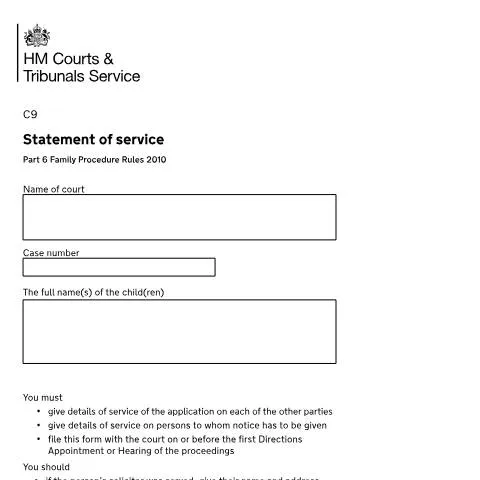
In family proceedings before HM Courts & Tribunals Service, ensuring that all parties receive proper notice of legal applications represents one of the most critical procedural safeguards protecting everyone's right to participate. The C9 Statement of Service form serves as your formal declaration to the court that you've successfully delivered the required documents to all relevant parties, transforming what might seem like a simple administrative task into a legally binding statement that can make or break your case proceedings.
This three-page document operates under Part 6 of the Family Procedure Rules 2010, requiring completion before your first Directions Appointment or Hearing. Unlike many court forms that focus on the substance of your case, Form C9 concentrates entirely on the procedural mechanics of how, when, and where you've served documents on other parties—details that courts scrutinise with particular care given their impact on procedural fairness.
The Critical Timeline: Meeting Court-Imposed Service Deadlines
The Family Procedure Rules establish strict timeframes for serving applications and supporting documents, with Form C9 acting as your proof of compliance. You must file this statement with the court on or before the first Directions Appointment or Hearing, creating a narrow window between completing service and attending your initial court appearance.
Consider a typical scenario: you file a child arrangements application on Monday, receive your allocated court date for the following Friday, and must serve all parties by Wednesday to allow reasonable notice time. Your C9 form then becomes due by Friday morning, documenting each service attempt with precise timing details that demonstrate compliance with procedural requirements.
| Service Method | Information Required on C9 | Evidence Standards |
|---|---|---|
| Personal service | Exact time, date, location of handover | Detailed description of recipient and circumstances |
| Postal service | Date, time, place of posting | Postal receipt recommended but not mandatory |
| Service on solicitor | Solicitor's name and business address | Confirmation of authority to accept service |
| Service on children's guardian | Guardian's name and contact address | Evidence of guardianship appointment |
Understanding "Prescribed Forms" Requirements
The C9's reference to "prescribed forms served" relates to the specific court documents that accompany your main application. Family proceedings typically involve multiple forms—from the primary application itself to supporting statements, financial schedules, or safeguarding questionnaires. Each document served must be individually listed on your C9, creating a comprehensive record of what information each party has received.
Dissecting the Service Record: Page-by-Page Completion Strategy
Form C9's second page presents a three-column grid that transforms complex service requirements into manageable documentation. The "Name and address of person served" column demands complete accuracy—partial addresses or informal name variations can invalidate your service attempts, potentially requiring you to start the entire process again.
The middle column, "How, when and where served," requires extraordinary precision. Courts expect detailed narratives: "Handed personally to Sarah Johnson outside 23 Maple Road, Birmingham B15 2QT at 2:15 PM on 15th March 2024" rather than vague statements like "delivered Tuesday afternoon." This specificity protects against later challenges to service validity, particularly if recipients claim they never received documents.
Special Considerations for Professional Representatives
When serving solicitors or legal representatives, Form C9 requires their professional details alongside standard service information. This reflects the legal principle that solicitors can accept service on behalf of their clients, but only when properly authorised. You must verify this authority before attempting service, as unauthorised service on legal representatives doesn't constitute valid service on the actual party.
Children's guardians occupy a similar position, accepting service on behalf of children in proceedings. However, guardians are typically appointed by the court during proceedings, meaning their involvement often develops after initial applications are filed. Your C9 may therefore show guardian service for some documents but not others, reflecting the evolving nature of family proceedings.
The Statement of Truth: Legal Implications Beyond Form-Filling
Form C9's final page contains a statement of truth that elevates this administrative document into a legally binding declaration. By signing, you're not merely confirming that you've filled in boxes correctly—you're making a formal statement to the court that could result in contempt proceedings if found to be false.
The form provides two signature options reflecting different circumstances. Direct applicants sign personally, taking full responsibility for the accuracy of service details. Legal representatives can sign on behalf of clients, but must confirm their authority to do so and provide their professional credentials, including firm name and their position within that organisation.
Professional Liability Considerations
For legal representatives, signing Form C9 engages professional indemnity alongside personal liability. Solicitors must maintain detailed file notes supporting every statement made on the form, as regulatory bodies may scrutinise service procedures during complaint investigations or compliance audits. This dual accountability explains why many solicitors prefer clients to handle service personally where appropriate, reducing professional risk exposure.
Alternative Service Methods and Their C9 Documentation Requirements
Standard service methods—personal delivery and postal service—represent only part of the available options when circumstances demand alternative approaches. Courts can authorise service by email, through social media platforms, or via newspaper advertisements when traditional methods prove ineffective, but each alternative carries specific documentation requirements for your C9 form.
Electronic service requires detailed technical information: email addresses, delivery confirmation receipts, and evidence that recipients regularly monitor their electronic communications. Social media service demands screenshots proving message delivery and recipient identity verification. These alternative methods generate substantially more complex C9 entries, often requiring continuation sheets to accommodate the additional detail.
Dispensing with Service Requirements
Exceptional circumstances may justify dispensing with service entirely—for instance, when parties cannot be located despite reasonable efforts, or when service might endanger vulnerable individuals. Courts can authorise these departures from normal procedure, but your C9 must then document the specific court order authorising non-service rather than traditional service details.
Common Pitfalls and Their Procedural Consequences
Incomplete or inaccurate C9 forms create immediate procedural complications that can delay proceedings for weeks or months. Courts may refuse to proceed with Directions Appointments when service documentation appears deficient, requiring fresh service attempts and new C9 submissions before rescheduled hearings.
Address discrepancies represent particularly problematic issues. If your C9 shows service at "15 Oak Street" but court records indicate the party lives at "15 Oak Road," judges may question whether service occurred at all. Similarly, timing inconsistencies—such as claiming postal service occurred on a Sunday—immediately raise credibility concerns that can undermine your entire case presentation.
Rectifying Service Defects
When service problems emerge, courts typically offer opportunities for remedy rather than immediate case dismissal. However, correction procedures vary significantly depending on the specific defect identified. Minor administrative errors might require simple C9 amendments, while fundamental service failures demand complete re-service with fresh documentation.
Integration with Broader Family Proceedings Strategy
Form C9 operates within a complex web of family court procedures where timing coordination becomes crucial for case management efficiency. Your service strategy must align with court timetables, school holidays affecting children's availability, and professional schedules of all legal representatives involved.
Strategic service timing can influence case dynamics beyond mere procedural compliance. Serving applications immediately before weekend periods gives recipients maximum time to obtain legal advice before court appearances, potentially facilitating more constructive initial hearings. Conversely, last-minute service may generate defensive responses that complicate early resolution attempts.
The C9's role extends into subsequent proceedings stages, providing the evidential foundation for later enforcement actions if parties ignore court orders. Courts rely on service documentation when determining whether non-compliance results from genuine ignorance or deliberate defiance, making your initial C9 accuracy crucial for long-term case management.
Multi-Party Proceedings Complexity
Complex family cases involving multiple respondents, interveners, and professional agencies create exponentially more complicated service requirements. Each party requires individual service, generating separate C9 entries with distinct timing and method details. Grandparents seeking contact, local authorities with safeguarding concerns, and children's guardians all demand tailored service approaches reflected in comprehensive C9 documentation.
Managing these multi-faceted service requirements often necessitates detailed planning matrices tracking which documents require service on which parties at what stages of proceedings. Your C9 becomes a snapshot of this complex coordination, demonstrating to courts that all procedural requirements have been systematically addressed rather than handled in an ad hoc manner.
Common Pitfalls and How to Avoid Them When Completing Form C9
Filing a Statement of Service using Form C9 can seem straightforward, but several common errors frequently cause delays or rejections. Understanding these pitfalls beforehand can save considerable time and prevent your case from stalling.
One of the most frequent mistakes involves incomplete service details. Many applicants fail to provide sufficient information about the method of service used. Simply stating "posted" or "delivered by hand" isn't adequate. You must specify the exact postal service used (Royal Mail first class, recorded delivery, special delivery), the tracking reference where applicable, and whether you obtained proof of posting. For hand delivery, you need to record who received the documents and their relationship to the intended recipient.
Date discrepancies represent another major stumbling block. The court requires precise dates, and any inconsistency between your Form C9 and supporting evidence will raise red flags. Ensure the service date matches exactly across all documentation. Remember that the date of service isn't necessarily when you posted documents—it's typically when they would have been received. For first-class post, this is usually the second working day after posting, excluding Sundays and bank holidays.
Address accuracy proves critical yet frequently problematic. Using an outdated address for the respondent can invalidate service entirely. Always verify the current address through electoral roll searches, credit reference checks, or by contacting known associates. If you're unsure about the address, consider applying for alternative service methods rather than risking invalid service.
Supporting evidence quality often falls short of court expectations. Blurry photographs of certificates of posting, incomplete delivery receipts, or missing witness statements can undermine your application. Ensure all evidence is clear, complete, and properly dated. If using electronic proof, such as email delivery confirmations, include full headers showing timestamps and recipient details.
Timing errors frequently occur around court deadlines. Many applicants assume they can file Form C9 at any point after service, but specific time limits often apply depending on your case type. Family proceedings, for instance, may require prompt filing to maintain case momentum. Check your specific court order or procedural rules for applicable deadlines.
Professional service agents sometimes create complications rather than solving them. If you've used a process server or solicitor's agent, ensure they've provided comprehensive documentation of their service attempts. Their certificate of service must include all required details, and you may need to obtain additional witness statements if their initial documentation proves insufficient.
Alternative Service Methods and Their Documentation Requirements
When standard postal or personal service proves impossible or ineffective, courts can authorise alternative service methods. Each alternative method carries specific documentation requirements for Form C9, and understanding these beforehand can streamline your application process.
Email service has become increasingly common, particularly in commercial disputes and some family matters. However, courts don't automatically accept email as valid service. You typically need prior court permission or the recipient's explicit agreement to email service. When documenting email service on Form C9, include the complete email headers showing delivery confirmation, read receipts where obtained, and evidence that the email address belongs to the intended recipient. Screenshot evidence should capture the entire email thread, including timestamps and delivery status notifications.
Social media service represents a modern solution for hard-to-reach respondents, though courts approach this cautiously. Platforms like Facebook, LinkedIn, or Twitter may be authorised where traditional methods have failed and you can demonstrate the account genuinely belongs to the respondent. Documentation requires extensive evidence: screenshots of the account profile showing identifying information, evidence of recent account activity, proof that messages were delivered and read, and detailed records of your attempts to verify the account holder's identity.
Fill in your form directly online
No printing: type your details into the boxes of the official form, tick, then download the PDF ready to send.
- 1Type into the form boxes
- 2Tick in one click
- 3Save and download the PDF
Text message service occasionally receives court approval, particularly in family cases where parties regularly communicate via SMS. Your Form C9 must include mobile phone records showing successful delivery, evidence linking the number to the respondent, and screenshots of the message thread. Network provider delivery reports can strengthen your evidence significantly.
Service through legal representatives requires careful documentation when the respondent has appointed solicitors but hasn't provided a current personal address. You must evidence that the legal representative has authority to accept service and that they've confirmed receipt. Include correspondence confirming their instructions and their acknowledgment of service acceptance.
Advertisement service, typically used as a last resort, involves publishing service notices in newspapers or official gazettes. Courts usually require evidence of extensive prior attempts at personal service before authorising this method. Your Form C9 must include copies of the published advertisement, evidence of the publication's circulation in the relevant area, and detailed records of all previous service attempts that necessitated this approach.
Service on corporate entities through Companies House filing addresses requires specific documentation. Include Companies House search results showing current registered address details, evidence that standard service methods at trading addresses have failed, and confirmation that documents were delivered to the official registered address. Remember that service timing rules may differ for corporate respondents.
Deemed service provisions sometimes apply when you can demonstrate that documents likely reached the respondent despite lack of formal acknowledgment. This might occur when recorded delivery items remain uncollected or when hand delivery occurs at a known address but no one signs for receipt. Document these situations thoroughly, including postal service records, witness statements from delivery attempts, and evidence supporting your belief that the respondent received the documents.
Post-Filing Procedures and Court Response Management
Successfully filing Form C9 marks the beginning, not the end, of the service documentation process. Understanding what happens after submission and how to manage potential court responses ensures your case progresses smoothly without unnecessary delays or complications.
Once submitted, court administrative staff review your Form C9 against the court file and applicable procedural rules. This review process typically takes 5-10 working days, though complex cases or busy court periods may extend this timeframe. The court examines whether your service method complies with relevant rules, whether supporting evidence adequately proves service, and whether any additional steps are required before proceedings can continue.
If the court accepts your statement of service without query, you'll usually receive a brief acknowledgment, and your case will proceed to the next stage as scheduled. However, don't assume silence means acceptance—court backlogs sometimes delay processing, and you should follow up if you haven't received any response within a reasonable timeframe.
Court queries about your Form C9 typically arrive as formal requests for additional information or clarification. Common queries include requests for clearer evidence of service dates, additional proof of the respondent's current address, or clarification about service methods used. Respond promptly and comprehensively to these queries, as delays can stall your entire case.
When courts reject your statement of service, they usually provide specific reasons and guidance for resubmission. Rejection doesn't necessarily mean starting over—often you can cure defects by providing additional evidence or clarifying existing documentation. Read rejection letters carefully, as they typically specify exactly what additional information or evidence the court requires.
Respondent challenges to your statement of service can arise even after initial court acceptance. The other party might argue they never received documents, that service was defective, or that you used an incorrect address. Prepare for these challenges by maintaining comprehensive records of your service efforts and keeping all original documentation safely stored.
Amendment procedures allow you to correct minor errors in your Form C9 after filing. Simple mistakes like typographical errors in dates or addresses can usually be corrected through a brief letter to the court explaining the error and providing the correct information. More substantial amendments might require a fresh Form C9 or formal application to the court.
Case management implications of your statement of service extend beyond mere procedural compliance. Effective service documentation can influence court scheduling, case allocation, and even substantive outcomes. Courts may view thorough, professional service documentation as indicative of your overall case preparation and reliability.
Record-keeping obligations continue throughout your case. Maintain complete files of all service-related documentation, including your original Form C9, supporting evidence, court correspondence, and any subsequent amendments. These records prove invaluable if service issues arise later in proceedings or if you need to demonstrate compliance with court orders.
Cost implications of defective service can be substantial. If your statement of service proves inadequate and requires re-service, you may face additional court fees, process server costs, and potential adverse costs orders if delays prejudice other parties. Investing time in accurate initial completion of Form C9 typically proves more economical than correcting errors later.
Future case planning should consider lessons learned from your Form C9 experience. If you encountered difficulties serving a particular respondent, consider addressing potential service issues proactively in any future proceedings involving the same parties. Courts appreciate parties who demonstrate learning from previous procedural challenges.