Navigating Cross-Border Civil Litigation: When Form N510 Becomes Your Gateway
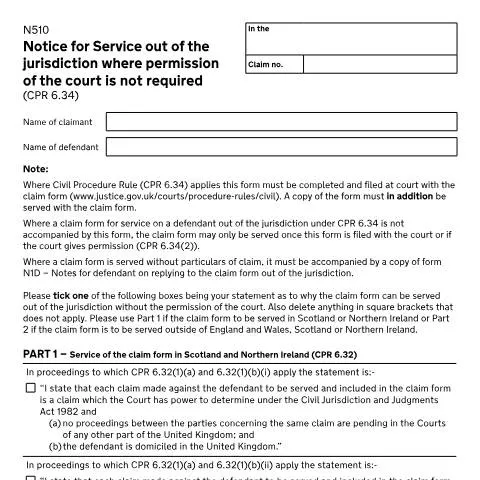
When legal disputes transcend borders within the United Kingdom or stretch beyond its boundaries entirely, the complexities multiply exponentially. Form N510 emerges as a critical procedural safeguard, serving as the mandatory declaration that enables claimants to serve court proceedings on defendants located outside England and Wales without seeking prior judicial permission. This seemingly technical document represents the difference between a straightforward domestic claim and a potentially costly, delayed international litigation process.
Under the Civil Procedure Rules, specifically CPR 6.34, this form acts as both a procedural requirement and a jurisdictional statement of confidence. The claimant essentially declares to the court that their case falls within established legal frameworks that automatically confer jurisdiction, thereby bypassing the more onerous permission-seeking route that characterises many international service scenarios.
The Jurisdictional Landscape: Understanding When Permission Isn't Required
The fundamental premise underlying Form N510 rests on the principle that certain categories of claims carry inherent jurisdictional validity that transcends geographical boundaries. This concept evolved from decades of legal harmonisation, particularly following the UK's implementation of various international conventions and bilateral arrangements.
The form distinguishes between two primary scenarios: service within the broader UK jurisdiction (Part 1) and service beyond UK borders entirely (Part 2). This distinction reflects the complex patchwork of jurisdictional rules that govern modern civil litigation, where different legal frameworks apply depending on the defendant's location and the nature of the underlying claim.
Part 1 Scenarios: Scotland and Northern Ireland Service
For claims directed toward defendants in Scotland or Northern Ireland, the Civil Jurisdiction and Judgments Act 1982 provides the foundational framework. The form offers three distinct pathways, each reflecting different grounds for automatic jurisdiction:
| Jurisdictional Basis | Key Requirements | Practical Application |
|---|---|---|
| Domicile-based jurisdiction | Defendant domiciled in UK; no parallel proceedings | Most straightforward route for individuals and companies with clear UK connections |
| Schedule 4 paragraph 11 matters | Claim falls within specific statutory categories | Specialised claims including certain property, tort, and contract matters |
| Jurisdiction agreements | Contractual clause conferring jurisdiction | Commercial disputes where parties previously agreed to UK court jurisdiction |
Part 2 Complexities: International Service Beyond UK Borders
International service scenarios present considerably more intricate jurisdictional considerations. The form accommodates various legal frameworks, from the 2005 Hague Convention on Choice of Court Agreements to employment and consumer contract provisions under the Civil Jurisdiction and Judgments Act 1982.
Consumer contract provisions under section 15B create particularly nuanced scenarios. The defendant must not themselves be a consumer, but must be party to a consumer contract, creating situations where businesses serving consumers can be pursued in UK courts despite being located abroad. Similarly, employment contract provisions under section 15C enable workers to pursue overseas employers in domestic courts, reflecting the policy objective of protecting individual claimants against jurisdictional disadvantages.
Dissecting the Declaration: What Each Statement Actually Means
The heart of Form N510 lies in its standardised statements, each carefully crafted to align with specific legal provisions. These aren't mere bureaucratic formalities—they represent legally binding assertions that carry significant consequences if proven incorrect.
The domicile declaration under Part 1 requires claimants to assert confidently that "the defendant is domiciled in the United Kingdom." This seemingly simple statement involves complex legal concepts. Domicile for individuals encompasses both residence and intention to remain, while corporate domicile typically relates to the place of incorporation or central management and control.
The "no parallel proceedings" assertion appears in multiple contexts throughout the form, reflecting the fundamental principle that courts seek to avoid conflicting judgments on identical disputes. This requirement demands thorough investigation by claimants, as parallel proceedings encompass not just active litigation but also pending applications and recently concluded matters between the same parties.
The Truth Declaration: More Than Standard Boilerplate
The statement of truth requirement transforms Form N510 from a simple administrative filing into a document carrying potential contempt of court consequences. Unlike many court forms where errors might result in procedural delays, false statements in Form N510 can expose claimants to serious sanctions, given the jurisdictional implications involved.
This elevated standard reflects the court's recognition that international service carries higher stakes and costs. Once a claim form is served internationally based on Form N510 assertions, reversing the process becomes significantly more complex and expensive than domestic service scenarios.
Strategic Filing Considerations: Timing and Tactical Implications
The procedural requirements surrounding Form N510 create several strategic considerations that can significantly impact litigation timelines and costs. The form must be filed simultaneously with the claim form, not as a subsequent administrative afterthought. This requirement means that jurisdictional analysis must be completed before initiating proceedings, not during the claim development process.
Where claimants attempt to serve internationally without filing Form N510, the Civil Procedure Rules create a procedural trap: the claim form cannot be served until either the form is filed or the court grants specific permission. This scenario often proves more expensive and time-consuming than the original automatic jurisdiction route that Form N510 would have provided.
The requirement to serve a copy of Form N510 alongside the claim form creates additional practical considerations. International service often involves translation requirements, apostille certifications, and compliance with destination country service rules. Having to include Form N510 in these processes adds complexity and cost, particularly where professional translation is required.
The N1D Connection: Defendant Information Requirements
When serving internationally without particulars of claim, Form N510 must be accompanied by Form N1D, which provides defendants with guidance on responding to international service. This requirement recognises that defendants served internationally face additional challenges in understanding their options and obligations under English court procedures.
The interaction between these forms creates practical filing considerations. Claimants must ensure that all required documentation is prepared and available before initiating service, as subsequent corrections or additions can prove significantly more challenging in international contexts.
Arbitration Claims: A Specialised Jurisdictional Route
Form N510 includes a specific provision for arbitration-related claims under CPR 62.5(2A), reflecting the increasing international nature of commercial arbitration. This pathway enables claimants to serve proceedings internationally where the arbitration seat is or will be in England and Wales, and the respondent is party to the relevant arbitration agreement.
This provision addresses common scenarios in international commercial disputes where arbitration agreements specify English seats but involve parties located globally. The jurisdictional assertion enables enforcement proceedings, interim relief applications, and other arbitration-related court involvement without requiring separate permission applications.
The requirement that "the seat of the arbitration is or will be in England and Wales" creates interesting temporal considerations. Claimants can utilise this route even before arbitration formally commences, provided the arbitration agreement designates an English seat. This enables proactive legal strategies in international commercial disputes.
Practical Completion: Navigating the Form's Requirements
Completing Form N510 effectively requires careful attention to both legal accuracy and procedural compliance. The form's structure, with its multiple tick-box options and bracketed deletions, demands precise selection based on the specific legal framework underlying the claim.
The deletion requirement for bracketed text that doesn't apply serves a practical purpose beyond mere tidiness. Courts reviewing filed forms need clear, unambiguous statements about the jurisdictional basis claimed. Leaving irrelevant text creates potential confusion and may prompt judicial queries that delay proceedings.
Each statement option contains specific legal terminology that must align precisely with the underlying legal framework. Using the wrong statement, even if the general jurisdictional concept is correct, can create procedural complications or even jurisdictional challenges from defendants.
Documentation and Evidence Considerations
While Form N510 itself is a declaration rather than an evidence-gathering exercise, claimants must possess supporting documentation to substantiate their assertions if challenged. This includes evidence of defendant domicile, contractual jurisdiction clauses, arbitration agreements, or other jurisdictional foundations claimed.
The form's structure anticipates that claimants have conducted thorough jurisdictional analysis before filing. Unlike permission-seeking procedures where courts evaluate evidence and make jurisdictional determinations, Form N510 represents the claimant's confident assertion that jurisdiction is automatically established.
Post-Filing Implications: What Happens Next
Once Form N510 is filed and international service completed, the procedural landscape shifts significantly from domestic litigation norms. Defendants served internationally typically receive extended time periods for responding, reflecting the additional challenges involved in instructing legal representation and understanding English court procedures.
The form's assertions become particularly important if defendants challenge jurisdiction. Unlike domestic proceedings where jurisdictional disputes are relatively rare, international service frequently prompts jurisdictional challenges, especially in high-value commercial disputes where defendants have strong incentives to avoid English court proceedings.
When jurisdictional challenges arise, Form N510 statements provide the foundation for the court's analysis. The claimant's assertions must be substantiated with evidence, and any inaccuracies in the original form can prove fatal to the jurisdiction claim. This reinforces the importance of careful preparation and accurate completion at the filing stage.
The international nature of these proceedings often creates additional procedural complexities, from translation requirements to compliance with international service conventions. Form N510, as the foundational jurisdictional document, becomes central to resolving these procedural disputes and maintaining the litigation's forward momentum.
Geographic Scope and Jurisdictional Boundaries for Service
Understanding the precise territorial limits where Form N510 applies requires careful consideration of both legal definitions and practical enforcement realities. The term "out of the jurisdiction" encompasses territories beyond England and Wales for proceedings in English courts, Scotland for Scottish courts, and Northern Ireland for Northern Ireland courts. However, the boundaries are more nuanced than simple geographic borders.
For England and Wales courts, service within Scotland or Northern Ireland technically falls within UK jurisdiction but may still require Form N510 depending on the specific court rules and the nature of the claim. Cross-border service within the UK often benefits from simplified procedures under the Civil Jurisdiction and Judgments Act 1982, but complex commercial disputes or family matters may still necessitate formal permission applications.
The European Union presents particular complexity post-Brexit. While the Brussels Regulation no longer applies to UK courts, bilateral agreements and the Hague Convention on Service Abroad still govern service to many European countries. Each EU member state maintains different requirements for accepting service of UK court documents, with some requiring translation, apostille certification, or service through specific diplomatic channels.
Commonwealth countries often maintain reciprocal arrangements dating back decades, yet these vary significantly in scope and application. Service to Australia, Canada, or New Zealand may proceed under simplified bilateral treaties, while service to newer Commonwealth members or those with different legal systems requires more formal diplomatic channels. The applicant must research the specific requirements for each destination country, as assumptions based on historical ties can lead to invalid service.
Countries outside established treaty frameworks present the greatest challenges. Service to jurisdictions without formal diplomatic relations, territories in conflict, or nations that don't recognise UK court jurisdiction requires careful legal analysis. The court may refuse permission entirely if service appears unlikely to succeed or if the foreign jurisdiction explicitly prohibits recognition of UK judgments.
Territorial waters, offshore installations, and vessels at sea create additional jurisdictional questions. Service to defendants on oil rigs, cruise ships, or military installations may require coordination with maritime authorities, flag state regulations, or international maritime law. The court considers whether alternative service methods might prove more effective in such circumstances.
Alternative Service Methods and Modern Communication Channels
When conventional postal service proves inadequate for international delivery, courts increasingly recognise electronic and digital service methods as valid alternatives. However, Form N510 applications must demonstrate that proposed alternative methods satisfy both UK procedural requirements and the foreign jurisdiction's legal standards for valid service.
Email service requires robust evidence that the defendant regularly uses the specified address and that the foreign jurisdiction accepts electronic service as legally valid. The applicant must provide detailed evidence of the defendant's email usage patterns, previous electronic communications, and any explicit consent to electronic service. Courts examine whether email service provides reasonable assurance that documents will reach the intended recipient and whether the foreign jurisdiction's courts would recognise such service as procedurally valid.
Social media platforms present emerging opportunities for service when defendants maintain active, verifiable profiles but prove difficult to locate through conventional means. However, courts scrutinise such applications carefully, requiring evidence that the defendant personally controls the account, regularly accesses the platform, and that the proposed method complies with the platform's terms of service and relevant data protection regulations.
WhatsApp, LinkedIn, and other messaging platforms may constitute valid service methods in appropriate circumstances, particularly for commercial disputes where parties previously communicated through such channels. The court examines the defendant's usage patterns, the platform's message delivery confirmation systems, and whether the foreign jurisdiction's legal system would accept such service as procedurally sound.
Video calling platforms and virtual meeting software gained prominence during pandemic restrictions and continue serving as viable alternatives in specific circumstances. Service through Zoom, Microsoft Teams, or similar platforms requires careful documentation of delivery confirmation, participant identification, and compliance with both platforms' security protocols and relevant privacy legislation.
Publication in newspapers or online platforms serves as a method of last resort when other alternatives fail. The court requires evidence that conventional and electronic methods have proven unsuccessful, that the proposed publication reaches the defendant's likely location, and that the foreign jurisdiction recognises publication as valid service. International newspapers, expatriate community publications, or professional journals may provide appropriate vehicles depending on the defendant's profile and circumstances.
Through agents or legal representatives offers another avenue, particularly in jurisdictions with mandatory legal representation requirements. The applicant must identify appropriately qualified local agents, demonstrate their authority to accept service, and ensure compliance with the foreign jurisdiction's professional regulations and ethical requirements.
Post-Service Compliance and Enforcement Considerations
Successfully serving documents abroad through Form N510 represents only the initial step in international litigation. The serving party must subsequently navigate complex requirements for proving service, managing foreign legal responses, and ultimately enforcing any judgment obtained. These post-service obligations significantly impact the strategic value of international proceedings.
Proving service requires meticulous documentation meeting both UK court standards and the foreign jurisdiction's evidentiary requirements. The serving party must obtain appropriate certificates of service, sworn affidavits from process servers, postal receipts with tracking information, and any additional documentation required by local law. Translation requirements vary by jurisdiction, with some countries requiring certified translations of all service documents while others accept English-language documents for commercial matters.
Diplomatic channels may require additional certification through apostille procedures, embassy authentication, or consular legalisation. The Foreign, Commonwealth and Development Office provides guidance on specific requirements for each country, but processing times can extend several weeks or months. Applicants must factor these delays into litigation timetables and court deadlines.
Foreign defendants may respond through their local legal systems, potentially challenging the UK court's jurisdiction, disputing service validity, or filing counter-claims in their home jurisdiction. Managing parallel proceedings requires careful coordination between UK solicitors and foreign legal representatives, with attention to conflicting court orders, inconsistent legal standards, and competing enforcement mechanisms.
Judgment enforcement presents the ultimate test of international service effectiveness. Even properly served proceedings may yield judgments that prove difficult or impossible to enforce in the defendant's jurisdiction. The applicant should research enforcement prospects before initiating proceedings, examining bilateral enforcement treaties, reciprocal judgment recognition agreements, and the foreign jurisdiction's practical approach to UK court orders.
Asset tracing and recovery across international boundaries requires sophisticated legal and investigative resources. Successfully served defendants may transfer assets to other jurisdictions, establish complex corporate structures to shield assets, or invoke foreign bankruptcy or insolvency protections. The initial Form N510 application should consider these enforcement challenges when evaluating the overall viability of international litigation.
Costs implications extend well beyond the initial application fee and court costs. International service often requires local legal representation, professional translation services, diplomatic authentication, and potentially expensive alternative service methods. These costs multiply if enforcement proceedings become necessary in multiple jurisdictions. The court may require cost estimates and security deposits for international proceedings, particularly where the claimant lacks sufficient UK assets to satisfy adverse costs orders.
Time limitations in the foreign jurisdiction may affect the validity of served proceedings. Some countries impose strict time limits on foreign court document validity, requiring re-service if proceedings extend beyond specified periods. Others may require periodic renewal or re-authentication of served documents. The serving party must monitor these requirements throughout the litigation process to maintain valid service status.