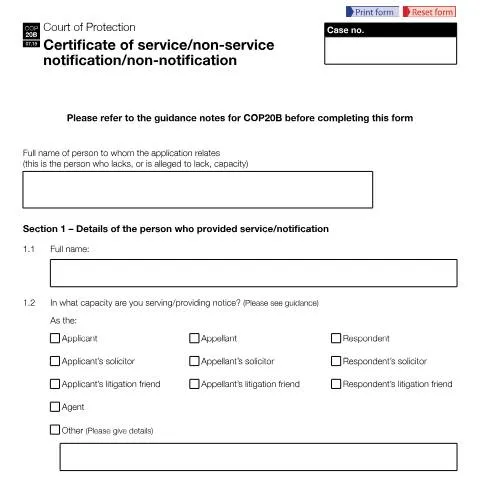
Understanding Court of Protection Service Documentation in Mental Capacity Proceedings
When legal proceedings involve individuals who may lack mental capacity, the Court of Protection operates under strict procedural requirements to ensure all relevant parties receive proper notice. Form COP20B serves as the formal certification mechanism that proves whether court documents have been successfully served on required individuals or explains why service could not be completed. This certificate becomes a crucial piece of evidence in the court file, potentially affecting case progression and judicial decisions.
The form addresses a fundamental principle of natural justice: no person should be subject to legal proceedings without proper notice. In mental capacity cases, this principle takes on heightened importance given the vulnerability of the individuals involved and the potentially life-altering nature of the court's decisions.
The Dual Nature of Service Versus Notification in Capacity Cases
Form COP20B distinguishes between two distinct legal concepts that often confuse court users. Service refers to the formal delivery of court documents to parties who have a direct legal interest in the proceedings, whilst notification involves informing interested persons who should be aware of the case but may not be formal parties.
In Court of Protection proceedings, this distinction proves particularly significant. The person who allegedly lacks capacity must always be served with the application, regardless of their condition. Family members, carers, or professionals involved in their care typically receive notification rather than formal service, unless they choose to become active parties in the proceedings.
Categories of Documents Requiring Certification
The certificate covers several types of court documents, each carrying different procedural implications:
- Application forms with supporting evidence - the initial documents that commence proceedings
- Appellant's and respondent's notices - documents used when appealing Court of Protection decisions
- Certificates of suitability of litigation friends - forms confirming someone's ability to represent the person who lacks capacity
- Other specified documents - any additional papers the court deems require certified service
Each document type may have different service requirements, timescales, and consequences for non-compliance, making accurate completion of the COP20B essential for maintaining procedural integrity.
Who Bears Responsibility for Service and Certification
The form accommodates various scenarios regarding who undertakes service duties. Primary responsibility typically falls on the applicant, but the Court of Protection Rules allow flexibility depending on case circumstances and representation arrangements.
Solicitors representing parties frequently handle service obligations, bringing professional expertise to ensure compliance with court rules. However, litigation friends - individuals appointed to represent someone who lacks capacity - may also bear this responsibility, particularly in cases where professional legal representation is limited.
Capacity Considerations for Service Providers
The person completing Form COP20B must possess the legal capacity and authority to undertake service. This creates interesting dynamics in Court of Protection cases where multiple individuals may themselves lack capacity to varying degrees. The court may need to appoint specific individuals or make directions about who should handle service obligations.
| Service Provider | Typical Scenarios | Considerations |
|---|---|---|
| Applicant | Simple family applications | Must understand legal requirements |
| Solicitor | Complex or contentious cases | Professional indemnity coverage |
| Litigation Friend | Where P lacks representation | Must act in P's best interests |
| Agent | Specialist service companies | Requires court permission |
Methods of Service and Their Legal Implications
Form COP20B acknowledges multiple service methods, each carrying different evidential weight and procedural requirements. Personal service remains the gold standard, providing the strongest evidence that the recipient actually received the documents. However, practical considerations often necessitate alternative methods.
First-class post represents the most common service method, with the Court of Protection Rules establishing presumptions about when documents are deemed received. Electronic service, including email and fax transmission, requires either the recipient's prior consent or specific court directions authorising such methods.
Alternative Service Arrangements
When standard service methods prove impractical, the court may authorise alternative arrangements. These might include service through intermediaries, publication in newspapers, or even dispensing with service entirely in exceptional circumstances. Each alternative method requires specific justification and court approval before implementation.
The DX (Document Exchange) system remains available for legal professionals, though its use has declined with technological advances. Some solicitors' firms maintain DX addresses specifically for receiving court documents, and service via this route carries the same legal effect as personal delivery.
Documenting Non-Service and Its Consequences
Section 4 of Form COP20B addresses situations where service cannot be completed despite reasonable efforts. The court requires detailed explanations for any non-service, as this information directly affects case management decisions and may trigger additional procedural steps.
Common reasons for non-service include individuals whose whereabouts are unknown, those actively avoiding service, or circumstances where the person's condition makes service inappropriate or impossible. Each scenario requires different judicial responses, from ordering alternative service methods to potentially proceeding without service in exceptional cases.
Impact on Case Progression
Non-service can significantly delay proceedings, particularly when essential parties remain unserved. The court may need to make interim directions, appoint investigators to locate missing individuals, or consider whether proceedings can continue without certain parties' participation.
In urgent cases involving immediate risk to the person who lacks capacity, the court might proceed despite incomplete service, but this requires compelling justification and usually involves additional safeguards to protect absent parties' interests.
Statement of Truth Requirements and Legal Accountability
Form COP20B concludes with a statement of truth, creating legal accountability for the information provided. The person signing accepts personal responsibility for the accuracy of all details concerning service attempts, dates, methods, and outcomes.
This requirement serves multiple purposes: it deters false or careless reporting, provides the court with reliable information for case management, and creates potential consequences for those who provide misleading information. The statement must be signed by the person who actually undertook the service activities, not merely someone with knowledge of the events.
Professional Standards and Liability
Solicitors completing the certificate must consider their professional conduct obligations alongside court requirements. Inaccurate certification could constitute professional misconduct, affecting both the individual case and the solicitor's regulatory standing.
For non-professional service providers, the statement of truth creates potential exposure to contempt of court proceedings if false information is knowingly provided. This underscores the importance of maintaining accurate records throughout the service process.
Coordination with Related Court Documentation
Form COP20B operates alongside Form COP20A within the Court of Protection's document management system. While COP20B can be submitted independently, the court encourages simultaneous filing when both forms are ready, as this provides a complete picture of service activities and reduces administrative burden.
The certificate becomes part of the permanent court record, potentially relevant for future proceedings involving the same individuals. Judges may refer to service histories when making directions about notification requirements in subsequent applications or when considering the adequacy of previous procedural steps.
Proper completion and timely submission of Form COP20B helps ensure that Court of Protection proceedings proceed efficiently whilst maintaining the procedural safeguards essential for protecting vulnerable individuals' rights and interests. The certificate serves not merely as administrative paperwork but as a fundamental component of the court's oversight mechanisms in mental capacity cases.
Managing COP20B Across Different Property Types and Tenancy Arrangements
The complexity of completing Form COP20B often increases significantly when dealing with varied property arrangements and tenancy structures. Understanding how service requirements differ across these scenarios is crucial for process servers and legal representatives.
For freehold properties, the service process typically follows standard residential protocols. However, the COP20B must clearly identify whether service was attempted at the registered address on the Land Registry or at a different residential address where the protected person is known to reside. When these addresses differ, additional documentation may be required to establish the connection between the protected person and the alternative address.
In leasehold arrangements, particularly in blocks of flats or converted properties, service can become considerably more complex. The process server must determine whether to serve documents directly to the individual flat or through a building's concierge or management company. Form COP20B requires specific details about the method chosen and any intermediate parties involved in the service process. If service is attempted through a management company or concierge service, the form must document their authority to receive documents on behalf of residents.
Shared accommodation scenarios present unique challenges that directly impact how COP20B is completed. When multiple adults share a property, the form must clearly distinguish between housemates, family members, and other residents when documenting who received or refused the documents. The relationship between the person accepting service and the protected person must be established and recorded, as this affects the validity of service under court rules.
For sheltered housing or assisted living facilities, special considerations apply when completing COP20B. Service may need to occur through care staff or facility administrators, but their authority to accept documents on behalf of residents varies significantly between different types of accommodation. The form must capture whether the facility has specific procedures for legal document service and whether these were followed.
Commercial properties where individuals might reside (such as above shops or in mixed-use buildings) require careful attention to access routes and appropriate service points. The COP20B must document whether service was attempted at business premises, residential areas, or both, and explain any access restrictions encountered.
When dealing with temporary accommodation, including hotels, bed and breakfasts, or emergency housing, Form COP20B must capture the transient nature of the arrangements and any limitations this places on effective service. Documentation should include details of how long the person has been at the address and whether management confirmed their current residence.
Electronic Service Attempts and Digital Documentation Requirements
Modern court proceedings increasingly involve electronic service attempts, and Form COP20B has evolved to accommodate these digital methods while maintaining strict evidential standards. Understanding how to properly document electronic service attempts is essential for ensuring court acceptance of the certificate.
Fill in your form directly online
No printing: type your details into the boxes of the official form, tick, then download the PDF ready to send.
- 1Type into the form boxes
- 2Tick in one click
- 3Save and download the PDF
When email service is attempted, COP20B requires comprehensive documentation beyond simple delivery receipts. The form must capture the specific email address used, the exact time stamps of sending and any delivery confirmations, and details of any automated responses received. However, mere delivery to an email server does not constitute effective service unless specifically authorised by the court or agreed by parties.
The documentation must distinguish between different types of email responses: automated out-of-office replies, delivery failure notifications, and actual acknowledgments from the intended recipient. Each type of response has different implications for whether service has been achieved, and the COP20B must reflect these distinctions clearly.
Digital messaging platforms present particular challenges for Form COP20B completion. While courts may occasionally permit service through platforms like WhatsApp or social media in exceptional circumstances, the evidential requirements are stringent. The certificate must include screenshots of message delivery confirmations, evidence of the recipient's identity verification on the platform, and proof that the account genuinely belongs to the intended person.
For electronic document service platforms authorised by specific court orders, COP20B must capture platform-specific confirmation details, including unique tracking references and platform-generated proof of delivery or access. The form should document whether the recipient opened or downloaded the documents, though this information may not always be available depending on the platform used.
Video call service attempts, while rare, may occur in exceptional circumstances with court permission. The COP20B must document the platform used, connection quality, verification of the recipient's identity, and whether the documents were successfully transmitted and acknowledged during the call. Technical difficulties or connection failures must be detailed thoroughly.
When electronic service fails or proves impossible, the COP20B must document the specific reasons for failure and what alternative methods were subsequently attempted. This creates a clear evidential trail showing due diligence in attempting service through all available means.
Coordinating COP20B with Vulnerable Adults and Mental Capacity Considerations
Court of Protection proceedings inherently involve individuals who may lack capacity in specific areas, making the completion of Form COP20B particularly sensitive and requiring additional safeguarding considerations. Process servers must balance legal requirements with appropriate protection for vulnerable adults.
When the protected person has fluctuating capacity, the timing of service attempts becomes crucial. COP20B must document not only when service was attempted, but also observations about the person's apparent state of understanding at the time. This might include noting whether they appeared confused, whether they recognised their own name, or whether they seemed to understand the nature of legal documents being served.
However, process servers must be careful not to make clinical assessments beyond their expertise. The form should record observable behaviours and responses without drawing conclusions about mental capacity. Phrases like "appeared not to understand" are more appropriate than "lacks capacity to understand".
In situations involving dementia or cognitive impairment, service may need to occur in the presence of family members or carers. COP20B must carefully document who else was present during service attempts and their relationship to the protected person. The form should note whether these individuals attempted to assist the person in understanding the documents or whether they advised against accepting service.
When communication barriers exist beyond mental capacity issues—such as hearing impairments, visual disabilities, or language barriers—Form COP20B must capture how these were addressed during service attempts. This includes documenting any interpreters used, assistive technology encountered, or alternative communication methods attempted.
Safeguarding concerns may arise during service attempts, particularly if the process server observes signs of abuse, neglect, or exploitation. While COP20B primarily documents service rather than welfare concerns, any safeguarding issues encountered should be noted appropriately and reported through proper channels independently of the court documentation.
For individuals in care settings, the form must distinguish between service to the individual directly and service through care providers. Care homes and similar facilities often have specific procedures for receiving legal documents, and COP20B should document whether these were followed and whether they appear adequate for ensuring the documents reach the intended person.
When dealing with deputies or attorneys already appointed for the protected person, Form COP20B must clearly identify whether service was attempted on the individual directly or through their legal representatives. The scope of the deputy's or attorney's authority may affect whether they can validly receive certain types of court documents on the person's behalf.
The form should also capture any advance directives or preferences expressed by the protected person regarding how they wish to receive legal communications, provided these are compatible with court requirements and legal obligations for effective service.