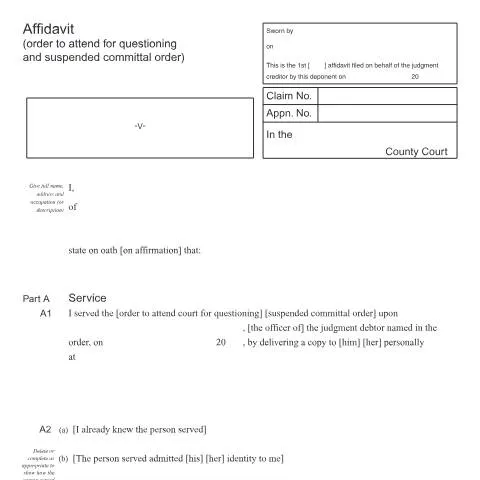
When Court Orders Need Proof: Understanding the EX550 Affidavit
In the complex machinery of debt enforcement proceedings, one crucial moment occurs when a judgment creditor must demonstrate to HM Courts & Tribunals Service that they have properly served legal documents on a debtor. The EX550 Affidavit of Service serves as this formal proof, creating an official record under oath that court orders have been delivered according to legal requirements.
This sworn statement becomes particularly vital when dealing with orders to attend court for questioning or suspended committal orders – enforcement tools that carry serious consequences for judgment debtors who fail to comply. Without proper service evidenced through Form EX550, even the most justified debt recovery action can grind to a halt, leaving creditors unable to proceed with enforcement measures.
The affidavit process reflects the courts' insistence on procedural fairness: before any debtor faces potential imprisonment for contempt of court, there must be unshakeable evidence that they received proper notice of their obligations. This protection extends beyond mere bureaucracy – it safeguards fundamental rights whilst ensuring legitimate creditors can pursue effective remedies.
Dissecting the Three-Part Structure of Form EX550
The EX550 follows a methodical three-part framework, each section addressing distinct legal requirements that together create comprehensive proof of service and ongoing debt obligations.
Part A: Establishing Valid Service
Section A1 requires the deponent to specify exactly how service was achieved. The form accommodates personal service – the gold standard in legal proceedings – where documents are handed directly to the named individual. The deponent must record the precise date, time, and location of service, creating an audit trail that courts can scrutinise if challenged.
Personal service carries particular weight because it eliminates doubt about whether the debtor received the order. Alternative service methods, whilst sometimes permitted, often face greater judicial scrutiny and may require additional court applications to validate.
Section A2 addresses a critical evidential challenge: proving the person served was indeed the judgment debtor named in the court order. The form provides three identification pathways:
- Prior knowledge: The server already knew the individual personally
- Admission of identity: The person served confirmed their identity during the service encounter
- Alternative identification: Other means of establishing identity (requiring detailed explanation)
This identification requirement prevents scenarios where documents are served on wrong individuals, protecting both debtors from mistaken enforcement and creditors from wasted proceedings based on invalid service.
Section A3 mandates that a copy of the served order be exhibited to the affidavit, marked as 'Exhibit A'. This attachment provides courts with direct evidence of what documents were actually delivered, ensuring consistency between the affidavit's claims and the physical evidence.
Part B: Confirming Continuing Debt
Part B serves a dual purpose: establishing the deponent's authority to make statements about the debt and confirming the current balance owed. This section recognises that judgment debts often involve partial payments, settlements, or accruing interest that affect the amount ultimately recoverable.
The form distinguishes between judgment creditors acting personally and representatives acting on behalf of creditor organisations. Individual creditors can state facts "to my own knowledge," reflecting direct personal involvement in the debt relationship.
Corporate creditors typically require employees or agents to complete affidavits, who must qualify their statements as being "to the best of my knowledge and belief having enquired of the judgment creditor's staff and consulted its records." This formulation acknowledges that corporate representatives may not have personal knowledge of every transaction whilst requiring them to undertake reasonable investigations.
The outstanding balance figure in Section B2 becomes crucial for subsequent enforcement proceedings, as courts need current debt amounts to assess proportionality of enforcement measures and calculate potential payment arrangements.
Part C: Travel Expense Obligations
Part C addresses the often-overlooked requirement to offer reasonable travel expenses to debtors ordered to attend court. This provision reflects principles of access to justice – individuals should not face financial barriers preventing compliance with court orders, even in enforcement proceedings.
The form provides two scenarios: either the debtor has not requested travel expenses, or they have made such a request and payment has been arranged. When payment is required, creditors must document the amount, payment method, and timing, demonstrating compliance with their statutory obligations.
This requirement can surprise creditors focused solely on debt recovery, but failure to address travel expenses appropriately may provide debtors with grounds to challenge enforcement proceedings or seek adjournments.
Strategic Timing and Court Procedure Integration
The EX550 affidavit operates within strict procedural timelines that can make or break enforcement proceedings. Understanding when and how to deploy this form requires appreciation of the broader enforcement sequence.
Following judgment, creditors seeking to question debtors about their financial circumstances must first obtain an order to attend court for questioning. Once granted, this order must be served personally on the judgment debtor, typically requiring professional process servers or court bailiffs given the challenges of locating and confronting reluctant debtors.
The affidavit must be filed after service occurs but before the hearing date, providing courts with advance confirmation that proper notice has been given. Late filing can result in hearings being adjourned, adding costs and delays to already protracted proceedings.
For suspended committal orders – where debtors face potential imprisonment for failing to comply with previous court directions – the stakes are higher and timing more critical. These orders typically arise when debtors have ignored questioning orders or failed to make court-ordered payments, escalating enforcement to contempt of court proceedings.
Courts scrutinise EX550 affidavits more closely in committal contexts, given the serious consequences flowing from non-compliance. Any defects in service or documentation can provide grounds for discharge applications, potentially allowing debtors to escape enforcement measures entirely.
Who Can Swear EX550 Affidavits and Where
The person making the affidavit – the deponent – must have direct knowledge of the service events described. This typically means the individual who personally served the documents, whether a professional process server, court bailiff, solicitor, or the creditor themselves.
Corporate creditors often face practical challenges here, as company directors or employees rarely undertake personal service themselves. Many engage specialist process serving agencies whose operatives can subsequently swear the necessary affidavits based on their direct involvement.
| Authorised Officers | Location | Typical Availability |
|---|---|---|
| Court-appointed officers | County court buildings | Business hours, advance booking recommended |
| Solicitors holding practising certificates | Law firm offices | By appointment, fees applicable |
| Commissioners for Oaths | Various professional offices | Extended hours possible, location-dependent |
| Justices of the Peace | Magistrates' courts, some community locations | Limited availability, often specific sessions |
The choice of officer can affect both convenience and cost. Court-appointed officers typically charge modest fees but require visits to court buildings during business hours. Solicitors and Commissioners for Oaths may offer greater flexibility but at higher cost, particularly valuable when dealing with urgent applications or complex cases requiring legal guidance.
The officer administering the oath bears responsibility for verifying the deponent's identity and ensuring they understand the serious nature of sworn statements. False affidavits constitute perjury, carrying potential imprisonment, making this verification role crucial for maintaining judicial confidence in the process.
Common Pitfalls in Service Documentation
Experience reveals recurring problems that can undermine otherwise valid EX550 affidavits, often stemming from inadequate preparation or misunderstanding of legal requirements.
Incomplete Identification Records
Section A2 problems frequently arise when servers fail to properly establish and document the served person's identity. Simply stating "the person served admitted their identity" without recording how this admission occurred may prove insufficient if challenged. Best practice involves noting specific details: "The person served confirmed they were [name] when I asked 'Are you [full name as per court order]?' and showed me a driving licence bearing that name and photograph matching their appearance."
Timing and Location Precision
Vague service details create unnecessary vulnerability. Recording service as occurring "in the morning" or "at defendant's home address" may satisfy basic form requirements but provides inadequate protection against challenge. Specific times ("approximately 2:30pm") and precise locations ("at the front door of the property, after the person answered my knock") demonstrate thoroughness and aid later recollection if court testimony becomes necessary.
Outstanding Balance Calculations
Part B errors often involve failing to account for all relevant factors affecting the debt balance. Judgment sums accrue statutory interest at 8% per annum unless the court orders otherwise, while partial payments reduce the principal. Court fees incurred during enforcement proceedings may also be recoverable, affecting the total amount due.
Creditors should calculate balances as at the date of swearing the affidavit, not the original judgment date or service date, ensuring accuracy for subsequent court proceedings.
Travel Expense Oversights
Part C complications arise when creditors misunderstand their obligations regarding debtor travel expenses. The requirement extends beyond merely asking if expenses are needed – creditors should proactively calculate reasonable costs and make genuine offers, particularly for debtors living substantial distances from the court.
Reasonable expenses typically cover public transport costs or mileage at standard rates, but may extend to parking fees or overnight accommodation for distant hearings. Failing to make adequate provision can provide debtors with grounds to seek adjournments or challenge enforcement proceedings.
Filing Procedures and Court Requirements
The completed EX550 affidavit must be filed with the court that issued the original order, accompanied by any required exhibits and appropriate fees. Most county courts accept filing by post, in person, or increasingly through online portals, though emergency applications may require personal attendance.
Filing fees vary depending on the specific application and court, with potential exemptions for applicants receiving qualifying benefits or meeting low-income thresholds. Fee remission applications should be submitted simultaneously with the main documents to avoid processing delays.
The court file should already contain the original order being enforced, but including a copy as Exhibit A ensures completeness and aids judicial review. Courts managing heavy caseloads appreciate self-contained documentation that enables quick assessment without extensive file searching.
Electronic vs Paper Filing Considerations
While digital submission offers convenience and speed, the sworn nature of affidavits creates specific requirements. Electronic filing typically requires the original sworn document to be posted separately, as courts need authentic signatures and oath administration records for their permanent files.
Some courts accept scanned copies for initial processing whilst requiring original documents within specified timeframes. This hybrid approach can expedite urgent applications whilst maintaining evidential integrity, but requires careful attention to follow-up deadlines.
Responding to Challenges and Court Scrutiny
Debtors facing enforcement proceedings may challenge EX550 affidavits on various grounds, requiring creditors to defend their service evidence through additional court hearings or documentation.
Service challenges typically allege that documents were not properly delivered or that the wrong person received them. Strong affidavit evidence, supported by detailed witness statements and any available photographic or video evidence, provides the best defence against such challenges.
Procedural objections may focus on timing issues, inadequate travel expense provisions, or failures to comply with specific court directions. These challenges often succeed where creditors have overlooked technical requirements, emphasising the importance of careful preparation and legal compliance.
When challenges arise, courts typically list further hearings to resolve disputed facts. The original deponent may need to attend court to give oral evidence supporting their written affidavit, facing cross-examination from the debtor or their legal representatives.
Successful challenge outcomes can range from minor procedural corrections to complete discharge of enforcement proceedings, depending on the severity of any proven defects. This potential for serious consequences underscores why proper completion of Form EX550 deserves careful attention rather than rushed completion.
The affidavit process ultimately serves broader objectives of procedural fairness and effective debt enforcement. When completed thoroughly and filed promptly, EX550 forms provide courts with reliable evidence enabling swift progression of legitimate enforcement proceedings, balancing creditor rights with debtor protections through established legal frameworks.