Understanding the Civil Procedure Rules Part 8 Response Framework
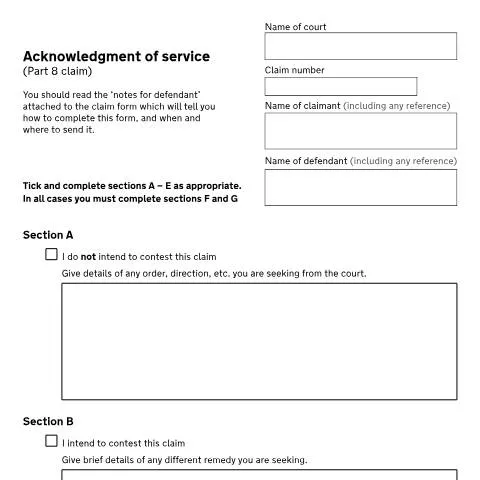
When civil proceedings commence under CPR Part 8, defendants face a streamlined yet precise response mechanism through Form N210. Unlike standard civil claims that involve extensive factual disputes, Part 8 proceedings typically address discrete legal questions, construction of documents, or situations where the facts are largely agreed but require judicial determination. The N210 acknowledgment of service becomes the defendant's crucial entry point into these proceedings, determining not just participation but the scope and nature of their defence strategy.
The Civil Procedure Rules introduced this simplified procedure to handle cases where traditional pleadings would be unnecessarily complex. Property boundary disputes involving deed interpretation, applications for declarations of trust, or challenges to administrative decisions often proceed via Part 8. The defendant's response through Form N210 shapes the entire trajectory of the case, from whether they contest the claim to what additional remedies they might seek.
The Strategic Landscape: Five Distinct Response Pathways
Form N210 presents defendants with five distinct response options, each carrying fundamentally different procedural and strategic implications. Understanding these pathways proves essential before completing any section of the form.
Section A: Non-Contestation with Potential Relief Seeking
Selecting Section A indicates acceptance of the claimant's case in principle whilst potentially seeking different or additional orders. This approach suits situations where the defendant agrees with the underlying facts but believes the court should grant alternative relief. For instance, in a boundary dispute where both parties accept the need for clarification but disagree on the specific declaration required, a defendant might not contest the claim whilst seeking a different form of declaratory relief.
Section B: Full Contestation with Alternative Remedies
Ticking Section B signals active opposition to the claimant's case. The defendant must provide brief details of any different remedy sought, establishing their alternative position from the outset. This section applies when fundamental disagreement exists about the appropriate outcome, even if the underlying facts remain largely undisputed.
Section C: Jurisdictional Challenges
Jurisdictional disputes under Section C require immediate attention to the 14-day deadline for formal applications. This pathway suits cases where the defendant questions whether the English courts have jurisdiction, perhaps involving international elements or disputes over which court should hear the matter. The acknowledgment of service filing date triggers this crucial deadline.
Section D: Procedural Objections
Section D addresses situations where the defendant believes Part 8 procedure is inappropriate for the case. This might arise where significant factual disputes exist that require traditional disclosure and witness evidence, making the streamlined Part 8 process unsuitable. The defendant must articulate specific reasons why the case should proceed under different procedural rules.
Section E: Evidence Strategy Declaration
The written evidence provisions in Section E require careful strategic consideration. Defendants must declare whether evidence accompanies the acknowledgment or will follow within 14 days. This timing proves crucial for case management, as late evidence may require court permission and could prejudice the defendant's position.
Navigating the Mandatory Completion Requirements
Regardless of which substantive sections apply, every defendant must complete Sections F and G. This universal requirement ensures proper identification and verification of the response.
| Section | Mandatory Content | Key Considerations |
|---|---|---|
| Section F | Full defendant name | Must match exactly with claim form details |
| Section G | Statement of truth | False statements risk contempt proceedings |
| Address Section | Service address for documents | Can differ from defendant's residential address |
The statement of truth in Section G carries significant legal weight. The form explicitly warns that contempt of court proceedings may follow false statements made without honest belief in their truth. This applies equally whether the defendant signs personally or through legal representation.
Critical Timing Considerations and Procedural Deadlines
Form N210 operates within a complex framework of interlocking deadlines that can determine case outcomes. The acknowledgment of service deadline typically falls 14 days after service of the claim form, though this may vary depending on the method of service and any extensions granted.
Defendants choosing Section C face a particularly tight schedule. The 14-day period for jurisdictional applications runs from the acknowledgment filing date, not from service of the original claim. This compressed timeline demands immediate legal assessment and swift action to preserve jurisdictional challenges.
For Section E declarations, the 14-day evidence deadline provides limited flexibility. Defendants promising evidence within this period must ensure compliance, as failure may require costly applications for extensions that courts grant only with good reason. The alternative of filing evidence with the acknowledgment provides certainty but may limit strategic flexibility in evidence preparation.
Distinguishing N210 from Other Civil Response Forms
The acknowledgment of service for Part 8 claims differs substantially from other civil response mechanisms. Unlike Form N9 used for standard civil claims, N210 reflects the streamlined nature of Part 8 proceedings where traditional defences may be inappropriate.
Standard acknowledgments under Part 7 proceedings focus on whether defendants intend to defend, with detailed defence statements following separately. N210 integrates these functions, requiring defendants to signal their position on contestation, jurisdiction, procedure, and evidence strategy simultaneously. This integrated approach suits the faster-paced Part 8 timeline but demands comprehensive strategic thinking at the acknowledgment stage.
The form also differs from specialist acknowledgment procedures in areas like judicial review or family proceedings, where different rules and forms apply. Defendants must ensure they're using N210 for genuine Part 8 proceedings rather than confused alternative procedures that might seem similar.
Practical Completion Strategies for Different Defendant Profiles
The approach to completing N210 varies significantly depending on the defendant's circumstances and legal representation status.
Self-Representing Defendants
Litigants in person face particular challenges with N210's strategic implications. The form requires immediate decisions about contestation and evidence without the benefit of traditional defence preparation time. Self-representing defendants should focus on understanding the claimant's actual request before determining their response strategy.
The address section proves crucial for self-representing defendants who must ensure reliable document service. Using a residential address may cause privacy concerns, whilst business addresses require consideration of availability and reliability for receiving court documents.
Legally Represented Defendants
Solicitors completing N210 must balance immediate strategic signaling with preserving future flexibility. The brief details required in Sections B and D should provide sufficient indication of the defence position without prejudicing detailed argument development. Legal representatives must also ensure proper authorization for signing statements of truth on behalf of defendant clients.
Corporate and Institutional Defendants
Companies and public bodies face additional complexity in ensuring proper authority for N210 completion. The form requires identification of the specific individual signing and their authority, whether as litigation friend for protected parties or as authorized representative for corporate defendants.
Evidence Coordination and Case Management Implications
The evidence provisions in Section E create immediate case management consequences that extend beyond the acknowledgment itself. Defendants must coordinate their evidence strategy with the overall Part 8 timeline and any directions the court may give.
Written evidence in Part 8 proceedings typically takes the form of witness statements rather than traditional documentary disclosure. Defendants must consider what evidence they need to support their position and whether the 14-day deadline provides sufficient preparation time. Complex cases involving expert evidence or extensive documentary analysis may require careful scheduling to meet these deadlines.
The choice between filing evidence with the acknowledgment or promising future filing affects case management directions. Courts may adjust subsequent deadlines based on when parties file their evidence, potentially accelerating or extending the overall timetable.
Submission Procedures and Administrative Requirements
Form N210 must be filed at the same court that issued the claim form, with the correct claim number and party details matching exactly. The court's administrative staff will check these details for consistency with the original claim before accepting the filing.
Most courts now accept electronic filing through designated portals, though paper submissions remain available. Electronic filing provides immediate confirmation and faster processing, whilst paper submissions require consideration of postal delays and receipt confirmation. Defendants should retain copies of their filed acknowledgment as proof of compliance with deadlines.
The court fee for acknowledgment of service is typically modest compared to other civil procedure costs, but defendants should verify current fee levels and available exemptions. Fee remission may apply for defendants meeting financial eligibility criteria, though applications require separate completion and assessment.
Service copies must be sent to all other parties in the proceedings, not just the claimant. In multi-party Part 8 proceedings, defendants must ensure all parties receive copies of their acknowledgment, maintaining the transparency essential to the streamlined Part 8 process. This service requirement operates independently of the court filing deadline and requires separate attention to ensure compliance.
Strategic Considerations for Different Types of CPR Part 8 Claims
The nature of your CPR Part 8 claim significantly influences how you should approach your Form N210 response. Understanding these distinctions helps you craft a more targeted and effective acknowledgment of service.
Boundary Disputes and Property Rights Claims
When responding to Part 8 claims concerning boundary disputes, easements, or restrictive covenants, your Form N210 should acknowledge any existing surveys, title deeds, or Land Registry entries that may be relevant. Even at this early stage, indicating awareness of key documentary evidence can strengthen your position. Consider whether you need to engage a chartered surveyor or seek specialist legal advice, as these cases often hinge on technical evidence about land boundaries or historical usage rights.
For claims involving adverse possession or rights of way, your response timing becomes particularly crucial. These cases frequently involve statutory limitation periods, and any delay in responding could be interpreted as acquiescence to the claimant's position. If you're defending against an adverse possession claim, your Form N210 should be filed promptly, even if you're still gathering evidence about your historical use of the disputed land.
Trust and Estate Administration Disputes
Part 8 claims in probate matters, such as applications for presumption of death certificates or disputes over will interpretation, require careful consideration of all beneficiaries' interests. When completing Form N210 for these cases, you may need to indicate whether you're responding as an executor, beneficiary, or interested party, as this affects your standing in the proceedings.
If the claim involves construction of will provisions or trust documents, your response should acknowledge any relevant correspondence with other beneficiaries or trustees. The court often expects parties in estate disputes to have attempted resolution through family mediation or professional trustee guidance before resorting to formal proceedings.
Professional Negligence and Regulatory Matters
When responding to Part 8 claims involving professional conduct or regulatory decisions, such as challenges to General Medical Council or Solicitors Regulation Authority determinations, your Form N210 response carries additional weight. These cases often involve complex procedural requirements and strict time limits that differ from standard civil litigation.
Your acknowledgment should reflect awareness of any ongoing regulatory proceedings or professional disciplinary matters that might run parallel to the court action. Consider whether you need to notify your professional indemnity insurers, as they may have specific requirements about how you respond to such claims.
Fill in your form directly online
No printing: type your details into the boxes of the official form, tick, then download the PDF ready to send.
- 1Type into the form boxes
- 2Tick in one click
- 3Save and download the PDF
Managing Multiple Defendants and Third Party Considerations
CPR Part 8 claims frequently involve multiple defendants or require consideration of third parties who may be affected by the court's decision. Your Form N210 response must account for these complexities from the outset.
Coordinating Responses Among Co-Defendants
When multiple defendants are named in a Part 8 claim, each must file their own Form N210, but coordination can prevent conflicting positions that might undermine everyone's defence. While you cannot collude to defeat the claimant's legitimate case, you can ensure that your responses are consistent on factual matters and don't inadvertently support the claimant's position against your co-defendants.
Consider whether your interests align with other defendants sufficiently to justify joint representation, or whether conflicts of interest require separate legal teams. This decision affects how you complete the legal representation section of Form N210 and may influence your approach to case management directions.
Identifying Necessary Third Parties
Part 8 proceedings sometimes require joinder of additional parties whose interests could be affected by the court's declaration or order. Your Form N210 response provides an early opportunity to alert the court and other parties to such requirements.
For example, in boundary disputes, neighbouring landowners who aren't currently parties might need to be joined if the proposed boundary changes affect their property rights. In trust disputes, beneficiaries who weren't initially aware of the proceedings may need to be notified and given the opportunity to participate.
If you believe additional parties should be joined, note this in your case management proposals. The court has broad powers under CPR Part 19 to add or remove parties, but it's generally more efficient to identify these issues early rather than seeking joinder later in the proceedings.
Third Party Funding and Insurance Considerations
Modern litigation increasingly involves third party funding arrangements or after-the-event insurance policies. While Form N210 doesn't explicitly require disclosure of these arrangements, CPR Part 46.2 requires parties to notify the court and other parties of third party funding arrangements that meet certain criteria.
If your defence involves such arrangements, consider whether disclosure obligations arise immediately upon filing your acknowledgment of service. Failure to comply with funding disclosure requirements can result in adverse costs consequences, regardless of the ultimate success of your case.
Electronic Filing Procedures and Digital Case Management
The Courts and Tribunals Service has increasingly moved towards digital case management, affecting how you submit Form N210 and interact with the court system throughout Part 8 proceedings.
CE-File System Requirements
Many courts now require or encourage electronic filing through the CE-File system for acknowledgments of service. When filing Form N210 electronically, ensure your PDF documents are properly formatted and that any exhibits or supporting documents are clearly labelled and bookmarked for easy navigation.
Electronic filing timestamps are crucial for meeting the acknowledgment deadline. The system typically provides confirmation of successful submission, but technical issues can occasionally prevent proper filing. Always retain screenshots or email confirmations showing successful submission, particularly when filing close to the deadline.
Consider file size limitations when preparing electronic submissions. Large exhibit bundles may need to be compressed or split across multiple files, with clear cross-referencing to maintain coherence. The court's technical requirements vary between jurisdictions, so check the specific court's practice direction for electronic filing protocols.
Digital Case Management Directions
Following your Form N210 submission, expect the court to issue case management directions that increasingly rely on digital processes. These might include requirements for electronic document exchange, virtual hearings, or online case management conferences.
Your initial response should demonstrate technical capability to participate in digital proceedings. If you or your legal representatives lack necessary technology or technical expertise, this should be addressed immediately after filing your acknowledgment of service, as courts have limited patience for technical difficulties that could have been anticipated.
Data Protection and Confidentiality in Digital Proceedings
Digital case management raises important considerations about data protection and confidentiality that weren't present in traditional paper-based systems. Your Form N210 and subsequent documents will likely be stored in electronic court systems with varying levels of security and access controls.
Consider whether your case involves particularly sensitive information that requires special handling under Data Protection Act 2018 provisions. Some Part 8 claims, particularly those involving personal or commercial confidentiality, may require applications for restricted access to court files or redaction of sensitive information in publicly accessible documents.
When completing Form N210 electronically, be aware that metadata in electronic documents can reveal information about document creation, editing history, and internal communications. Ensure any sensitive metadata is removed before submission, or use PDF conversion processes that eliminate such hidden information.