When Civil Disputes Branch Out: Understanding Part 20 Claims in English Courts
Civil litigation rarely follows a straight path. What begins as a straightforward dispute between claimant and defendant can quickly evolve into a web of interconnected claims involving multiple parties. This complexity is precisely what the N211 Claim Form addresses under Civil Procedure Rules Part 20, providing the legal framework for bringing additional parties into existing proceedings or pursuing counterclaims that extend beyond the original dispute's boundaries.
The N211 form serves as the gateway for what lawyers term "Part 20 claims" – a category encompassing counterclaims, additional claims against third parties, and contribution claims. Unlike standard claim forms that initiate fresh proceedings, the N211 operates within the ecosystem of existing litigation, allowing parties to address related disputes without fragmenting cases across multiple court files.
The Architecture of Additional Claims Under CPR Part 20
Part 20 of the Civil Procedure Rules establishes a comprehensive framework for managing complex multi-party disputes. The rules recognise that modern commercial and personal disputes rarely involve just two parties, and that justice is better served by resolving related claims together rather than forcing parties into separate proceedings.
Categories of Part 20 Claims
The N211 form accommodates several distinct types of additional claims:
- Counterclaims where defendants assert claims against the original claimant
- Additional claims bringing new defendants into the existing proceedings
- Contribution or indemnity claims between co-defendants
- Claims for relief or remedy relating to the subject matter of the original claim
Each category serves different strategic purposes. A building contractor sued for defective work might use a Part 20 claim to bring in the subcontractor actually responsible for the defects. Similarly, in personal injury cases involving multiple vehicles, defendants often pursue contribution claims against other drivers to apportion liability fairly.
Timing Requirements and Court Permission
The timing of Part 20 claims follows strict rules that vary depending on the type of claim. Defendants may file counterclaims against the claimant without court permission if filed simultaneously with their defence. However, bringing additional parties into proceedings typically requires the court's permission, particularly if attempted after the case management conference.
| Claim Type | Permission Required | Time Limit |
|---|---|---|
| Counterclaim against claimant | No (if with defence) | With acknowledgment of service or defence |
| Additional claim (new party) | Usually yes | Case management discretion |
| Contribution between defendants | Usually yes | Before or during trial |
Navigating the N211 Form: Section-by-Section Breakdown
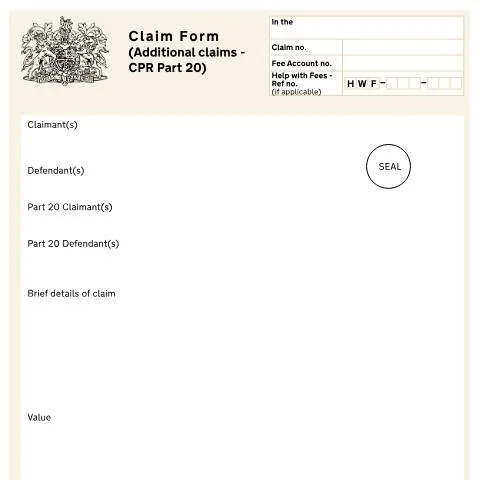
The N211 form follows the familiar structure of civil claim forms but incorporates specific fields addressing the complexities of multi-party litigation. Understanding each section's purpose prevents costly errors that could delay proceedings or result in struck-out claims.
Case Reference and Court Details
The header section requires the existing claim number from the original proceedings. This seemingly simple requirement often trips up litigants who assume they need a new claim number. The N211 operates as an extension of existing proceedings, not a fresh case, so the original claim number must be carried forward.
The fee account number and Help with Fees reference fields accommodate different payment methods. Legal representatives with established court fee accounts can reference their account numbers, while individuals may qualify for fee remissions under the Help with Fees scheme, requiring the HWF reference number obtained through separate application.
Party Designation Complexities
The form distinguishes between original parties and "Part 20 parties" – those brought into proceedings through the N211. This distinction matters for procedural purposes, as Part 20 defendants have different response timeframes and may face different case management directions.
When completing party details, precision is crucial. The Part 20 claimant is whoever initiates the additional claim (often the original defendant), while the Part 20 defendant is the new party being brought into proceedings. Incorrect party designation can create confusion about who owes what obligations to whom.
Claim Value and Fee Calculation
The claim value section requires careful consideration of what remedy is actually sought. In contribution claims, for instance, the value might be the proportion of damages the Part 20 claimant seeks to recover, not the full amount claimed in the original proceedings. This affects both court fees and case management track allocation.
Court fees for N211 forms follow the standard civil court fee structure based on claim value. However, additional administrative fees may apply when bringing new parties into proceedings, particularly in complex commercial cases requiring extensive case management.
Strategic Considerations in Multi-Party Litigation
Filing an N211 involves more than completing forms – it requires careful strategic analysis of how additional claims will affect the overall litigation landscape. Bringing new parties into proceedings can strengthen your position by spreading liability or providing alternative sources of compensation, but it also increases complexity and costs.
Case Management Implications
Courts increasingly scrutinise Part 20 claims for their impact on case management efficiency. Judges have broad discretion to refuse permission for additional claims that would cause disproportionate delay or expense. The key test is whether the additional claim is "convenient" to determine alongside the main claim.
Successful Part 20 applications typically demonstrate clear factual or legal connections to the original dispute. A personal injury claim arising from a road traffic accident might appropriately include claims between insurers about policy coverage, but would be less likely to accommodate unrelated contractual disputes between the parties.
Cost Consequences and Risk Assessment
Part 20 claims create additional cost exposure for all parties. The Part 20 claimant becomes liable for the Part 20 defendant's legal costs if the claim fails, while successful claims may result in cost orders against the new defendant. This cost risk must be weighed against the potential benefits of bringing additional parties into proceedings.
The proportionality principle under CPR Part 1 requires that additional claims must be proportionate to the amount at stake and the complexity of the issues. Courts will not permit Part 20 claims that transform straightforward disputes into unwieldy multi-party litigation without clear justification.
The Statement of Truth: Compliance and Consequences
The N211 form concludes with a statement of truth that carries the same legal weight as statements in any other civil proceedings. The signatory confirms their honest belief in the truth of the facts stated, with contempt of court proceedings possible for false statements made without honest belief.
For legally represented parties, the statement of truth may be signed by the legal representative, provided they are authorised to do so and clearly state their capacity. This authorisation should be documented in writing, as courts may require evidence of the representative's authority if the statement of truth is later challenged.
Signature Requirements and Authorisation
The form provides multiple signature options depending on the Part 20 claimant's circumstances. Individual claimants sign personally, while companies require signatures from authorised officers with their position clearly stated. Litigation friends sign on behalf of children or protected parties, requiring evidence of their appointment and authority.
Legal representatives signing statements of truth must ensure they have specific authorisation for this purpose, as general retainer agreements may not extend to verifying factual statements on behalf of clients. The representative's firm details, reference numbers, and contact information must be completed comprehensively to facilitate court communications.
Service Requirements and Procedural Compliance
Unlike original claims served on existing parties, Part 20 claims often involve serving proceedings on parties who have had no previous involvement in the litigation. This requires careful attention to service requirements under CPR Part 6, particularly for corporate defendants or individuals located outside England and Wales.
Service Methods and Timeframes
Part 20 defendants must be served with both the N211 form and all relevant documents from the original proceedings to understand the context of their involvement. This typically includes the original claim form, defence, and any case management directions already made. The deemed service provisions under CPR Part 6.14 apply, with service generally deemed effective on the second business day after posting by first-class mail.
Service outside the jurisdiction requires court permission under CPR Part 6.36, with specific grounds that must be established for Part 20 claims. The most common ground is that the additional claim relates to the subject matter of the original proceedings, but applicants must demonstrate a "real prospect of success" and that England and Wales is the appropriate forum for the dispute.
Response Obligations and Default Consequences
Part 20 defendants have 14 days from service to acknowledge service and a further 14 days to file their defence, following the same timeframes as original defendants. However, they may apply for extensions of time, particularly where they need to investigate complex factual allegations or obtain specialist legal representation.
Default judgment may be entered against Part 20 defendants who fail to respond within the prescribed timeframes, but the court retains discretion to set aside default judgments where defendants can show good reason for their failure to respond and an arguable defence to the Part 20 claim.
Case Management and Trial Coordination
Part 20 claims fundamentally alter case management dynamics, often requiring courts to coordinate multiple sets of proceedings with different parties, issues, and procedural stages. The overriding objective of dealing with cases justly and at proportionate cost becomes particularly challenging when additional parties enter established litigation.
Directions and Timetabling Challenges
Courts typically adjust case management directions when Part 20 claims are permitted, extending deadlines for disclosure, witness statements, and expert evidence to accommodate the additional complexity. However, this must be balanced against the interests of original parties who may face significant delays in resolving their disputes.
The case management conference becomes crucial for establishing how Part 20 claims will be managed alongside the main proceedings. Courts may order separate trials for different issues, split trials between liability and quantum, or require Part 20 claims to be determined as preliminary issues before addressing the main claim.
Effective case management often requires early identification of common issues between the main claim and Part 20 claims. Where factual disputes overlap significantly, joint disclosure exercises and shared expert evidence can reduce costs and avoid duplicated effort. However, where Part 20 claims raise distinct legal or factual issues, separate case management may be more appropriate.
Settlement Dynamics and Resolution Strategies
Multi-party litigation created through Part 20 claims often presents enhanced settlement opportunities, as parties may find resolution through arrangements that would be impossible in bilateral disputes. However, it also complicates settlement negotiations, as any agreement must address the interests of all parties and the interaction between different claims.
The court's case management powers include directing Alternative Dispute Resolution processes specifically designed for multi-party disputes. These may include structured settlement conferences where all parties attend simultaneously, or phased mediation addressing different aspects of the overall dispute separately.
Strategic Timing and Procedural Requirements for N211 Submissions
The timing of your Form N211 submission can significantly impact both the procedural pathway and the substantive outcome of your additional claim. Under CPR Part 20, the court distinguishes between claims made with and without permission, creating distinct procedural tracks that require careful consideration.
Automatic right period: You may file an additional claim without seeking the court's permission if you submit Form N211 before or when you file your defence to the original claim. This automatic right extends to situations where you're responding to a Part 8 claim procedure, though the timeframes may differ from standard Part 7 claims. The defence deadline typically falls 14 days after service of particulars of claim (or 28 days if you file an acknowledgment of service), making early preparation crucial.
However, the 'before or with defence' rule contains important nuances. If you're a defendant who has already filed a defence but subsequently identifies grounds for an additional claim—perhaps following disclosure or witness statement exchange—you'll need the court's permission. The court applies a multi-factor test when considering late applications, examining the strength of your proposed claim, any prejudice to other parties, and whether the delay was reasonable in the circumstances.
Permission-required scenarios: Applications made after defence filing must demonstrate compelling reasons for the delay. Courts typically scrutinise whether the additional claim could have been identified earlier through reasonable diligence. For instance, if your counterclaim relates to defective goods that were obviously faulty at the time of the original dispute, explaining why this wasn't raised initially becomes critical to obtaining permission.
The court's case management powers under CPR Part 3 also influence timing decisions. Where additional claims would significantly complicate proceedings or delay trial, judges may refuse permission or impose conditions such as separate trials or expedited case management directions. This is particularly relevant in commercial disputes where multiple parties and complex factual matrices are involved.
Service requirements and deemed dates: Once filed, Form N211 must be served on all relevant parties within specific timeframes. Service on the additional party (in third party claims) must occur within four months of filing, unless the court orders otherwise. However, service methods and deemed service dates follow the standard CPR Part 6 rules, meaning postal service is deemed effective on the second business day after posting, while email service (where permitted) is deemed effective on the next business day.
International service adds complexity, requiring consideration of service provisions under the Hague Convention or bilateral treaties. Where your additional claim involves parties in Scotland or Northern Ireland, cross-border enforcement mechanisms may apply, though these fall within the UK's unified legal framework.
Fill in your form directly online
No printing: type your details into the boxes of the official form, tick, then download the PDF ready to send.
- 1Type into the form boxes
- 2Tick in one click
- 3Save and download the PDF
Complex Multi-Party Scenarios and Contribution Claims
Form N211 becomes particularly intricate when multiple defendants seek contribution from each other or when cascading liability chains emerge. These scenarios, common in construction disputes, professional negligence claims, and product liability cases, require sophisticated case management and clear pleading strategies.
Contribution Act 1978 implications: When claiming contribution from co-defendants under the Civil Liability (Contribution) Act 1978, your Form N211 must establish both that you and the proposed contributor are liable to the claimant for the same damage, and that the contribution claim falls within the two-year limitation period. This period runs from the date of judgment or settlement against you, creating timing pressures that may conflict with the main action's progression.
The court's approach to contribution claims has evolved significantly following cases like Birse Construction Ltd v Haiste Ltd, where the Court of Appeal clarified that contribution claims survive even where the original claimant discontinues against one defendant. This means your N211 contribution claim remains viable even if the main claimant settles with or discontinues against the party from whom you seek contribution.
Percentage liability assessments: In multi-party contribution scenarios, courts must apportion liability between defendants based on their respective responsibilities for the damage. Your Form N211 should therefore include detailed allegations about each party's conduct, the causal relationship between their actions and the loss, and your proposed percentage allocation. This requires careful analysis of each defendant's role, from initial design decisions through to final implementation failures.
Professional defendants—such as architects, engineers, or solicitors—face particular challenges where their liability may be joint and several with contractors or other professionals. The court's assessment considers not just the severity of each party's breach, but also their respective roles in the overall project or transaction. A design professional who specifies inappropriate materials may bear greater responsibility than a contractor who merely follows those specifications, even where both breached their respective duties.
Indemnity versus contribution distinctions: Your N211 claim must clearly distinguish between seeking contribution (proportionate sharing of liability) and indemnity (complete reimbursement). Indemnity claims typically arise from contractual relationships where one party has agreed to hold another harmless, or where statute imposes strict liability on one party despite another's greater culpability.
Insurance considerations add another layer of complexity. Where defendants have different insurance arrangements—or where some lack coverage entirely—the court's contribution assessment may consider the practical ability to satisfy any judgment. However, insurance arrangements generally don't affect legal liability percentages, though they may influence settlement dynamics and case management decisions.
Case management in multi-party disputes: Courts increasingly use their case management powers to streamline multi-party additional claims. This may involve ordering preliminary issues trials to determine liability principles before addressing quantum, or requiring simultaneous exchange of expert evidence across all parties. Where your N211 significantly increases the dispute's complexity, expect robust case management directions that may include costs budgeting requirements and extended disclosure obligations.
Enforcement Mechanisms and Post-Judgment Procedures
Successfully obtaining judgment on your Form N211 additional claim represents only the beginning of the enforcement journey. The remedies available and enforcement mechanisms differ significantly depending on whether you've secured a money judgment, injunctive relief, or declaratory orders.
Money judgment enforcement options: Where your additional claim results in a money judgment—whether for damages, contribution, or indemnity—you gain access to the full range of enforcement mechanisms under CPR Parts 70-73. These include third party debt orders (formerly garnishee orders) against the judgment debtor's bank accounts, charging orders against their property, and attachment of earnings orders for employed debtors.
However, enforcement against additional parties requires careful consideration of their asset position and potential defences. A third party who successfully defended the main claim but faces liability under your additional claim may have different assets or financial circumstances than the original parties. This is particularly relevant where your additional claim brings in overseas entities or individuals with limited UK assets.
The interaction between enforcement against multiple judgment debtors requires strategic consideration. Where you hold joint and several judgments against the original defendant and an additional party, you may enforce against either or both until the full judgment is satisfied. However, any recovery from one judgment debtor reduces the amount recoverable from others, and the court may stay enforcement proceedings where there are ongoing contribution disputes between co-debtors.
Injunctive relief complexities: Additional claims seeking injunctive relief face particular enforcement challenges. Where your N211 seeks to restrain the additional party from specific conduct—such as continuing trademark infringement or maintaining a nuisance—enforcement typically involves committal proceedings for contempt of court if the injunction is breached.
The court's approach to injunctive relief in additional claims considers the balance of convenience not just between you and the additional party, but also the potential impact on the main proceedings. An injunction that effectively determines the main claim's outcome may be refused on case management grounds, even where it's otherwise justified on the merits.
Cross-border enforcement considerations: Where your additional claim involves parties in different UK jurisdictions or overseas, enforcement becomes significantly more complex. Judgments obtained in English courts are generally enforceable throughout the UK under the unified legal framework, but may require registration or recognition procedures in Scotland or Northern Ireland.
For overseas enforcement, the Hague Convention on Choice of Court Agreements and various bilateral treaties may apply, depending on the additional party's location and any jurisdiction clauses in relevant contracts. Brexit has complicated enforcement against EU-based additional parties, requiring consideration of the Hague Convention framework rather than the previously applicable Brussels Regulation mechanisms.
Costs recovery and detailed assessment: Successful additional claims generate potential costs recovery rights, but the interaction between main claim costs and additional claim costs requires careful analysis. Where you succeed on your additional claim but the main claimant succeeds against you, the court must consider whether your additional claim costs should be set off against the main claim costs order.
The proportionality test under CPR Part 44 applies with particular force to additional claims, where the costs of bringing in additional parties may exceed the financial benefit achieved. Courts increasingly scrutinise whether additional claims represent genuine attempts to resolve related disputes or tactical manoeuvres to increase pressure on the main claimant.
Detailed assessment proceedings under CPR Part 47 may involve multiple paying parties where your additional claim succeeds against several defendants. The court's approach to apportioning costs liability between multiple paying parties generally follows the same principles as substantive liability apportionment, though specific costs orders may create different allocation arrangements.