Commercial Court Claims Under CPR Part 8: A Specialised Gateway for Business Disputes
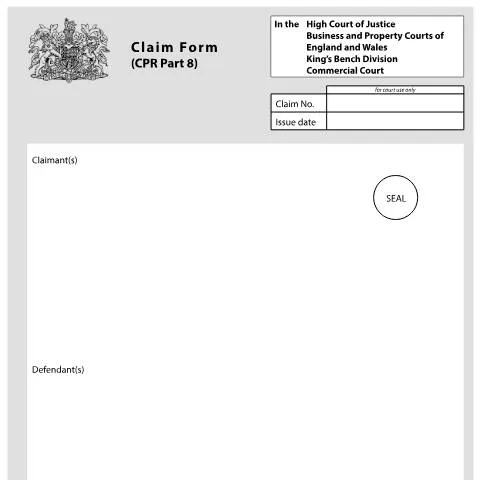
When commercial disputes reach a point where traditional negotiation fails, the Business and Property Courts of England and Wales offer a streamlined procedure through CPR Part 8 claims. Form N208 (CC) represents the gateway to this specialised jurisdiction, designed specifically for matters that require judicial determination without the need for extensive factual disputes or witness evidence. Unlike standard civil litigation, this procedure acknowledges that certain commercial questions—particularly those involving contractual interpretation, company law issues, or trust matters—benefit from direct judicial consideration rather than protracted adversarial proceedings.
The Commercial Court, housed within the magnificent Royal Courts of Justice at 7 Rolls Building, Fetter Lane, has evolved into one of the world's premier commercial dispute resolution forums. The N208 (CC) form serves as the formal mechanism to access this expertise, requiring claimants to present their case with precision and clarity from the outset. This approach reflects the court's expectation that commercial parties and their legal representatives understand both the substantive law and the procedural requirements necessary for efficient case management.
Understanding the Commercial Court's Distinctive Jurisdiction
The Commercial Court operates under a fundamentally different philosophy from general civil courts. Established to handle complex business disputes with commercial sensitivity and technical expertise, it attracts cases involving substantial financial stakes and sophisticated legal questions. The court's judges possess extensive commercial law experience, often drawn from leading commercial barristers who understand the practical realities of modern business.
CPR Part 8 procedure suits cases where the primary issue involves legal interpretation rather than factual investigation. Typical scenarios include:
- Construction of commercial contracts, particularly complex financing agreements or joint venture arrangements
- Directors' duties and shareholders' rights in corporate governance disputes
- Trust law questions affecting commercial structures or pension schemes
- Insurance coverage disputes where policy interpretation is paramount
- Professional negligence claims against solicitors, accountants, or other advisers where liability principles require clarification
The procedure deliberately excludes cases requiring extensive witness evidence or document disclosure. If factual disputes emerge during proceedings, the court may direct conversion to standard Part 7 proceedings, though experienced practitioners structure their Part 8 claims to avoid this outcome.
Navigating the Form N208 (CC) Structure and Requirements
Form N208 (CC) demands considerably more precision than standard claim forms. The document structure reflects the court's expectation that commercial claimants present their case comprehensively from initiation. Each section serves a specific purpose in the court's case management approach.
Essential Claimant and Defendant Information
The form requires complete identification of all parties, including corporate registration details for companies. Defendant identification proves particularly crucial as service requirements in commercial cases often involve multiple jurisdictions or complex corporate structures. The court expects claimants to verify defendant addresses through company searches or other reliable means, as incorrect service can invalidate proceedings entirely.
For international defendants, additional considerations apply regarding service outside the jurisdiction. While the N208 (CC) form itself doesn't address these complexities, claimants must ensure they comply with relevant service provisions before filing.
Crafting the Details of Claim Section
This section represents the heart of any Part 8 application. Unlike standard particulars of claim, the details must present both the legal questions requiring determination and sufficient factual background for the court to understand the commercial context. Successful Part 8 claims strike a careful balance between comprehensive legal argument and concise factual presentation.
The court expects claimants to identify specifically what declarations, orders, or determinations they seek. Vague requests for general relief rarely succeed in the Commercial Court's rigorous environment. Practitioners typically structure this section with numbered paragraphs addressing:
- The commercial relationship between parties and relevant contractual or statutory framework
- The specific legal issue requiring determination, often arising from contractual ambiguity or statutory interpretation
- Why the matter suits Part 8 procedure rather than standard litigation
- The precise relief sought, drafted with sufficient specificity to enable enforcement
Strategic Timing and Case Management Considerations
Commercial Court proceedings operate on accelerated timescales compared to standard civil litigation. The Admiralty and Commercial Registry, open from 10 am to 4:30 pm Monday to Friday, processes Part 8 claims with particular attention to case management efficiency. Initial directions hearings typically occur within weeks rather than months, reflecting the court's commercial sensitivity.
| Stage | Typical Timeframe | Key Requirements |
|---|---|---|
| Initial filing and service | Immediate upon filing | Proper defendant identification and service address verification |
| Acknowledgment of service | 14 days from service | Defendants must indicate whether they contest the claim |
| Case management directions | 4-6 weeks from filing | Court sets timetable for evidence and hearing preparation |
| Final hearing | 3-6 months from filing | Determined by case complexity and court availability |
The court's case management approach favours front-loaded preparation. Unlike standard litigation where disclosure and witness statements develop gradually, Part 8 procedure expects parties to present their complete legal arguments early in proceedings. This approach suits commercial parties who typically prefer certainty over protracted litigation timescales.
Evidence Requirements and Supporting Documentation
Part 8 claims in the Commercial Court rely primarily on documentary evidence and legal argument rather than witness testimony. The form N208 (CC) itself must be supported by a statement of case that presents both factual background and legal analysis. This requirement distinguishes commercial Part 8 claims from simpler applications in other courts.
Claimants typically support their applications with:
- Relevant contracts, corporate documents, or statutory materials central to the legal questions
- Correspondence between parties demonstrating the commercial dispute's development
- Expert reports on technical matters, though these require court permission and careful justification
- Comparative legal authorities from other jurisdictions, particularly valuable in international commercial law
The court discourages voluminous documentary exhibits unless directly relevant to the legal questions. Commercial Court judges expect practitioners to curate their evidence carefully, presenting only materials essential for legal determination. Excessive documentation often indicates that Part 8 procedure may be inappropriate for the dispute.
Statement of Truth: Professional Responsibility and Consequences
The statement of truth section carries particular weight in Commercial Court proceedings. The warning about contempt proceedings reflects the court's serious approach to professional standards and accurate case presentation. In commercial litigation, false or misleading statements can have severe consequences beyond individual cases, potentially affecting practitioners' professional standing and clients' commercial reputations.
Legal representatives signing on behalf of firms must ensure they possess proper authority and have conducted appropriate investigations. The Commercial Court's sophisticated clientele and high-stakes disputes mean that factual inaccuracies or procedural errors face intense scrutiny from opposing parties and the court itself.
Signature requirements vary depending on the representative's status. Partners in law firms typically sign directly, while employed solicitors may require specific authorisation. In-house legal teams representing corporate claimants must demonstrate clear authority to commence proceedings, often requiring board resolutions or similar corporate authorisations.
Costs, Fees, and Financial Implications
Commercial Court proceedings involve substantial court fees reflecting the specialised judicial resources required. The form indicates space for both court fees and legal representative's costs, acknowledging that commercial litigation typically involves significant professional expenses from initiation.
Part 8 proceedings generally follow standard costs principles, with unsuccessful parties bearing the winner's reasonable legal costs. However, the Commercial Court's approach to costs assessment reflects commercial litigation realities. Proportionality assessments consider the commercial stakes and complexity rather than applying standard county court approaches.
The court expects parties to consider alternative dispute resolution before commencing proceedings. While Part 8 procedure suits cases requiring judicial determination, the court may stay proceedings to encourage mediation or expert determination where appropriate. Unreasonable refusal to engage with alternative dispute resolution can affect costs awards, even in successful cases.
International Dimensions and Cross-Border Enforcement
The Commercial Court's international reputation means many Part 8 claims involve cross-border elements requiring careful procedural consideration. Form N208 (CC) applications frequently concern international contracts, foreign corporate structures, or disputes with enforcement implications across multiple jurisdictions.
Service outside England and Wales requires additional procedural steps not addressed in the basic form. Claimants must consider whether they need permission to serve foreign defendants and whether resulting judgments will achieve practical enforcement in relevant jurisdictions. The court's expertise in international commercial law makes it particularly suitable for cases involving complex jurisdictional questions or international arbitration issues.
Post-Brexit considerations add complexity to European enforcement, though the Commercial Court's judgments retain strong international recognition. Practitioners must carefully consider enforcement implications when structuring Part 8 claims involving international elements, ensuring that successful applications translate into practical commercial results.
Strategic Considerations for Complex Commercial Disputes
The Commercial Court's Part 8 procedure serves particularly well for disputes involving intricate contractual interpretation, professional negligence claims, and matters requiring urgent declaratory relief. When commercial parties face disagreements over contract terms—especially in construction, insurance, or financial services sectors—the streamlined Part 8 route often proves more cost-effective than traditional litigation.
Consider scenarios where parties dispute the meaning of force majeure clauses following unexpected events, or where insurance coverage disputes arise requiring judicial interpretation of policy wording. These situations typically benefit from Part 8's focus on legal argument rather than extensive fact-finding missions that characterise Part 7 claims.
The Commercial Court judges possess specialised expertise in commercial law, making them particularly suited to resolve disputes involving complex financial instruments, international trade terms, or sophisticated contractual arrangements. However, claimants must carefully assess whether their dispute genuinely requires only legal determination rather than contested evidence.
Professional negligence claims against solicitors, accountants, or financial advisers frequently proceed via Part 8 when the central issue concerns the proper interpretation of professional duties or regulatory requirements. Similarly, disputes over director's duties, shareholder rights, or company law matters often suit this procedure when the factual matrix remains largely undisputed.
Timing considerations prove crucial in commercial contexts. The Commercial Court's case management approach emphasises swift resolution, but parties must ensure they've completed necessary pre-action protocols and attempted alternative dispute resolution where appropriate. The court expects commercial parties to act reasonably and proportionately before commencing proceedings.
International elements add complexity to Part 8 claims in the Commercial Court. Jurisdiction questions, choice of law issues, and enforcement considerations require careful analysis. The court's experience with cross-border commercial disputes makes it well-equipped to handle these complexities, but claimants must present clear arguments on why English courts should determine the matter.
Procedural Pitfalls and Common Errors in Form N208 (CC)
Even experienced commercial practitioners encounter difficulties when completing Form N208 (CC), particularly in articulating the precise legal questions requiring determination. A common error involves framing issues too broadly, leading to case management directions that defeat Part 8's streamlined purpose.
Fill in your form directly online
No printing: type your details into the boxes of the official form, tick, then download the PDF ready to send.
- 1Type into the form boxes
- 2Tick in one click
- 3Save and download the PDF
The "Details of Claim" section demands particular attention. Unlike Part 7 particulars of claim, this section must clearly identify the specific legal questions whilst providing sufficient factual context. Practitioners often err by including excessive factual detail better suited to witness statements, or conversely, by providing insufficient background for the court to understand the legal issues.
Defendant identification presents unique challenges in commercial contexts. Multi-party disputes involving parent companies, subsidiaries, guarantors, or joint venture partners require careful consideration of who should properly be named as defendants. The form provides limited space for complex corporate structures, necessitating clear, concise identification that avoids later service difficulties.
Statement of truth requirements demand particular care in commercial contexts. The person signing must have direct knowledge of the facts stated, which can prove challenging in corporate environments where information spans multiple departments or jurisdictions. Companies should identify the most appropriate individual early in the process, ensuring they understand their responsibilities under the statement of truth provisions.
Remedy specification often proves inadequate in initial drafts. Commercial disputes may require multiple forms of relief—declarations, injunctions, damages, or specific performance. The form requires clear articulation of each remedy sought, with sufficient detail to enable defendants to understand the claim's scope and the court to make appropriate orders.
Supporting documentation attachments frequently cause problems. The Commercial Court expects parties to provide essential documents with the claim form, but excessive documentation can overwhelm the court and defendants. Practitioners must strike the right balance, including key contracts, correspondence, or regulatory materials whilst avoiding information overload.
Cost implications require careful consideration when completing the form. The court fee varies based on claim value, but commercial disputes often involve complex valuation issues. Understating claim value to reduce fees risks later cost consequences, whilst overstating values may trigger unnecessarily high initial costs.
Alternative Pathways and Strategic Exit Routes
Commercial parties initiating Part 8 proceedings must maintain awareness of alternative resolution pathways that may emerge during the litigation process. The Commercial Court actively encourages settlement discussions and alternative dispute resolution, even after proceedings commence.
Early Neutral Evaluation schemes operated by the Commercial Court offer valuable alternatives for parties seeking expert judicial input without full trial proceedings. These schemes work particularly well for Part 8 disputes involving technical legal questions where parties would benefit from provisional judicial views before committing to full litigation.
Mediation opportunities often arise naturally during Part 8 proceedings, particularly when initial case management directions clarify the legal issues and relative party positions. The court may stay proceedings to allow mediation, especially where commercial relationships require preservation or where ongoing contractual performance remains necessary.
Expert determination clauses in commercial contracts may provide alternative routes even after Part 8 proceedings commence. Parties should review their contractual arrangements carefully, as courts generally enforce properly drafted expert determination provisions, potentially making litigation unnecessary.
The Commercial Court's flexible case management approach allows for conversion between Part 8 and Part 7 procedures where circumstances change. If significant factual disputes emerge during initial case management, the court may direct conversion to Part 7, though this obviously affects timing and cost projections.
Arbitration considerations merit particular attention in international commercial disputes. Many commercial contracts contain arbitration clauses that may preclude court proceedings, whilst others provide options for either arbitration or litigation. Parties must carefully analyse their contractual position before proceeding with Part 8 claims.
Settlement opportunities often increase once Form N208 (CC) clarifies the legal issues in dispute. Defendants gain better understanding of the claimant's position, whilst claimants benefit from testing their arguments through the formal pleading process. This clarification frequently facilitates meaningful settlement discussions that might not have been possible pre-proceedings.
Regulatory resolution mechanisms may provide alternatives in certain commercial sectors. Financial services disputes might benefit from Financial Ombudsman Service involvement, whilst construction disputes could utilise adjudication procedures under the Construction Act. These sector-specific alternatives often prove faster and less expensive than court proceedings, though they may not provide the definitive legal precedent that Part 8 proceedings can establish.