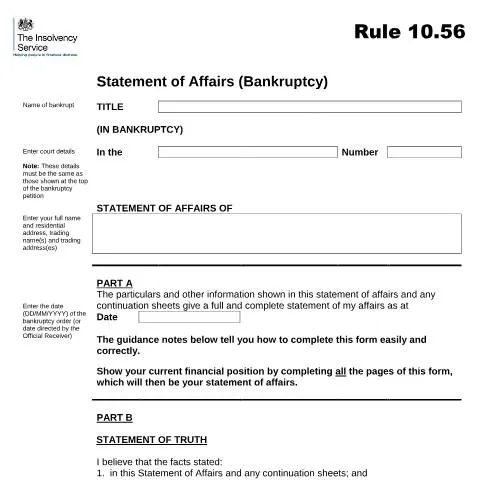
Understanding the Rule 10.55 and 10.56 Statement of Affairs: A Comprehensive Guide
When faced with bankruptcy in the UK, individuals often find themselves navigating a complex web of legal requirements, documentation, and potential consequences. One crucial document in this process is the Rule 10.55 and 10.56 Statement of Affairs, which forms a fundamental part of the bankruptcy proceedings. This statement not only offers a transparent insight into the bankrupt individual's financial standing but also serves as a key element in the statutory obligations set forth by The Insolvency Service.
The Key Role of the Statement of Affairs in Bankruptcy Proceedings
The Statement of Affairs is not merely a formality; it is pivotal in detailing an individual's financial circumstances as of a specific date, usually the date of the bankruptcy order. It aims to provide a comprehensive overview of the individual's assets and liabilities, thus allowing creditors and the Official Receiver to make informed decisions regarding the bankruptcy case.
The document serves multiple functions:
- Transparency: It ensures that all stakeholders are aware of the debtor's financial situation.
- Accountability: The individual is required to provide accurate information, which is crucial for the fair treatment of all creditors.
- Legal Compliance: Filing the Statement of Affairs is a legal requirement that must be adhered to in bankruptcy proceedings.
Who is Required to File the Statement of Affairs?
Primarily, the individual who has been declared bankrupt is responsible for completing and submitting the Statement of Affairs. However, there are specific circumstances and exceptions where other parties may also be involved:
Individual Bankrupts
The individual whose financial situation has led to bankruptcy is the primary filer. They must provide detailed information about their finances, which necessitates a thorough understanding of both their assets and debts.
Partnerships and Sole Traders
Individuals operating as partnerships or sole traders will need to complete this document to reflect their business-related debts alongside personal liabilities. In such cases, the business assets and debts must be distinguished from the personal financial situation.
Legal Representatives
In certain instances where individuals cannot complete the form themselves, such as due to mental incapacity or serious illness, a legal representative may be allowed to fill out the Statement of Affairs on their behalf.
Preparation: What You Need Before Filling Out the Form
Completing the Statement of Affairs requires careful preparation. Here’s what individuals should gather before embarking on this task:
Financial Documents
Relevant financial documentation is essential for accurately completing the form:
- Bank Statements: Recent bank statements will provide a clear picture of cash reserves.
- Loan Agreements: Details of any loans taken out, including amounts owed, repayment terms, and lenders.
- List of Assets: A comprehensive list of personal and business assets, along with their estimated values, is necessary.
- Debts: A detailed record of all unsecured and secured creditors must be compiled.
Understanding the Categories of Creditors
Individuals must differentiate between secured and unsecured creditors:
- Secured Creditors: These are creditors with a legal claim to specific assets (e.g., mortgage lenders).
- Unsecured Creditors: These creditors do not have a claim to specific assets and may include personal loans, credit cards, and utility bills.
A Step-by-Step Process for Completing the Statement of Affairs
Filling out the Statement of Affairs can be daunting, but breaking it down into manageable parts can facilitate the process:
Part A: Financial Position
This section includes crucial information about your financial status:
- Full name, address, and any business names.
- Date of bankruptcy order.
- Details of your current financial position.
Part B: Listing Creditors
In Part B, you will categorize your creditors:
| No. | Name of Creditor | Address | Amount Owed | Your Estimate |
|---|---|---|---|---|
| 1 | [Creditor Name] | [Creditor Address] | [Amount] | [Your Estimate] |
| 2 | [Creditor Name] | [Creditor Address] | [Amount] | [Your Estimate] |
Part C: Assets
Next, list all of your assets:
- Cash at bank
- Valuable personal items (e.g., vehicles, property)
- Outstanding debts owed to you
The Importance of Accuracy: Implications of Errors or Omissions
Completing the Statement of Affairs with accuracy is paramount. Inaccurate information can lead to significant repercussions:
Potential Consequences of Inaccuracy
- Legal Repercussions: Providing false information can lead to criminal charges, including bankruptcy fraud.
- Delayed Proceedings: Errors may result in delays in the bankruptcy process, compounding financial issues.
- Impact on Creditors: Misleading information can unfairly advantage or disadvantage creditors, which is against the principles of fair handling.
Understanding the Timeline: Key Dates and Deadlines
Time management is critical when preparing the Statement of Affairs:
Filing Deadlines
Once a bankruptcy order is made, the Statement of Affairs should ideally be submitted promptly:
- The form should be submitted to the Official Receiver as soon as possible.
- Keep in mind that any delays could affect how quickly creditors are notified.
Post-Submission Process
After submitting the Statement of Affairs, the following may occur:
- The Official Receiver reviews it, which may lead to further inquiries or requests for clarification.
- Creditors are notified and may respond with their claims, which will be considered during the bankruptcy proceedings.
Special Circumstances: Unique Situations in Filing the Statement of Affairs
There are unique cases where individuals may face additional challenges or considerations in the bankruptcy process:
Non-Residents and Foreign Nationals
Individuals who are not UK residents may encounter specific legal complexities:
- They may need to consult with legal experts familiar with international law and bankruptcy regulations.
- Understanding the implications of being a non-resident in bankruptcy proceedings is critical.
Minors and Incompetent Persons
In cases where minors or individuals with mental incapacities are involved:
- A legal guardian may be required to file the Statement of Affairs on their behalf.
- It’s vital to ensure that all filings adhere to legal standards to avoid future complications.
What to Do if Issues Arise: Handling Errors and Disputes
Should you find discrepancies in your filing or face disputes with creditors, here’s how to navigate the situation:
Errors in Submission
If an error is discovered post-submission:
- Contact the Official Receiver immediately to rectify the mistake.
- Keep documentation of all communications regarding the error for future reference.
Disputes with Creditors
In case of disputes:
- Engage in communication with the creditor(s) to resolve misunderstandings.
- If necessary, seek legal advice to protect your interests.
Navigating the Aftermath: What Comes Next After Filing
Following the submission of the Statement of Affairs, individuals may wonder what to expect next:
Official Receiver's Review
The Official Receiver will carry out a thorough review of the submitted documents:
- They may set up a meeting to discuss your financial situation further.
- It’s advisable to prepare additional relevant documentation that may be asked for during this review.
Potential Outcomes
Based on the review, several outcomes can follow:
- Approval of the bankruptcy proceedings and the distribution of assets to creditors.
- Further inquiries leading to more rigorous examination of certain claims or assets.
Distinguishing the Statement of Affairs from Other Forms and Documents
The Statement of Affairs can sometimes be confused with other forms related to insolvency. Understanding its specific role can clarify its importance.
Comparison with Other Documentation
| Document | Description | Purpose |
|---|---|---|
| Statement of Affairs | A detailed account of a bankrupt individual's financial position. | Transparency in the bankruptcy process. |
| Bankruptcy Petition | A formal request for bankruptcy declaration. | Initiates bankruptcy proceedings. |
| Creditors' Meeting Minutes | Documentation of discussions and decisions made during creditor meetings. | Records outcomes and agreements made between parties. |
Each of these documents plays a distinct role, and recognizing their differences is essential for anyone navigating the bankruptcy process.
In Closing: The Path Ahead in Bankruptcy
Completing the Rule 10.55 and 10.56 Statement of Affairs is a vital step for any individual facing bankruptcy. It may seem challenging, but with careful preparation, understanding of the requirements, and awareness of the implications, individuals can navigate this process more effectively. The goal remains clear: to achieve a fair and just resolution for all parties involved, moving towards financial stability in the future.
Understanding the Role of the Official Receiver in Bankruptcy Proceedings
The Official Receiver (OR) plays a pivotal role in the bankruptcy process in the United Kingdom. Appointed by the Insolvency Service, the OR is responsible for managing the affairs of the bankrupt individual. This includes the collection and distribution of assets, as well as investigating the circumstances leading to the bankruptcy. Understanding the OR's functions and powers can provide insight into how your Statement of Affairs (SA) may impact your financial future.
Upon filing for bankruptcy, the OR will review your Statement of Affairs to ascertain the totality of your financial situation. This involves a thorough examination of your liabilities, assets, and any income you may have. The OR has the authority to seize assets if they are deemed non-exempt, and they can also investigate transactions made prior to the bankruptcy filing that may have been intended to defraud creditors. Such investigations are crucial for ensuring that all creditors receive fair treatment during the bankruptcy process.
Additionally, the OR is responsible for ensuring compliance with the provisions set out in the Insolvency Act 1986. Their role extends to providing advice and guidance to bankrupt individuals regarding their rights and obligations. This includes informing you about the consequences of bankruptcy, such as the impact on your credit rating and the potential for restrictions on certain professions. It is vital to remain communicative with the OR throughout the bankruptcy process, as they can provide valuable insights into managing your financial recovery.
Consequences of Failing to Submit an Accurate Statement of Affairs
The Statement of Affairs is not only a financial document but also a legal obligation. Failing to submit an accurate SA can have serious repercussions. If inaccuracies or fraudulent information are identified, the Official Receiver can take action that may include extending the period of bankruptcy or even criminal proceedings. This can lead to additional stress and complications, further exacerbating an already challenging financial situation.
It's crucial to understand that your credibility as a debtor hinges on the transparency and accuracy of the information provided in your Statement of Affairs. The OR relies heavily on this document to determine the appropriate course of action regarding asset distribution and creditor claims. Misrepresentation of any kind, whether intentional or unintentional, can lead to harsher penalties. You may face restrictions on your ability to obtain credit in the future, or even personal liability for any losses suffered by creditors.
Moreover, if the Official Receiver deems that you have acted dishonestly, you may be facing bankruptcy restrictions for longer than the usual one year period. This can severely limit your financial options and opportunities for rebuilding your credit. Therefore, ensuring that your Statement of Affairs is comprehensive and truthful is crucial not only for your current bankruptcy proceedings but also for your long-term financial health.
How to Prepare for Your Bankruptcy Hearing
Preparing for your bankruptcy hearing can seem daunting, but taking the right steps can help ease the process. Prior to the hearing, you must ensure that your Statement of Affairs is meticulously completed and submitted to the Official Receiver. This document serves as the foundation of your case and will be scrutinized during the hearing. Gather all relevant financial documents, including bank statements, pay slips, and any legal correspondence related to your debts, to substantiate your claims.
It is also advisable to consider consulting with a licensed insolvency practitioner. They can provide you with tailored advice specific to your situation and help you navigate the complexities of the hearing process. They can also assist in preparing you for potential questions that may arise regarding your finances and decision-making leading up to the bankruptcy.
During the bankruptcy hearing, you will be given the opportunity to explain your financial situation in detail. Be prepared to discuss your Statement of Affairs openly and honestly. Transparency is critical, as any reluctance to provide information can raise red flags for the Official Receiver and may affect their decisions.
Lastly, consider the emotional aspect of the hearing. Bankruptcy can be a stressful experience, and it is important to approach the situation with a clear mind. Take time to prepare mentally for the hearing, and if necessary, seek support from friends, family, or professional counseling services. Understanding your rights and obligations can also bolster your confidence during the proceedings.