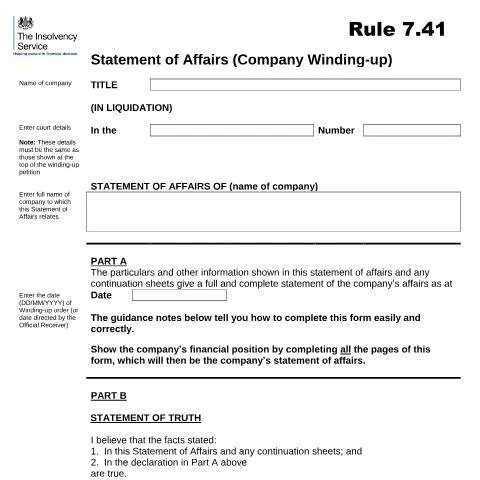
Understanding the Rule 7.41 Statement of Affairs: A Crucial Document in Company Liquidation
The journey of a company facing liquidation can be daunting, and the Rule 7.41 Statement of Affairs plays a pivotal role in navigating these turbulent waters. As companies find themselves unable to meet their financial obligations, this document serves as a comprehensive disclosure of the company's financial position at the point of winding-up. This particular form is lodged with the court and informs creditors and stakeholders about the company’s assets, liabilities, and overall financial standing. It is essential that companies approach this task with diligence and accuracy, as the implications of this submission can significantly affect the outcome of the liquidation process.Legal Foundations: The Framework Surrounding Rule 7.41
The Rule 7.41 Statement of Affairs is grounded in the Insolvency Act 1986, particularly within the framework of company winding-up procedures. This act provides the legal basis for the appointment of liquidators and the processes they must follow. Understanding the underlying regulations can help companies better navigate the complexities of insolvency. Moreover, the significance of this document is underscored by the responsibilities it imposes on directors and other stakeholders. The Insolvency Service outlines that the Statement of Affairs must be complete, truthful, and timely, as incorrect or misleading information might result in serious ramifications, including potential legal consequences for directors.The Role of the Insolvency Practitioner: Who Files the Statement?
Typically, the filing of the Rule 7.41 Statement of Affairs is the responsibility of the appointed liquidator or insolvency practitioner. This professional, either appointed by the court or selected by the company’s directors, serves as the intermediary between the liquidated company and its creditors. The insolvency practitioner must gather all relevant financial documents and seek input from directors and company officers to compile an accurate picture of the company’s financial affairs. Therefore, it is crucial for all parties involved to cooperate fully to ensure the document’s accuracy and completeness.Navigating the Completion of the Statement: A Step-by-Step Guide
Completing the Rule 7.41 Statement of Affairs requires meticulous attention to detail. The form comprises several sections that must be filled out accurately:A – Summary of Assets
This section requires a listing of all the company’s assets, including both tangible and intangible properties.- Assets subject to fixed charge: Identify assets that have been pledged as collateral against specific loans.
- Assets subject to floating charge: Include assets not fixed but that can be claimed by creditors upon liquidation.
- Uncharged assets: List assets with no claims against them.
B – Summary of Liabilities
Here, the company must list its liabilities, differentiating between preferential creditors, floating charge holders, and unsecured creditors.| Type of Creditor | Estimated Value (£) |
|---|---|
| Preferential Creditors | *Insert value* |
| Floating Charge Holders | *Insert value* |
| Unsecured Creditors | *Insert value* |
C – Creditor Information
The creditor section of the form is crucial. It must clearly indicate the name, address, and amount owed to each creditor, along with any security held by them. When identifying creditors, it is essential to omit consumer creditors and employees in the initial creditor list, as they will be captured in separate sections. This separation ensures clarity and prevents confusion in the liquidation process.Tackling Errors and Missing Information: What to Do Next
In the event that the Rule 7.41 Statement of Affairs is rejected due to errors or missing information, it is imperative to act swiftly. The liquidator will typically notify the company or the insolvency practitioner to correct the submitted information.Common Pitfalls to Avoid
When filling out the form, watch out for:- Inaccurate asset valuation: Ensure that all valuations reflect realistic market values.
- Incomplete creditor lists: Double-check that all creditors have been included.
- Missing signatures: The form must be signed and dated by the liquidator to validate the submission.
The Submission Process: Channels for Filing the Statement
Once the Statement of Affairs is completed, it must be submitted to the appropriate court. The modes of delivery can vary:Online Submission
If the court allows electronic filings, this can be a convenient way to submit the document, ensuring that you receive an immediate acknowledgment of receipt.Postal Submission
Alternatively, documents can be sent via registered post. This method provides a physical tracking option, ensuring proof of submission.In-Person Filing
For those preferring a more personal approach, delivering the form directly to the court can facilitate a quicker response and clarification of any immediate queries. Regardless of the method chosen, ensuring that the submission is completed by the stipulated deadline is essential to avoid further complications in the winding-up process.Preparing Supporting Documents: What to Include and How to Organize
Beyond the Statement of Affairs itself, additional documentation may be required to support the filing.- Financial Statements: Provide recent balance sheets and profit and loss statements that paint a clear picture of the company's financial health.
- Previous Tax Returns: Include tax documentation to support revenue claims and asset valuations.
- Debtor Lists: Document all outstanding debts to substantiate the listed liabilities.
Implications of the Statement: Rights and Responsibilities of Stakeholders
Understanding the implications of the Rule 7.41 Statement of Affairs is crucial for all stakeholders involved.For Company Directors
Directors are responsible for ensuring that the information disclosed in the Statement is accurate and complete. Failure to do so could lead to accusations of misconduct or negligence, along with potential legal consequences.For Creditors
The Statement provides creditors with a comprehensive overview of the company’s financial standing, which they can use to gauge their likelihood of recovery. This document also allows them to make informed decisions regarding any claims they may pursue against the company. In summary, the Rule 7.41 Statement of Affairs is not merely a formality; it is a crucial element of the winding-up process that demands careful attention and accuracy. By grasping its significance and adhering to regulatory requirements, companies can navigate the complexities of liquidation more effectively, safeguarding the interests of all parties involved.Understanding the Role of a Rule 7.41 Statement of Affairs in Company Winding-Up
The Rule 7.41 Statement of Affairs is a critical document in the process of company winding-up in the UK. It provides a comprehensive overview of a company's financial situation at the point of insolvency. This statement is not merely a formality; it is a vital tool that allows creditors, the liquidator, and the court to assess the financial health and obligations of the company.
Essentially, this statement details all of the assets and liabilities of the company, including information about any secured and unsecured creditors. The accuracy and completeness of this document are paramount, as it forms the backbone of the liquidation process. Under the Insolvency Act 1986, directors are obligated to prepare this statement within 14 days after the company enters into liquidation. Failure to comply can have serious implications, including potential penalties for directors.
When drafting a Rule 7.41 Statement of Affairs, it must include several key components:
- Assets: A detailed summary of all tangible and intangible assets owned by the company must be listed. This includes property, equipment, and intellectual property.
- Liabilities: Directors should itemize all outstanding debts, distinguishing between secured and unsecured creditors.
- Estimated realizable value: In conjunction with the assets, directors must provide an estimated value of how much the assets could realistically fetch in a liquidation scenario.
- Creditor details: A breakdown of both the creditor’s names and the amounts owed must be provided to illustrate the company's overall financial obligations.
- Director’s declaration: The directors must make a declaration that the information contained within the statement is accurate and honest to the best of their knowledge.
For those involved in the liquidation process, understanding the nuances of the Rule 7.41 Statement of Affairs can significantly influence the outcome of the winding-up process. The detail and precision included in this statement can affect not only the distribution of assets but also the potential for recovery for creditors.
Common Pitfalls When Preparing a Rule 7.41 Statement of Affairs
While the Rule 7.41 Statement of Affairs serves a vital role in the winding-up process, there are common pitfalls that individuals and companies often encounter. Recognising these can help ensure compliance and minimize complications.
One of the most prevalent issues is the undervaluation of assets. When directors either intentionally or unintentionally undervalue company assets, it can lead to substantial discrepancies when it comes to distributing assets among creditors. Accurate valuations are essential not only for ensuring fair treatment of creditors but also for adhering to legal responsibilities.
Another significant pitfall involves failing to disclose all liabilities. Some directors may overlook certain debts, particularly those arising from informal lending arrangements or personal guarantees. This oversight can lead to legal consequences, as the Insolvency Act requires complete transparency regarding all financial obligations.
In addition, directors often miscalculate the estimated realizable values of assets. This can happen due to a lack of understanding of the liquidation process or market conditions. Engaging a professional valuer can mitigate this risk and provide a more accurate assessment of asset values.
Moreover, there are legal obligations surrounding the timing and submission of the Rule 7.41 Statement of Affairs. Directors must remember that submitting the statement late can result in penalties and further complications in the winding-up process. The submission must be done within the stipulated timeframe, which is typically 14 days post-commencement of the liquidation process.
To avoid these pitfalls, it is recommended that directors seek the assistance of insolvency practitioners or legal advisors who specialize in corporate insolvency. Their expertise can guide companies through the complexities of the winding-up process, ensuring that the Rule 7.41 Statement of Affairs is completed accurately and on time.
Implications of Non-Compliance with Rule 7.41 Statements of Affairs
The implications of failing to comply with the requirements surrounding the Rule 7.41 Statement of Affairs can be severe. Both directors and the company itself can face legal and financial repercussions that extend beyond the immediate context of the winding-up process.
One of the primary consequences of non-compliance is the potential for personal liability for directors. If it can be shown that directors acted with negligence in preparing the statement, or if they failed to disclose critical information, they may be held personally liable for the debts incurred by the company. This is particularly true in instances of wrongful trading, where directors continued to trade while the company was insolvent.
Moreover, the liquidator may take legal action against directors for misrepresentation or failure to comply with statutory obligations. This can lead to prolonged legal battles, damaging not only the director's reputation but also their financial stability.
Additionally, creditors may feel justified in pursuing claims against directors personally, which can lead to bankruptcy proceedings against the individuals involved. This is a stark reminder of the importance of transparency and accuracy when compiling a Rule 7.41 Statement of Affairs.
Another less obvious implication involves the potential for increased scrutiny from regulatory bodies. If a company appears to have unresolved issues regarding its Rule 7.41 Statement of Affairs, this can lead to investigations by entities such as The Insolvency Service or HMRC. These bodies are tasked with enforcing compliance and can impose sanctions or penalties for non-compliance.
In summary, the consequences of not adhering to the requirements of the Rule 7.41 Statement of Affairs are far-reaching and serious. It is crucial for those involved in the winding-up process to fully understand their legal obligations and to prioritize accuracy and compliance when preparing this essential document. Seeking professional advice can help mitigate risks and ensure that the winding-up process proceeds as smoothly as possible.