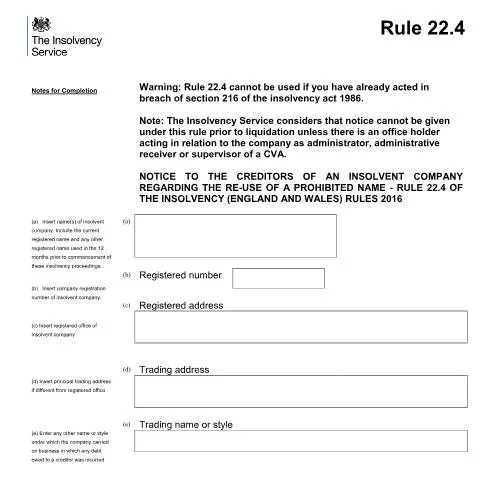
Understanding Section 216 Restrictions: When Directors Face Name Prohibition
When a company enters insolvent liquidation, directors face significant restrictions under section 216 of the Insolvency Act 1986. These provisions prevent former directors from immediately setting up new ventures using the same or similar company names, effectively creating a prohibited name regime that can last up to five years. However, Rule 22.4 of the Insolvency (England and Wales) Rules 2016 provides a crucial exception mechanism—but only when properly implemented through formal creditor notification.
The Rule 22.4 notice represents a statutory escape route that allows directors to continue trading under what would otherwise be prohibited names, provided they follow strict procedural requirements. This document serves as both a declaration of intent and a protective mechanism, but its effectiveness depends entirely on proper completion and timely distribution to creditors.
Critically, this notice cannot retrospectively cure breaches that have already occurred. Directors who have acted without permission face potential criminal liability and unlimited personal liability for debts incurred by successor companies. The timing and circumstances of giving notice therefore become paramount considerations.
Decoding the Two-Track Approach: Pre-Liquidation versus Post-Liquidation Scenarios
The Rule 22.4 notice operates through two distinct pathways, each addressing different insolvency scenarios and requiring different procedural approaches. Understanding which section applies determines not only the completion requirements but also the legal consequences of the notice.
Section A: Companies Under Formal Insolvency Procedures
Section A applies when a company has entered administration, administrative receivership, or is subject to a Company Voluntary Arrangement (CVA) but has not yet proceeded to insolvent liquidation. This represents the most advantageous timing for directors, as it provides maximum flexibility and protection.
The Insolvency Service's position is clear: notice under this section requires an office holder to be acting in relation to the company. This means directors cannot simply give notice speculatively—there must be a formal insolvency appointment. The office holder's presence provides oversight and ensures the notice serves legitimate business rescue purposes rather than abuse avoidance.
Directors using Section A can indicate they are already acting in prohibited ways or intend to act in such ways should the company subsequently enter insolvent liquidation. This forward-looking protection proves invaluable when business continuity requires immediate action under potentially prohibited names.
Section B: Post-Liquidation Declarations
Section B applies after insolvent liquidation has commenced, creating a more restrictive framework. Directors must have served during the 12 months preceding liquidation and can only declare future intentions—not retrospectively legitimise actions already taken.
The post-liquidation pathway offers less flexibility but remains essential when pre-liquidation notice was not feasible. However, directors must exercise extreme caution, as any prohibited activities undertaken between liquidation and proper notice delivery remain unlawful.
Navigating the Prohibited Name Minefield: What Constitutes Similarity
Section 216 restrictions extend beyond identical names to encompass names that are "so similar as to suggest an association" with the insolvent company. This creates a grey area that requires careful analysis of multiple factors.
| Similarity Factor | Risk Level | Considerations |
|---|---|---|
| Identical trading name | High | Automatic prohibition unless excepted |
| Minor spelling variations | High | Courts look at overall impression |
| Different legal form (Ltd/PLC) | Medium | Substance over form approach |
| Geographic or descriptive additions | Medium | Depends on prominence of core name |
| Completely different name | Low | No restriction unless other connections exist |
The notice must capture all names used by the insolvent company during the 12 months prior to insolvency proceedings, including registered names, trading names, and business styles under which debts were incurred. This comprehensive approach reflects the legislation's purpose of preventing directors from simply rebranding to continue business while leaving creditors unpaid.
Courts apply a commercial reality test, examining whether the name would give creditors or the public the impression of continued association with the failed company. Even substantial changes may not provide protection if the core identifying elements remain recognisable.
Creditor Notification Requirements: Ensuring Legal Compliance
The Rule 22.4 notice must reach all creditors of the insolvent company, but the practical mechanics of achieving comprehensive distribution present significant challenges. The effectiveness of the entire procedure depends on meeting these notification requirements.
Creditors for these purposes include not just unsecured trade creditors, but also secured creditors, preferential creditors, employees with claims, and contingent creditors. The director giving notice bears responsibility for identifying and reaching this diverse group, often without access to complete company records.
Timing Considerations and Practical Delivery
While the rules do not specify a minimum notice period, the underlying purpose suggests creditors require meaningful opportunity to respond or take protective action. Delivering notice simultaneously with prohibited activities may fail to achieve the rule's protective objectives.
The notice should accompany the statutory statement explaining section 216's effects, as prescribed by Rule 22.5. This explanatory statement clarifies the scope of prohibited activities and the purpose of the notice, helping creditors understand their position.
Directors often struggle with practical delivery methods, particularly for large creditor bases or when company records are incomplete. While the rules do not mandate specific delivery methods, directors should maintain evidence of distribution attempts to demonstrate compliance efforts.
Business Continuity Strategies: Legitimate Uses and Commercial Rationale
The Rule 22.4 exception serves legitimate business rescue purposes, but directors must demonstrate genuine commercial rationale beyond mere name preservation. The most defensible scenarios involve continuation of viable business operations that preserve employment and creditor value.
Established customer relationships often justify name continuation, particularly where brand recognition represents significant commercial value. Professional service firms, retail operations with local recognition, or manufacturing businesses with established supply chains may legitimately require name continuity for operational viability.
Asset Purchases and Business Transfers
The notice commonly facilitates business transfers where directors acquire assets from the insolvent company and continue operations through new corporate vehicles. This structure can preserve going concern value while providing creditors with transparent disclosure of the arrangements.
However, directors must ensure proper separation between the failed entity and successor operations. Creditors may challenge arrangements that appear designed primarily to avoid liabilities rather than preserve genuine business value.
Employment continuity provides another legitimate rationale, particularly where TUPE regulations apply or where specialist skills would be lost through business cessation. Directors should document employment preservation benefits when justifying name continuation.
Enforcement Consequences and Risk Management
Breaching section 216 carries severe consequences that extend well beyond regulatory sanctions. Directors face both criminal liability and unlimited personal liability for debts incurred by companies using prohibited names.
The criminal offence carries potential imprisonment up to two years and unlimited fines. More significantly for commercial purposes, personal liability extends to all debts incurred by the successor company during the breach period, creating potentially catastrophic financial exposure.
Personal Liability Mechanisms
Section 217 of the Insolvency Act 1986 creates automatic personal liability for company debts where directors breach section 216 restrictions. This liability applies regardless of whether creditors suffer additional prejudice, making it a strict liability regime.
The liability extends to anyone involved in the management of the successor company who knows about the breach, potentially catching other directors, managers, or advisers. This creates compliance obligations beyond the original restricted director.
Courts have consistently rejected arguments that technical compliance or lack of creditor prejudice should limit liability. The statutory scheme operates automatically once breach is established, emphasising the importance of proper Rule 22.4 compliance.
Professional Guidance and Implementation Strategy
Given the complexity and severe consequences of section 216 breaches, directors should approach Rule 22.4 notices with appropriate professional support. The document itself provides a framework, but successful implementation requires careful analysis of specific circumstances.
Insolvency practitioners often coordinate notice procedures as part of broader restructuring strategies. Their involvement provides credibility with creditors and ensures integration with formal insolvency processes. However, directors retain personal responsibility for compliance decisions.
Legal advisers can assess name similarity risks and advise on timing strategies. The interaction between section 216 restrictions and other regulatory requirements—such as company law, employment law, and sector-specific regulations—often requires specialist analysis.
Directors should maintain comprehensive records of notice procedures, including creditor identification efforts, distribution methods, and any responses received. These records provide evidence of compliance efforts and may prove crucial if challenges arise.
The Rule 22.4 notice represents a valuable statutory protection, but its effectiveness depends entirely on proper implementation within the broader framework of insolvency law. Directors who understand both the opportunities and limitations of this procedure can navigate section 216 restrictions while preserving legitimate business interests and avoiding personal liability.
Timing and Service Requirements for Rule 22.4 Notices
The effectiveness of a Rule 22.4 notice hinges critically on proper timing and service, with strict requirements that directors must navigate carefully to avoid inadvertent breaches of s216. The notice must be served on all creditors of the liquidating company, but the definition of "creditor" extends beyond those with proven claims to include contingent and prospective creditors who may have dealings with the company.
Service must occur before any use of the prohibited name commences. This creates a practical challenge for directors planning to establish successor businesses, as they cannot begin trading under the proposed name until all creditors have been properly notified. The Insolvency Service guidance emphasises that "before" means the notice must be received by creditors, not merely posted, which places the burden on directors to ensure actual delivery.
For creditors with known addresses, service typically occurs by first-class post to their last known address, with deemed service occurring two business days after posting. However, directors must exercise reasonable diligence in ascertaining current addresses, particularly for trade creditors who may have relocated. Where creditors are companies that have themselves entered insolvency proceedings, service should be directed to their appointed insolvency practitioner.
The challenge intensifies with unknown or untraced creditors. Rule 22.4 permits advertisement in the London Gazette as an alternative service method, but this must be accompanied by advertisement in a newspaper circulating in the locality where the company's principal place of business was situated. The advertisement must contain the essential information required by the rule and allow a reasonable period for creditors to respond before name usage begins.
Creditors who emerge after proper service has been completed present a particular consideration. While the director may proceed with using the prohibited name following compliant service, newly discovered creditors retain rights under s216, and the director's protection depends on demonstrating that reasonable efforts were made to identify all creditors at the time of service.
Electronic service methods require express creditor consent and must comply with the Electronic Communications Act 2000. Email service without prior agreement does not satisfy Rule 22.4 requirements, regardless of whether the creditor actually receives the notice. This reflects the serious nature of s216 obligations and the need for certainty in the service process.
Creditor Objections and Response Mechanisms
Rule 22.4 establishes a framework for creditor engagement that goes beyond mere notification, creating a structured process for objections and responses that directors must carefully manage. Creditors receiving a Rule 22.4 notice possess specific rights to object to the proposed name usage, though the statutory framework does not explicitly detail the consequences of such objections.
Creditor objections typically arise from concerns about potential confusion in the marketplace, difficulties in pursuing claims against directors, or suspicions about phoenix trading activities. A creditor might object where the proposed new business operates in the same sector and geographic area as the failed company, particularly if using similar branding or marketing approaches alongside the prohibited name.
The notice period allows creditors to seek clarification about the director's intentions and the nature of the proposed business. Creditors may request additional information about funding sources, business plans, or safeguards for creditor interests. While directors are not legally obligated to provide extensive detail beyond the Rule 22.4 requirements, practical considerations often favour transparency to reduce objections.
Where creditors raise legitimate concerns, directors may choose to modify their proposals or provide additional assurances. This might include agreeing to use distinguishing features in branding, limiting the geographic scope of operations, or providing guarantees for certain categories of debt. Such arrangements, while not legally required, can demonstrate good faith and reduce the risk of subsequent legal challenges.
Some creditors may attempt to use the objection process as leverage for debt recovery or preferential treatment. Directors should be aware that Rule 22.4 does not create any obligation to satisfy creditor demands beyond the notice requirements. However, creditors retain their underlying rights to pursue directors for breach of s216 if they believe the statutory conditions have not been met.
The absence of a formal objection does not necessarily provide complete protection for directors. Courts have established that creditor silence cannot cure fundamental defects in the Rule 22.4 process, such as inadequate disclosure or failure to serve all relevant creditors. Directors must ensure substantive compliance with the rule's requirements regardless of creditor response levels.
Record-keeping becomes crucial during the objection period. Directors should maintain comprehensive records of all communications with creditors, including objections received, clarifications provided, and any modifications made to proposals. These records may prove essential if the validity of the Rule 22.4 process is subsequently challenged in court proceedings.
Practical Considerations for Complex Corporate Structures
Rule 22.4 compliance becomes significantly more complex when dealing with corporate groups, holding companies, or businesses with intricate ownership structures. Directors of subsidiary companies may find themselves caught between competing obligations to different entities within the group, while the prohibited name restrictions can have unexpected consequences for related businesses.
Group company scenarios present particular challenges where a subsidiary enters insolvent liquidation but continues to trade under licence from a parent company holding the trademark. The subsidiary's directors cannot simply assume that group relationship provides protection from s216. Each company within the group must be treated as a separate legal entity, and directors must serve Rule 22.4 notices in their capacity as directors of the specific liquidating company.
Holding companies face distinct considerations where subsidiaries fail while the parent continues trading. If the holding company wishes to use a name similar to that of the failed subsidiary, directors must carefully assess whether s216 applies to their situation. The key test remains whether they were directors of a company that has gone into insolvent liquidation and subsequently wish to use a prohibited name.
Franchise arrangements create additional complexity, particularly where the franchisor continues operating while a franchisee company enters insolvent liquidation. Directors of the failed franchisee cannot automatically rely on the franchisor's continued use of the brand name to justify their own usage without proper Rule 22.4 compliance. The commercial relationship between franchisor and franchisee does not override the statutory requirements.
Partnership structures involving corporate partners present unique challenges where one partner company enters liquidation. The continuing partnership may wish to trade under a name incorporating elements of the failed partner's name, but directors of the liquidating company must ensure proper compliance if they remain involved in the partnership's management.
Asset purchase scenarios frequently involve name usage issues where directors acquire the business and assets of their former company through a new entity. While this is a legitimate commercial structure, directors must ensure that any use of names similar to the original company complies with s216. The fact that they have purchased the assets does not automatically confer rights to use prohibited names without following proper procedures.
Management buyout situations present similar considerations, particularly where the buying team includes former directors of the failed company. The new ownership structure does not eliminate s216 obligations for directors who were in post when the original company entered insolvent liquidation. Each director's personal exposure must be assessed individually, regardless of their role in the buyout transaction.
Cross-border elements add further complexity where companies operate across multiple jurisdictions. UK directors of companies incorporated abroad may still face s216 restrictions if those companies enter insolvency proceedings equivalent to UK liquidation. Conversely, directors of UK companies may need to consider how s216 affects their ability to use similar names in overseas operations.