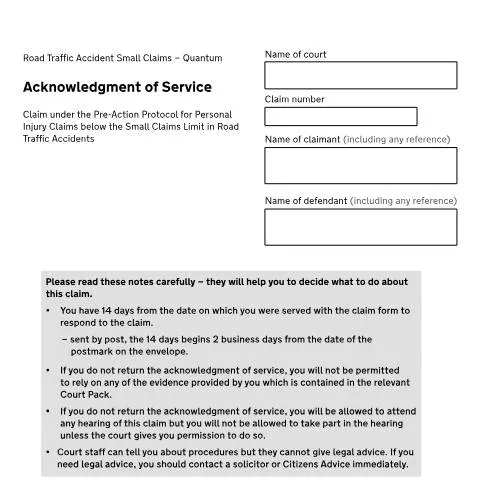
Understanding the RTAASQ Framework: When Road Traffic Accident Claims Enter the Court System
When personal injury claims arising from road traffic accidents cannot be resolved through the Pre-Action Protocol for Personal Injury Claims below the Small Claims Limit, they progress into formal court proceedings. The Road Traffic Accident Small Claims – Quantum (RTAASQ) acknowledgment of service represents a critical juncture in this process, where defendants must formally respond to claims that have moved beyond pre-litigation settlement attempts.
This document serves as the defendant's first formal response once HM Courts & Tribunals Service has issued proceedings. Unlike standard acknowledgment forms used across the civil courts system, the RTAASQ specifically addresses the unique procedural requirements that apply to road traffic accident claims under £10,000, incorporating the specialised protocol framework that governs these disputes.
The form's structure reflects the quantum-focused nature of these proceedings, where liability has typically been established or is not in dispute, and the court's primary task involves determining the appropriate level of compensation. This procedural refinement represents a significant development in how the courts handle the substantial volume of minor road traffic accident claims that would otherwise overwhelm the traditional litigation system.
The Critical 14-Day Response Window: Timing and Consequences
The RTAASQ operates under strict temporal constraints that defendants ignore at their peril. From the moment of service, defendants have precisely 14 days to file their acknowledgment, with postal service extending this deadline by two business days from the postmark date. This seemingly straightforward timeline carries profound implications for a defendant's ability to participate meaningfully in the proceedings.
Failure to respond within this window triggers a cascade of procedural consequences that fundamentally alter the defendant's position. Most critically, defendants who miss this deadline forfeit their right to rely on any evidence they provided during the pre-action protocol phase, effectively silencing their voice in the quantum assessment process. While they retain the right to attend hearings, their participation becomes subject to the court's discretion, transforming them from active participants into passive observers unless judicial permission is granted.
| Response Status | Evidence Rights | Hearing Participation |
|---|---|---|
| Timely acknowledgment filed | Full reliance on protocol evidence | Automatic right to participate |
| Late or no acknowledgment | Protocol evidence excluded | Court permission required |
| Late with court permission | Limited evidence rights | Restricted participation |
This rigid framework reflects the courts' determination to maintain the efficiency gains achieved through the RTA Small Claims Protocol. By penalising procedural non-compliance, the system incentivises defendants to engage properly with both the pre-action process and subsequent court proceedings.
Navigating Section A: Quantum Disputes and Protocol Compliance Challenges
Section A of the RTAASQ form addresses the most common scenario in RTA small claims: cases where liability is accepted but the quantum of damages remains in dispute. This section requires defendants to make precise procedural choices that will shape the entire litigation process, with each option carrying distinct implications for case management and evidential rules.
When ticking the "liability is not disputed" box, defendants acknowledge that their challenge focuses purely on the amount of compensation claimed. This admission streamlines proceedings considerably, allowing the court to concentrate on medical evidence, loss of earnings calculations, and other quantum-related matters without becoming embroiled in fault attribution.
However, defendants can also challenge the appropriateness of using the RTA Small Claims Protocol procedure itself. This option becomes relevant when claimants have allegedly circumvented proper pre-action procedures, omitted material evidence from the protocol exchange, or introduced new evidence with their court claim that was not previously disclosed. Such challenges require detailed explanations in the designated boxes, as courts will scrutinise these allegations carefully before deciding whether to allow the claim to proceed under the streamlined protocol framework.
- Procedural bypass allegations: Cases where claimants failed to follow mandatory protocol steps, such as sending proper letters of claim or allowing adequate response periods
- Evidence omission claims: Situations where material evidence provided during protocol exchanges has been excluded from the court pack, potentially prejudicing the defendant's position
- New evidence introduction: Instances where claimants have added fresh evidence with their court claim that was not available during pre-action discussions
Hearing Preferences and Case Management Directions
Section B addresses a distinctive feature of the RTA small claims system: the option for determination without a hearing. This reflects the courts' recognition that many quantum disputes involve straightforward evidential assessments that can be resolved through paper-based determinations, reducing costs and delays for all parties.
When claimants request paper-only determination, defendants must carefully consider their response. Agreeing to this approach can expedite resolution and reduce costs, particularly in cases involving clear-cut medical evidence and standard compensation calculations. However, defendants should resist paper-only determination when their case benefits from oral advocacy, witness testimony, or complex evidential arguments that require detailed judicial examination.
The witness identification requirement in Section B serves dual purposes: it helps courts estimate hearing time requirements and ensures all parties understand the evidential scope of any hearing. Defendants must list all potential witnesses, including themselves, even if they ultimately agree to paper-only determination, as this information assists with case management directions.
Strategic considerations for hearing preferences often depend on the nature of the quantum dispute. Claims involving straightforward whiplash injuries with standard medical evidence frequently suit paper determination, while cases featuring complex loss of earnings calculations, disputed medical causation, or significant credibility issues typically require oral hearings to achieve fair resolution.
Evidence Management Beyond the Protocol Framework
Section C confronts a fundamental tension in the RTA small claims system: balancing procedural efficiency with evidential completeness. The court pack compiled during pre-action protocol exchanges forms the evidential foundation for most determinations, but circumstances occasionally arise where additional evidence becomes necessary or available.
Defendants seeking to introduce evidence not contained in the court pack face a demanding justification process. They must explain why such evidence was not produced during protocol exchanges, summarise its content and relevance, and demonstrate its necessity for fair determination of the quantum dispute. Courts approach these applications with considerable scepticism, recognising that unlimited evidence introduction could undermine the entire protocol system.
Acceptable reasons for additional evidence typically include:
- Newly discovered medical evidence: Reports or opinions that became available after protocol exchanges concluded, particularly where delays in medical investigation were unavoidable
- Expert evidence addressing novel issues: Professional opinions on matters that were not apparent during initial protocol discussions
- Documentary evidence from third parties: Records from employers, medical providers, or other sources that were not accessible during pre-action exchanges
When additional evidence cannot be physically attached to the acknowledgment form, defendants must provide compelling explanations for this inability. Courts will not accept convenience-based excuses, but they may accommodate genuine practical difficulties such as large file sizes, third-party confidentiality restrictions, or technical formatting issues that prevent attachment.
Service Requirements and Multi-Party Coordination
The RTAASQ's service requirements reflect the complex party structures often found in road traffic accident litigation. Beyond filing with the court, defendants must simultaneously serve copies of their acknowledgment on all other named parties, ensuring coordinated case management across potentially multiple defendants, insurers, and interested parties.
This simultaneous service requirement prevents information asymmetries that could prejudice case management or create tactical advantages for particular parties. In multi-vehicle accidents or cases involving passenger claims, proper service coordination becomes essential for maintaining procedural fairness and avoiding unnecessary delays.
Electronic service increasingly dominates this process, with email addresses provided in Section 1.1 becoming the primary communication channel for most parties. However, defendants must ensure their chosen service address remains current throughout proceedings, as changes in legal representation or business addresses can disrupt case progression if not properly communicated to all parties and the court.
Post-Acknowledgment Case Progression and Judicial Management
Upon receiving acknowledgments of service, courts initiate a structured case management process tailored to the specific issues raised by the parties. Cases where both parties seek to rely solely on court pack evidence typically proceed directly to determination scheduling, while applications for additional evidence trigger judicial review of the proposed material's relevance and necessity.
Courts will issue directions addressing any evidential applications, hearing preferences, and procedural compliance issues identified in the acknowledgment forms. These directions often include specific deadlines for evidence submission, witness statement exchange, and any required expert evidence, maintaining the streamlined approach that characterises RTA small claims proceedings.
The determination process varies significantly based on the parties' hearing preferences and the case's complexity. Paper-only determinations typically occur within 8-12 weeks of acknowledgment filing, while cases requiring hearings may face longer delays depending on court availability and witness scheduling requirements. Courts prioritise efficient case progression while ensuring adequate time for proper consideration of quantum issues.
Judicial case management in RTA small claims emphasises proportionality, with courts actively managing costs and procedural steps to ensure they remain proportionate to the sums in dispute. This approach influences everything from evidence applications to hearing length allocations, reflecting the system's commitment to accessible justice for smaller-value claims.
Strategic Considerations for Insurance Representatives and Legal Practitioners
The RTAASQ form requires careful strategic analysis, particularly regarding the interplay between procedural compliance and substantive defence preparation. Insurance companies and legal representatives must balance their desire to challenge quantum calculations against the risk of procedural exclusion that could severely compromise their position.
The statement of truth requirements in Section D carry significant weight, with potential contempt proceedings awaiting those who make false statements. This creates particular pressure for insurance representatives, who must ensure their acknowledgments accurately reflect their principals' positions while maintaining appropriate professional oversight of the litigation process.
Coordination between insurers, legal representatives, and insured defendants becomes crucial during the acknowledgment period. Clear communication protocols must ensure that all relevant parties understand their roles, responsibilities, and the implications of various strategic choices available within the RTAASQ framework.
The form's provision for different categories of signatories—defendants, insurers, and legal representatives—reflects the complex commercial relationships underlying most RTA claims. Each category carries specific authority requirements and professional obligations that must be carefully observed to maintain the acknowledgment's validity and effectiveness.
Ultimately, successful navigation of the RTAASQ process requires understanding that this form represents more than mere procedural compliance—it establishes the evidential and strategic framework within which quantum disputes will be resolved, making careful completion essential for achieving favourable outcomes in this specialised area of civil litigation.
Calculating Loss of Earnings and Employment Impact
When a road traffic accident affects your ability to work, calculating the financial impact requires careful documentation and understanding of how courts assess employment-related losses. The calculation method depends on your employment status, with different approaches for employees, self-employed individuals, and those with irregular income patterns.
For employed individuals, loss of earnings typically begins with your gross salary, though the court will consider your net loss after accounting for benefits received. If you're paid monthly, provide three to six months of payslips before the accident to establish your average earnings. Variable workers—including those on zero-hours contracts or with commission-based roles—need longer documentation periods, often six to twelve months, to demonstrate typical income patterns.
The court distinguishes between past loss (from accident date to trial) and future loss of earnings. Past loss calculations are relatively straightforward: multiply your daily/weekly rate by time off work, minus any sick pay or benefits received. However, you must prove the time off was genuinely necessary due to accident-related injuries, typically through medical evidence from your GP or treating consultant.
Future loss calculations become complex when injuries cause permanent reduction in earning capacity. Courts consider factors including your age, qualifications, career prospects, and local employment market conditions. If you can return to work but at reduced capacity—perhaps switching from manual to office work—the court assesses the difference in earning potential over your working lifetime, applying what's known as a "multiplier" based on life expectancy and career duration.
Self-employed claimants face additional challenges proving income loss. HMRC Self Assessment returns (SA100) from the three years preceding the accident provide the primary evidence base, though courts recognise these may not reflect true earnings if you've minimised declared income for tax purposes. Business bank statements, invoices, and client contracts help corroborate actual income levels.
For those unable to work immediately after the accident, you must also account for statutory benefits received. Jobseeker's Allowance, Employment and Support Allowance, or Universal Credit payments reduce your loss of earnings claim pound-for-pound, as you cannot recover twice for the same loss. However, if you're entitled to company sick pay or income protection insurance, these may not reduce your claim depending on the policy terms and whether you've contributed to premiums.
The court also considers your duty to mitigate losses. If medical evidence shows you could have returned to light duties earlier, or if suitable alternative employment was available, your loss of earnings claim may be reduced accordingly. This particularly affects long-term claims where you've made limited effort to retrain or seek alternative work within your capabilities.
Fill in your form directly online
No printing: type your details into the boxes of the official form, tick, then download the PDF ready to send.
- 1Type into the form boxes
- 2Tick in one click
- 3Save and download the PDF
Medical Evidence Requirements and Expert Testimony
Medical evidence forms the foundation of any road traffic accident claim, determining both liability and the extent of damages recoverable. The court requires objective medical assessment of your injuries, treatment needs, and prognosis, moving beyond your subjective account of pain and suffering.
Initial medical evidence typically comes from your GP records, A&E attendance notes, and any hospital treatment received immediately after the accident. These contemporaneous records carry significant weight as they document your condition before any litigation considerations arise. However, GP notes alone rarely provide sufficient detail for court proceedings, particularly regarding prognosis and long-term impact.
For claims exceeding the small claims track limit, you'll likely need independent medical examination by a consultant in the relevant specialty. Orthopaedic surgeons assess bone, joint, and soft tissue injuries, while neurologists examine head injuries or nerve damage. The examining doctor produces a comprehensive report addressing your pre-accident health, accident-related injuries, treatment received, current condition, and future prognosis including likely recovery timeframe.
The medical expert must also address causation—whether your current symptoms genuinely result from the accident or pre-existing conditions. This becomes crucial where you had previous back problems, arthritis, or other conditions that the accident may have exacerbated rather than caused. Courts apply the "but for" test: would you be suffering these symptoms but for the accident?
Psychological injuries require specialist assessment, particularly where you've developed anxiety about driving, post-traumatic stress, or depression following the accident. A consultant psychiatrist or clinical psychologist examines not just current symptoms but how they impact your daily life, work capacity, and relationships. Psychological injuries often take longer to resolve than physical injuries, affecting the overall claim value.
Medical evidence must also address treatment needs and associated costs. This includes physiotherapy, counselling, or ongoing medication requirements. Private treatment costs are recoverable if reasonable and necessary, though you must justify choosing private care over NHS treatment. Courts generally accept that private treatment may be necessary to expedite recovery and reduce overall losses, particularly where NHS waiting times would delay your return to work.
The medical report should distinguish between symptoms likely to resolve with time and treatment, and those representing permanent disability or ongoing limitation. This assessment directly impacts both general damages for pain and suffering, and special damages for future care needs or earning capacity loss.
When challenging the defendant's medical evidence, you may need a second opinion from another expert in the same field. Courts prefer joint instruction of experts where possible, but in contested cases, each party may instruct their own expert. The court then decides between conflicting medical opinions based on the experts' qualifications, examination thoroughness, and reasoning quality.
Property Damage Assessment and Vehicle Valuation Disputes
Vehicle damage claims often appear straightforward but can become contentious when determining repair costs, pre-accident vehicle value, or whether a vehicle should be written off. Understanding how insurers and courts assess property damage helps ensure you recover appropriate compensation for vehicle loss and associated expenses.
The primary question is whether your vehicle is economically repairable or constitutes a "total loss." Insurers typically write off vehicles where repair costs exceed 60-70% of pre-accident value, though this threshold varies between insurers. However, the legal test differs: courts consider whether a reasonable person would repair the vehicle, taking into account factors beyond pure economics including sentimental value, vehicle rarity, or specific adaptations for disability needs.
When claiming repair costs, you need detailed estimates from reputable garages, preferably including VAT if you cannot recover it elsewhere. The estimate should specify genuine manufacturer parts versus pattern parts, as courts generally award genuine parts costs for newer vehicles but may accept pattern parts for older vehicles where the cost difference is substantial. Labour rates vary significantly by location, with London garages commanding higher hourly rates than rural areas.
For total loss claims, establishing pre-accident value requires market research rather than relying solely on insurance valuations. Sources include similar vehicles advertised in Auto Trader, manufacturer approved used car programmes, or professional valuation services. The court seeks the cost of purchasing a replacement vehicle of similar age, mileage, and condition immediately before the accident.
Vehicle modifications present particular challenges. Aftermarket alloy wheels, sound systems, or performance modifications may not increase the vehicle's market value proportionately to their cost. However, disability adaptations like wheelchair lifts or hand controls should be valued at replacement cost, recognising their essential nature for the claimant's mobility needs.
Recovery vehicles and storage charges accumulate quickly after serious accidents. You're entitled to reasonable recovery costs to the nearest suitable garage, but not necessarily to your preferred repairer across the country. Storage charges continue until you or your insurer arrange vehicle collection, creating pressure to make prompt decisions about repair or write-off.
Temporary replacement vehicle costs are recoverable if you can demonstrate genuine need for transport. The replacement should be of similar type to your damaged vehicle—you cannot claim luxury car hire costs if your damaged vehicle was a basic hatchback. However, if you need a larger vehicle due to accident-related mobility aids, this additional cost may be justified.
Personal belongings damaged in the accident are recoverable, but you must prove their pre-accident value and condition. Receipts help, though courts accept that items like clothing or mobile phones depreciate over time. High-value items like laptops or jewellery require particular evidence of ownership and value, ideally through insurance valuations or purchase receipts.
When disputing the defendant's insurer's valuation, obtain independent assessments from vehicle valuers or motor trade professionals. These experts can identify factors the insurer may have overlooked, such as recent maintenance work, new tyres, or above-average condition for the vehicle's age and mileage. However, remember that the court seeks market value, not replacement cost with a newer vehicle or sentimental value.