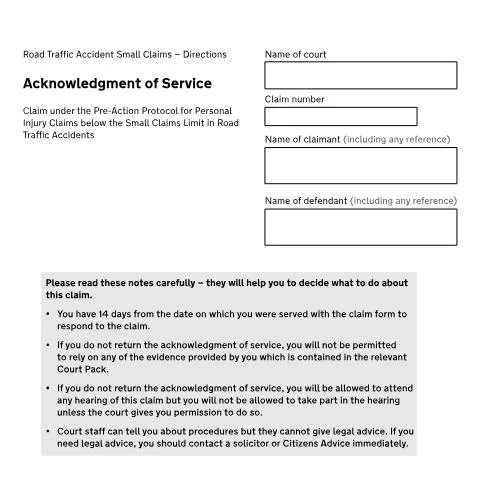
Understanding the RTA Small Claims Directions Framework
When a road traffic accident claim enters the small claims track, the defendant faces a critical procedural crossroads. The Road Traffic Accident Small Claims – Directions form represents far more than a simple acknowledgment—it's the defendant's strategic declaration of how they intend to contest or accept the claim brought against them.
This document emerges at a pivotal moment: after the claimant has issued proceedings under the Pre-Action Protocol for Personal Injury Claims below the Small Claims Limit in Road Traffic Accidents, but before the substantive hearing begins. The defendant has precisely 14 days from service of the claim form to respond, and their choices on this form will fundamentally shape the trajectory of the entire case.
Unlike standard acknowledgment forms, this specialised document reflects the unique nature of RTA small claims, where liability disputes, vehicle damage assessments, and exceptional uplift applications create distinct procedural pathways. The form's branching structure—directing defendants through Sections A to F based on their specific circumstances—demonstrates the sophisticated framework governing these seemingly straightforward traffic claims.
Navigating the Critical 14-Day Response Window
The timing requirements embedded within this form carry severe consequences that extend beyond mere procedural compliance. Defendants who fail to return their acknowledgment within the statutory 14-day period face a cascade of restrictions that can fundamentally undermine their case.
Evidence exclusion represents the most immediate penalty. Any evidence contained in the relevant Court Pack—typically comprising police reports, witness statements, photographs, and expert assessments compiled during the pre-action protocol stage—becomes inadmissible if the acknowledgment deadline passes. This restriction proves particularly harsh given that Court Pack evidence often forms the backbone of traffic accident defences.
The hearing participation restrictions create an additional layer of difficulty. While late defendants retain the right to attend hearings, they cannot actively participate unless the court grants specific permission. This judicial discretion operates unpredictably—some District Judges readily accommodate genuine oversights, whilst others strictly enforce procedural requirements regardless of the underlying merits.
| Timeframe | Defendant Status | Available Options | Evidence Rights |
|---|---|---|---|
| Within 14 days | Compliant | Full participation, all sections accessible | Court Pack evidence admissible |
| 15-28 days | Late but pre-hearing | Court discretion required | Evidence exclusion likely |
| Post-hearing listed | Significantly late | Attendance only unless permission granted | Court Pack evidence excluded |
Decoding the Three-Track Pathway System
Section A's seemingly simple tick-box options mask a sophisticated case management system that channels defendants through three distinct procedural tracks, each reflecting different dispute characteristics and judicial resource requirements.
Track One: Partial Liability Admission with Ongoing Disputes
When defendants select the first option—liability admitted in part but remaining in dispute—they trigger Section B procedures designed for the most complex small claims scenarios. This pathway accommodates cases where fault attribution remains contested, damages calculations face challenge, or exceptional uplift applications require opposition.
The witness identification requirements within Section B demand particular attention. Defendants must specify not only liability witnesses but also those addressing damages valuation, non-protocol vehicle costs, and uplift applications. This comprehensive witness disclosure serves dual purposes: ensuring judicial efficiency whilst preventing tactical surprise at hearing.
Track Two: Liability Accepted with Vehicle Cost Disputes
Section C governs scenarios where fault attribution remains undisputed, but disagreements persist regarding vehicle repair costs or exceptional uplifts. This streamlined pathway reflects judicial recognition that liability-clear cases require different case management approaches than fault-contested claims.
The distinction between protocol and non-protocol vehicle costs proves crucial here. Protocol costs—those recoverable under standard RTA procedures—face different evidential requirements than non-protocol costs, which demand enhanced justification and often expert support.
Track Three: Pure Uplift Disputes
Section D addresses the narrowest category: cases where liability remains undisputed and no vehicle cost disputes exist, leaving only exceptional uplift applications in contention. These proceedings focus exclusively on whether circumstances justify departing from standard compensation levels.
The Strategic Implications of Evidence Declaration
Section E transforms what appears to be routine evidence disclosure into a strategic battleground where defendants must balance transparency against tactical advantage. The binary choice between relying solely on Court Pack evidence or introducing additional materials carries profound implications for hearing preparation and costs exposure.
Court Pack reliance offers procedural simplicity but strategic limitations. Defendants choosing this route accept the evidentiary framework established during pre-action protocol exchanges, potentially constraining their ability to challenge claimant narratives or introduce alternative theories of causation.
Conversely, additional evidence introduction provides tactical flexibility whilst creating disclosure obligations and potential costs consequences. Defendants pursuing this route must justify why relevant evidence remained absent from protocol exchanges—a requirement that can expose procedural failures or tactical decisions to judicial scrutiny.
The form's requirement for evidence summarisation when physical attachment proves impossible creates particular challenges for defendants dealing with voluminous technical reports, extensive photographic evidence, or expert assessments requiring specialist software for proper presentation.
Address Notification and Service Obligations
Section 1.1's address requirements extend beyond simple contact information to encompass sophisticated service protocols that can significantly impact case progression. The inclusion of DX numbers, email addresses, and reference systems reflects the courts' modernisation efforts whilst maintaining traditional service safeguards.
Defendants must distinguish between correspondence addresses for routine case management and service addresses for formal legal documents. This distinction proves particularly relevant for defendants represented by solicitors, where different addresses may apply for different document categories.
The mandatory service obligation requiring defendants to serve acknowledgment copies on all other named parties simultaneously with court filing creates coordination challenges in multi-party accidents. Defendants must identify all relevant parties from the claim form, obtain current addresses, and ensure contemporaneous service—failure in any element can invalidate the entire acknowledgment process.
The courts have consistently emphasised that service obligations represent substantive requirements rather than mere procedural formalities, with non-compliance potentially resulting in acknowledgment rejection regardless of content quality.
Statement of Truth: Beyond Routine Verification
Section F's Statement of Truth provisions carry particular gravity within the RTA small claims context, where insurance companies, legal representatives, and individual defendants navigate complex authority relationships whilst assuming personal liability for factual accuracy.
The form's three-tier signature structure—defendant, insurer, and legal representative—reflects the practical reality that different parties possess different knowledge levels regarding accident circumstances. Individual defendants typically possess direct factual knowledge but limited legal understanding, whilst insurance representatives may lack personal accident knowledge but possess comprehensive file information.
Legal representatives face unique challenges when signing statements of truth on behalf of clients or insurers. The requirement for authorisation verification ensures that representatives possess genuine authority whilst creating potential professional liability exposure for inadequate client instruction verification.
The contempt of court warning embedded within this section represents more than routine legal boilerplate. Courts have demonstrated increasing willingness to pursue contempt proceedings against parties who provide knowingly false information, particularly where such falsehoods impact judicial resource allocation or prejudice opposing parties.
Post-Submission Case Management Implications
The acknowledgment's submission triggers an automated judicial referral process that shapes subsequent case trajectory through targeted directions tailored to the specific dispute characteristics identified within the form. District Judges utilise acknowledgment responses to determine appropriate hearing lengths, expert evidence requirements, and case management directions.
Liability-disputed cases typically receive more generous hearing allocations and may trigger automatic directions for witness statement exchange or expert evidence disclosure. The court's advance knowledge of witness numbers and evidence types enables more accurate hearing scheduling and resource allocation.
Cases involving non-protocol vehicle costs often generate specific directions regarding expert evidence, particularly where repair estimates exceed £1,000 or total loss valuations face challenge. The acknowledgment's early identification of these issues enables courts to address expert appointment and disclosure requirements before hearing dates become imminent.
The judicial directions process following acknowledgment receipt operates with varying efficiency across different court centres. Some courts issue comprehensive directions within days of acknowledgment receipt, whilst others may require several weeks for judicial consideration—particularly during peak periods or where complex multi-party scenarios require individualised case management approaches.
Integration with Broader RTA Protocol Requirements
This acknowledgment form represents one component within the comprehensive RTA Small Claims Protocol framework, designed to streamline low-value traffic accident litigation whilst maintaining procedural fairness. Understanding its relationship to preceding protocol stages and subsequent hearing procedures proves essential for effective utilisation.
The pre-action protocol requirements that precede acknowledgment submission create evidentiary foundations that significantly influence form completion strategies. Defendants who actively participated in protocol exchanges possess comprehensive case knowledge, whilst those who remained passive during protocol stages may face evidential gaps requiring acknowledgment-stage remediation.
The form's integration with standard Civil Procedure Rules creates potential conflicts where RTA-specific requirements diverge from general small claims procedures. These tensions most commonly arise regarding evidence disclosure timelines, witness statement requirements, and costs consequences—areas where specialised RTA provisions may override standard rules.
Future procedural developments may further refine this framework, particularly as courts gain experience with digital hearings and remote evidence presentation. The current form structure reflects pre-pandemic assumptions about hearing conduct that may require modification as hybrid hearing models become established practice within small claims procedures.
Preparing Your Evidence Bundle for Court
The strength of your road traffic accident claim largely depends on the quality and organisation of your evidence bundle. Courts expect parties to present their case efficiently, and a well-prepared bundle demonstrates professionalism whilst helping the judge understand your position quickly.
Your evidence bundle should include all relevant documents in chronological order, with clear page numbering and an index at the front. Essential documents typically comprise the accident report form, photographs of vehicle damage and the accident scene, repair estimates or invoices, medical reports if personal injury is claimed, witness statements, and correspondence between parties or insurers.
Photographs deserve particular attention in road traffic cases. Take multiple angles showing vehicle positions, road conditions, traffic signs, and any relevant environmental factors like poor lighting or road works. Include close-up shots of damage and wider contextual images. If you didn't take photographs immediately after the accident, returning to photograph the scene later can still provide valuable evidence about road layout, sight lines, and permanent features.
Witness statements must be in the prescribed format, including a statement of truth declaring that the witness believes the facts stated are true and understands that proceedings for contempt of court may be brought if they have deliberately included false information. Independent witnesses—those with no connection to either party—carry particular weight with courts.
Fill in your form directly online
No printing: type your details into the boxes of the official form, tick, then download the PDF ready to send.
- 1Type into the form boxes
- 2Tick in one click
- 3Save and download the PDF
Expert evidence may be necessary for complex technical issues, such as accident reconstruction or mechanical failures. In small claims cases, courts are generally reluctant to allow expert witnesses due to proportionality concerns, but they may permit written expert reports on specific technical matters that cannot be understood without specialist knowledge.
Vehicle maintenance records can prove crucial, particularly in cases involving mechanical failure or where the roadworthiness of either vehicle is questioned. MOT certificates, service records, and any recent repair work should be included if relevant to the circumstances of the accident.
Understanding Contributory Negligence and Apportionment
Road traffic accident cases frequently involve questions of contributory negligence, where both parties bear some responsibility for the collision. Understanding how courts assess and apportion blame can significantly impact your claim strategy and settlement negotiations.
The Law Reform (Contributory Negligence) Act 1945 allows courts to reduce damages awarded to a claimant based on their degree of fault. This isn't an all-or-nothing determination—courts can apportion blame in percentages, such as finding one driver 70% at fault and the other 30% responsible.
Common scenarios involving contributory negligence include failing to wear a seatbelt (typically reducing damages by 15-25% for injuries that would have been prevented or reduced), excessive speed even when not the primary cause of the accident, failing to observe road conditions or hazards that a reasonable driver would have noticed, and inadequate vehicle maintenance affecting stopping distances or visibility.
The court considers what a reasonable driver would have done in the circumstances, taking account of factors like weather conditions, traffic density, road familiarity, and any sudden emergencies. A momentary lapse of attention is treated differently from a deliberate decision to ignore traffic rules.
Mobile phone use represents a particular category of contributory negligence. Even hands-free conversations can constitute distraction if they demonstrably affected the driver's attention at the crucial moment. Courts examine phone records to establish timing and duration of calls relative to the accident.
Previous case law provides guidance on typical apportionment scenarios. Rear-end collisions generally favour the following driver bearing primary responsibility, but contributory negligence may apply if the front vehicle stopped suddenly without warning or had defective brake lights. Junction accidents often involve complex apportionment based on right of way, observation of traffic signals, and each driver's opportunity to avoid the collision.
When presenting your case, acknowledge any potential contributory factors honestly whilst emphasising the other party's primary responsibility. Courts respond better to realistic assessments than attempts to deny obvious contributory elements. Focus on demonstrating that your actions were reasonable given the circumstances and that the other party's negligence was the substantial cause of the accident.
Post-Judgment Enforcement and Recovery Options
Obtaining a judgment in your favour represents only the first step—enforcing that judgment to actually recover your damages requires understanding the various enforcement mechanisms available through the court system.
Before initiating enforcement proceedings, attempt to contact the judgment debtor directly. Many people honour court judgments once the formal legal process concludes, particularly if you provide clear payment instructions and reasonable time scales. A simple letter referencing the judgment and requesting payment within 14 days often proves effective.
If voluntary payment doesn't materialise, several enforcement options exist depending on the debtor's circumstances and assets. County Court Bailiffs can seize and sell goods belonging to the debtor, though certain items like basic household necessities and tools of trade are protected from seizure. This method works best when the debtor owns valuable, easily removable items like vehicles or electronics.
Attachment of Earnings Orders direct the debtor's employer to deduct specified amounts from their salary and pay them directly to you. This proves particularly effective for employed individuals with regular income, though it doesn't work for self-employed people or those receiving only benefits. The court sets the deduction rate based on the debtor's income and essential living expenses.
Third Party Debt Orders (formerly called Garnishee Orders) freeze money in the debtor's bank accounts and redirect it to satisfy the judgment debt. You'll need information about the debtor's banking arrangements, which might be obtainable through an Order to Obtain Information requiring them to attend court and disclose their financial circumstances.
Charging Orders secure the debt against the debtor's property, typically their home. Whilst this doesn't provide immediate payment, it protects your position and may prompt settlement, particularly if the debtor wishes to sell or remortgage their property. In exceptional circumstances, you might seek an Order for Sale to force property disposal, though courts are reluctant to make people homeless for relatively small debts.
The enforcement process incurs additional costs, including court fees and bailiff charges, which can be added to the judgment debt if recovery proves successful. However, these costs are at risk if enforcement fails, so consider the debtor's apparent means carefully before proceeding.
Insolvency proceedings represent the ultimate enforcement option for substantial debts, though the costs and complexity make this unsuitable for most small claims. However, the threat of bankruptcy or winding-up proceedings sometimes encourages payment where other methods have failed.