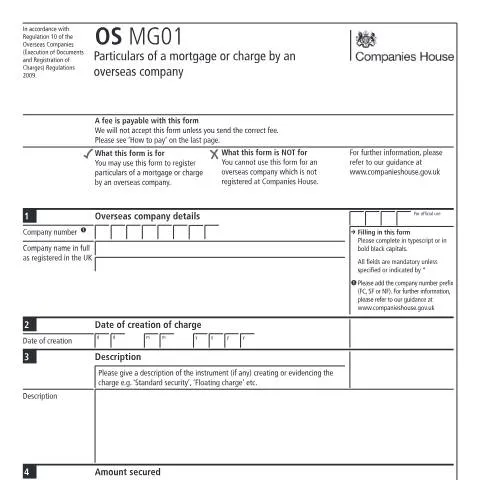
When Overseas Companies Must Navigate UK Charge Registration Requirements
Foreign companies conducting business in the UK face a complex web of regulatory obligations, particularly when securing financing through mortgages or charges against their assets. The OS MG01 form represents a critical gateway for overseas companies to comply with UK transparency requirements, ensuring that financial encumbrances on company property are properly recorded on the public register maintained by Companies House.
This registration mechanism serves multiple stakeholders: it protects creditor interests, provides transparency for potential investors or business partners, and ensures overseas companies meet their statutory obligations under the Overseas Companies (Execution of Documents and Registration of Charges) Regulations 2009. The process involves strict timing requirements and detailed documentation that can catch unprepared companies off-guard.
The Twenty-One Day Window: Understanding Critical Timing Requirements
The most unforgiving aspect of charge registration lies in its absolute deadlines. Companies must deliver the completed OS MG01 form alongside certified documentation within 21 days of charge creation. However, the calculation of this period varies significantly depending on where the charge originates.
For charges created within the UK, the 21-day period runs from the actual date of creation. This straightforward calculation becomes more complex for charges created outside the UK, where the deadline extends to 21 days after the date when copies of the creating instrument could reasonably have been received in the UK through due course of post, dispatched with due diligence.
This distinction acknowledges practical realities of international business operations whilst maintaining regulatory certainty. Companies operating across multiple jurisdictions must carefully track where charges are being created and adjust their compliance timelines accordingly. Missing these deadlines can render charges void against liquidators and creditors, potentially devastating the security holder's position.
| Charge Location | Deadline Calculation | Key Considerations |
|---|---|---|
| Created in UK | 21 days from creation date | Clear-cut timeline, no postal allowances |
| Created outside UK | 21 days from when documents could reach UK by post | Requires assessment of postal delivery times |
| Electronic creation | 21 days from creation date | Instantaneous transmission doesn't extend deadline |
Eligibility Boundaries: Which Overseas Companies Must Register
The OS MG01 form serves exclusively overseas companies that have established a UK presence through Companies House registration. This creates a clear demarcation: companies holding FC (foreign company), SF (Scottish foreign company), or NF (Northern Ireland foreign company) prefixes can utilise this registration pathway, whilst entirely foreign entities without UK registration cannot.
This restriction reflects the regulatory framework's focus on companies operating within UK jurisdiction whilst maintaining foreign incorporation. Such companies typically include subsidiaries of multinational corporations, foreign companies with UK branches, or overseas entities conducting regular business activities requiring UK registration.
The registration requirement applies regardless of the charge's monetary value or the nature of secured property. Whether securing a modest equipment loan or a substantial property development facility, overseas companies must navigate identical registration procedures. This uniform approach ensures comprehensive public disclosure whilst avoiding arbitrary thresholds that might create loopholes.
Company Number Prefixes and Registration Categories
Understanding company number prefixes proves essential for correct form completion. Each prefix indicates specific registration pathways and compliance obligations:
- FC prefix: Standard overseas companies registered in England and Wales
- SF prefix: Overseas companies registered in Scotland
- NF prefix: Overseas companies registered in Northern Ireland
These prefixes must appear on the OS MG01 form, and errors in prefix designation can lead to form rejection and potential deadline breaches.
Dissecting the Documentation: Essential Components and Certified Copies
The OS MG01 form demands comprehensive information spanning multiple interconnected elements. Beyond basic company identification, registrants must provide detailed charge descriptions, specify secured amounts, identify all mortgagees or charge holders, and describe charged property with sufficient particularity to enable public understanding.
The description of instrument section requires precise legal terminology reflecting the charge's actual nature. Standard securities, floating charges, fixed charges, and hybrid instruments each carry distinct legal implications and must be accurately categorised. Vague or incorrect descriptions can mislead stakeholders and potentially affect the charge's enforceability.
Property descriptions demand particular attention to detail. The form requires "short particulars" of charged property, balancing brevity with sufficient specificity for identification purposes. Real property typically requires full addresses including postcodes, whilst personal property descriptions must enable clear identification without excessive detail.
Certified Copy Requirements and Authentication
Accompanying the completed form, companies must provide certified copies of instruments creating or evidencing the charge. This authentication requirement ensures document integrity and prevents fraudulent registrations. Certification typically involves solicitor or notary confirmation that copies accurately reflect original documents.
For charges created through multiple documents or complex structures, all relevant documentation requires certification and submission. This comprehensive approach ensures complete public disclosure whilst protecting against incomplete or misleading registrations.
Floating Charge Complexities: Ranking Provisions and Security Restrictions
Section 7 of the OS MG01 form addresses floating charge intricacies that often perplex companies unfamiliar with UK security law concepts. Floating charges create security over changing assets, requiring detailed disclosure of ranking arrangements and restrictions on further security creation.
Companies must disclose any restrictions on their power to grant further securities ranking in priority to or pari passu with the floating charge. These provisions significantly impact future financing flexibility and must be clearly articulated to inform potential creditors and investors.
Ranking provisions determine priority amongst multiple security interests, creating complex hierarchies that affect recovery prospects in insolvency scenarios. The form requires clear explanation of how the floating charge ranks against existing and future securities, ensuring stakeholders understand their relative positions.
Priority Arrangements and Subordination Agreements
Complex financing structures often involve sophisticated priority arrangements requiring careful disclosure. Subordination agreements, intercreditor arrangements, and waterfall provisions all impact ranking and must be accurately reflected in form submissions.
Commission Disclosure and Financial Transparency Requirements
Section 8 addresses commission, allowance, or discount arrangements connected to debenture subscriptions. This disclosure requirement ensures transparency around financing costs and potential conflicts of interest that might affect stakeholder decision-making.
Companies must specify commission amounts or percentage rates paid to persons subscribing for debentures or procuring subscriptions. This encompasses both direct payments and indirect benefits, capturing the full scope of transaction costs and incentive structures.
The distinction between commission payments and interest rates requires careful attention. While commission disclosure is mandatory, standard interest payable under debenture terms should not be entered in this section, avoiding double-counting and confusion.
Submission Pathways and Regional Processing Centres
Companies House operates distinct regional centres accepting OS MG01 submissions, each serving specific geographic areas whilst maintaining consistent processing standards. The Cardiff centre handles England and Wales registrations, Edinburgh processes Scottish matters, and Belfast manages Northern Ireland submissions.
Each centre maintains dedicated postal addresses and DX (document exchange) numbers for professional users. Legal practitioners and corporate service providers often utilise DX services for enhanced security and tracking capabilities, particularly valuable given the form's strict timing requirements.
Electronic submission options continue evolving, though traditional postal and courier services remain widely used for forms requiring certified documentation. Companies should verify current submission methods and processing times, particularly when approaching registration deadlines.
Fee Structure and Payment Methods
Registration incurs prescribed fees that must accompany form submissions. Companies House will reject incomplete submissions lacking correct fees, potentially causing dangerous delays in time-sensitive registrations. Fee structures may vary based on submission method and processing urgency.
Post-Submission Procedures and Public Register Impact
Upon successful registration, charge particulars become part of the company's public record, accessible to creditors, investors, and other stakeholders conducting due diligence. This transparency serves crucial commercial functions whilst imposing ongoing disclosure obligations on registered companies.
The public register entry includes all information provided on the OS MG01 form, creating permanent records that survive charge satisfaction or company dissolution. Companies must consider long-term implications of their disclosures, ensuring accuracy and completeness from initial submission.
Subsequent modifications to registered charges typically require additional filings, creating ongoing compliance obligations throughout the security's lifecycle. Companies should establish robust systems for tracking registered charges and managing modification requirements as commercial circumstances evolve.
Registration provides legal protection for charge holders whilst creating constructive notice for subsequent creditors and purchasers. This dual function makes proper registration essential for maintaining enforceable security interests whilst fulfilling transparency obligations inherent in UK corporate law framework.
Complex Ownership Structures and Multiple Charges
Overseas companies with intricate ownership arrangements face particular challenges when registering charges using Form MG01. Companies operating through holding structures, subsidiary networks, or joint venture arrangements must carefully consider how these relationships affect their charge registration obligations.
When a parent company creates a charge that affects assets held by its UK subsidiary, the registration requirements can become complex. The overseas parent must register the charge if it directly creates security over UK assets, even when those assets are operationally managed by the subsidiary. Conversely, if the UK subsidiary creates the charge independently, it falls under domestic company charge registration rules rather than the overseas provisions.
Multiple charges over the same asset present another layer of complexity. Where an overseas company has granted several charges over UK property—perhaps a first legal charge to a primary lender and a second charge to a mezzanine financier—each charge requires separate MG01 registration. The priority of charges depends on registration order and the specific terms of each security document, not merely the chronological creation of the underlying debt.
Cross-guarantees within corporate groups create additional registration scenarios. When an overseas parent company guarantees debts of its UK operations and grants security over its own assets to support that guarantee, this constitutes a registrable charge. The guarantee itself may not require registration, but any security backing the guarantee must be filed using MG01 within the statutory timeframe.
Floating charges present particular nuances for overseas companies. Unlike fixed charges over specific assets, floating charges hover over changing pools of assets until crystallisation occurs. An overseas company granting a floating charge over its UK trading stock, for instance, must register this arrangement even though the specific assets covered will vary daily. The registration captures the charge mechanism rather than individual asset details.
When charges are created simultaneously—such as during a refinancing transaction where multiple lenders take security—Companies House expects each MG01 form to clearly identify the relationship between charges. This prevents confusion about priority and ensures the register accurately reflects the company's security position.
Amendment, Release and Rectification Procedures
The lifecycle of registered charges extends well beyond initial filing, requiring overseas companies to understand amendment and release procedures. Unlike domestic companies, overseas entities face additional procedural hurdles when modifying or discharging registered charges.
Partial releases present common scenarios requiring careful handling. When an overseas company sells part of charged property—perhaps disposing of one building from a portfolio secured under a single charge—the lender typically provides a partial release. This requires filing Form MG04 (Statement of satisfaction in whole or in part) within 21 days of the partial discharge. The form must clearly identify which assets remain subject to the charge and which have been released.
Charge variations, such as increasing facility amounts or extending security coverage to additional assets, create registration obligations distinct from original charge filing. Material variations that alter the charge's scope or priority typically require fresh MG01 registration rather than simple amendment. However, administrative changes—such as correcting lender name spellings or updating registered addresses—can often be handled through informal correspondence with Companies House.
Rectification of registration errors follows established procedures, but overseas companies must navigate these with particular care given their distance from UK regulatory infrastructure. Common errors include incorrect charge amounts, missing asset descriptions, or wrong priority dates. Companies House maintains discretion to accept rectification applications, but evidence supporting the correction request must be comprehensive.
When security documents are amended post-registration, overseas companies must assess whether changes trigger fresh registration requirements. Substituting charged assets, altering interest rates, or changing repayment terms may or may not require new MG01 filing depending on whether the charge's essential character changes. Legal advice is often prudent when evaluating amendment implications.
Release procedures require coordination between overseas companies, lenders, and Companies House. Full discharge typically follows debt repayment and requires Form MG04 filing accompanied by evidence of satisfaction. Lenders must provide satisfaction statements, but overseas companies bear responsibility for ensuring timely filing. Delays in discharge registration can complicate future financing arrangements and asset disposals.
The electronic filing system allows real-time tracking of amendment and release applications, providing overseas companies with visibility over processing progress. However, processing times may extend beyond standard periods during peak filing seasons or when applications require manual review.
International Enforcement and Cross-Border Implications
Charge registration creates a framework for enforcement that extends beyond UK borders, presenting both opportunities and challenges for overseas companies and their creditors. Understanding these cross-border implications proves crucial for companies structuring international financing arrangements.
English law governed charges benefit from well-established enforcement mechanisms, but realising security often requires coordination across multiple jurisdictions. When an overseas company defaults on secured obligations, lenders must navigate both UK enforcement procedures for registered charges and local legal requirements in the company's home jurisdiction. This dual-jurisdiction challenge affects enforcement strategy and timing.
Registered charges over UK assets provide lenders with significant advantages during insolvency proceedings, regardless of where those proceedings are initiated. If an overseas company enters administration or liquidation in its home country, properly registered UK charges typically maintain their priority and enforceability. However, cross-border insolvency protocols may affect practical enforcement timelines and procedures.
Asset tracing becomes particularly relevant for overseas companies with complex international structures. Registered charges create public notice of security interests, but determining the current location and ownership of charged assets may require investigation across multiple jurisdictions. This is especially pertinent for mobile assets like aircraft, ships, or intellectual property that can be relocated or assigned internationally.
Currency fluctuations add another dimension to international enforcement. Charges registered in sterling may secure debts denominated in foreign currencies, creating exchange rate risk for both lenders and borrowers. While registration captures charge amounts at creation date, enforcement values depend on prevailing exchange rates and local market conditions.
Reciprocal enforcement arrangements between the UK and various countries affect how registered charges operate internationally. Some jurisdictions recognise and enforce UK charge registrations more readily than others, influencing both financing structure decisions and enforcement strategies. Companies should consider these factors when determining where to locate assets and how to structure security arrangements.
International sanctions and export controls may impact charge enforcement for overseas companies from certain jurisdictions. Lenders must verify that enforcement actions comply with applicable sanctions regimes, which can change rapidly and affect both the enforcement process and asset disposition options.
The Brexit transition has introduced additional considerations for overseas companies, particularly those based in EU member states. While existing charge registrations remain valid, new arrangements may face different recognition and enforcement frameworks. Companies should review their charge portfolios to ensure continued effectiveness under evolving international legal frameworks.