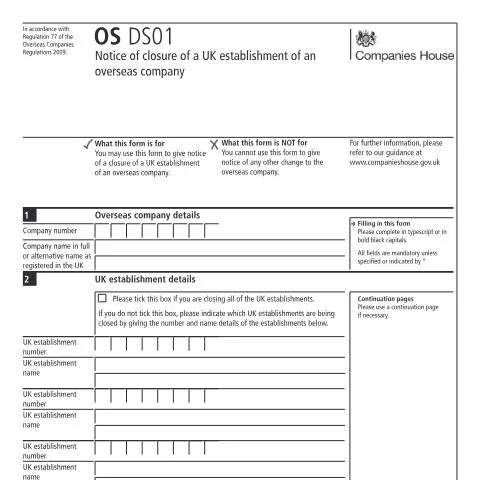
When Overseas Companies Need to Formally Exit the UK Market
Overseas companies operating in Britain through UK establishments face a critical administrative moment when they decide to cease their operations. The OS DS01 notice represents the formal mechanism by which foreign entities notify Companies House of their intention to close down their UK presence entirely or partially. This document serves as the official bridge between an overseas company's decision to withdraw from the British market and the legal requirement to update the public record maintained by Companies House.
The closure of a UK establishment isn't merely a business decision—it triggers specific regulatory obligations under the Overseas Companies Regulations 2009. When an overseas company established under foreign law has been operating through UK establishments, any closure must be properly documented and reported to maintain compliance with British company law. The OS DS01 form fulfils this statutory requirement, ensuring that the public record accurately reflects the current status of overseas company operations within the UK.
Understanding this notice becomes particularly crucial for overseas companies that maintain multiple establishments across England, Wales, Scotland, or Northern Ireland. The form accommodates both scenarios: complete withdrawal from the UK market and selective closure of specific establishments whilst maintaining others. This flexibility reflects the complex operational structures that many international businesses develop when entering the British market.
Scope and Limitations of the Closure Notice
The OS DS01 notice operates within carefully defined parameters that overseas companies must understand before proceeding. The form serves exclusively for notifying establishment closures—it cannot be used for any other type of change affecting the overseas company's UK operations. This specificity means that companies seeking to modify their registered details, change their UK representative, or update their business activities must use entirely different procedures and forms.
The notice applies specifically to overseas companies that have registered UK establishments under the Overseas Companies Regulations 2009. These establishments differ fundamentally from UK subsidiaries, which are separate legal entities incorporated under British law. An establishment represents a branch or permanent presence of the foreign parent company, operating under the overseas company's name and legal identity rather than as an independent UK entity.
Companies House maintains strict boundaries around what constitutes a closure notification. The form cannot accommodate situations where an overseas company merely suspends operations temporarily, transfers an establishment to another entity, or restructures its UK presence without actually closing. Such scenarios require different regulatory approaches and potentially involve other government departments or regulatory bodies.
| Closure Scenario | OS DS01 Required | Additional Considerations |
|---|---|---|
| Complete UK market exit | Yes - tick closure box | HMRC tax clearance may be required |
| Selective establishment closure | Yes - specify establishments | Remaining establishments continue obligations |
| Temporary suspension | No | Consider dormant company procedures |
| Transfer to UK subsidiary | No | Requires separate incorporation process |
Critical Information Requirements and Verification
The OS DS01 notice demands precise information that must align exactly with Companies House records. The overseas company number and registered name must match the details held on the public register without variation. Even minor discrepancies in spelling, punctuation, or formatting can result in form rejection and processing delays.
When specifying UK establishment details, companies must provide both the establishment number and name as they appear in the official records. These identifiers were assigned when the establishment was originally registered and appear on all subsequent Companies House correspondence. The establishment number typically follows a specific format that distinguishes it from standard UK company numbers.
The closure date requires careful consideration, as it represents the actual date when the establishment ceased operations rather than when the notice is submitted. Companies should ensure this date reflects the reality of their operational cessation, as it becomes part of the public record and may have implications for tax obligations, employment law compliance, and creditor relations.
For companies closing multiple establishments simultaneously, the form accommodates up to three establishment entries on the main document, with continuation pages available for larger-scale closures. Each establishment must be individually identified with its unique number and name, creating a comprehensive record of the closure activity.
Authorisation and Signature Requirements
The OS DS01 notice requires authorisation from individuals with specific authority to act on behalf of the overseas company. Only directors, company secretaries, or permanent representatives possess the legal standing to sign this form. This restriction ensures that closure notifications carry appropriate corporate authority and cannot be submitted by unauthorised individuals.
The signature section explicitly states that the signatory is acting "on behalf of the overseas company," reinforcing the representative nature of the authorisation. This language becomes particularly important for overseas companies where the concepts of directorship or company secretary may differ from British corporate law conventions.
Permanent representatives hold special significance in this context, as they often serve as the primary UK-based contact for overseas companies. When a permanent representative signs the closure notice, they are typically managing the final administrative obligations before their own role concludes with the establishment's closure.
Companies should ensure that the individual signing the form holds current authority to act. If directorship or representative status has changed recently, these changes should be reflected in Companies House records before submitting the closure notice to avoid complications or potential rejection.
Documentation Standards and Processing
Companies House maintains strict standards for document submission, requiring completion in typescript or bold black capitals. This requirement ensures document legibility and facilitates accurate data entry into the public record. Handwritten submissions in light ink or unclear formatting risk rejection and processing delays.
All mandatory fields must be completed unless specifically marked as optional with an asterisk. The form's design makes clear distinctions between required and optional information, but companies should review each section carefully to ensure compliance.
Strategic Timing and Operational Considerations
The timing of OS DS01 submission carries significant strategic implications beyond mere compliance. Companies should coordinate the notice with their broader exit strategy, considering obligations to employees, creditors, customers, and regulatory bodies. The closure notice represents one element of a potentially complex withdrawal process that may involve multiple government departments and regulatory requirements.
HMRC obligations often represent the most complex aspect of establishment closure. Tax clearance procedures may need completion before or alongside the Companies House notification, particularly where the establishment has been trading or employing staff. VAT registration cancellation, PAYE scheme closure, and corporation tax obligations all require separate attention and may influence the optimal timing for submitting the OS DS01 notice.
Employment law considerations add another layer of complexity, especially where the establishment closure affects UK-based employees. Redundancy consultation requirements, notice periods, and transfer of undertakings regulations may all impact the practical closure date and should be factored into the timeline for submitting the notice.
Creditor relationships require careful management during the closure process. While the OS DS01 notice doesn't directly affect creditor rights, the public nature of the filing means that creditors will become aware of the closure through the public record. Companies should consider whether advance notification to key creditors is appropriate before submitting the formal notice.
Multiple Establishment Scenarios and Complex Structures
Overseas companies operating through multiple UK establishments face particular complexity when implementing selective closures. The OS DS01 form accommodates this scenario by allowing companies to specify exactly which establishments are closing whilst leaving others operational. This granular approach recognises that overseas companies often develop sophisticated UK structures that may require partial restructuring rather than complete market exit.
When maintaining some establishments whilst closing others, companies must ensure that their ongoing UK presence remains compliant with regulatory requirements. The remaining establishments continue to carry all associated obligations, including annual return filings, registered office maintenance, and ongoing disclosure requirements.
Geographic considerations often drive selective closure decisions, with companies potentially maintaining presence in England whilst closing Scottish or Northern Irish establishments, or vice versa. Each jurisdiction within the UK maintains its own Companies House office, but the OS DS01 notice can be submitted to any of these offices regardless of where the establishments being closed are located.
The form's structure anticipates complex scenarios by providing space for multiple establishment details and offering continuation pages for extensive closures. This flexibility proves essential for multinational corporations that may have developed extensive UK networks over time and need to rationalise their presence systematically.
Public Record Implications and Transparency
Every detail provided on the OS DS01 notice becomes part of the public record maintained by Companies House. This transparency serves important public policy objectives but requires companies to consider the implications of their disclosures carefully. Competitors, customers, suppliers, and other stakeholders can access this information through standard Companies House search facilities.
The public nature of the filing means that the closure becomes a matter of public knowledge, potentially affecting relationships with UK-based partners and customers. Companies should factor this visibility into their communication strategies and consider whether advance notification to key stakeholders is appropriate.
Administrative Processing and Follow-up Procedures
Companies House processes OS DS01 notices through established procedures that update the public record and generate confirmation documentation. The processing timeline can vary depending on submission method, document completeness, and current processing volumes at Companies House offices.
The checklist provided with the form serves as a final verification tool, highlighting the most common reasons for form rejection. Companies should systematically verify that the overseas company number and name match public records exactly, that all mandatory sections are completed, that the closure date is provided, and that appropriate signature authority exists.
Submission can be made to any Companies House office—Cardiff for England and Wales, Edinburgh for Scotland, or Belfast for Northern Ireland. The choice of office doesn't affect processing but may influence delivery timelines depending on the company's location and preferred submission method.
Electronic alternatives may be available for some aspects of overseas company administration, though the OS DS01 notice currently requires paper submission. Companies should verify current submission options through the Companies House website, as digital transformation initiatives continue to expand electronic filing capabilities across different form types.
After successful processing, the closure information appears on the public record, effectively marking the end of the establishment's official UK presence. However, companies should remember that closure notification doesn't automatically resolve all regulatory obligations—separate procedures may be required with HMRC, employment authorities, and other relevant bodies to achieve complete regulatory closure.
Step-by-Step Completion Guide for OS DS01
Completing the OS DS01 form requires meticulous attention to detail and accurate information gathering. The form comprises several distinct sections, each serving a specific regulatory purpose that Companies House uses to process your closure notification effectively.
Section 1: Company identification details demands your overseas company's full legal name exactly as it appears on your original registration documents. Any discrepancies between the name you provide and Companies House records will trigger queries and potential delays. Include the company number assigned when you first registered your UK establishment—this alphanumeric identifier appears on all official correspondence from Companies House.
The registered office address section requires the UK address that appears on public records, not necessarily where your business operations occur. If you've changed this address during your establishment's lifetime, ensure you're using the most recent version registered with Companies House. Providing an outdated address may invalidate your submission.
Section 2: Closure details and reasoning allows you to specify why you're closing the UK establishment. Common scenarios include corporate restructuring, where the overseas parent company consolidates operations in other jurisdictions; market withdrawal due to strategic business decisions; or regulatory compliance issues that make continued operation unviable. Be specific rather than vague—"cessation of UK trading activities following strategic review" carries more weight than simply "business closure."
The effective closure date holds particular significance for tax and regulatory obligations. Choose this date carefully, ensuring all outstanding matters conclude by this point. HMRC may scrutinise transactions occurring after your stated closure date, particularly if they suggest continued business activity.
Section 3: Declaration and authorisation requires signature from an authorised person—typically a director, secretary, or someone holding equivalent authority within your overseas company structure. The signatory assumes legal responsibility for the accuracy of all information provided. Companies House may request additional documentation proving the signatory's authority if questions arise.
Fill in your form directly online
No printing: type your details into the boxes of the official form, tick, then download the PDF ready to send.
- 1Type into the form boxes
- 2Tick in one click
- 3Save and download the PDF
Supporting documentation requirements vary depending on your specific circumstances. Standard submissions require certified copies of board resolutions authorising the closure, particularly if the decision impacts shareholders or creditors. If your establishment holds assets or maintains ongoing contracts, include details of how these matters will conclude.
Common Pitfalls and Rejection Scenarios
Companies House rejects a significant proportion of OS DS01 submissions due to preventable errors and oversights. Understanding these common failure points helps ensure your application succeeds on first submission, avoiding frustrating delays and resubmission costs.
Incomplete financial clearance represents the most frequent rejection cause. Many overseas companies assume that simply ceasing operations satisfies closure requirements, overlooking outstanding obligations to HMRC, local authorities, or regulatory bodies. Companies House typically refuses to process closure notifications when evidence suggests unresolved tax matters or outstanding statutory filings.
Before submitting OS DS01, obtain written confirmation from HMRC that your establishment has no outstanding corporation tax, PAYE, or VAT obligations. This doesn't necessarily require zero balances—arrangements for settling outstanding amounts may suffice—but you need documented evidence that HMRC acknowledges your tax position.
Timing conflicts with ongoing legal proceedings create another common rejection scenario. If your establishment faces litigation, regulatory investigations, or insolvency proceedings, Companies House cannot process closure notifications until these matters conclude. Even disputes seemingly unrelated to your UK operations may prevent closure if they involve your UK establishment as a party.
Employment law complications frequently surface during closure notifications. If your establishment employed staff in the UK, you must demonstrate compliance with redundancy consultation requirements, TUPE regulations where applicable, and proper settlement of employment-related obligations. Documentation from ACAS or employment tribunals may be necessary if disputes arose during the closure process.
Asset disposal irregularities trigger scrutiny from Companies House, particularly when valuable assets transfer to related entities without proper valuation or documentation. The transfer of intellectual property, property leases, or significant contracts requires careful documentation showing arms-length transactions or proper corporate authorisation for intra-group transfers.
Environmental and regulatory compliance issues may also prevent closure approval. If your establishment operated in regulated sectors—financial services, pharmaceuticals, energy, or manufacturing—you need clearance from relevant regulatory bodies confirming that all sector-specific obligations conclude properly.
Creditor notification deficiencies represent another frequent oversight. While OS DS01 doesn't require the extensive creditor notification process applicable to company liquidations, you must still ensure that significant creditors receive appropriate notice of closure. This includes suppliers with ongoing contracts, landlords, professional service providers, and any parties holding security interests over establishment assets.
Post-Submission Monitoring and Compliance Obligations
Successfully submitting OS DS01 marks the beginning, not the end, of your closure process. Companies House processes these notifications within specific timeframes, but various factors can extend processing periods or trigger additional requirements that demand prompt attention.
Standard processing timelines typically range from 8 to 12 weeks for straightforward cases, though complex situations may require considerably longer. Companies House publishes your closure notice in the London Gazette, triggering a statutory waiting period during which interested parties may raise objections or claims against your establishment.
This publication period serves multiple purposes: alerting creditors who might have missed your direct notifications, providing regulatory bodies with final opportunities to raise compliance concerns, and allowing shareholders or other stakeholders to challenge the closure if they believe proper procedures weren't followed.
Objection procedures allow various parties to halt your closure process. Creditors claiming outstanding debts, HMRC identifying unpaid taxes, or regulatory bodies discovering compliance failures can all lodge formal objections that suspend closure proceedings until resolution occurs. Understanding who might object and why helps you prepare appropriate responses or prevent objections through proactive communication.
During the waiting period, your establishment remains subject to all applicable UK regulations and filing requirements. This includes maintaining registered office accessibility, responding to official correspondence, and ensuring that any ongoing activities comply with your stated closure timeline. Conducting new business after submitting OS DS01 may invalidate your closure notification and require resubmission.
Final documentation requirements often emerge after initial submission approval. Companies House may request additional evidence of asset disposal, creditor settlements, or regulatory clearances before issuing final closure confirmation. Maintaining comprehensive records throughout the closure process ensures you can respond quickly to these requests.
The closure becomes legally effective when Companies House issues formal confirmation and removes your establishment from the overseas companies register. However, certain obligations may persist beyond this point, particularly regarding document retention, potential warranty claims on asset disposals, or ongoing indemnities provided to third parties.
Record retention obligations continue for specified periods after closure, typically seven years for tax-related documents and longer for certain regulatory records. While your UK establishment no longer exists, your overseas parent company remains responsible for maintaining these records and providing access to UK authorities when legally required.
Understanding these post-closure obligations helps prevent unexpected compliance issues that could affect your overseas company's broader operations or create complications if you later decide to re-establish UK operations through a new registration process.