Contesting Planning Decisions Through the High Court's Specialised Process
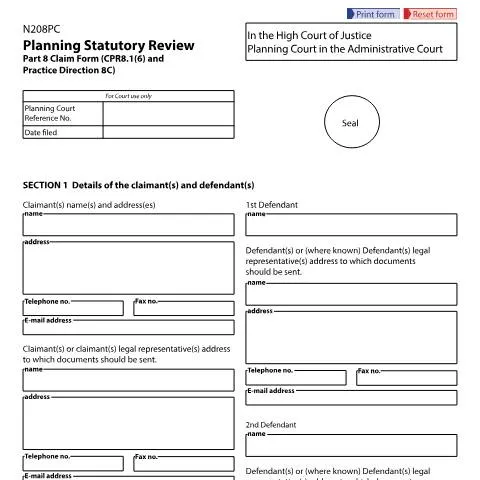
When a local planning authority refuses your application for a house extension, or when a planning inspector dismisses your appeal against an enforcement notice, the administrative process may feel exhausted. Yet Form N208PC represents a crucial gateway to challenge these decisions through the High Court's Planning Court, part of the Administrative Court within HM Courts & Tribunals Service.
This specialised claim form operates under a strict statutory framework that distinguishes planning challenges from ordinary civil litigation. Unlike typical court proceedings where claimants seek damages, planning statutory reviews focus on procedural correctness and legal compliance of public authorities' decision-making. The form serves multiple statutory regimes, from standard planning permissions under the Town and Country Planning Act 1990 to listed building consents and hazardous substances licensing.
The Planning Court handles approximately 400-500 statutory review claims annually, with success rates varying significantly depending on the legal grounds advanced. Most claims challenge local authority decisions, though planning inspectors' determinations and ministerial decisions also face scrutiny through this route.
The Statutory Architecture Behind Planning Court Challenges
Form N208PC implements several distinct statutory review mechanisms, each with specific time limits and procedural requirements. Section 287 of the Town and Country Planning Act 1990 covers challenges to development plan adoptions and modifications, whilst section 288 addresses appeals determined by planning inspectors or the Secretary of State.
The Planning (Listed Buildings and Conservation Areas) Act 1990 creates parallel review rights under section 63, specifically for listed building and conservation area consents. Meanwhile, section 22 of the Planning (Hazardous Substances) Act 1990 governs challenges to hazardous substances consent decisions, and section 113 of the Planning and Compulsory Purchase Act 2004 addresses local development scheme matters.
Each statutory provision imposes different limitation periods. Section 288 challenges must typically be filed within six weeks of the decision date, creating an extremely tight window for preparation. This compressed timeframe reflects Parliament's intention to provide swift resolution of planning disputes whilst preventing prolonged uncertainty for developers and communities.
| Statutory Provision | Typical Decision Types | Standard Time Limit | Key Considerations |
|---|---|---|---|
| Section 287 TCPA 1990 | Development plan adoption | 6 weeks from adoption | Must challenge specific policies |
| Section 288 TCPA 1990 | Planning appeals, enforcement appeals | 6 weeks from decision | Most common statutory review |
| Section 63 Listed Buildings Act | Listed building consents | 6 weeks from decision | Heritage considerations apply |
| Section 22 Hazardous Substances Act | Hazardous substances consents | 6 weeks from decision | Environmental and safety factors |
Navigating the Permission Filter and Procedural Requirements
Unlike many Administrative Court claims, planning statutory reviews operate under a permission stage where judges screen applications for arguable legal merit. Section 4 of Form N208PC explicitly seeks this permission, requiring claimants to demonstrate their challenge raises substantial legal questions rather than mere disagreement with planning judgment.
The permission test applies a relatively low threshold—whether the claim is "arguable"—but judges scrutinise whether challenges address legal errors rather than planning merits. Common grounds include procedural irregularities, failure to consider relevant factors, taking into account irrelevant considerations, or reaching decisions no reasonable authority could reach (Wednesbury unreasonableness).
Exceptional urgency applications through Section 8 serve specific circumstances where standard timetables would defeat the claim's purpose. Examples include enforcement notices taking effect imminently, or demolition works threatening listed buildings. Courts rarely grant urgency without compelling evidence that delay would cause irreparable harm.
The Aarhus Convention's Impact on Environmental Planning Cases
Section 6 of Form N208PC specifically addresses Aarhus Convention claims, reflecting the UK's implementation of international environmental law obligations. These provisions apply to planning decisions with environmental implications, offering enhanced access to justice through protective costs orders limiting financial exposure for unsuccessful claimants.
Aarhus claims typically involve developments affecting air quality, noise levels, biodiversity, or climate change considerations. The Convention's "not prohibitively expensive" requirement means legal costs should not deter environmental challenges, though claimants must still demonstrate the case falls within Aarhus scope and meets standard legal merit tests.
Completing the Form: Technical Requirements and Common Pitfalls
Section 1 demands precise identification of all parties, including the decision-maker as first defendant and any interested parties (typically developers or applicants) as additional defendants. Failure to identify proper parties correctly can lead to procedural complications or dismissal, particularly where multiple authorities were involved in the decision-making process.
Legal representatives' details require careful attention, as the Planning Court operates strict case management procedures. Email addresses enable electronic service and communication, whilst DX numbers facilitate efficient document exchange between legal professionals. Missing or incorrect contact details can disrupt tight procedural timetables.
Section 3's decision details section requires absolute precision regarding dates and decision references. Planning authorities often issue multiple related decisions, and challenges must identify the specific determination being contested. Appeal decisions include inspector reference numbers and inquiry dates, whilst local authority decisions reference application numbers and committee meeting dates.
Crafting Effective Grounds of Challenge
Section 5's detailed statement of grounds represents the claim's substantive heart. Successful challenges typically focus on legal errors rather than disagreement with planning conclusions. Common grounds include:
- Procedural irregularities—failure to follow prescribed consultation procedures, inadequate publicity, or breaches of natural justice
- Misinterpretation of policy—incorrect application of development plan policies or national planning guidance
- Inadequate reasoning—decisions lacking sufficient explanation to understand the decision-maker's rationale
- Failure to consider material considerations—overlooking relevant factors like environmental impact or highway safety
- Taking into account irrelevant factors—allowing improper considerations to influence the decision
Human Rights Act 1998 challenges require specific articulation of which Convention rights allegedly suffered breach. Article 8 (private and family life) and Article 1 of Protocol 1 (property rights) feature most commonly in planning contexts, though claimants must demonstrate the decision's impact on protected rights exceeded acceptable limits.
Documentary Evidence and the Administrative Record
Section 10's supporting documents requirements reflect planning cases' heavy reliance on the administrative record—the complete set of documents before the decision-maker when reaching their determination. This typically includes application documents, consultation responses, representations, officer reports, and committee minutes.
The Planning Court Bundle must contain all documents the claimant relies upon, arranged chronologically with clear page numbering. Essential documents for advance reading require identification with specific page references, enabling judges to locate key passages quickly during case management conferences or substantive hearings.
Missing documents can prove fatal to claims, particularly where claimants lack access to the complete administrative record. Section 10 allows identification of documents not presently available, with explanations of expected availability dates and reasons for current unavailability. This provision proves crucial where authorities hold relevant correspondence or technical reports not disclosed during the original application process.
Civil Legal Aid and Costs Protection
Planning statutory reviews rarely qualify for civil legal aid, given the strict financial eligibility criteria and exceptional funding requirements. However, costs protection schemes may limit financial exposure for individuals and community groups challenging decisions affecting wider public interests.
Aarhus cases benefit from specific costs caps—currently £5,000 for individuals and £10,000 for groups—though these figures may vary with inflation adjustments. Non-Aarhus planning challenges face standard commercial litigation costs risks, potentially reaching tens of thousands of pounds for complex cases proceeding to substantive hearing.
Case Management and Procedural Directions Following Submission
Once filed, Form N208PC triggers the Planning Court's case management procedures. Permission applications typically receive paper consideration within 4-6 weeks, though urgent cases may receive expedited treatment. If permission is refused on paper, claimants may request oral reconsideration at a brief hearing.
Successful permission applications proceed to substantive consideration, usually through a rolled-up hearing combining permission and substantive determination if permission was granted on paper without oral hearing. Case management conferences address procedural matters including bundle preparation, expert evidence requirements, and hearing timetables.
The Planning Court operates under Civil Procedure Rules Part 8 procedure, emphasising documentary evidence over oral testimony. Witnesses rarely give evidence, as challenges focus on the lawfulness of decisions based on the administrative record rather than disputed facts requiring resolution through cross-examination.
Remedies Available Through Planning Statutory Review
Section 7 requires specification of remedies sought, typically including quashing orders (setting aside unlawful decisions) and mandatory orders (requiring proper reconsideration). Interim relief may suspend enforcement action or prevent development pending final determination, though courts apply strict criteria given planning decisions' commercial implications.
Successful challenges rarely result in the Planning Court substituting its own planning judgment. Instead, quashed decisions return to the original decision-maker for fresh determination following correct legal procedures. This approach respects the separation of powers between courts (determining legal compliance) and planning authorities (exercising planning judgment within legal parameters).
Strategic Considerations and Alternative Dispute Resolution
Form N208PC represents the final stage of planning dispute resolution, following exhaustion of administrative remedies through appeals or reviews. However, pre-action correspondence may occasionally prompt authorities to reconsider decisions voluntarily, particularly where clear legal errors are identified.
The Planning Court encourages early identification of issues through pre-action protocols, though the tight statutory time limits often prevent extensive correspondence. Claimants must balance thorough preparation against the risk of missing limitation deadlines, particularly where complex technical evidence requires assembly.
Alternative dispute resolution proves less common in planning contexts than commercial litigation, given the public law nature of planning decisions and the involvement of democratic decision-making processes. However, mediation may assist where disputes involve technical matters susceptible to expert resolution or where community concerns could be addressed through modified proposals.
The increasing complexity of planning law, environmental regulation, and human rights considerations means most Form N208PC claims require specialist legal representation. The Planning Court's concentrated expertise in Birmingham and Manchester (with London as the principal centre) reflects the specialised nature of these proceedings and the importance of consistent legal interpretation across England and Wales.
Strategic Timing and Procedural Considerations
The timing of your Form N208PC submission involves several critical procedural elements that extend beyond the basic six-week deadline. Understanding these nuances can significantly impact your claim's success rate and procedural trajectory through the Administrative Court system.
The six-week statutory period begins from the date the planning decision notice was issued, not when you received it. This distinction becomes crucial when postal delays occur or when notices are served on multiple parties. If you're uncertain about the exact date, the planning authority's decision register typically records the formal issue date. For online planning portals, screenshot the decision page showing the timestamp, as this evidence may prove vital if timing becomes disputed.
Pre-action protocol requirements add another layer of timing complexity. While not mandatory for planning statutory reviews, sending a formal pre-action letter to the planning authority can sometimes resolve disputes without court intervention. However, this correspondence must not compromise your six-week deadline. If you choose this route, ensure your Form N208PC is prepared and ready for immediate submission should the pre-action approach fail.
Protective claims represent a sophisticated timing strategy worth considering in complex cases. If you're awaiting crucial evidence or expert reports that might arrive close to the deadline, you can submit Form N208PC with your current grounds and subsequently apply to amend your claim. This approach secures your position within the statutory timeframe while allowing for claim refinement. However, the court expects genuine uncertainty, not tactical delay, as justification for this approach.
Bank holiday periods and court closures require careful navigation. The Administrative Court operates specific filing procedures during these periods, and electronic filing systems may have different availability schedules. Christmas and Easter periods are particularly problematic, as extended court closures can compress effective filing windows. Check the Administrative Court's published closure dates well in advance and plan accordingly.
International considerations apply when claimants reside overseas or when planning decisions affect cross-border interests. Service requirements become more complex, potentially requiring additional time allowances. If you're based abroad, consider appointing a UK-based legal representative to handle procedural matters, as postal delays and time zone differences can create unnecessary complications with tight deadlines.
Evidence Gathering and Documentation Strategy
Effective evidence compilation for Form N208PC requires systematic organisation and strategic thinking about what materials will support your specific legal grounds. The Administrative Court expects comprehensive documentation that directly relates to your challenge, not exhaustive collections of marginally relevant material.
Planning application files form the foundation of your evidence bundle. Request the complete file from the planning authority, including all submitted documents, consultation responses, and internal correspondence. This material often reveals procedural irregularities or demonstrates that key considerations were overlooked. Pay particular attention to late-submitted documents, as these may indicate procedural failures in the consultation process.
Officer reports to planning committees deserve detailed analysis. These documents reveal the professional advice given to decision-makers and often contain the substantive reasoning behind recommendations. Look for inconsistencies between officer assessments and committee decisions, or instances where material considerations appear to have been ignored or inadequately addressed. Highlight specific paragraphs that support your legal grounds.
Consultation responses and representations provide crucial evidence of the decision-making context. Statutory consultee responses from bodies like Natural England, the Environment Agency, or Historic England carry particular weight, especially if their concerns were dismissed without adequate justification. Third-party objections may also reveal material considerations that weren't properly addressed in the decision process.
Site visit records and photographs require careful consideration. If committee members or officers conducted site visits, their notes may reveal factors that influenced the decision but weren't adequately reflected in formal documentation. Your own photographic evidence should be timestamped and clearly annotated to show specific issues referenced in your grounds for challenge.
Policy documentation extends beyond the development plan to include supplementary planning documents, neighbourhood plans, and emerging policy frameworks. If your challenge relates to policy interpretation or application, ensure you have the correct versions of all relevant documents as they stood at the time of decision. Policy updates or revisions that occurred after your application submission but before decision may create additional grounds for challenge.
Expert evidence requires careful strategic consideration. While Form N208PC doesn't require expert reports at submission stage, identifying potential expert witnesses early helps assess your claim's strength. Planning consultants, highway engineers, ecological specialists, or heritage experts may provide crucial analysis of technical aspects that support your legal grounds. However, expert evidence is typically expensive, so focus on areas where professional analysis could definitively establish procedural or substantive errors.
Correspondence trails often reveal procedural irregularities or demonstrate bias in decision-making. Email chains between officers, committee communications, or external pressure from third parties may support grounds relating to improper consideration or predetermination. Freedom of Information Act requests can access internal communications, though timing constraints may limit this option for statutory review claims.
Cost Implications and Financial Risk Management
The financial dimensions of Form N208PC claims extend far beyond the initial court fee, requiring careful risk assessment and strategic planning to avoid potentially significant adverse cost orders. Understanding these implications before submitting your claim helps inform tactical decisions throughout the process.
Court fees represent the most predictable cost element. The current fee for planning statutory review claims varies depending on whether you're applying for interim relief alongside your main claim. Fee remission schemes exist for applicants with limited financial means, but eligibility criteria are strictly applied. Complete form EX160 for fee remission applications, providing comprehensive financial disclosure including savings, property values, and income sources.
Legal representation costs vary dramatically depending on case complexity and chosen counsel. Solicitor rates in planning law typically range from £200-800 per hour depending on experience level and regional location. Barrister fees for statutory review work generally start around £150-300 per hour for junior counsel, rising to £500+ per hour for leading silks in complex cases. However, many planning statutory reviews are conducted by experienced solicitors without barrister involvement, potentially reducing overall costs.
The "loser pays" principle creates the most significant financial risk in statutory review proceedings. If your claim fails, you'll typically face liability for the defendant's legal costs and potentially interested parties' costs. Local authority legal costs in defended statutory reviews commonly range from £10,000-50,000, depending on case complexity and duration. Private sector defendants or interested parties may incur even higher costs, particularly if leading counsel is instructed.
Cost protection mechanisms deserve serious consideration for individual claimants and small businesses. Aarhus Convention claims, which relate to environmental information or environmental decision-making, benefit from special cost protection rules limiting adverse cost exposure to £5,000 for individuals and £10,000 for groups. However, Aarhus protection requires specific procedural steps and only applies to qualifying environmental cases.
After the Event (ATE) insurance can provide protection against adverse cost orders, though premiums reflect the risk assessment of your particular claim. ATE policies for planning statutory reviews typically cost 20-40% of the cover amount, with cover levels often set at £100,000-300,000. However, ATE premiums are generally recoverable from the losing party if you succeed, making this option particularly attractive for strong cases.
Cost budgeting procedures apply to planning statutory reviews, requiring parties to submit detailed cost estimates and seek court approval for significant expenditure. This process provides some protection against excessive cost exposure but requires careful management to avoid satellite litigation about costs themselves. Prepare realistic cost budgets that reflect your case's genuine requirements rather than aspirational figures.
Settlement negotiations often focus heavily on cost implications rather than substantive merits. Many planning authorities prefer settling statutory reviews to avoid the expense and uncertainty of defended proceedings. Early identification of potential settlement terms, including cost arrangements, can significantly reduce overall financial exposure while achieving practical objectives.
Protective costs orders represent another risk management tool, allowing courts to limit adverse cost exposure at case outset. Applications for protective costs orders require early submission with detailed evidence of financial circumstances and case merits. While not automatically granted, successful applications can transform the risk profile of statutory review proceedings, making them accessible to claimants who couldn't otherwise afford potential adverse cost exposure.