When the Court Steps In: Understanding Your TE3 Recovery Order
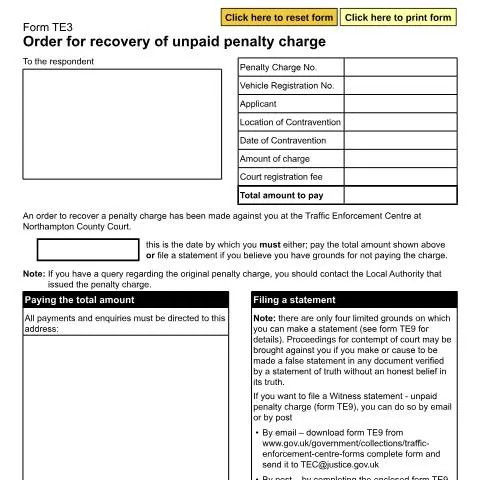
Receiving a Form TE3 Order for recovery of unpaid penalty charge represents a significant escalation in penalty charge proceedings. This document arrives when a parking or traffic penalty has progressed through initial notice stages and reached the enforcement phase at the Traffic Enforcement Centre (TEC) in Northampton County Court. Unlike earlier penalty charge notices that originate from local authorities, the TE3 is a court order with enhanced legal powers, marking the transition from administrative enforcement to judicial recovery proceedings.
The TE3 typically emerges after a sequence of missed opportunities: the original penalty charge notice went unpaid, the subsequent notice to owner was ignored, and any representations period has expired without resolution. At this juncture, the local authority has transferred the case to HM Courts & Tribunals Service for formal debt recovery, transforming what began as a civil penalty into a court-ordered debt with bailiff enforcement powers.
This court order carries immediate consequences and strictly limited timeframes for response. The recipient faces a binary choice: settle the total amount due or file a witness statement on very specific grounds within the deadline shown on the form. Failure to act triggers enforcement proceedings that can result in bailiffs attending the debtor's address to seize goods for sale.
Decoding the TE3: Essential Information and Immediate Obligations
The TE3 form presents critical information in a structured format that demands careful attention to detail. The header section identifies the specific penalty through the Penalty Charge Number and Vehicle Registration Number, linking this court order to the original contravention. The location and date of the alleged offence provide essential context for anyone considering whether to contest the charge.
The financial breakdown reveals the true cost of delayed action. The form displays the original penalty charge amount plus a court registration fee, typically £8, creating the total amount now recoverable through court enforcement. This fee represents the administrative cost of transferring the case from local authority to court jurisdiction and is non-negotiable once the TE3 stage is reached.
| Component | Typical Range | Notes |
|---|---|---|
| Original penalty charge | £25-£130 | Varies by local authority and contravention type |
| Court registration fee | £8 | Fixed amount added when case transfers to TEC |
| Potential bailiff costs | £75+ compliance stage | Additional if enforcement action required |
The deadline shown on the TE3 is absolutely critical. This date represents the final opportunity to either pay in full or file a witness statement without requiring a separate application for extension of time. The Traffic Enforcement Centre typically allows 21 days from the date of the order, though this can vary depending on postal delivery timescales and court processing schedules.
The Four Pillars: Limited Grounds for Witness Statements
Unlike earlier stages where representations could be made on various grounds, the TE3 phase restricts challenges to precisely four statutory grounds. These limitations reflect the court's recognition that previous opportunities for broader representations have already passed, and only fundamental procedural failures or payment disputes remain viable.
The first ground—payment in full—requires comprehensive documentation. Simply claiming payment is insufficient; the witness statement must specify the exact date, payment method (cash, cheque, card, online transfer), and recipient organisation. The TEC may subsequently request bank statements, receipt copies, or other proof of payment, making it essential to gather supporting evidence before filing the statement.
The second ground—non-receipt of notices—challenges the fundamental requirement that proper service of documents must occur before enforcement can proceed. This ground acknowledges that penalty charge procedures depend on notices reaching the registered keeper, and genuine non-receipt undermines the entire process. However, claiming non-receipt requires careful consideration of DVLA address records and any recent moves or forwarding arrangements.
The third and fourth grounds address procedural failures in the representations and appeals process. These grounds apply when the registered keeper submitted timely representations to the issuing authority but received no response, or when appeals were made to an approved adjudicator without receiving a decision. These situations represent systemic failures in the penalty charge process that warrant court intervention.
Warning: The form explicitly states that proceedings for contempt of court may be brought against anyone making false statements verified by a statement of truth without honest belief in their truth. This warning carries real consequences, as contempt proceedings can result in fines or imprisonment.
Strategic Response Options: Payment versus Challenge
Choosing between immediate payment and filing a witness statement requires careful assessment of both the merits of any potential challenge and the practical consequences of each option. Payment in full provides immediate resolution and prevents any additional enforcement costs, but forfeits all opportunity to challenge the underlying penalty charge on its merits.
When considering payment, recipients should contact the local authority directly rather than the Traffic Enforcement Centre for payment processing. The TE3 form typically includes specific payment instructions and contact details for the issuing authority, as they retain responsibility for collecting the penalty charge amount while the court handles enforcement procedures.
Filing a witness statement through Form TE9 suspends enforcement action but requires meeting strict procedural requirements. The statement must be completed accurately, signed with a statement of truth, and submitted within the deadline either by email to [email protected] or by post to the Northampton County Court address. Electronic submission often provides faster processing and confirmation of receipt.
The witness statement process involves several stages. Once filed, the TEC reviews the statement against the four permitted grounds and may request additional evidence or clarification. If the statement appears to have merit, the court may set aside the original order and refer the matter back to the local authority for reconsideration. However, if the statement is rejected, enforcement proceedings resume with additional costs potentially added.
Preparing Supporting Evidence
Each ground for witness statements demands specific types of supporting evidence. For payment claims, gather bank statements showing the transaction, any receipts or confirmation emails, and correspondence with the payment recipient. For non-receipt claims, consider DVLA correspondence showing address changes, Royal Mail redirection confirmations, or evidence of extended absence from the registered address.
For procedural failure claims, compile copies of original representations sent to the local authority, proof of posting or electronic submission, and any acknowledgment or reference numbers received. Similarly, appeals procedure failures require evidence of timely submission to the appropriate adjudication service and lack of response within reasonable timescales.
The Extension Application Route: Form TE7 Considerations
When the TE3 deadline cannot be met, Form TE7 (Application to file a statement out of time) provides a potential remedy, though success is not guaranteed. The court expects compelling reasons for delay and evidence that the application is made promptly once the need becomes apparent. Valid reasons might include serious illness, extended absence from the usual address, or postal delivery failures.
The TE7 application must be completed by the named respondent on the TE3, except in cases involving protected parties under the Mental Capacity Act 2005. For protected parties, a litigation friend must handle all proceedings, including extension applications. This requirement ensures that individuals lacking capacity to conduct legal proceedings receive appropriate representation.
Litigation friends bear significant responsibilities, including acting in the protected party's best interests and managing all aspects of the court proceedings. Anyone considering acting as a litigation friend should understand these obligations and may benefit from legal advice, particularly in complex penalty charge cases.
The TEC contact number (0300 123 1059) provides direct access to court staff who can advise on extension applications and procedural requirements. However, this service focuses on procedural guidance rather than substantive legal advice about the merits of any challenge to the underlying penalty charge.
Enforcement Consequences: When Bailiffs Become Involved
Ignoring the TE3 triggers a well-established enforcement process that can have serious practical and financial consequences. The court order grants authority for enforcement agents (bailiffs) to attend the debtor's address and seize goods sufficient to cover the debt plus their fees. This process follows statutory procedures under the Taking Control of Goods Regulations 2013.
Bailiff involvement adds substantial costs to the original penalty charge. The compliance stage fee (typically £75) applies when bailiffs first become involved, even if they do not visit the property. If a visit occurs, an enforcement stage fee (typically £235) is added, and if goods are removed for sale, a sale stage fee (typically £110 plus costs) applies. These fees are in addition to the original penalty charge and court registration fee.
Enforcement agents have specific powers and limitations. They can seize most personal belongings, vehicles (except those on hire purchase), and business assets, but cannot take essential household items, tools of trade up to £1,350 in value, or goods belonging to third parties. They cannot force entry to residential premises on first visits but may do so on subsequent visits if peaceful entry was previously achieved.
Vulnerable Debtor Protections
Enforcement procedures include protections for vulnerable individuals, including those with mental health conditions, disabilities, or serious illnesses. Bailiffs must identify vulnerability indicators and may suspend action or refer cases back to the creditor when appropriate. However, vulnerability does not automatically prevent enforcement action—it requires proper identification and assessment.
Business premises face different enforcement rules, with bailiffs able to force entry if necessary. This distinction makes commercial penalty charges particularly serious, as enforcement action can disrupt business operations and affect equipment essential for trading activities.
Distinguishing TE3 from Related Traffic Enforcement Documents
The TE3 sits within a family of traffic enforcement documents, each serving distinct functions in the penalty charge process. Understanding these distinctions helps recipients recognise where they stand in the enforcement timeline and what options remain available.
Penalty Charge Notices (PCNs) represent the initial stage, issued by local authorities or their contractors for parking and traffic contraventions. These notices offer reduced payment amounts for early settlement and begin the statutory process that can ultimately lead to TE3 orders.
Notices to Owner (NTOs) follow when initial PCNs remain unpaid, formally requiring the registered keeper to either pay the penalty or make representations explaining why they should not be liable. The NTO stage provides the main opportunity for substantive challenges to penalty charges on grounds such as vehicle theft, cloning, or procedural failures.
The Charge Certificate increases the penalty amount (typically by 50%) when NTO deadlines pass without payment or successful representations. This document serves as final notice before cases transfer to court enforcement, though some authorities offer final settlement opportunities at this stage.
In contrast to these administrative documents, the TE3 represents judicial intervention with enhanced enforcement powers. While earlier stages involve local authority decision-making, the TE3 emerges from court proceedings and carries the authority of HM Courts & Tribunals Service.
Post-TE3 Outcomes and Resolution Pathways
The resolution of TE3 proceedings follows several possible pathways, each with distinct implications for the respondent. Successful witness statements result in the court order being set aside, typically returning the matter to the local authority for reconsideration of the original representations or procedural issues raised.
When witness statements succeed on procedural grounds, local authorities may restart the penalty charge process from the appropriate stage, issue fresh notices, or abandon proceedings entirely depending on the specific circumstances identified. This outcome does not automatically invalidate the underlying penalty charge but provides opportunity for proper consideration of representations or appeals.
Rejected witness statements allow enforcement proceedings to resume, often with additional costs reflecting court time and administrative expenses. The TEC notifies respondents of rejection decisions and the resumption of enforcement action, typically providing a brief period for payment before bailiff involvement.
Payment at any stage before goods seizure remains possible and immediately halts enforcement action. Even after bailiff involvement begins, settlement prevents goods removal and additional sale stage fees, though compliance and enforcement stage fees already incurred remain payable.
Some cases result in court hearings when witness statements raise complex issues requiring judicial consideration. These hearings allow both parties to present evidence and legal arguments, with district judges making final determinations about liability and enforcement. Representation at such hearings, while not mandatory, can significantly impact outcomes in complex cases.
The Traffic Enforcement Centre maintains comprehensive records of all proceedings, providing audit trails for appeals or complaints about procedural handling. These records prove essential when cases progress to formal hearings or when systemic issues with local authority procedures emerge across multiple cases.