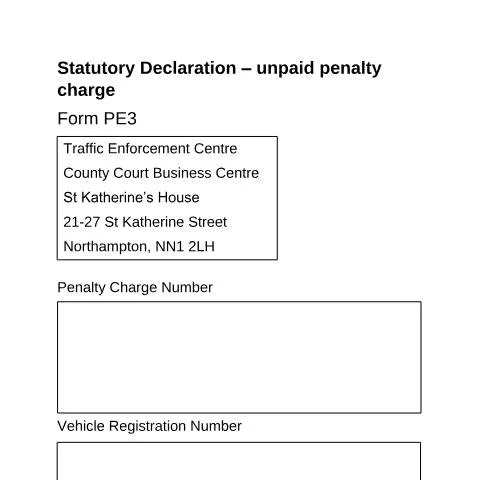
When Court Enforcement Catches Up: Understanding the PE3 Statutory Declaration Process
Receiving an Order for Recovery of an unpaid penalty charge can feel like a bolt from the blue, particularly when you believed the matter was resolved or never properly notified in the first place. The PE3 form represents a crucial legal mechanism within England and Wales' traffic enforcement framework, designed to address situations where penalty charges have escalated to court enforcement despite legitimate procedural failures in the original process.
This statutory declaration process operates under Civil Procedure Rules Part 75, providing a formal avenue to challenge enforcement action when fundamental procedural requirements weren't met during the initial penalty charge process. The form specifically addresses three distinct scenarios where the enforcement chain may have broken down, each carrying different implications for how you present your case.
Understanding the PE3's role requires grasping its position within the broader penalty charge enforcement timeline. By the time this form becomes relevant, your case has typically progressed through multiple stages: initial penalty charge notice, Notice to Owner or Enforcement Notice, potential representations, possible appeals, and ultimately court enforcement proceedings. The PE3 essentially allows you to halt this progression when procedural failures occurred earlier in the chain.
Decoding the Three Statutory Declaration Grounds
The PE3 form presents three specific grounds for statutory declaration, each addressing distinct procedural failures within the penalty charge process. These grounds aren't interchangeable options but represent different points where the enforcement chain may have legitimately broken down.
Non-Receipt of Initial Enforcement Documents
The first ground addresses non-receipt of crucial initial documents: the Notice to Owner for parking contraventions, Enforcement Notice for bus lane violations, or Penalty Charge Notice for moving traffic or congestion charging contraventions. This ground recognises that proper service of these documents is fundamental to due process.
For parking contraventions, the Notice to Owner typically arrives several weeks after the initial Penalty Charge Notice placed on your vehicle. If you never received this Notice to Owner, you may have been unaware that formal enforcement proceedings were progressing. Similarly, for bus lane contraventions, the Enforcement Notice serves as your first formal notification, and non-receipt can leave you entirely unaware of the penalty.
Moving traffic and congestion charging contraventions rely on Penalty Charge Notices sent by post as the primary notification method. Non-receipt of these notices can result from various factors: incorrect vehicle registration details, postal issues, or changes of address not updated with DVLA records.
Unacknowledged Representations
The second ground covers situations where you submitted representations within the statutory 28-day period but never received a rejection notice from the local authority. This scenario recognises that the representations process includes a duty on authorities to respond to challenges, and failure to do so undermines the entire procedural framework.
Representations must typically address specific grounds outlined in relevant legislation, such as the Traffic Management Act 2004 or London Local Authorities Act 1996. When you submit valid representations within the prescribed timeframe, authorities are obligated to consider them and provide a formal response, whether accepting or rejecting your challenge.
The absence of a rejection notice creates a procedural limbo. Without this formal rejection, you cannot progress to the appeals stage, yet the authority may continue enforcement proceedings as if your representations were unsuccessful. This ground acknowledges that such procedural failures fundamentally compromise your right to challenge the penalty.
Unresolved Appeals
The third ground addresses situations where you submitted an appeal to the appropriate adjudicator within 28 days of receiving a rejection notice, but received no response to your appeal. This recognises that the independent appeals process is a crucial safeguard within the penalty charge framework.
Appeals typically go to specialist bodies: the Parking and Traffic Appeals Service for most areas outside London, London Tribunals for London borough penalties, or the Bus Lane Adjudication Service for certain bus lane contraventions. These bodies operate independently from local authorities and provide an impartial review of penalty charge decisions.
When appeals disappear into administrative limbo without response, the entire enforcement process becomes fundamentally unfair. This ground acknowledges that procedural failures at the appeals stage can justify statutory declaration, even when earlier stages proceeded correctly.
Navigating the Sworn Declaration Requirement
The PE3's most distinctive requirement involves having your declaration sworn before an authorised official. This isn't merely a formality but reflects the serious legal nature of statutory declarations and the potential consequences of false statements.
Authorised Officials and Their Roles
Three categories of officials can administer your statutory declaration: Commissioners for Oaths (typically solicitors), Justices of the Peace (available at Magistrates' Courts), or designated officers at your local county court. Each option offers different advantages depending on your circumstances and location.
Solicitors acting as Commissioners for Oaths provide the most accessible option for many people, as they're widely available and familiar with sworn statement procedures. However, they typically charge fees for this service, and you should confirm their availability before visiting their offices.
Magistrates' Courts offer Justice of the Peace services, often at lower cost than solicitors. However, availability may be limited to specific days or hours, and you should contact the court beforehand to confirm arrangements and any required appointments.
County court officers represent another option, particularly convenient if you're already dealing with court-related matters. Like Magistrates' Courts, availability may be restricted, and advance contact is advisable to arrange appointments.
The Swearing Process and Documentation Requirements
The swearing process involves more than simply signing the form. The authorised official must verify your identity, confirm you understand the declaration's content, and witness your signature in their presence. They'll also complete their portion of the form, including their official designation and full postal address.
You must bring appropriate identification to the swearing appointment, typically including photo identification and proof of address. The official may also want to see the Order for Recovery document to verify the penalty charge details you've entered on the PE3 form.
Any amendments to your completed form after swearing will require the entire process to be repeated with fresh witnessing. This emphasises the importance of completing the form accurately before your appointment and double-checking all details against the Order for Recovery.
Critical Information Transfer from Court Documents
The PE3 form requires precise transcription of specific details from your Order for Recovery of unpaid penalty charge. This information transfer is crucial because inaccuracies can result in rejection of your statutory declaration and continuation of enforcement proceedings.
| Required Detail | Source Location | Common Issues |
|---|---|---|
| Penalty Charge Number | Order for Recovery header | Confusion with other reference numbers |
| Vehicle Registration | Order details section | Misreading similar characters (0/O, 1/I) |
| Location of Contravention | Penalty charge details | Abbreviations or incomplete addresses |
| Date of Contravention | Original penalty information | Date format confusion (DD/MM/YYYY) |
The vehicle registration number requires particular attention, as confusion between similar characters can invalidate your declaration. The Order for Recovery should clearly state the registration, but if there's any doubt, cross-reference with your vehicle documentation or DVLA records.
Location details must match exactly as stated in the original penalty charge documentation. Avoid the temptation to "correct" what appears to be incomplete or abbreviated location descriptions, as the court system requires exact matching with original records.
Date formatting follows the standard DD/MM/YYYY convention used throughout UK administrative systems. However, some penalty charge systems may display dates differently, so ensure you're transcribing the actual contravention date rather than issue or service dates.
Building Your Case: The "Full Reasons" Section
The PE3 form's "full reasons" section represents your opportunity to provide detailed explanation supporting your chosen ground for statutory declaration. This section requires careful consideration, as it forms the substantive basis for your challenge to the enforcement proceedings.
Structuring Your Explanation
Your explanation should follow a logical chronological structure, starting with the alleged contravention date and progressing through each stage of the enforcement process. This helps court officials understand exactly where procedural failures occurred and why your statutory declaration is justified.
Begin by acknowledging the alleged contravention details, then systematically address each stage of the enforcement process. If claiming non-receipt of documents, explain your normal postal arrangements, any address changes, and why you would have expected to receive the relevant notices.
For representation-related grounds, provide specific dates when you submitted challenges, the methods used (post, email, online portal), and any acknowledgment receipts or reference numbers received. Include details of follow-up attempts to contact the authority about your unresolved representations.
Supporting Evidence and Documentation
While the PE3 form itself doesn't require attached evidence, your "full reasons" section should reference any supporting documentation you possess. This might include proof of posting for representations, email confirmations, or correspondence with the issuing authority.
Address changes represent a common factor in non-receipt claims. If relevant, explain when you moved, when you notified DVLA of address changes, and provide reference numbers for these notifications. However, remember that vehicle keepers remain responsible for ensuring DVLA holds current address details.
For appeals-related grounds, include specific reference numbers for your appeal submission and details of the appeals body involved. Explain any attempts to contact the appeals service about delayed responses and any interim correspondence received.
Understanding the Perjury Warning and Legal Implications
The PE3 form includes a stark warning about the criminal implications of false declarations under the Perjury Act 1911. This warning isn't mere legal boilerplate but reflects the serious consequences of knowingly providing false information in sworn statements.
The Perjury Act 1911 Section 5 specifically addresses false statutory declarations, carrying potential penalties of up to two years' imprisonment, fines, or both. These penalties apply when false statements are made "knowingly and wilfully," meaning there must be deliberate intent to deceive rather than innocent mistakes.
However, this legal framework also protects legitimate users of the PE3 process. If your statutory declaration accurately reflects your experience of the penalty charge process, you're protected even if subsequent investigation reveals administrative complexities you weren't aware of.
The key distinction lies between factual accuracy about your own experience and broader claims about administrative processes. Your declaration should focus on what you did or didn't receive, what actions you took, and what responses you received, rather than making assumptions about what authorities should have done.
Submission Process and Traffic Enforcement Centre Procedures
The completed and sworn PE3 form must be submitted to the Traffic Enforcement Centre at the specific Northampton address provided on the form. This centralised facility handles statutory declarations for penalty charges across England and Wales, operating under standardised procedures designed to ensure consistent treatment of cases.
Submission Requirements and Timing
Your statutory declaration should be submitted as soon as possible after receiving the Order for Recovery, though no specific deadline is mentioned on the PE3 form itself. However, prompt submission demonstrates the legitimacy of your challenge and may prevent further enforcement action while your declaration is processed.
The form emphasises that incomplete or improperly sworn declarations cannot be accepted, highlighting the importance of following all procedural requirements precisely. Any deficiencies will likely result in rejection and continuation of enforcement proceedings.
Include clear covering correspondence with your submission, explaining that you're submitting a statutory declaration under CPR Part 75 and referencing the specific penalty charge number. This helps ensure proper filing and processing of your documentation.
Post-Submission Expectations
After submitting your PE3 statutory declaration, the Traffic Enforcement Centre will review your case and determine whether the procedural failures you've identified justify setting aside the enforcement proceedings. This process may involve correspondence with the original issuing authority to verify details of their enforcement procedures.
Successful statutory declarations typically result in the matter being returned to the appropriate stage of the penalty charge process, allowing you to pursue representations or appeals that were previously unavailable due to procedural failures. However, this doesn't automatically cancel the penalty charge itself.
If your statutory declaration is accepted, you'll need to act promptly on any opportunities to challenge the underlying penalty charge through normal representations and appeals processes. The PE3 process addresses procedural failures rather than the merits of the original penalty charge decision.
London Borough Variations and Special Considerations
The PE3 form includes specific instructions for London Borough parking contraventions, requiring users to tick only one box rather than potentially multiple grounds. This reflects the distinct administrative framework governing parking enforcement within London boroughs compared to other areas of England and Wales.
London's parking enforcement operates under different legislative frameworks, primarily the London Local Authorities Acts rather than the Traffic Management Act 2004 that governs most other areas. These differences affect the specific procedures and timeframes that apply to penalty charges issued within London boroughs.
However, the fundamental principles underlying statutory declarations remain consistent across jurisdictions. Whether dealing with London borough penalties or those issued elsewhere, the PE3 process addresses the same core issue: procedural failures that undermine due process in penalty charge enforcement.
The distinction becomes particularly important when determining which appeals body has jurisdiction over your case. London penalties typically go to London Tribunals, while penalties elsewhere usually fall under the Parking and Traffic Appeals Service. Your statutory declaration should reference the correct appeals body when claiming unresolved appeals.
Understanding these jurisdictional differences helps ensure your PE3 declaration accurately reflects the specific procedures that should have been followed in your case, strengthening the foundation for challenging enforcement proceedings based on procedural failures.