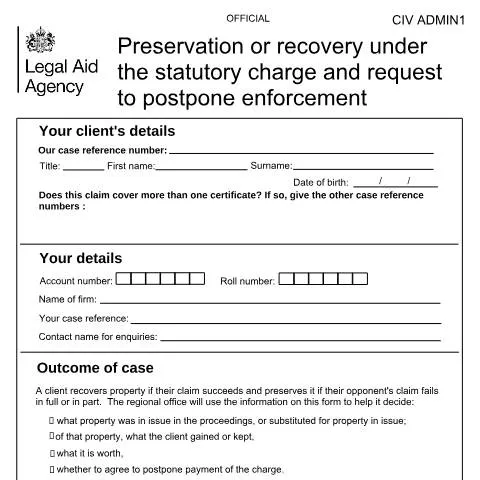
When Civil Legal Aid Meets Property Recovery: Understanding the CIV ADMIN1 Process
The moment a legally aided client successfully defends their home from repossession or recovers valuable assets through civil proceedings, a complex administrative machinery springs into action. The Legal Aid Agency must determine how much of the recovered property can be claimed back to reimburse public funds—a process that begins with the CIV ADMIN1 form. This document sits at the intersection of legal victory and financial accountability, requiring solicitors to navigate between celebrating their client's success and calculating what portion belongs to the state under the statutory charge.
Unlike straightforward billing forms, the CIV ADMIN1 demands a comprehensive analysis of what was truly at stake in the proceedings, what the client gained or preserved, and crucially, whether any exemptions might protect the recovered assets from the Legal Aid Agency's charge. The form's complexity reflects the nuanced reality that not all legal victories are financially straightforward—particularly when family homes, business premises, or complex property arrangements are involved.
The Statutory Charge Landscape: More Than Simple Debt Recovery
The statutory charge operates as the Legal Aid Agency's mechanism to recover costs from successful cases, but its application varies dramatically depending on the type of property involved and the nature of the proceedings. Under regulation 44 of the CLS (Financial) Regulations 2000 for cases post-April 2013, or the earlier Civil Legal Aid (General) Regulations 1989 for older cases, certain recoveries may be wholly or partially exempt from the charge.
The most significant exemption relates to family proceedings involving the main residence. When a client preserves or recovers their family home through divorce proceedings or domestic violence cases, the charge may be postponed indefinitely rather than enforced immediately. This recognises that forcing the sale of a family home to pay legal costs would often defeat the purpose of the legal protection in the first place.
| Type of Recovery | Charge Application | Exemption Potential |
|---|---|---|
| Family home in matrimonial proceedings | Usually postponed | High - indefinite postponement common |
| Commercial property | Immediate enforcement | Limited - exceptional circumstances only |
| Personal injury settlements | Partial application | Moderate - first £3,000 typically exempt |
| Maintenance awards | Usually exempt | High - ongoing income protected |
Dissecting Property Recovery: What Counts as 'Preserved' or 'Recovered'
The CIV ADMIN1 form requires solicitors to distinguish between property that was recovered (gained through successful claims) and property that was preserved (retained by defeating opponents' claims). This distinction matters because the Legal Aid Agency's regional offices use different assessment criteria for each scenario.
Recovery scenarios typically involve situations where the client successfully claimed money, property, or rights they didn't previously possess. A successful boundary dispute that gains garden space, a contract claim that secures unpaid invoices, or a probate action that recovers inherited assets all constitute recovery. The value calculation is generally straightforward—what did the client gain that they didn't have before?
Preservation scenarios are more complex, often involving defendants who successfully fought off claims against their existing assets. When a homeowner defeats a neighbour's claim for adverse possession, or when beneficiaries successfully defend against a will challenge, they've preserved rather than recovered property. Here, the value calculation requires determining what portion of the existing property was genuinely at risk during the proceedings.
Valuation Challenges in Mixed Outcomes
Many civil cases produce mixed results where clients partially succeed on some claims while losing others. The CIV ADMIN1 form must capture these nuances, particularly where settlement agreements involve complex arrangements. For instance, in a partnership dispute where one partner retains the business premises but pays compensation to the other, the form must separate what was preserved (the premises) from what was lost (the cash payment).
The Legal Aid Agency specifically requests title numbers for any land, houses, or flats because property values can fluctuate significantly between the start of proceedings and their conclusion. In lengthy cases, particularly those involving development land or properties in rapidly changing markets, the timing of valuation becomes crucial for accurate charge calculation.
The Solicitor's Certification Dilemma: Balancing Client and Public Interests
Page 3 of the CIV ADMIN1 places solicitors in a delicate position through its certification requirements. The authorised litigator must certify that all information provided is correct while simultaneously advocating for their client's interests in minimising the statutory charge. This dual role requires careful navigation of professional obligations.
The form's structure acknowledges this tension by providing multiple payment options. Solicitors can submit pages 1-3 only if the client has already paid sufficient funds to cover the charge, avoiding the need for detailed postponement arguments. However, when clients cannot immediately pay, the full form becomes necessary, requiring detailed justification for why enforcement should be delayed.
The undertaking regarding total costs represents a significant professional commitment. By signing, the solicitor guarantees that public funding won't exceed the stated amount, creating potential personal liability if additional work becomes necessary. This provision reflects the Legal Aid Agency's concern about cost overruns in cases where valuable property is at stake.
Professional Certificate Requirements
The form explicitly states that the LAA will not pay for any work done during any period in which the solicitor does not have a practising certificate. This seemingly obvious requirement becomes significant in cases spanning multiple years, where certificate renewals might lapse during proceedings. Solicitors must maintain continuous certification throughout the case lifecycle, not just at its conclusion.
Postponement Requests: When Immediate Payment Would Cause Hardship
Page 4 of the CIV ADMIN1 addresses the most sensitive aspect of statutory charge enforcement—requests for postponement when immediate payment would cause genuine hardship. The Legal Aid Agency recognises that forcing asset sales to pay legal costs can sometimes undermine the very protection the legal aid system aimed to provide.
The form distinguishes between postponement on the client's own home versus a dependent's property. When the recovered funds are intended to purchase a home for dependents rather than the client directly, additional scrutiny applies. The Legal Aid Agency requires court certification that the property is genuinely intended as a residence, preventing abuse where commercial investments are disguised as family homes.
Joint ownership arrangements receive particular attention because they can complicate charge enforcement. When recovered funds will purchase property jointly with someone else, the form demands detailed explanation of the arrangement's appropriateness. The Legal Aid Agency must ensure that joint proprietors understand and consent to the Lord Chancellor's charge being registered against the property.
Family Proceedings Exception
The form specifically asks whether proceedings constituted family proceedings as defined in the relevant regulations. This classification is crucial because family proceedings often qualify for indefinite postponement of the statutory charge, recognising the special protection afforded to family homes. Divorce cases, domestic violence proceedings, and children disputes frequently fall within this protected category.
Regional Office Assessment: The Decision-Making Process
The CIV ADMIN1 form feeds into a broader assessment process conducted by the Legal Aid Agency's regional offices. These offices don't simply rubber-stamp submissions but conduct detailed evaluations comparing outcomes against original case estimates and regulatory compliance.
Regional offices examine whether the outcome justified the costs incurred, comparing the final result against the solicitor's initial assessment of prospects. Cases where modest recoveries generated disproportionate legal costs face enhanced scrutiny, particularly where alternative dispute resolution might have achieved similar results more economically.
The assessment also considers whether solicitors complied with regulations designed to secure the charge effectively. This includes checking whether proper notices were given to clients about potential charge liability and whether steps were taken to protect the Legal Aid Agency's interests during settlement negotiations.
Payment Delays and Additional Requirements
The form warns that the regional office may delay paying claims until satisfied that the full charge amount has been paid or secured. This provision gives regional offices significant leverage to request additional documentation or clarification before releasing final payments to solicitors.
In complex cases, regional offices may require independent valuations, particularly for unique properties or assets with disputed values. They may also request detailed breakdowns of settlement negotiations to ensure that the Legal Aid Agency's charge was properly considered during discussions with opposing parties.
Documentation Requirements: Beyond the Basic Form
The CIV ADMIN1 form explicitly requests a copy of the final order or record of any agreement concluding proceedings. This requirement reflects the Legal Aid Agency's need to verify claims independently rather than relying solely on solicitor summaries. Court orders provide definitive evidence of what was recovered or preserved, while settlement agreements reveal the negotiation dynamics that led to particular outcomes.
For property cases, title documentation becomes essential. The form requests title numbers for all relevant land, enabling the Legal Aid Agency to conduct its own property searches and verify ownership details. This independent verification helps prevent disputes later about property values or ownership arrangements.
When cases involve multiple certificates or extended proceedings, cross-referencing becomes crucial. The form allows for multiple case reference numbers, acknowledging that complex disputes often generate several legal aid certificates as cases evolve or appeals develop.
Continuing Sheet Provisions
Several sections of the CIV ADMIN1 explicitly provide for continuation on separate sheets, recognising that complex cases cannot always be summarised within the form's limited space. This flexibility is particularly important for multi-party disputes or cases involving numerous assets, where comprehensive description requires extensive detail.
Strategic Timing: When to Submit and What to Expect
The CIV ADMIN1 submission timing can significantly impact both client outcomes and solicitor cash flow. Submitting immediately after case conclusion ensures prompt processing but may not allow time for optimal settlement of outstanding issues. Conversely, delaying submission to resolve complications may trigger Legal Aid Agency queries about the delay.
Solicitors holding client funds in relation to statutory charges face particular pressure. The form's certification requirements mean that funds cannot be released to clients until the Legal Aid Agency confirms the charge amount and any postponement arrangements. In cases where clients urgently need access to recovered funds—perhaps to complete property purchases—this timing becomes critical.
The form structure acknowledges these pressures by providing streamlined options for straightforward cases where clients can immediately pay the charge. However, cases requiring postponement evaluation inevitably take longer, as regional offices must assess exemption claims and postponement justifications thoroughly.
Understanding the CIV ADMIN1 process requires recognising it as more than administrative form-filling. It represents a crucial stage where legal success transforms into financial accountability, where client protection meets public fund recovery, and where solicitors must balance competing professional obligations. The form's detailed requirements reflect the complexity of these competing interests and the Legal Aid Agency's determination to ensure that public funding contributes appropriately to access to justice while maintaining fiscal responsibility.
Statutory Charge Calculations and Assessment Methods
The calculation of statutory charge amounts involves sophisticated methodologies that vary significantly depending on the type of legal aid received and the nature of the recovered property or money. The Legal Aid Agency employs distinct assessment frameworks for different categories of cases, each with specific rules governing how the charge is computed and applied.
For property recovery cases, the statutory charge typically attaches to the net value of property preserved or recovered through legal aid assistance. The LAA calculates this by determining the gross value of the property at the time of preservation or recovery, then deducting reasonable costs associated with the legal proceedings. These deductions may include court fees, expert witness costs, and other litigation expenses directly attributable to securing the property interest.
In matrimonial and family cases, the assessment becomes more nuanced. The statutory charge may apply to both capital assets and periodic payments, such as maintenance orders. When dealing with the matrimonial home, the LAA considers factors including the client's contribution to the purchase price, mortgage payments made during the relationship, and any improvements funded by the client. The charge calculation must also account for the 'first £3,000 exemption' that applies specifically to property recovered or preserved in certain family proceedings.
Personal injury cases present unique calculation challenges, particularly regarding the treatment of different types of damages. General damages for pain and suffering remain exempt from the statutory charge, whilst special damages and future loss calculations may be subject to charge depending on the specific circumstances. The LAA applies a structured approach to identify which elements of a settlement or award fall within the charge's scope, often requiring detailed breakdowns of compensation components.
Commercial and civil litigation cases involve straightforward net recovery calculations, where the statutory charge attaches to money or property recovered after deducting reasonable legal costs. However, complications arise when dealing with partial settlements, structured payments, or cases involving multiple defendants with varying liability proportions.
The timing of valuation proves crucial in all calculations. Property values are typically assessed at the date of preservation or recovery, not at the time of charge enforcement. This distinction can significantly impact the charge amount, particularly in volatile property markets or cases involving business assets subject to fluctuating valuations.
Interest calculations add another layer of complexity to statutory charge assessments. The LAA applies interest from the date the charge first attached to the property until full discharge of the debt. Interest rates follow statutory provisions and may vary depending on when the legal aid was granted and the type of proceedings involved.
Enforcement Mechanisms and Recovery Procedures
When preservation or recovery claims proceed to enforcement stage, the Legal Aid Agency employs a range of mechanisms designed to secure payment whilst balancing the client's ongoing financial circumstances. The enforcement approach varies considerably depending on whether the charge attaches to real property, personal assets, or monetary awards.
For charges secured against real property, the LAA typically registers a legal charge with HM Land Registry, creating a binding interest that must be satisfied before any sale or transfer can complete. This registration process involves submitting specific documentation, including a copy of the legal aid certificate, details of the costs incurred, and evidence of the property's preservation or recovery through legal aid assistance. The registered charge remains in place indefinitely until discharged through full payment or agreed settlement arrangements.
The enforcement of charges against the matrimonial home requires particular sensitivity, especially where the property remains the family residence. The LAA operates under guidance that prioritises the welfare of children and recognises the practical difficulties of immediate enforcement. In such cases, the agency may agree to postpone active recovery until specific trigger events occur, such as the property's sale, the client's death, or when the youngest child reaches majority age.
Personal property enforcement involves different considerations, particularly when dealing with business assets or investment portfolios. The LAA must balance recovery objectives against the client's ongoing livelihood and the practical implications of asset realisation. In business contexts, enforcement action might involve appointing receivers or seeking court orders for asset preservation pending resolution of the charge liability.
Monetary award enforcement typically follows more straightforward debt recovery procedures, though complications arise when dealing with structured settlements or awards payable over extended periods. The LAA may accept instalment arrangements that reflect the payment structure of the underlying award, particularly in personal injury cases involving periodic compensation payments.
The agency's enforcement discretion extends to considering exceptional circumstances that might justify postponing or modifying recovery action. These circumstances include severe financial hardship, significant health issues affecting the client's earning capacity, or situations where immediate enforcement would cause disproportionate harm to family members not party to the original legal proceedings.
Third-party interests in charged property create additional enforcement complexities. Where property is jointly owned or subject to existing charges, the LAA must navigate competing interests whilst preserving its statutory recovery rights. This often involves detailed negotiations with mortgage lenders, other charge holders, or joint owners to establish priority arrangements and payment sequences.
Enforcement procedures must also account for potential challenges to the charge's validity or amount. Clients retain rights to dispute calculations, seek variations based on changed circumstances, or argue for exemptions under specific statutory provisions. The LAA maintains internal review procedures for handling such disputes, with ultimate recourse to court determination where agreements cannot be reached.
Cross-Border Implications and International Considerations
Statutory charge preservation and recovery claims increasingly involve cross-border elements, particularly following the UK's departure from the European Union and the evolution of international legal aid arrangements. These international dimensions create complex jurisdictional questions and practical challenges for both charge attachment and enforcement procedures.
Property located outside England and Wales presents immediate complications for charge registration and enforcement. Whilst the Legal Aid Agency's statutory charge powers derive from domestic legislation, their effectiveness depends heavily on recognition and enforcement mechanisms in the relevant foreign jurisdiction. The LAA must therefore assess the practical enforceability of charges against overseas assets before committing significant resources to recovery proceedings.
European Union member states previously operated under mutual recognition principles that facilitated cross-border enforcement of legal charges and judgments. Post-Brexit arrangements have introduced additional procedural requirements and potential limitations on enforcement effectiveness. The LAA now relies on bilateral treaties, international conventions, and reciprocal enforcement arrangements that vary significantly between jurisdictions.
Cases involving clients who relocate abroad during or after legal aid proceedings create particular challenges for ongoing charge management. The LAA must maintain effective communication channels with overseas clients whilst navigating different legal systems' approaches to debt enforcement and asset preservation. This often requires engaging local legal representation in the relevant jurisdiction, adding complexity and cost to recovery procedures.
International family cases involving matrimonial property in multiple jurisdictions require sophisticated coordination between different legal systems' approaches to property division and charge recognition. The LAA must consider how statutory charges interact with foreign court orders, particularly where different jurisdictions apply conflicting principles regarding legal aid cost recovery.
Commercial litigation with international elements may involve assets spread across multiple jurisdictions, each with distinct legal frameworks governing charge attachment and enforcement. The LAA's strategy must account for varying limitation periods, different approaches to asset freezing, and potential conflicts between recovery proceedings in different countries.
Immigration status changes affecting legal aid clients create additional complications for charge enforcement. Clients who lose right to remain in the UK may relocate to jurisdictions where the LAA has limited enforcement capabilities, potentially rendering charges practically unenforceable despite their technical validity.
The agency has developed specific protocols for managing international enforcement challenges, including early assessment of cross-border implications, engagement with specialist international recovery firms where appropriate, and consideration of cost-benefit analyses that account for reduced enforcement prospects in certain jurisdictions.
Currency fluctuations and exchange rate considerations add further complexity to international charge calculations and enforcement. The LAA must determine appropriate conversion dates and rates, particularly for charges that attach to foreign currency assets or where enforcement proceeds are received in non-Sterling currencies. These decisions can significantly impact the net recovery amount and must be made consistently with statutory charge calculation principles.