Understanding the Official Notice for Walls of Court of a Protection Measure in Scotland
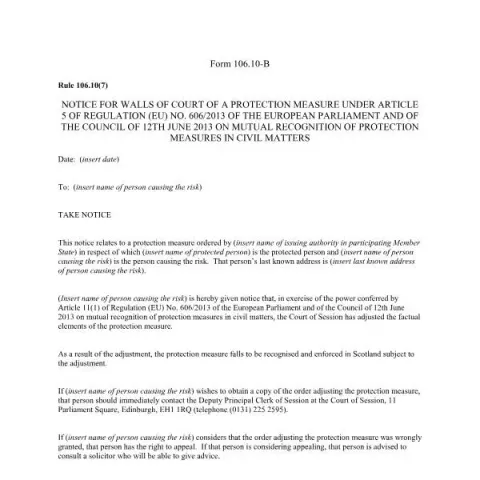
This article provides a comprehensive overview of the official form issued by the Scottish Courts and Tribunals Service, specifically the document titled "NOTICE FOR WALLS OF COURT OF A PROTECTION MEASURE UNDER ARTICLE 5 OF REGULATION (EU) NO. 606/2013 OF THE EUROPEAN PARLIAMENT AND OF THE COUNCIL OF 12TH JUNE 2013 ON MUTUAL RECOGNITION OF PROTECTION MEASURES IN CIVIL MATTERS." This form, identified as Form 106/10-B, plays a crucial role in the recognition and enforcement of protection orders across European Union (EU) member states, including Scotland.
What Is the Purpose of This Official Notice?
This official notice serves to inform a specific individual—referred to as the person causing the risk—about a protection measure ordered by a competent authority in another participating Member State of the EU. The primary purpose is to communicate that the protection order, which is intended to safeguard a protected person, is now recognized within Scotland, following the legal provisions of Regulation (EU) No. 606/2013.
Specifically, the notice indicates that the protection measure has been adjusted by the Scottish Court of Session to align with local legal requirements, making it enforceable within Scottish jurisdiction. This process ensures mutual recognition of civil protection orders across member states, facilitating cross-border legal protection.
Who Needs to Fill Out This Form?
The form is typically completed by the court or legal authorities responsible for implementing the recognition of foreign protection measures. It is used to officially notify the individual causing the risk about the recognition and adjustment of the protection order. The person causing the risk, or their legal representative, may also be involved in requesting further copies or contesting the adjustment through appeal.
How to Complete the Form Correctly
Key Details to Include
- Date of the notice: The date when the notice is issued.
- Name of the person causing the risk: The individual who is subject to the protection measure.
- Details of the protection measure: Including the issuing authority of the original order in the participating Member State.
- Protected person’s name: The individual protected by the order.
- Last known address of the person causing the risk: To ensure proper identification and notification.
Additional Instructions
The form must be signed by the Deputy Principal Clerk of Session at the Court of Session. It is essential to accurately fill in all details to avoid delays or misunderstandings. If the person causing the risk wishes to obtain a copy of the order or the adjustment details, they should contact the Court of Session directly at the address provided.
What Are the Next Steps After Filling the Form?
Notification and Enforcement
Once completed, the notice is officially served to the individual causing the risk, informing them of the recognition and enforcement of the foreign protection measure within Scotland. This ensures that the protection order is legally effective locally, providing safety and legal recourse for the protected person.
Right to Appeal
If the person causing the risk believes that the adjustment or recognition was wrongly granted, they have the right to appeal the decision. It is advisable for them to seek legal advice from a solicitor to understand the grounds and process for appealing under Scottish law.
Fill in your form directly online
No printing: type your details into the boxes of the official form, tick, then download the PDF ready to send.
- 1Type into the form boxes
- 2Tick in one click
- 3Save and download the PDF
Where to Find More Information or Assistance
For further details or to request a copy of the order, the individual should contact the Deputy Principal Clerk of Session at the Court of Session, located at 11 Parliament Square, Edinburgh, EH1 1RQ. Telephone inquiries can be made to (0131) 225 2595.
This official form and process exemplify the UK’s commitment to respecting cross-border civil protection measures, ensuring individuals’ safety across jurisdictions within the European Union framework.