When Financial Decisions Require Court Protection: Understanding Deposit Requests for Deputies
Managing the financial affairs of someone who lacks mental capacity involves navigating a complex web of legal safeguards designed to protect vulnerable individuals. At the heart of this system lies the Court of Protection, which operates through a network of appointed deputies who must handle funds with meticulous care and transparency. When these deputies need to deposit money into court-administered accounts, they encounter a specific procedural requirement that demands both precision and compliance with strict regulatory frameworks.
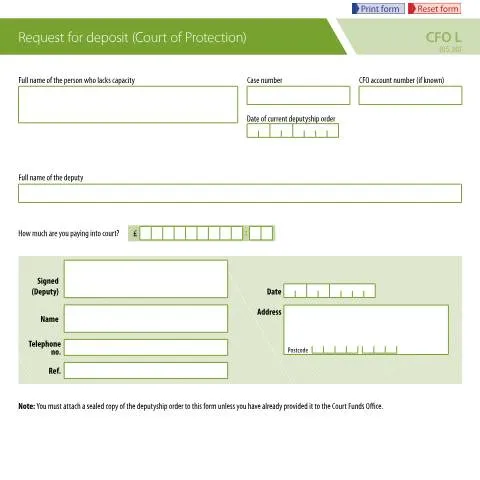
The Court Funds Office, operating under the Ministry of Justice's oversight, maintains these protected accounts as part of Britain's broader mental capacity legislation. Deputies find themselves using the Request for deposit (Court of Protection) form when circumstances require funds to be placed under direct court supervision, whether for investment purposes, pending resolution of disputes, or to ensure proper safeguarding during transitional periods in a person's care arrangements.
The Legal Framework Behind Court Fund Deposits
The requirement for court-supervised deposits stems from the Mental Capacity Act 2005, which established comprehensive protections for individuals unable to make their own financial decisions. This legislation created the Court of Protection as a specialist jurisdiction with powers to oversee property and financial affairs, working in conjunction with the Office of the Public Guardian to monitor deputy activities.
Deputies operate under strict fiduciary duties, meaning they must act solely in the protected person's best interests while maintaining complete transparency about all financial transactions. The Court Funds Office serves as an independent custodian for money that requires enhanced protection or professional management beyond what individual deputies can provide. This arrangement ensures that substantial sums benefit from institutional-grade investment management while remaining readily accessible when needed for the person's care and support.
The deposit request form represents a critical control mechanism within this system. Unlike standard banking arrangements, court funds operate under judicial oversight, with the Accountant General of the Senior Courts holding ultimate responsibility for their stewardship. This structure provides additional security layers that prove particularly valuable when managing the estates of vulnerable adults whose circumstances may change unpredictably.
Navigating Deputy Responsibilities and Deposit Triggers
Deputies encounter various scenarios that necessitate court fund deposits, each carrying specific implications for how they manage their responsibilities. Property sale proceeds often require temporary court custody pending decisions about reinvestment or care funding arrangements. Similarly, inheritance windfalls may exceed what deputies feel comfortable managing independently, particularly when amounts could significantly impact means-tested benefit entitlements.
Insurance settlements present another common trigger, especially following personal injury claims where structured settlements require professional oversight. Deputies may also seek court fund deposits when facing family disputes about financial management, as court custody provides neutral ground while legal proceedings resolve underlying disagreements.
The timing of deposit requests often proves critical. Deputies must balance the protected person's immediate needs against longer-term financial security, while considering how court fund deposits might affect benefit calculations under Universal Credit or other means-tested systems. The Court Funds Office operates investment policies designed to preserve capital while generating reasonable returns, but deputies must understand that accessing deposited funds requires formal court procedures that can take several weeks to complete.
Distinguishing Between Deposit Types
The Court Funds Office manages several distinct fund categories, each serving different purposes within the mental capacity framework. Basic accounts provide simple custody services for money awaiting distribution or reinvestment decisions. Special accounts offer enhanced investment management for larger sums intended for long-term growth. Damages accounts specifically handle personal injury awards with structured payment arrangements.
Deputies must specify their intended deposit type when submitting requests, as this determines both the investment approach and withdrawal procedures that will apply. The form's design accommodates these distinctions through specific reference fields that link deposits to existing case management systems.
Completing the Deposit Request: Section-by-Section Analysis
The deposit request form's apparent simplicity masks several critical requirements that deputies must address with precision. The amount field requires exact figures, as the Court Funds Office processes deposits to the penny and maintains detailed audit trails for all transactions. Deputies should verify amounts multiple times, particularly when converting assets from non-cash forms or when exchange rates affect international transfers.
The capacity details section demands complete accuracy in naming both the person lacking capacity and the appointed deputy. Names must match exactly with court records, as discrepancies can delay processing significantly. The Court Funds Office cross-references all submissions against existing deputyship orders and will reject applications containing inconsistent information.
Documentation Requirements and Sealed Orders
The form specifically requires attachment of sealed deputyship orders unless previously provided to the Court Funds Office. This requirement reflects the office's need to verify legal authority before accepting deposits. Sealed orders carry official court authentication that confirms the deputy's legal standing and defines their specific powers and limitations.
| Document Type | When Required | Processing Impact |
|---|---|---|
| Original sealed order | First-time deposits | Full verification process |
| Certified copy | Subsequent deposits | Expedited processing |
| Amended order | Changed circumstances | Authority re-verification |
Deputies should maintain certified copies of their orders specifically for Court Funds Office purposes, as original sealed documents prove difficult to replace if lost during postal submission. The office maintains records of previously submitted orders, but deputies benefit from referencing their CFO account numbers when known, as this accelerates the verification process.
Payment Procedures and Processing Protocols
The Court Funds Office operates specific payment protocols that deputies must follow precisely to ensure successful deposit processing. Cheques must be made payable exclusively to the "Accountant General of the Senior Courts", with no alternative payee designations accepted. This requirement reflects the office's statutory role as custodian for court-supervised funds.
Electronic transfers require prior arrangement through the office's customer helpline, as the Court Funds Office maintains specialized banking arrangements that differ from standard commercial accounts. Deputies planning large deposits should contact the office in advance to confirm processing procedures and avoid delays that could affect time-sensitive financial arrangements.
The office's Sunderland location handles all deposit processing centrally, with dedicated systems for tracking submissions and maintaining audit trails. Processing typically takes 5-10 working days from receipt, though complex cases requiring additional verification may extend this timeframe. Deputies receive written confirmation once deposits are successfully processed and allocated to the appropriate account category.
Monitoring Deposit Status and Account Management
Once deposits are processed, deputies gain access to regular account statements and online monitoring systems that track investment performance and transaction history. The Court Funds Office provides quarterly statements as standard, with more frequent reporting available upon request for accounts with regular activity.
Deputies should establish systematic monitoring procedures, particularly for accounts funding ongoing care arrangements. The office's customer helpline provides status updates and can expedite processing when circumstances require urgent attention.
Integration with Broader Court of Protection Procedures
Deposit requests rarely occur in isolation but typically form part of broader case management processes within the Court of Protection system. Deputies must consider how court fund deposits interact with their annual reporting obligations, particularly the detailed financial accounts required by the Office of the Public Guardian.
The Court Funds Office coordinates closely with both the Court of Protection and OPG to ensure seamless information sharing about deputy activities. Deposit transactions appear in annual account summaries, and deputies must be prepared to explain their rationale for using court funds rather than alternative investment or banking arrangements.
When deputies face court applications for authority to make specific expenditures, existing court fund deposits can provide immediate funding sources without requiring asset liquidation or borrowing arrangements. This flexibility proves particularly valuable for care home fees, medical treatments, or property adaptations that require substantial upfront payments.
Withdrawal Procedures and Forward Planning
Deputies should understand withdrawal procedures before making deposits, as accessing court funds requires formal applications that can take several weeks to process. Emergency access provisions exist for urgent care needs, but these require compelling justification and medical evidence of immediate necessity.
The Court Funds Office provides detailed guidance on withdrawal procedures, including standard forms and documentation requirements. Deputies benefit from maintaining contingency plans that account for court fund access timeframes when planning major expenditures or care transitions.
Addressing Complications and Procedural Challenges
Deputies encounter various complications when submitting deposit requests, often stemming from incomplete documentation or misunderstanding of court fund procedures. Rejected applications typically result from naming inconsistencies, missing sealed orders, or attempts to deposit funds without proper legal authority.
The Court Funds Office customer helpline provides support for resolving procedural issues, but deputies should allow additional time for resubmission when problems arise. Common complications include expired deputyship orders, changes in deputy appointments, or disputes about financial management authority that require court resolution before deposits can proceed.
When multiple deputies share responsibility for financial management, the Court Funds Office requires clear designation of which deputy has authority to make deposit requests. Joint deputyship arrangements often complicate this process, particularly when deputies disagree about investment strategies or fund management approaches.
Deputies facing urgent financial decisions should maintain open communication with the Court Funds Office about their circumstances, as the office can provide guidance on expedited procedures when genuine emergencies arise. However, the office maintains strict adherence to legal requirements and cannot bypass verification procedures even in urgent situations.
The integration of court fund deposits within broader mental capacity protection systems demonstrates the sophisticated safeguards that British law provides for vulnerable adults. Deputies who understand these procedures can navigate them effectively while ensuring that the people they serve receive optimal financial protection and management throughout their period of incapacity.
Navigating Complex Family Circumstances and Multiple Deputies
Court of Protection deposit arrangements become particularly intricate when dealing with complex family dynamics or situations involving multiple deputies. The Court recognises that many protected persons have multifaceted family structures, blended families, or circumstances where several individuals may have legitimate interests in their welfare and financial management.
When multiple family members seek deputy appointments, the Court may approve joint or several deputy arrangements, each requiring separate deposit considerations. Joint deputies typically share collective responsibility and may be required to provide a combined security deposit, calculated based on the total estate value they will jointly manage. However, the Court may apportion liability differently depending on each deputy's specific role – for instance, one deputy might handle day-to-day expenses whilst another manages investment portfolios.
Several deputies, by contrast, can each act independently within their designated spheres of authority. This arrangement often necessitates individual deposit requirements, with each deputy's security reflecting their particular area of responsibility. A property deputy might require substantial security based on real estate values, whilst a deputy handling only personal welfare decisions may face minimal or no deposit requirements.
Blended family situations present unique challenges, particularly where step-children, ex-spouses, or half-siblings may have competing interests. The Court scrutinises these appointments carefully, often requiring enhanced security deposits when family tensions exist or where previous disputes over the protected person's affairs have occurred. Documentary evidence of family relationships, including marriage certificates, divorce decrees, or adoption papers, may influence both appointment decisions and deposit calculations.
Professional deputies appointed alongside family members – such as solicitors working with spouse deputies – create hybrid arrangements requiring careful deposit coordination. The Court may require the professional deputy to maintain their standard professional indemnity insurance whilst the family deputy provides additional security for their specific responsibilities.
Fill in your form directly online
No printing: type your details into the boxes of the official form, tick, then download the PDF ready to send.
- 1Type into the form boxes
- 2Tick in one click
- 3Save and download the PDF
Cross-border family situations, where protected persons have assets or relatives in Scotland, Northern Ireland, or internationally, add further complexity. Deputies managing assets across different jurisdictions may face enhanced deposit requirements to account for the additional risks and oversight challenges involved in cross-border estate management.
Professional Deputy Obligations and Enhanced Security Requirements
Professional deputies – including solicitors, chartered accountants, and specialist court-appointed deputies – face distinct deposit obligations reflecting their enhanced duties and the typically larger estates they manage. These professionals often handle multiple deputyships simultaneously, creating unique administrative and financial challenges in meeting Court of Protection security requirements.
Solicitor deputies must maintain adequate professional indemnity insurance as a baseline requirement, but the Court frequently mandates additional security deposits for specific cases. The Solicitors Regulation Authority's minimum insurance levels may prove insufficient for large estates, prompting the Court to require supplementary bonding or deposit arrangements. These additional securities often reflect the solicitor's caseload volume, the complexity of estates involved, and any previous regulatory issues or client complaints.
Chartered accountant deputies similarly face enhanced scrutiny, particularly given their expertise in financial management. The Court may impose higher deposit requirements on accountant deputies, recognising their professional capability to engage in sophisticated financial transactions that could potentially disadvantage protected persons if mismanaged. Their deposit calculations often incorporate factors such as the deputy's other professional responsibilities, potential conflicts of interest, and the technical complexity of the estate's financial arrangements.
Panel deputies – professionals appointed from the Court's approved panel – operate under standardised security arrangements, but individual cases may warrant enhanced requirements. Panel deputy deposit obligations typically reflect their experience level, specialisation area, and the geographic scope of their practice. Rural panel deputies managing agricultural estates may face different security calculations than urban deputies handling commercial property portfolios.
Corporate deputies, including trust companies and professional deputy services, must demonstrate robust institutional security arrangements. These organisations typically provide corporate guarantees, professional indemnity coverage, and regulatory oversight that may reduce individual deposit requirements. However, the Court scrutinises their financial stability, regulatory compliance history, and internal governance structures when determining appropriate security levels.
Professional deputies managing estates exceeding £1 million face progressively enhanced security requirements, with the Court often demanding detailed financial projections, investment strategies, and risk management protocols. These high-value cases may require quarterly reporting, independent financial audits, and specialised insurance coverage beyond standard professional indemnity policies.
Regulatory changes affecting professional deputies – such as modifications to Solicitors Regulation Authority requirements or changes to professional indemnity insurance markets – can impact ongoing deposit obligations. Deputies must monitor their professional regulatory environment and promptly notify the Court of any changes affecting their security arrangements or professional standing.
Deposit Variations and Estate-Specific Considerations
Court of Protection deposit requirements vary significantly based on the protected person's specific estate composition, creating a nuanced system that reflects the diverse range of circumstances the Court encounters. Understanding these variations helps deputies and their advisers prepare appropriate security arrangements and anticipate potential adjustments throughout the deputyship period.
Property-heavy estates require careful deposit calibration, particularly where the protected person owns multiple properties, commercial real estate, or properties with complex ownership structures. Deputies managing portfolios including buy-to-let properties face enhanced deposit requirements reflecting rental income management responsibilities, maintenance obligations, and potential tenant disputes. Listed building ownership or properties with agricultural ties create additional complications, as these assets may have restricted marketability or specialised management requirements that influence deposit calculations.
Business ownership situations demand sophisticated deposit arrangements, especially where the protected person holds significant shareholdings in private companies or partnership interests. Deputies may need to demonstrate understanding of company law, partnership agreements, and commercial decision-making processes. The Court often requires enhanced security when business interests involve family companies, professional practices, or businesses requiring active management participation. Voting rights attached to shareholdings create additional responsibilities that may warrant increased deposit requirements.
Investment portfolio management presents unique challenges, particularly for deputies handling sophisticated financial instruments, overseas investments, or alternative assets. Deposit requirements may reflect the complexity and risk profile of existing investments, with higher securities required for portfolios including derivatives, hedge fund investments, or cryptocurrency holdings. Deputies managing Self-Invested Personal Pensions (SIPPs) or Small Self-Administered Schemes (SSAS) face additional regulatory compliance obligations that influence their security arrangements.
Intellectual property ownership – including patents, copyrights, or trademark portfolios – requires deputies to demonstrate relevant expertise or engage appropriate professional advisers. The Court may mandate enhanced deposits when intellectual property represents significant estate value or requires active management to maintain or exploit commercial opportunities. Royalty income streams create ongoing management responsibilities that influence long-term deposit arrangements.
Charitable giving arrangements established by the protected person before losing capacity require careful navigation, with deposits potentially reflecting the deputy's discretionary powers over continued philanthropic activities. The Court scrutinises situations where the protected person previously made substantial charitable commitments or established private foundations requiring ongoing management.
Debt management responsibilities significantly impact deposit calculations, particularly where the protected person has guaranteed others' obligations, holds joint and several liabilities, or faces potential contingent claims. Deputies managing estates with significant creditor exposure may require enhanced security reflecting their negotiation and litigation responsibilities. Mortgage guarantees provided for adult children or business associates create ongoing contingent liabilities that influence deposit assessments.
Trust beneficiary positions held by protected persons create complex deputy obligations, particularly where discretionary trust distributions require active pursuit or where trust disputes may arise. Deputies may need enhanced security when representing protected persons' interests in family trusts, pension scheme trusts, or charitable trust arrangements where beneficiary rights require active protection or enforcement.