When Court of Protection Proceedings Become a Financial Burden
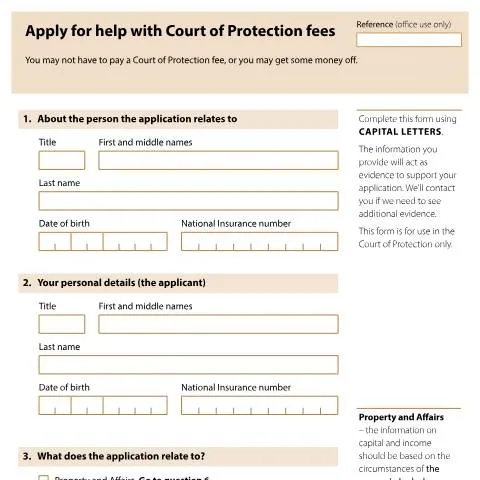
Court of Protection proceedings can carry substantial fees that may prove prohibitive for individuals already facing the emotional and practical challenges of managing a loved one's affairs or pursuing their own welfare rights. Form COP44A represents the official route to seek financial relief when Court of Protection fees threaten to block access to justice. This application mechanism acknowledges that the court's protective jurisdiction should remain accessible regardless of economic circumstances.
The form addresses two distinct scenarios: those seeking prospective fee assistance before proceedings commence, and those pursuing retrospective refunds within three months of a Final Order. Understanding which category applies determines both the timing of your application and the financial assessment criteria that will govern the decision.
Unlike many court fee remission schemes, the Court of Protection system recognises the unique circumstances surrounding mental capacity cases, where the person requiring protection may have different financial resources from the person initiating proceedings. This creates a dual assessment framework that varies significantly depending on whether your case concerns Property and Affairs or Health and Personal Welfare matters.
Determining Your Application Category and Assessment Basis
The fundamental distinction between Property and Affairs cases and Health and Personal Welfare cases shapes every aspect of your fee remission application. This categorisation determines whose financial circumstances undergo scrutiny and establishes the evidence requirements that will support your claim.
Property and Affairs applications centre the financial assessment on the person who lacks or may lack capacity – the individual whose estate, investments, or financial decisions form the subject matter of the proceedings. Whether you're seeking to become a deputy, challenging existing arrangements, or pursuing specific financial decisions, the court examines the protected person's resources rather than your own. This approach recognises that Property and Affairs proceedings typically involve managing someone else's money.
Health and Personal Welfare cases reverse this assessment focus entirely. Here, the court evaluates the financial circumstances of the person making the application – you, the applicant – along with your partner's resources if you're married or cohabiting. This reflects the reality that welfare decisions often arise from family disputes or care planning situations where the applicant bears the financial burden of pursuing the case.
Partnership Status and Income Aggregation
Question 4 on the form requires careful consideration of your relationship status, as this determines whether partner income becomes relevant to your assessment. The form distinguishes between single status and being married or living with someone and sharing an income. The phrase "sharing an income" encompasses various arrangements beyond formal marriage, including civil partnerships and cohabiting relationships where finances are substantially integrated.
If you're married or cohabiting with shared finances, your partner's income and savings become part of the assessment calculation. This includes situations where you maintain some separate accounts but share major expenses like rent, mortgage payments, or household bills. However, temporary separations or relationships where finances remain entirely separate may warrant single status designation.
Navigating the Savings and Investment Thresholds
The form establishes clear financial thresholds that determine eligibility for fee assistance, with different rules applying depending on the applicant's age and the type of assets held. Understanding these thresholds helps gauge your prospects before completing the detailed financial disclosure sections.
| Age Category | Initial Threshold | Upper Limit | Likely Outcome |
|---|---|---|---|
| Under 66 | £4,250 | £16,000 | Assessment continues if under £16,000 |
| 66 and over | No initial threshold | £16,000 | Direct assessment regardless of amount |
The £4,250 threshold for applicants under 66 serves as an initial filter, directing those with minimal savings straight to the benefits assessment while requiring others to declare their full financial position. For those 66 and over, the form bypasses this initial threshold entirely, recognising that older applicants may hold modest savings that shouldn't automatically disqualify them from assistance.
The £16,000 upper limit represents a near-absolute barrier to fee assistance. The form states that applicants with savings and investments exceeding this amount are "unlikely to get help with their fees." This threshold encompasses all savings and investments, including ISAs, premium bonds, shares, and other financial products detailed in the accompanying guidance document COP44B.
What Counts as Savings and Investments
The savings calculation extends beyond traditional bank accounts to encompass a broad range of financial assets. Individual Savings Accounts (ISAs) count towards the threshold despite their tax-advantaged status, as do premium bonds, stocks and shares, and money held in trust funds where the applicant has beneficial interest.
Property other than the main residence may also factor into the assessment, particularly rental properties or second homes. However, the calculation becomes more complex when property is jointly owned or subject to mortgage debt, requiring careful evaluation of the applicant's actual beneficial interest.
Qualifying Benefits and Automatic Entitlement Routes
Receipt of specific means-tested benefits can provide an automatic route to fee assistance, bypassing the detailed income assessment process. The form lists five qualifying benefits that indicate financial hardship sufficient to warrant fee relief:
- Income-based Jobseeker's Allowance (JSA) – the means-tested version, not contribution-based JSA
- Income-related Employment and Support Allowance (ESA) – again, the means-tested variant
- Income Support – the legacy benefit for those unable to work
- Universal Credit with annual earnings below £6,000
- Pension Credit (guarantee credit element) – the means-tested support for older people
The distinction between contribution-based and income-based benefits proves crucial here. Contribution-based JSA and ESA, paid based on National Insurance contributions rather than means testing, do not qualify for automatic fee assistance. These benefits can supplement other income without indicating the level of financial hardship required for court fee relief.
Universal Credit recipients face an additional earnings threshold of £6,000 annually. This recognises that Universal Credit operates as an in-work benefit for low earners, but higher earnings may indicate sufficient resources to contribute towards court fees. The £6,000 threshold equates to approximately £500 monthly earnings, providing a clear benchmark for assessment.
Verification and Department for Work and Pensions Liaison
When you claim entitlement based on qualifying benefits, HM Courts & Tribunals Service contacts the Department for Work and Pensions directly to verify your benefit status. This verification process eliminates the need for you to provide benefit letters or other documentary evidence, streamlining the application where qualifying benefits apply.
The verification extends to historical benefit receipt, acknowledging that benefit status may have changed between the time of application and the assessment. This flexibility proves particularly important for Universal Credit claimants whose earnings may fluctuate around the £6,000 threshold.
Income Assessment and Dependency Allowances
For applicants who don't qualify through the benefits route, the form requires comprehensive income disclosure across multiple categories. This assessment considers both the applicant's income and, where applicable, their partner's earnings, creating a household income picture that determines eligibility for fee assistance.
The income thresholds incorporate dependency allowances that recognise the additional financial burden of supporting children. These allowances vary by age, reflecting the different costs associated with younger and older dependent children:
- Children aged up to 13: £425 monthly allowance
- Children aged 14 and over: £710 monthly allowance
- Base threshold (single applicant): £1,420 monthly
- Base threshold (couple): £2,130 monthly
These allowances apply to financially dependent children up to age 19 if in full-time education, including both children living with the applicant and those for whom the applicant pays maintenance. This broad definition acknowledges various family arrangements and the continuing financial responsibility parents bear for older children in education.
Excluded Income Categories
Certain types of income are specifically excluded from the assessment, recognising their particular purpose or nature. Carer's Allowance doesn't count towards the income threshold, acknowledging the additional costs and responsibilities associated with providing care. Similarly, Housing Benefit and the childcare element of Working Tax Credit are excluded as they represent specific support for housing and childcare costs rather than general income available for court fees.
This selective approach to income assessment ensures that benefits designed to meet specific needs don't artificially inflate the apparent resources available for court fee payment.
Documentation Requirements and Evidence Standards
While form COP44A itself serves as the primary evidence for your fee assistance application, additional documentation may be required to verify the information provided. The form states that HM Courts & Tribunals Service will contact you if additional evidence is needed, rather than requiring comprehensive documentation upfront.
However, section 12 explicitly requires evidence of income to accompany your application. This evidence requirement varies depending on your income sources but typically includes:
- Recent payslips for employed applicants
- Self-assessment returns or business accounts for self-employed individuals
- Pension statements for retired applicants
- Benefit notification letters where relevant
- Bank statements showing rental income or other regular payments
The accompanying guidance document COP44B provides detailed specifications for acceptable evidence, including requirements for document currency and the treatment of irregular income. This guidance proves particularly important for applicants with complex income arrangements or multiple income sources.
Partner Documentation and Joint Applications
Where partner income forms part of the assessment, evidence requirements extend to cover both parties' financial circumstances. This may include situations where partners have different employment arrangements or income sources, requiring coordination to provide comprehensive documentation.
The form doesn't require your partner to sign the declaration, but their financial information becomes part of your sworn statement, creating shared responsibility for the accuracy of disclosed information.
Submission Procedures and Processing Timescales
Form COP44A must be submitted to the Court of Protection's dedicated processing address at First Avenue House in High Holborn, London. The form can be sent by post to PO Box 70185 or delivered via the DX legal document exchange system using reference DX 160013 Kingsway 7.
The declaration section requires your signature and carries significant legal weight, warning of potential fraud proceedings for deliberately false information. This declaration extends beyond simple accuracy to encompass completeness, requiring disclosure of all relevant financial information rather than selective reporting.
Processing timescales aren't specified on the form, but the Court of Protection typically aims to resolve fee assistance applications before substantive case management begins. This timing allows fee decisions to inform early case directions and prevents delays in the main proceedings.
Refund Applications and Time Limits
Retrospective applications for fee refunds face a strict three-month time limit from the date of the Final Order. This limitation recognises the administrative burden of processing historical fee assessments while providing reasonable opportunity for recently concluded cases where fee assistance circumstances weren't initially apparent.
Refund applications require the same financial assessment as prospective applications, but the assessment date typically relates to the financial circumstances at the time the original fee was paid rather than current circumstances.
The refund provision acknowledges that Court of Protection proceedings can evolve in ways that reveal financial hardship not apparent at the outset, or that applicants may become aware of fee assistance availability only after proceedings conclude. This flexibility ensures that fee barriers don't permanently exclude those who might have qualified for assistance.
Understanding the Court of Protection Fee Structure and Available Reductions
Before completing Form COP44A, it's essential to understand the comprehensive fee structure that applies to Court of Protection proceedings. The court operates on a tiered system where different types of applications attract varying fee levels, and your eligibility for fee remission or reduction depends on both the nature of your case and your financial circumstances.
Application fees range from modest amounts for straightforward requests to substantial sums for complex property and affairs cases. For instance, applications concerning personal welfare decisions typically incur lower fees than those involving significant financial assets or business interests. The court recognises that many applicants are family members acting in difficult circumstances, often managing the affairs of a vulnerable relative whilst dealing with their own financial pressures.
Fee remissions fall into several categories on Form COP44A. Full remission means you pay nothing if your gross monthly income falls below specified thresholds and you have minimal savings or capital. These thresholds are regularly updated and vary depending on whether you're single, married, or in a civil partnership. Partial remission applies when your income slightly exceeds the full remission limits but remains within a defined band – you'll pay a reduced fee calculated as a percentage of your disposable income.
Fill in your form directly online
No printing: type your details into the boxes of the official form, tick, then download the PDF ready to send.
- 1Type into the form boxes
- 2Tick in one click
- 3Save and download the PDF
The assessment also considers exceptional circumstances that might justify fee relief even if you don't meet standard criteria. This discretionary element proves particularly relevant for applicants facing sudden financial hardship due to caring responsibilities, recent unemployment, or significant medical expenses related to the person lacking capacity.
When calculating your financial position, HM Courts & Tribunals Service examines net monthly income after essential deductions including income tax, National Insurance contributions, and pension contributions. They also assess capital and savings, though certain assets are disregarded – notably, your main residence if you live there, essential household items, and funds held in trust for the person who lacks capacity.
It's worth noting that the court may request updated financial information if your circumstances change during lengthy proceedings. This ensures that fee arrangements remain fair and proportionate throughout the case duration.
Special Considerations for Different Types of Applicants
Form COP44A recognises that Court of Protection applicants come from diverse backgrounds with varying relationships to the person lacking capacity. Each category faces distinct challenges that the fee remission system attempts to address through tailored assessment criteria.
Family members, particularly adult children managing elderly parents' affairs, represent the largest group of applicants. These individuals often juggle their own household expenses with increasing costs related to care provision. The form acknowledges this by allowing you to detail care-related expenses that reduce your disposable income, including travel costs for regular visits, additional insurance premiums, and modifications to accommodate someone with reduced capacity in your home.
Professional deputies, such as solicitors or accountants appointed by the court, face different considerations. While they may have higher incomes, they're often managing multiple cases and may not benefit financially from their deputy role, particularly when acting for family members. The assessment recognises that professional fees for deputy services are separate from personal income and shouldn't automatically disqualify someone from fee assistance.
Local authorities and NHS trusts applying to the Court of Protection operate under special provisions. These public bodies may qualify for reduced fees when acting in the best interests of vulnerable individuals, particularly in cases involving safeguarding concerns or where no suitable family member can assume responsibility.
Charitable organisations and advocacy groups face unique challenges when supporting individuals through Court of Protection proceedings. Form COP44A allows these entities to demonstrate their non-profit status and limited resources, recognising that their involvement often serves broader public interest beyond individual cases.
Young adults transitioning from children's services to adult social care represent another distinct category. These individuals may have limited income and assets but face complex decisions about their future. The court recognises that imposing full fees could prevent necessary applications that protect vulnerable young people's interests.
The assessment also considers cultural and religious factors that might affect someone's financial circumstances. For example, religious obligations to support extended family members or cultural expectations about property ownership might legitimately reduce available income for court fees while not necessarily indicating financial hardship in the traditional sense.
Managing Fee Remission Applications During Urgent Proceedings
Emergency situations in Court of Protection cases create unique challenges for fee remission applications. When someone lacks capacity and faces immediate risks – such as financial exploitation, inappropriate medical treatment, or unsuitable living arrangements – the urgency of proceedings can conflict with the time needed to properly complete Form COP44A and gather supporting documentation.
The court has developed specific procedures to address these tensions. You can submit an urgent application with a request to defer fee payment pending assessment of your COP44A form. This approach ensures that critical decisions aren't delayed while fee arrangements are resolved. However, you must still submit the completed fee remission application within a specified timeframe, typically within 14 days of the urgent application being filed.
When completing Form COP44A for urgent cases, focus on providing clear, accurate information even if you cannot immediately supply all supporting documents. The court staff understand that bank statements, benefit letters, and payslips may not be readily available when someone faces a crisis requiring immediate court intervention. You can submit these documents as soon as practically possible while noting on the form why certain evidence is temporarily unavailable.
Emergency applications often involve situations where the person lacking capacity has complex financial arrangements that are not immediately clear. For example, they might have multiple bank accounts, property investments, or business interests that require investigation before their full financial position becomes apparent. Form COP44A allows you to explain these uncertainties while providing your best understanding of the situation based on currently available information.
The court recognises that urgent proceedings may result in additional costs for applicants, such as emergency legal advice, rushed travel arrangements, or time off work. While these costs don't automatically qualify for reimbursement, they can be factored into the assessment of your ability to pay court fees, particularly if they represent unexpected financial pressure that affects your monthly budget.
In cases involving potential financial abuse of the person lacking capacity, the court may expedite fee remission decisions to ensure that protective measures aren't delayed by administrative processes. This might involve telephone assessments or provisional decisions based on limited information, with more detailed review following once the immediate crisis has been addressed.
It's important to maintain detailed records of all costs incurred during urgent proceedings, as these may be relevant to later cost applications or when demonstrating the financial impact of taking protective action on behalf of someone who lacks capacity.