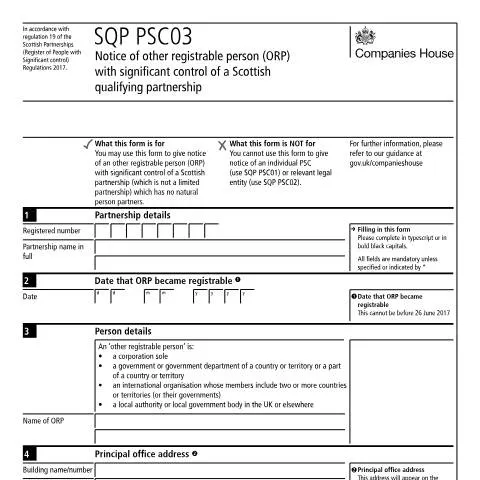
Navigating the Scottish Qualifying Partnership PSC03: A Practical Guide
When dealing with partnerships, particularly Scottish Qualifying Partnerships (SQPs), understanding the legal framework surrounding the registration of Other Registrable Persons (ORPs) is crucial. The SQP PSC03 document is not merely a form to be filled out, but rather a comprehensive notice that serves a significant purpose in ensuring transparency and accountability within the structure of partnerships.
The Essence of Other Registrable Persons
Within the context of Scottish Partnerships, an ORP is defined as a corporation sole, government department, international organisation, or local authority that possesses significant control over the partnership. This document is crucial for partnerships that do not have natural person partners and serves to notify Companies House of these entities. Understanding who qualifies as an ORP is essential for correct registration.
Understanding the Designations
- Corporation Sole: A legal entity consisting of a single incorporated officeholder.
- Government Department: Any governmental body at a national or regional level.
- International Organisation: Entities representing multiple countries or territories.
- Local Authority: Any governmental body at the local level.
Each of these entities can influence or exert control over the partnership, necessitating their registration through the SQP PSC03 document. It is critical to determine if any of these entities hold significant control before proceeding with the registration.
Key Aspects of the SQP PSC03 Document
The SQP PSC03 guide is structured to address both the procedural requirements and the specific information needed to accurately represent other registrable persons. Here are the core components that you will encounter while preparing your notice:
- Partnership Details: This includes the full name of the partnership and its registered number, crucial for identification.
- Date of Registrability: The document requires the date when the ORP became registrable, which cannot precede 26 June 2017.
- Principal Office Address: The registered address of the ORP will be displayed on the public record. This transparency is aimed at ensuring public accountability.
Significant Control: Defining the Parameters
The document carefully delineates what constitutes significant control. This is categorized into several key criteria:
- The ownership of surplus assets: Identifying the percentage of any surplus assets on liquidation.
- Voting rights: Determining the percentage of voting rights held within the partnership.
- Management appointment rights: The ability to appoint or remove individuals who manage the partnership.
It is paramount to tick the appropriate boxes that reflect the nature of control exercised by the ORP. Misrepresentation of these details can lead to legal complications and a lack of compliance with Companies House regulations.
Integrating the SQP PSC03 into Partnership Operations
For partnerships operating without natural person partners, the SQP PSC03 document becomes indispensable. The registration of ORPs is not only a legal obligation but also a best practice for fostering trust among stakeholders.
A Step-by-Step Guide to Implementation
- Identify ORPs: Conduct a thorough assessment to determine if any ORPs have significant control over the partnership.
- Compile Information: Gather essential details related to the partnership and ORPs, including names, addresses, and relevant dates.
- Complete the Document: Fill out the SQP PSC03 using clear, legible text and ensure all mandatory fields are complete. This includes checking the correct dates and percentages.
- Submit the Notice: Choose to submit the form either electronically or by post to Companies House, following the guidelines provided on their official website.
This step-by-step approach simplifies the often daunting task of compliance with legal obligations while reinforcing the structure and governance of the partnership.
Common Misinterpretations and Their Consequences
Understanding the nuances of the SQP PSC03 can prevent common pitfalls that many partnerships encounter. Misinterpretation of the requirements can lead to inaccuracies in the submission, which can have serious ramifications, including fines or legal action.
Identifying Common Misunderstandings
- Assuming All Partners are Natural Persons: It's crucial to recognize when an ORP is involved in the partnership, especially when there are no natural person partners.
- Incorrectly Reporting Control: Understating or overstating the extent of control held by an ORP can lead to significant compliance issues.
- Outdated Information: Failing to keep the registered information up-to-date can result in the partnership being non-compliant.
The risks associated with inaccuracies cannot be overstated. Partnerships should implement a regular review process to ensure that the details concerning ORPs remain current and accurate.
Interplay with Other Documentation
The SQP PSC03 interacts with various other forms and documents within the Companies House framework. Understanding this interplay is vital for comprehensive compliance.
Related Documentation
Several forms relate closely to the SQP PSC03:
- SQP PSC01: This form is used for notifying Companies House of an individual Person with Significant Control.
- SQP PSC02: When an entity is a relevant legal entity, this form should be employed.
Each of these forms serves a distinct purpose and must be utilized correctly based on the partnership's circumstances. A clear differentiation between these forms can streamline the registration process and enhance compliance.
Final Thoughts on Registration and Compliance
Completing the SQP PSC03 document is an integral part of maintaining a transparent and legally compliant partnership. The implications of failing to register ORPs can be significant, impacting the partnership’s operations and its stakeholders. By understanding the importance of accurate and timely registration, partnerships can not only comply with legal obligations but also build greater trust and credibility in the market.
In essence, the SQP PSC03 is more than just a notice of registration; it is a pivotal document that embodies the principles of responsibility and transparency. The successful navigation of this process is essential for any partnership operating within the evolving landscape of Scottish business law.
| Criteria for Significant Control | Description |
|---|---|
| Ownership of Surplus Assets | Percentage of surplus assets entitled on liquidation. |
| Voting Rights | Percentage of voting rights held in the partnership. |
| Management Appointment Rights | The right to appoint/remove management personnel. |
| Significant Influence or Control | The right to exert influence or control over the partnership. |
In conclusion, the SQP PSC03 serves as a critical tool in the landscape of business compliance in Scotland. Its proper utilization can pave the way for a transparent and accountable partnership structure, fostering trust and integrity in business dealings.
Understanding the Role of a Person with Significant Control (PSC) in a Scottish Qualifying Partnership
In the context of Scottish Qualifying Partnerships (SQPs), a Person with Significant Control (PSC) is defined under the Companies Act 2006 and associated regulations. While SQPs are not required to register with Companies House like traditional companies, the requirements regarding PSCs still apply. A PSC is any individual or entity that holds more than 25% of the voting rights or has the power to exercise significant influence or control over the partnership.
This control can manifest in various forms, such as the ability to appoint or remove partners or direct decision-making processes. Consequently, identifying and notifying the correct PSCs is crucial, not only for compliance but also for transparency and accountability within the partnership.
For SQPs, it’s essential to consider that partnerships can involve multiple parties, each potentially holding varying degrees of control. In such cases, understanding the hierarchy of control can help clarify who qualifies as a PSC. This detail is particularly important when managing the partnership's operational dynamics and when filing the PSC03 form.
Filing the PSC03: Step-by-Step Guidance
Filing the PSC03 form involves a series of precise steps to ensure that the notice of registration of a person with significant control is both accurate and compliant with legal requirements. Here’s a detailed guide on how to approach this process:
- Step 1: Gather Relevant Information - Before filling out the PSC03, collect necessary details about the individual(s) or entities designated as PSCs. This includes their full name, nationality, date of birth, and address, as well as the nature of their control over the partnership.
- Step 2: Complete the PSC03 Form - The form is structured to capture specific information about the PSC. You will need to indicate the type of control the PSC exercises and how this reflects their significance within the partnership.
- Step 3: Submit the Form - Once the form is completed, submit it to Companies House. Ensure that it is done within the stipulated timeframe to avoid penalties.
- Step 4: Maintain Accurate Records - After filing, it's critical to keep accurate and up-to-date records of your partnership’s PSCs to facilitate any future filings and ensure compliance.
Remember, the accuracy of the PSC information is vital. If there are changes to the partnership, such as the removal or addition of a PSC, the PSC03 must be updated accordingly.
Common Pitfalls to Avoid When Notifying Changes in PSCs
While the procedure for notifying changes to registrable persons with significant control may seem straightforward, several common pitfalls can lead to complications or even legal issues. Here are some key areas to avoid pitfalls:
- Inaccurate Data Entry - One of the most frequent issues arises from clerical errors. Double-check all entries for accuracy, especially sensitive information like names and addresses.
- Failure to Update Timely - If there are changes in the PSCs or their control status, failing to notify Companies House within the required timeframe can lead to penalties. The law mandates that changes should be reported as they occur, not just during the annual confirmation process.
- Neglecting Legal Advice - Given the complexities involved in defining significant control, seeking legal advice can be invaluable. This can help avoid misinterpretations of control and prevent potential disputes among partners.
- Not Recording Internal Decisions - Ensure that all decisions regarding the status of PSCs are documented within the partnership's records. This not only helps maintain accountability but serves as evidence if any disputes arise regarding control.
Each of these pitfalls can impact the integrity of the partnership’s operations and its legal standing. Therefore, it is essential for all partners to be diligent in maintaining compliance with PSC regulations.