Understanding the PSC01c Document: A Critical Component for Companies House Compliance
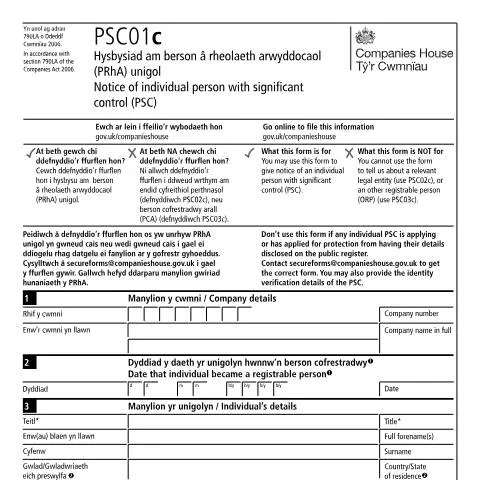
The PSC01c document, officially titled “Notice of Individual Person with Significant Control,” is an essential notification required by Companies House. This guide details its function and significance in the corporate governance landscape of the UK. For companies, understanding this notice is crucial, especially as it pertains to transparency and the identification of individuals who wield significant influence or control over a business entity.
The Scope of the PSC01c Notice
This notice serves to inform Companies House about individuals who have significant control over a company. But what exactly does "significant control" mean? It typically refers to an individual who holds 25% or more of the shares or voting rights in a company, or who has the right to appoint or remove the majority of the board of directors.
However, the PSC01c notice is not merely a formality; it carries legal weight and implications for corporate governance. Failure to disclose this information can lead to penalties, and it jeopardizes the company’s standing with regulatory authorities.
Definition of Significant Control
- Ownership of 25% or more of shares
- Voting rights that confer control over the company
- Ability to exercise significant influence over the company
Who Should Use PSC01c?
The PSC01c should be utilized by companies when they need to notify Companies House regarding an individual who meets the criteria for significant control. It cannot be used for related legal entities or other registrable persons, which are instead addressed using different forms (e.g., PSC02c or PSC03c).
Navigating Common Pitfalls with PSC01c
Handling the PSC01c notice can be fraught with misunderstandings. One frequent issue arises when companies mistakenly identify individuals as PSCs without understanding the criteria of significant control. Furthermore, companies often confuse the PSC notice with notifications for legal entities or other types of registrable persons.
Moreover, if an individual has applied to protect their details from being disclosed on the public register, the PSC01c cannot be used. This necessitates contacting Companies House for the appropriate form to ensure compliance.
Important Clarifications
- PSC01c is exclusively for individuals, not legal entities.
- Ensure that the individual’s identity is verified as per the guidelines of the Companies Act 2006.
- If there are discrepancies in names, provide the relevant explanations—whether it be a legal name change or a preferred name.
Operational Steps to Effectively Utilize the PSC01c Document
To ensure that the PSC01c notice is filed correctly, companies should follow these operational steps:
- Determine whether the individual qualifies as a PSC by assessing their shareholding and control.
- Complete the PSC01c form accurately, ensuring all required details are included, such as the individual’s name, date of birth, and service address.
- If applicable, indicate whether the individual has applied for protection from disclosure of their residential address under section 790ZF of the Companies Act 2006.
- Submit the PSC01c form to Companies House in the correct format, either electronically or via post, as necessary.
Key Information Required on the PSC01c Form
| Item | Description |
|---|---|
| Individual’s Full Name | Complete legal name as verified. |
| Date of Birth | Full date of birth in DD/MM/YYYY format. |
| Service Address | The address where notifications can be sent; must not be a residential address if protected. |
| Nature of Control | Describe how the individual exercises significant control over the company. |
Noteworthy Exceptions and Considerations
When filing a PSC01c notice, it’s essential to be aware of certain exceptions that may apply. For instance:
- If the individual is in the process of applying for an exemption from public disclosure, the PSC01c cannot be used, and the correct procedure must be followed to ensure compliance.
- The PSC may also be subject to varying legal interpretations, which can lead to complications if not navigated carefully.
Understanding Exemptions under Section 790ZF
Section 790ZF of the Companies Act 2006 provides individuals the ability to protect their usual residential address from being disclosed on the public register. Companies must be vigilant in identifying whether the PSC is in this position before submitting the PSC01c notice. In such cases, the PSC must apply for and be granted an exemption by the Registrar, and it’s crucial that both the exemption application and the PSC01c notice are submitted together to the appropriate address:
“The Registrar of Companies, PO Box 4082, Cardiff, CF14 3WE.”
Demystifying Identity Verification for PSCs
Identity verification plays a critical role in the implementation of the PSC01c form. It is a safeguard designed to ensure that the person listed as having significant control is properly authenticated. This verification process must comply with the stipulations of the Companies Act 2006.
Companies House requires that the individual’s identity is confirmed before including them in the PSC notice, ensuring that all protections are in place to safeguard against potential fraud or misrepresentation.
How to Confirm Identity
- Gather supporting documentation such as utility bills or bank statements that confirm the individual's name and address.
- Utilize identification methods that meet the regulations set forth in the Companies Act.
- Submit the identity verification details alongside the PSC01c form.
The Importance of Timely Submission
It is vital to file the PSC01c notice promptly upon identifying a PSC. This ensures compliance with legal requirements and helps maintain the integrity of the company’s public record. Companies should be aware of the deadlines associated with PSC notifications and should not delay the filing process unnecessarily.
Furthermore, companies must also be vigilant regarding changes in PSCs. Any updates to significant control must be reported within the statutory timeframe, usually within 14 days of the change occurring.
Potential Consequences of Delayed Filing
- Fines and penalties imposed by Companies House for non-compliance.
- Increased scrutiny from regulatory authorities.
- Negative perception among stakeholders if governance standards are not upheld.
Conclusion: Navigating the PSC01c with Confidence
In summary, the PSC01c notice is a pivotal document in the realm of corporate governance in the UK. Understanding its nuances—ranging from the criteria for significant control, identity verification processes, exemptions, and the importance of timely submission—enables companies to navigate their obligations confidently. By adhering to these standards and ensuring accurate reporting, companies can safeguard their operations and fulfil their responsibilities to stakeholders and regulatory authorities alike.
Understanding the Role of PSC in Corporate Governance
The concept of Persons with Significant Control (PSC) plays a pivotal role in enhancing transparency within the corporate governance landscape of the UK. Introduced under the Small Business, Enterprise and Employment Act 2015, the PSC regime is designed to ensure that the individuals who ultimately control or significantly influence a company are known, thus preventing misuse of companies for illicit activities, such as money laundering or tax evasion. A person is typically considered to have significant control if they hold more than 25% of the shares or voting rights, have the right to appoint or remove a majority of directors, or otherwise exert significant influence over the company.
This transparency helps to combat fraud and promote trust among stakeholders, which is particularly critical in today’s global economy. Companies House, which maintains the public register of companies in the UK, plays an essential role in enforcing these regulations by requiring accurate and timely filings regarding PSCs.
Moreover, it is vital for companies to regularly review their PSC information to ensure compliance. Failure to do so could result in penalties, including fines and restrictions on the company, such as a prohibition from filing certain documents until compliance is rectified. Therefore, understanding the implications and responsibilities associated with PSCs is crucial not only for legal compliance but also for fostering good corporate governance.
Key Steps in Completing the PSC01c Form
Filing the PSC01c form accurately requires careful attention to detail. Here’s a step-by-step breakdown of the key sections of the form, along with practical tips to ensure proper completion:
- Section 1: Company Details — Begin by providing your company’s registered name and number. Ensure that this information matches exactly with what is recorded at Companies House. Any discrepancies can lead to rejection of your submission.
- Section 2: PSC Information — You will need to provide details of the individual who has significant control. This includes their full name, date of birth, nationality, and residential address. It’s imperative to keep in mind that you must include the individual’s date of birth in the correct format (DD/MM/YYYY) and ensure that the address is not one that can be classified as a correspondence address. Instead, provide the individual's current residential address to meet the Act’s requirements.
- Section 3: Nature of Control — This section is crucial as it outlines the nature of the individual's control over the company. You need to tick the appropriate boxes that reflect the type of control, such as ownership of more than 25% of shares or voting rights. Ensure that any percentage associated with ownership is accurately represented to reflect the true nature of control.
- Section 4: Signature and Date — The form must be signed by either the PSC themselves or a representative of the company. If a representative is signing, they must provide their full name and position within the company. Ensure the form is dated properly, as this is important for record-keeping and compliance verification.
Once completed, the PSC01c form should be submitted to Companies House. It's advisable to keep a copy of the submitted form for your records, along with any correspondence related to the filing. This is crucial for future reference, especially during audits or inspections.
Consequences of Non-Compliance with PSC Regulations
Understanding the consequences of failing to comply with PSC regulations is vital for both individuals and companies. Non-compliance can lead to serious repercussions, including financial penalties and reputational damage. Here are some of the key consequences you might face:
- Financial Penalties: Companies that fail to file accurate PSC information face financial penalties that can escalate depending on the duration of non-filing or inaccuracies. Companies House may impose fines that start at £500 and can increase significantly for repeated offences.
- Restrictions on Company Operations: A company that has failed to comply with PSC regulations may be prohibited from filing certain documents. This can include changes to the company’s articles of association or other essential filings, effectively paralyzing operations until compliance is achieved.
- Criminal Liability: Individuals who knowingly provide false information or fail to comply with the PSC reporting requirements may face criminal charges, leading to potential imprisonment. The legal system takes PSC violations seriously, emphasizing the importance of compliance.
- Reputational Damage: Non-compliance can significantly damage the reputation of a company. Stakeholders, including investors and customers, may lose trust in a company that fails to adhere to transparency standards. This can have long-term consequences on business relationships and overall market position.
To mitigate these risks, companies must prioritize compliance with PSC regulations. Regular training and updates for staff responsible for corporate governance can help ensure that everyone is aware of their responsibilities and the importance of accurate reporting.