Navigating the Complexities of the SQP PSC05 Form
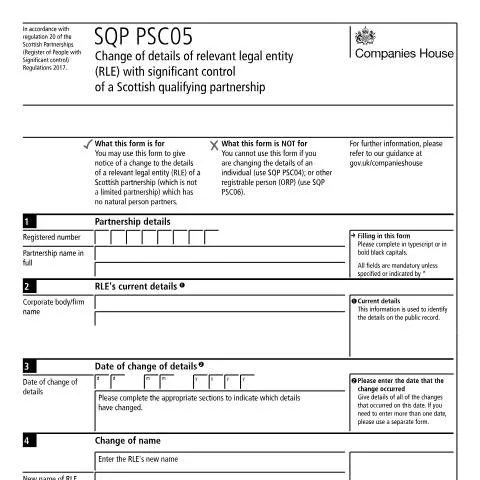
In the intricate world of Scottish qualifying partnerships, the SQP PSC05 form stands as a crucial document for ensuring compliance with the regulatory requirements set forth by Companies House. This form is specifically designed for relevant legal entities (RLEs) with significant control over these partnerships, which do not involve natural person partners. Understanding how to accurately complete and submit this form is vital for maintaining proper records and avoiding potential penalties.
Unpacking the Purpose of the SQP PSC05 Form
The SQP PSC05 form serves as a vehicle for notifying changes to the details of an RLE that holds significant control over a Scottish qualifying partnership. It is important to note that this form is strictly for entities and does not accommodate changes related to individual partners, which are managed through form SQP PSC04. Given the specificity of this form, the details provided are intended to ensure that the public record remains up-to-date and reflects any changes in control.
Why is Accurate Reporting Crucial?
Failing to report changes accurately can lead to significant repercussions, including fines or legal action from Companies House. Moreover, inaccuracies can obscure the true ownership and control of the partnership, which can lead to issues in legal disputes or financial dealings. Thus, precise completion of the SQP PSC05 is not merely a bureaucratic exercise but a fundamental obligation of the partnership.
Key Sections of the SQP PSC05 Form: A Detailed Guide
Completing the SQP PSC05 form requires careful attention to several key sections. Each part of the form elicits different information, and understanding these sections helps in avoiding common pitfalls.
Current Details of the Relevant Legal Entity
The initial section demands the current details of the RLE:
- Corporate Body/Firm Name: Enter the full, legal name of the RLE.
- Date of Change of Details: Use the format DD/MM/YYYY to ensure clarity.
It is essential to ensure that the details entered match precisely with those recorded in official documents to prevent rejection on the grounds of inaccuracy.
Address Changes and Their Implications
If there are any changes to the registered or principal office address, these must be documented in this section:
- Building Name/Number: Ensure you provide the full address, including any suite or unit numbers.
- Country and Postcode: Double-check to confirm that the postcode corresponds with the region listed.
Changes to the principal office address can affect the service of legal documents, making this section particularly significant.
Legal Form and Governing Law Adjustments
Any changes in the legal form of the RLE or the governing law under which the entity operates must be reported:
- Legal Form: Specify whether the nature of control has altered.
- New Registration Number: If applicable, record any new registration number that corresponds with an update in the governing register.
Inaccuracies in this section can lead to complications in legal standing, making attention to detail paramount.
Calculating Significant Control: Financial Implications
Defining how the RLE exercises significant control over the partnership is central to this form:
- Share of Assets: Select the appropriate range of asset control (e.g., more than 25% but not more than 50%).
- Voting Rights: Indicate the percentage of voting rights held by the RLE.
- Management Control: Confirm whether the RLE can appoint or remove management.
These indicators help define the structure and decision-making dynamics within the partnership, which is crucial for regulatory oversight.
Submission Channels: Understanding Your Options
Once the SQP PSC05 form is completed, it can be submitted through several channels:
- Online Submission: The most efficient method, enabling quicker processing times.
- Paper Submission: Requires careful attention to mailing logistics to ensure timely delivery to Companies House.
- In-Person Submission: This option offers immediate confirmation of receipt and is useful for urgent changes.
Choosing the right submission channel can affect the speed and reliability of the processing of your form.
Tips for Successful Submission
Consider these strategies to ensure your submission proceeds smoothly:
- Check for completeness; all fields marked as mandatory must be filled.
- Verify the accuracy of all information against official records.
- Retain copies of submitted documents for your own records.
These proactive measures can help mitigate issues during the review process.
Timelines and Deadlines: Staying Compliant
Understanding the timelines associated with the SQP PSC05 form is essential for compliance:
- Changes must be reported to Companies House within 14 days of the change occurring.
- Failure to report changes within this timeframe can lead to penalties, including fines.
Staying aware of these deadlines helps ensure that your partnership remains compliant with legal requirements.
Specific Cases: What to Do in Unique Situations
Partnerships might encounter unique situations that require special consideration when submitting the SQP PSC05 form:
- Foreign Entities: If the RLE is registered in another country, it's crucial to understand additional compliance requirements that may apply.
- Minors and Other Vulnerable Persons: Special provisions may need to be considered if the RLE is managed by individuals under legal age.
- Complex Ownership Structures: When control of a partnership is shared among multiple entities, clearly delineating rights and responsibilities in the form is necessary.
Consulting with legal professionals in these cases can provide additional clarity and assurance of compliance.
Emergency Situations: Expedited Processing
In cases where rapid changes are necessary—such as a sudden leadership shift or unexpected legal requirements—utilizing the in-person submission option can facilitate expedited processing.
The Importance of Ongoing Monitoring
Partnerships must remain vigilant regarding their statutory obligations. Regularly reviewing the details recorded on the public register is crucial, especially following significant changes in control or management. This practice not only ensures compliance but also fosters transparency and trust among stakeholders.
Recommended Best Practices for Monitoring
- Establish a routine schedule for reviewing public records.
- Maintain open communication with all partners regarding potential changes in control or governance.
- Designate a compliance officer to oversee regulatory obligations.
Such initiatives contribute to a culture of accountability and regulatory adherence.
Final Insights on the SQP PSC05 Form
The SQP PSC05 form is not just a bureaucratic requirement but an essential tool for safeguarding the integrity of Scottish qualifying partnerships. By understanding the nuances of each section, adhering to submission timelines, and remaining vigilant about changes, partnerships can effectively navigate the complexities of legal compliance in Scotland.
Always keep abreast of changes in legislation or guidance from Companies House, as these can impact the obligations surrounding the SQP PSC05 and other related forms.
Understanding the Concept of Significant Control in Scottish Qualifying Partnerships
In the context of a Scottish Qualifying Partnership (SQP), the notion of significant control is pivotal. Significant control pertains to individuals or entities that have the power to influence or direct the management and policies of the partnership, either directly or indirectly. Under the UK’s Companies Act 2006 and subsequent regulations, knowing who holds such control is essential. The definition often involves ownership thresholds, voting rights, or the ability to appoint or remove members of the management body. For an SQP, this means that any partner meeting the criteria set out in the legislation must be disclosed.
More specifically, significant control can manifest in various forms, such as:
- Ownership of More Than 25% of Shares: This is particularly relevant when the SQP is linked to a corporate entity.
- Voting Rights: An individual or legal person that holds rights to vote at partnership meetings exceeding 25% must be identified as having significant control.
- Rights Over the Partnership’s Financial Assets: Access to or the ability to control the financial resources or assets of the partnership can also confer significant control.
Understanding these factors is crucial for fulfilling the legal obligations under PSC05. The completion of this form demands not only a deep understanding of who qualifies as a person of significant control but also an assessment of the implications such control has on the partnership's operations and governance.
Filing the PSC05: Step-by-Step Guidance
Filing the PSC05 form is a crucial task for any Scottish Qualifying Partnership that needs to report its significant controllers. The process itself can be broken down into manageable steps to ensure compliance with the legal requirements.
- Step 1: Gather Necessary Information - Collect details about each person of significant control, including their name, date of birth, nationality, and address. Ensure that these details are accurate and current, as inaccuracies can lead to penalties under the Data Protection Act 2018 and UK GDPR.
- Step 2: Identify the Control Mechanisms - Determine how each individual or entity meets the criteria for significant control. This may involve reviewing partnership agreements, financial documents, or ownership records that clarify the control structure.
- Step 3: Complete the PSC05 Form - Fill out the form accurately, stating each person of significant control's information. Pay close attention to the sections requiring specific details about how they exert control over the partnership.
- Step 4: Submit the Form - Once completed, submit the PSC05 form to Companies House. Make sure to check the submission deadline, as delays can result in compliance issues for the partnership.
- Step 5: Maintain Records - After submission, it's essential to keep a copy of the completed form and any supporting documents. This documentation may be necessary for future reference, especially during audits or inspections.
By following these steps meticulously, a Scottish Qualifying Partnership can ensure that it complies with legal obligations regarding reporting significant control. Additionally, it reflects good governance practices that can enhance the partnership's credibility with stakeholders and regulatory bodies.
Common Challenges in Identifying Significant Controllers
Identifying significant controllers within a Scottish Qualifying Partnership can present various challenges. Understanding these potential hurdles can aid in smoother compliance efforts and prevent common pitfalls.
1. Complexity of Ownership Structures: In some cases, ownership and control can be obscured by complex arrangements, especially if corporate entities are involved. Partners must analyze any multi-layered ownership structures to ensure that all individuals who meet the criteria are identified correctly.
2. Changes in Control: Significant control is not static; it can change over time due to various factors, such as the transfer of shares or partnerships. Regular reviews are necessary to update the PSC05 form and reflect current realities accurately. Establishing a routine for reviewing control structures can mitigate the risk of reporting outdated information.
3. Compliance with Data Protection Laws: With the Data Protection Act 2018 and UK GDPR impacting how personal data is processed, partnerships must ensure they handle the personal information of significant controllers with due care. This includes obtaining consent where necessary and implementing security measures to protect sensitive data.
4. Partner Disputes: Disagreements among partners can complicate the identification of significant controllers. If partners have conflicting views on control arrangements, it may lead to inconsistencies in reporting. Establishing clear communication and governance protocols can help minimize disputes and ensure everyone is on the same page.
Addressing these challenges proactively can enhance the partnership’s ability to comply with the legal requirements and foster a positive governance environment. Regular training and discussions about significant control can further equip all partners to handle these complexities efficiently.