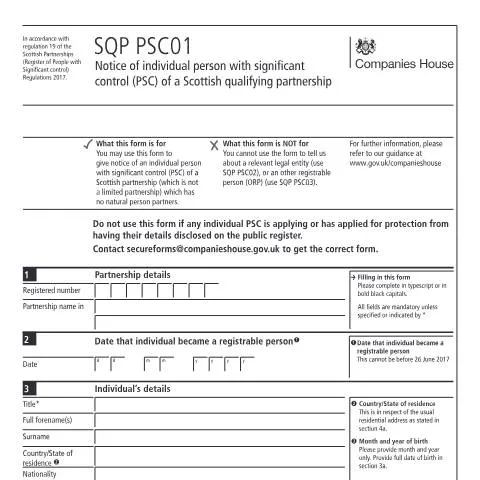
Understanding the Importance of the PSC01 Notice for Scottish Qualifying Partnerships
In the realm of business governance in the UK, particularly for Scottish qualifying partnerships, the clarity of ownership and control is paramount. The PSC01 notice serves as a crucial mechanism for businesses to transparently declare the individuals who hold significant control within their structure. As such, its utility transcends mere compliance; it plays a critical role in fostering trust and transparency in business operations.
Essential Components of the PSC01 Notice
The PSC01 notice is not merely a bureaucratic document; it encapsulates vital information about individuals who significantly influence or control the direction of a Scottish qualifying partnership (SQP). To effectively navigate the requirements of this document, it is essential to understand its key components.
Partnership Identification
One of the first elements of the PSC01 notice requires the identification of the partnership itself. This includes:
- Partnership Name: Clearly state the name under which the partnership operates.
- Registered Number: Provide the unique registration number assigned to the partnership by Companies House.
This information is foundational as it ensures that the notice is accurately linked to the correct entity, which is crucial for public record-keeping.
Details of the Individual in Control
Next, the notice necessitates detailed personal information about the individual classified as a person with significant control (PSC). This encompasses:
- Full Name: Include the title, forename(s), and surname.
- Nationality: Specify the citizenship of the individual.
- Service Address: This address will appear on the public record and does not have to be the individual’s residential address.
- Residential Address: This must be detailed unless it is the same as the service address.
- Date of Birth: Provide the full date of birth, ensuring compliance with data requirements.
Ensuring accuracy in these details is imperative, as mistakes could lead to legal complications or issues with the public record.
Types of Control and Their Implications
Understanding how an individual can exert significant control over a partnership is critical for accurately completing the PSC01 notice. The document outlines several types of control that must be disclosed.
Forms of Significant Control
In the PSC01 notice, the individual must indicate how they have significant control over the partnership through the following mechanisms:
| Type of Control | Description |
|---|---|
| Share of Assets | The percentage of the partnership’s surplus assets that the individual holds rights to upon winding up. |
| Voting Rights | The percentage of voting rights the individual holds directly or indirectly in the partnership. |
| Management Appointments | The right to appoint or remove a majority of the individuals entitled to manage the partnership. |
| Significant Influence or Control | Indicates that the individual has significant influence or control over the partnership’s decisions. |
This classification of control is crucial, as it determines not only the governance of the partnership but also informs external stakeholders about who is effectively running the partnership.
Temporal Context: When to Submit the PSC01 Notice
Timing plays a vital role in the context of the PSC01 notice. Given that the legislation surrounding significant control was enacted in June 2017, any declarations regarding individual PSCs must adhere to the stipulated timelines.
Registered Date Considerations
When filling out the PSC01, it is essential to note that the date on which an individual became a registrable person cannot predate 26 June 2017. This condition means that any control exercised before this date does not necessitate declaration, as it falls outside the regulation's effective period.
Effects of Delayed Submission
Failure to submit the PSC01 notice in a timely manner can lead to several consequences:
- Legal Implications: Non-compliance can result in penalties for the partnership and individuals involved.
- Public Record Issues: Inaccurate or outdated records can lead to misunderstandings in business dealings, affecting stakeholder trust.
- Fines: Companies House has the authority to impose fines for late submissions, thereby increasing operational costs.
Thus, staying vigilant about submission deadlines is an integral part of managing your partnership.
Intersections with Other Forms
For those involved in Scottish partnerships, understanding the PSC01 notice's relationship with other related documents can significantly streamline the governance process.
Comparison with Related Documents
The PSC01 notice is part of a broader framework in which various forms serve specific purposes:
| Document | Purpose |
|---|---|
| PSC01 | Notice of individual person with significant control of a Scottish qualifying partnership. |
| SQP PSC02 | Used to notify about a relevant legal entity in control. |
| SQP PSC03 | For notifying about other registrable persons (ORPs) associated with the partnership. |
Understanding these distinctions ensures that businesses are not only compliant but also accurately represent their governance structures.
Practical Scenarios: When is the PSC01 Notice Indispensable?
Certain situations demand the completion and submission of the PSC01 notice. Recognizing these scenarios can help prevent administrative oversights.
Examples of Necessity
Formation of a New Partnership: Upon the establishment of a new Scottish qualifying partnership, the PSC01 notice must be submitted to declare the significant controllers.
Change of Control: If an individual gains or loses significant control over the partnership (e.g., through a transfer of shares or voting rights), it is necessary to submit an updated PSC01 to reflect this change.
Regulatory Compliance Checks: During either internal audits or external regulatory checks, having accurate PSC records can be critical in demonstrating compliance with Companies House requirements.
Understanding when the PSC01 notice is obligatory ensures that partnerships maintain transparency and uphold their legal obligations.
Data Privacy Considerations within the PSC01 Framework
In a world increasingly concerned with data privacy, the PSC01 notice must navigate the complexities of the Data Protection Act 2018 and the UK GDPR.
Implications for Personal Data Disclosure
The PSC01 notice requires the disclosure of certain personal details about the PSC. However, it is crucial to understand the implications of this requirement:
- Public Record Information: The service address of the PSC is publicly available, while residential addresses are not unless specified. This distinction helps protect the personal privacy of the individual while ensuring necessary transparency.
- Protection from Disclosure: If a PSC feels that their information may put them at risk (for instance, in situations of domestic abuse), they can apply for protection under specific conditions. In such cases, the appropriate forms must be sought to ensure privacy is maintained.
Fulfilling the PSC requirements while adhering to data protection laws is essential for maintaining public trust and safeguarding individual privacy.
Final Thoughts on Navigating the PSC01 Notice
Navigating the PSC01 notice entails more than mere familiarity with its sections; it requires a comprehensive understanding of the broader legal and operational context in which these notices function. By ensuring accurate completion, timely submission, and adherence to data privacy guidelines, partnerships can embody transparency and robust governance.
The PSC01 notice, while seemingly straightforward, encapsulates crucial details about the dynamics of control within Scottish qualifying partnerships. Its proper handling is not just a regulatory necessity but a foundational element of responsible partnership management. In doing so, individuals and partnerships alike lay the groundwork for trust and integrity in their business practices.
Understanding the Role of a Person with Significant Control (PSC) in a Scottish Qualifying Partnership
The term “Person with Significant Control” (PSC) is crucial in the context of Scottish Qualifying Partnerships (SQP). To qualify as a PSC, an individual must meet specific criteria that demonstrate their significant influence or control over the partnership. In Scotland, these individuals play a vital role in ensuring that the partnership is compliant with its obligations under the Companies Act 2006, which also applies to partnerships that have certain characteristics.
To be considered a PSC, an individual must hold more than 25% of the shares or voting rights in the partnership, or they must have the right to appoint or remove a majority of the Partnership’s board of directors. Alternatively, a PSC may be an individual who has the right to exercise significant influence or control over the partnership due to their position or relationship with the partnership.
This designation is particularly important for transparency and accountability. It aims to prevent illicit activities such as tax evasion and money laundering by ensuring that individuals who exert control over business decisions are identifiable. In the context of the SQP, this means that all partners must be aware of their responsibilities to declare their PSCs accurately and promptly.
Filing Responsibilities and Deadlines for SQP PSC01
When an SQP is formed, one of the first compliance tasks is to ensure that the PSC register is established accurately, alongside filing the PSC01 form. The PSC01 form must be submitted to Companies House when there is a change in the information relating to a person with significant control, or when a new PSC is appointed. This includes instances where a new partner joins the SQP or when the ownership structure changes.
The deadline for filing the PSC01 form with Companies House is typically within 14 days of the event that triggers the requirement to make the change. This emphasizes the importance of keeping accurate records and being diligent about timely submissions. Failing to meet this deadline can result in penalties for the partnership, which highlights the need for effective internal procedures for monitoring changes in control.
It's also worth noting that while the individual responsible for completing the PSC01 form may vary—depending on internal agreements—it is advisable for the designated partner to take ownership of this task to ensure that all information is accurately captured and submitted. This designated partner should be well-versed in the partnership’s structure and ownership to fulfill this responsibility efficiently.
The Implications of Non-Compliance and Consequences for Scottish Qualifying Partnerships
Non-compliance with the PSC reporting requirements can have serious consequences for an SQP, ranging from administrative penalties to reputational damage. If an SQP fails to file the PSC01 form or submits incorrect information, it may be subject to fines by Companies House, which can escalate depending on the severity of the non-compliance. Additionally, the partnership may face scrutiny from regulatory bodies, which could lead to audits or further investigation into its activities.
Moreover, non-compliance could impact the ability of the partnership to secure financing or establish contracts with other entities, as potential partners or investors often conduct due diligence checks that include an examination of PSC records. A lack of transparency can raise red flags, leading to hesitance from external parties to engage with the SQP.
To mitigate these risks, it is essential for partnerships to establish comprehensive compliance protocols that include regular reviews of their PSC registers, employee training on reporting responsibilities, and a clear communication strategy among partners regarding any changes in control. By proactively managing these aspects, an SQP can ensure that it remains in good standing and protects its business interests.