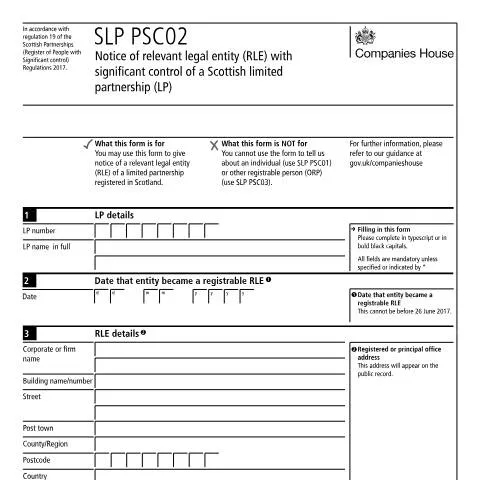
The Importance of Notice of Relevant Legal Entity with Significant Control of a Scottish Limited Partnership
In the realm of corporate governance in Scotland, understanding the Notice of Relevant Legal Entity (RLE) with Significant Control of a Scottish Limited Partnership (SLP PSC02) is essential for compliance and transparency. This document serves a pivotal role, enabling the declaration of entities that possess significant control over a limited partnership. Not only does it align with the overarching legal framework set forth by the Companies Act, but it also ensures that the principles of accountability are upheld within the corporate structure. This guide delves into the intricacies of the SLP PSC02 and elucidates its significance for various stakeholders.Key Concepts to Grasp Before Filing
To use the SLP PSC02 effectively, it is crucial to comprehend the fundamental concepts it encompasses. Here are some essential points to consider:Understanding Significant Control
Significant control refers to the power held by an individual or entity over a limited partnership, encompassing various parameters:- Ownership Ratios: This includes any percentage of assets or voting rights that exceed 25%.
- Management Influence: The ability to appoint or remove management personnel is another indicator of significant control.
- Influence Over Partnership Activities: Entities exercising significant influence can affect decision-making processes.
Relevant Legal Entities (RLEs)
An RLE can include various forms of legal bodies, such as:- Companies
- Limited liability partnerships
- Other partnerships
Typical Scenarios for Filing the SLP PSC02
The SLP PSC02 is not merely a formality but is vital for several reasons. Here are some scenarios where this notice becomes indispensable:Establishing Transparency in Ownership
For Scottish limited partnerships, establishing who holds significant control fosters trust among stakeholders, including investors, clients, and regulatory bodies. This transparency is essential for attracting new business relationships and maintaining existing ones.Legal Compliance and Avoiding Penalties
Failure to file the SLP PSC02 when required can lead to legal repercussions for the partnership and its management. Companies House imposes strict compliance measures to ensure that partnerships adhere to regulations. This includes potential penalties or restrictions on business operations.Mergers and Acquisitions
In the context of mergers or acquisitions, understanding the control structure of a limited partnership aids in due diligence processes. Buyers require clarity on significant players within the organization to gauge risks and opportunities effectively.Navigating the Filing Process: Step-by-Step
Filing the SLP PSC02 may seem daunting, yet breaking it down into manageable steps can simplify the process considerably:Step 1: Gather Necessary Information
Before you commence filling out the SLP PSC02, ensure you have all required details. This includes:- Full name and registration number of the limited partnership
- Details of the relevant legal entity, including its registered office address
- Nature of control and the respective percentages held
Step 2: Completing the Form
The form necessitates clarity and accuracy. Fill in the SLP PSC02 using typewritten or bold black capital letters. Every field must be completed unless specifically indicated otherwise. Pay particular attention to the sections detailing the nature of control as this is crucial for correct reporting.Step 3: Submission Process
Once you’ve completed the form, you have the option to submit it either online or via post:- Online Submission: Upload your notice directly to Companies House for immediate processing.
- Postal Submission: If submitting by post, ensure you send it to the correct office address. Check the Companies House website for the appropriate mailing address.
Clarifying Common Misconceptions
Filing the SLP PSC02 can lead to misunderstandings that could hinder compliance. Here are some common misconceptions clarified:1. Confusion Between Different Forms
Many individuals mistakenly believe that the SLP PSC02 can also be used for individuals or other registrable persons. This is incorrect. Ensure you use SLP PSC01 for individuals and SLP PSC03 for other registrable persons.2. Misinterpretation of "Significant Control"
Some may underestimate what constitutes significant control, mistakenly thinking that minor shareholdings qualify. Remember, significant control is defined by specific thresholds (e.g., holding more than 25% of assets or voting rights).Interrelationships with Other Documents
Understanding how the SLP PSC02 interacts with other documentation is vital for maintaining accurate records. Here’s a breakdown of its relationships:| Document | Purpose |
|---|---|
| SLP PSC01 | Used to report individual persons with significant control |
| SLP PSC03 | For reporting other registrable persons (like trusts) |
| Companies House Registration | All partnerships must maintain accurate registration with Companies House |
The Consequences of Inaccurate or Late Notifications
The ramifications of failing to submit the SLP PSC02 accurately or on time can be extensive:- Financial Penalties: Late filings may incur penalties imposed by Companies House.
- Legal Repercussions: Failing to comply can lead to legal action against the partnership.
- Operational Restrictions: Partnerships may face operational limitations until compliance is achieved.
Final Thoughts: Emphasizing Good Practice
The SLP PSC02 is more than a regulatory requirement; it is an instrument for promoting transparency and accountability within partnerships. Understanding its purpose, maintaining accurate records, and ensuring timely submissions are not merely administrative tasks but essential practices that enhance the integrity of the business environment in Scotland. By embracing these principles, partnerships can not only comply with legal requirements but also foster stronger relationships with stakeholders and the public. This proactive approach to governance will ultimately bolster reputation and trust in the marketplace.Understanding the Legal Entity with Significant Control in Scottish Limited Partnerships
In the context of Scottish Limited Partnerships (SLPs), the term "Significant Control" holds particular significance. Under UK law, an individual or entity can be deemed to have significant control if they meet certain criteria. Specifically, they may hold more than 25% of the shares or voting rights, have the right to appoint or remove the majority of the board of directors, or have the right to exercise significant influence or control over the company. Understanding these stipulations is critical when preparing to complete the PSC02 form, as any inaccuracies can lead to penalties and further scrutiny from regulatory bodies such as Companies House.
Additionally, it is essential to keep in mind that the legal definition of "significant control" extends beyond mere ownership. For example, an individual may exert control through indirect means, such as controlling another entity that holds shares in the SLP. Therefore, a thorough examination of the partnership's ownership structure and the relationships between various stakeholders is essential to accurately identify and disclose the individuals or entities that meet the criteria for significant control.
Filing the PSC02 Form: Key Considerations for Business Owners
When filing the PSC02 form, it is important to be aware of the various aspects that can affect the process. First and foremost, the submission of accurate and timely information is vital to maintain compliance with legal obligations. Failure to file the PSC02 correctly or on time can result in not only fines but also reputational damage to the partnership. Hence, it is advisable to allocate sufficient resources and time to gather all necessary information prior to completing the form.
Another vital consideration is the need to ensure that the information provided is up to date. Changes in significant control may occur frequently, especially in active partnerships. For example, if a partner sells their shares or if the partnership structure is modified, it is essential to file an updated PSC02 to reflect these changes. Regular audits and reviews of the partnership's control structure can help ensure that the information remains current and accurate.
Common Mistakes and How to Avoid Them in PSC02 Filings
Filing the PSC02 form might seem straightforward, but there are several common mistakes that partnerships often encounter. Understanding these pitfalls and how to avoid them can streamline the process and ensure compliance.
One common error is failing to list all individuals or entities who qualify as having significant control. As mentioned previously, significant control can be complex and may involve multiple layers of ownership. Partnerships should carry out comprehensive assessments to ensure no relevant controller is overlooked.
Another frequent mistake involves the incorrect completion of personal information on the form. It is paramount that the names, addresses, and dates of birth are accurately recorded, as discrepancies can lead to delays or rejections of the submission. Moreover, ensuring compliance with the Data Protection Act 2018 is essential when handling personal data; partnerships must adopt measures to protect the information of those listed in the PSC02.
Lastly, not keeping copies of submitted forms can create difficulties in future filings or in the event of an inquiry from Companies House. It is prudent to maintain a well-organised record of all official documents, including any evidence regarding the establishment of significant control, to facilitate any required clarifications or updates.