Understanding the N252 Assessment Notice: When Court Costs Become Contentious
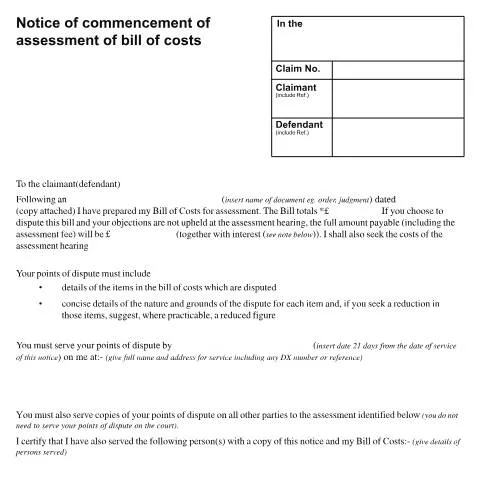
The moment a party receives Form N252, the stakes in their legal dispute have shifted significantly. This official notice signals that detailed costs assessment proceedings are about to commence, transforming what might have been a straightforward matter of paying legal costs into a potentially complex and expensive procedural battle. Unlike summary assessment where costs are determined quickly at the end of a hearing, detailed assessment involves a thorough, line-by-line examination of every expense claimed by the successful party's legal team.
The N252 notice serves as the formal starting gun for this process, but its implications extend far beyond mere notification. For recipients, it represents a critical decision point: accept the costs bill as presented, or challenge it through the detailed assessment procedure. This choice carries significant financial consequences, as unsuccessful challenges can result in additional liability for assessment fees and the costs of the assessment hearing itself.
Understanding the mechanics and strategic implications of this notice becomes crucial for anyone involved in litigation where substantial legal costs are at stake. The document establishes strict procedural requirements and deadlines that, if missed, can result in automatic liability for the full amount claimed through a default costs certificate.
Decoding the Financial Framework Behind Form N252
The financial structure outlined in Form N252 creates a compelling incentive for careful consideration before challenging a costs bill. The notice must specify the total amount of the bill being assessed, but more significantly, it warns of the escalated financial exposure that unsuccessful challengers face.
When a party disputes a costs bill and their objections are not upheld, they become liable not only for the original bill amount but also for additional assessment fees and potentially the costs of the assessment hearing itself. This creates a risk-reward calculation that must factor in the strength of potential objections against the possibility of increased liability.
| Scenario | Financial Outcome | Additional Consequences |
|---|---|---|
| No challenge filed | Pay bill as stated | No additional costs |
| Successful challenge | Pay reduced amount | May recover own costs of assessment |
| Unsuccessful challenge | Pay original bill plus assessment fee | Liable for opponent's assessment costs |
| Default (no response) | Default costs certificate issued | Fixed costs and court fees added |
The interest provisions referenced in the notice add another layer of financial pressure. Under the Judgments Act 1838 and County Courts Act 1984, interest continues to accrue on High Court judgments and county court judgments of £5,000 or more, meaning delays in resolution compound the financial burden.
The Strategic Minefield of Points of Dispute
The requirement to serve points of dispute within 21 days creates the first major procedural hurdle for anyone considering challenging a costs bill. These points of dispute are far from a casual list of complaints; they must meet specific technical requirements that can determine the success or failure of the entire challenge.
Each disputed item requires concise details of the nature and grounds of the dispute, and where a reduction is sought, the challenger should suggest a reduced figure where practicable. This requirement forces parties to engage substantively with the costs bill rather than making general objections, but it also creates opportunities for procedural failures that can undermine otherwise valid challenges.
The specificity required in points of dispute serves multiple purposes within the assessment framework. It enables the costs judge to focus on genuine areas of contention, prevents fishing expeditions through opponents' costs bills, and ensures that the paying party has genuinely considered the merits of their challenge before initiating assessment proceedings.
Common grounds for dispute include:
- Proportionality challenges where costs appear excessive relative to the value or complexity of the case
- Hourly rate disputes questioning the appropriate charging rates for different categories of fee earner
- Time recording issues where the time claimed for particular tasks appears unreasonable
- Necessity challenges questioning whether certain work was required at all
- Duplication concerns where multiple fee earners appear to have undertaken the same work
Service Requirements and the Web of Procedural Obligations
The service requirements embedded within Form N252 create a complex web of procedural obligations that extend beyond the immediate parties to the assessment. The notice must be served not only on the paying party but also on all other parties to the assessment, creating potential complications in multi-party litigation scenarios.
The receiving party faces equally complex service obligations when responding with points of dispute. These must be served on the costs claimant and all other parties to the assessment, but notably not on the court at this stage. This distinction reflects the principle that detailed assessment begins as a process between the parties, with court involvement triggered only when disputes cannot be resolved through negotiation.
The certification requirement within the notice places a professional obligation on the costs claimant's legal representatives to confirm proper service on all relevant parties. This creates an audit trail that becomes important if disputes later arise about whether proper notice was given or deadlines were triggered correctly.
Practical considerations around service include:
- Ensuring current addresses for service are used, particularly where parties may have changed representatives
- Accounting for DX numbers and electronic service preferences where specified
- Managing timing to ensure the 21-day deadline for points of dispute allows adequate consideration time
- Coordinating with other parties' representatives in multi-party scenarios
The Default Costs Certificate: When Silence Becomes Expensive
Perhaps the most consequential aspect of Form N252 is its warning about default costs certificates. When points of dispute are not served within the specified 21-day period, the costs claimant can apply for a default certificate covering the full amount of their bill plus additional fixed costs and court fees.
The default certificate mechanism serves the court system's efficiency objectives by preventing indefinite delays in costs resolution. However, for paying parties, it represents a significant trap that can result in liability for amounts that might otherwise have been successfully challenged.
The finality of default costs certificates creates particular challenges because setting them aside requires demonstrating good reason for the failure to serve points of dispute in time. Courts apply strict standards when considering such applications, recognising that the detailed assessment system depends on adherence to procedural deadlines.
Circumstances that might justify setting aside a default costs certificate include:
- Service failures where the paying party can demonstrate they did not receive proper notice
- Exceptional circumstances such as serious illness or other incapacity during the relevant period
- Administrative errors by legal representatives, though these rarely provide sufficient grounds
- Manifest errors in the costs bill that would result in obvious injustice
Tactical Considerations in Multi-Party Assessment Scenarios
Form N252 becomes particularly complex in multi-party litigation where several parties may have liability for costs or interest in challenging the bill. The notice requirements ensure all relevant parties are informed, but this can create coordination challenges and strategic complications.
In such scenarios, parties may find themselves with aligned or conflicting interests regarding particular aspects of the costs bill. Some challenges may benefit all paying parties, while others might shift liability between them. This dynamic requires careful consideration of whether to coordinate challenge strategies or pursue independent approaches.
The requirement to serve points of dispute on all parties to the assessment means that each party's challenge strategy becomes visible to the others, potentially affecting negotiation dynamics and settlement prospects. Parties must balance the benefits of transparency against the strategic advantages of maintaining flexibility in their positions.
Professional conduct considerations also arise in multi-party scenarios, particularly where legal representatives act for multiple parties with potentially conflicting interests in the costs assessment. Clear arrangements about how costs challenges will be handled and funded become essential to avoid later disputes.
Integration with Broader Case Management and Enforcement Procedures
Form N252 does not operate in isolation but forms part of a broader framework of post-judgment procedures that can significantly impact the parties' overall litigation experience. The timing of detailed assessment in relation to other post-judgment activities requires careful coordination to avoid unnecessary complications or additional costs.
Where judgment has been obtained but enforcement proceedings may be necessary, the detailed assessment process can create delays that affect enforcement strategy. Creditor parties must balance the benefits of challenging potentially excessive costs against the risk of delaying recovery of their substantive judgment.
The interaction between detailed assessment and Part 36 offers creates additional strategic considerations. Costs consequences that flowed from Part 36 offers during the substantive proceedings may be affected by the outcome of detailed assessment, particularly where the assessed costs differ significantly from the amounts originally claimed.
Settlement negotiations often intensify following service of Form N252, as parties gain clearer sight of their potential exposure and the strength of any challenges. The formal framework established by the notice provides a structure for these negotiations while maintaining pressure through the procedural deadlines and default certificate provisions.
Practical Management of Assessment Timelines and Court Interaction
The administrative aspects of detailed assessment proceedings require careful attention to court office procedures and communication protocols. Form N252 includes standard guidance about court office hours and correspondence requirements, but effective management of assessment proceedings requires understanding the broader court administrative framework.
Court communication during detailed assessment typically flows through the district judge or costs judge responsible for the assessment, with specific requirements about how applications and requests should be formatted and submitted. The claim number referenced in Form N252 becomes the key identifier for all subsequent court interaction.
Timing considerations extend beyond the initial 21-day deadline for points of dispute. The detailed assessment process involves multiple stages, each with their own deadlines and requirements:
- Initial exchange period following service of points of dispute where parties may seek to resolve disputes through correspondence
- Request for assessment hearing if disputes cannot be resolved, with associated court fees and listing requirements
- Pre-hearing procedures including any case management directions and preparation of hearing bundles
- Assessment hearing itself, which may require multiple appointments for complex bills
- Post-hearing procedures including finalisation of the assessed bill and any applications regarding assessment costs
Understanding these broader procedural requirements helps parties make informed decisions about whether to challenge costs bills and how to structure their challenge strategies effectively. The formal notice provided by Form N252 marks just the beginning of what can become a substantial procedural undertaking with significant cost implications for all involved parties.
Specific Scenarios Requiring Form N252 Assessment
Form N252 serves multiple distinct purposes within the civil courts system, each requiring careful consideration of timing and procedural requirements. Understanding when assessment becomes necessary helps parties navigate the costs recovery process more effectively.
Inter partes costs assessment represents the most common scenario, occurring when the paying party disputes the amount of costs claimed by the receiving party. This typically arises following a judgment where the court has made a costs order in favour of one party. The successful party prepares a bill of costs detailing their legal expenses, but the losing party may challenge individual items or the overall quantum. Form N252 must be filed within three months of the judgment becoming final, though this period can be extended in exceptional circumstances.
The assessment process becomes particularly complex in multi-party litigation where several defendants may be jointly and severally liable for costs. Each paying party retains the right to seek assessment independently, potentially leading to multiple N252 applications for the same bill of costs. The court may consolidate these proceedings to avoid duplication, but separate applications require individual forms and fees.
Solicitor-client assessment represents a distinct category where the relationship between legal representative and client has broken down. Former clients may challenge their solicitor's bill using Form N252, but specific rules apply under the Solicitors Act 1974. The application must typically be made within one month of delivery of the bill, unless the court exercises its discretion to extend this period. These assessments often involve detailed scrutiny of time recordings, hourly rates, and the reasonableness of work undertaken.
In contentious business agreement situations, where solicitor and client have agreed specific fee arrangements, assessment may still be sought if the agreement is deemed unfair or unreasonable. The court examines whether the agreement was properly explained and whether the client received adequate independent advice before signing.
Legal aid cases present unique complications when assessment is required. The Legal Aid Agency may be an interested party in proceedings, particularly where a statutory charge applies to recovered property or money. Form N252 applications must consider potential impacts on legal aid certificates and whether prior authority was obtained for specific work.
Assessment becomes mandatory in certain circumstances, removing any element of choice from the parties. Provisional assessment procedures, introduced to manage costs proportionately, require automatic progression to detailed assessment if either party requests it following the initial paper-based review. The N252 form must be filed within specified timeframes following service of the provisional assessment.
Default costs certificates create another pathway to assessment. When a paying party fails to serve points of dispute within the prescribed period, the receiving party may obtain a default certificate for the full amount claimed. However, the paying party can subsequently apply to set aside this certificate and commence assessment proceedings using Form N252, provided they demonstrate good reason for the delay and an arguable case on the merits.
Court Fees and Financial Considerations
The financial implications of commencing costs assessment extend far beyond the initial court fee, creating a complex landscape of potential liabilities that parties must carefully evaluate before proceeding.
Fill in your form directly online
No printing: type your details into the boxes of the official form, tick, then download the PDF ready to send.
- 1Type into the form boxes
- 2Tick in one click
- 3Save and download the PDF
Assessment fees operate on a sliding scale based on the amount of costs claimed in the bill. The court fee for Form N252 varies significantly depending on whether the bill exceeds £15,000, with higher amounts attracting proportionally increased fees. These fees are typically recoverable from the unsuccessful party at the conclusion of assessment, but parties risk liability if their challenge proves unsuccessful or achieves minimal reduction in the claimed costs.
The 'one-fifth rule' represents a crucial financial consideration in assessment proceedings. If the paying party fails to achieve a reduction of at least one-fifth (20%) in the costs claimed, they may be ordered to pay the receiving party's costs of the assessment proceedings in addition to their own. This rule serves to discourage frivolous or poorly founded challenges while ensuring genuine disputes receive proper judicial consideration.
Calculating potential exposure requires careful analysis of the assessment costs themselves. These typically include the costs judge's fee for conducting the hearing, legal representatives' fees for preparing and attending the assessment, and administrative costs associated with the proceedings. In complex cases involving substantial bills of costs, assessment proceedings can generate significant additional legal expenses that may exceed any potential savings achieved through reduction of the original bill.
Security for costs may be ordered by the court in appropriate cases, particularly where the paying party is resident outside England and Wales or is a company with insufficient assets to meet a potential adverse costs order. The court must balance the paying party's right to challenge excessive costs against the receiving party's legitimate expectation of recovering their legal expenses.
Part 36 offers play an increasingly important role in costs assessment, allowing parties to make settlement proposals that carry significant costs consequences if not bettered at assessment. A receiving party may serve a Part 36 offer to accept a reduced sum in satisfaction of their bill, while a paying party may offer a specific amount in settlement. Failure to better these offers at assessment can result in enhanced costs liability, including indemnity costs and additional interest.
The timing of interim payments on account of costs affects the financial dynamics of assessment proceedings. Courts routinely order paying parties to make interim payments representing a proportion of the likely final assessment, even where the quantum remains disputed. These payments reduce the financial pressure on receiving parties during lengthy assessment proceedings but may complicate final accounting if significant reductions are ultimately achieved.
Funding arrangements add further complexity to the financial landscape. Conditional fee agreements (CFAs) and after-the-event (ATE) insurance policies may affect both the liability for costs and the assessment process itself. Success fees and insurance premiums require separate consideration under current rules, potentially doubling the complexity of assessment proceedings.
The court's case management powers enable summary assessment in appropriate cases, avoiding the need for detailed assessment altogether. This typically occurs in shorter hearings where costs are proportionate and can be determined without extensive investigation. However, parties retain the right to challenge summary assessments and commence detailed assessment using Form N252 if the amounts involved justify the additional procedure.
Alternative Dispute Resolution and Settlement Strategies
Before embarking on formal assessment proceedings through Form N252, parties should carefully consider alternative approaches to resolving costs disputes that may achieve better outcomes with reduced expense and uncertainty.
Pre-action protocols encourage meaningful dialogue between parties before commencing assessment proceedings. The receiving party should provide detailed explanations of disputed items when requested, while the paying party should articulate specific objections with supporting reasoning. This exchange often identifies areas of agreement and narrows the scope of any subsequent assessment, reducing both time and costs.
The court actively encourages settlement discussions throughout the assessment process, recognising that negotiated agreements often produce more satisfactory outcomes than imposed judicial decisions. Settlement may involve accepting a percentage reduction from the claimed amount, agreeing specific hourly rates for future application, or compromising on disputed items while accepting others in full.
Mediation services specifically designed for costs disputes have emerged as an effective alternative to formal assessment. Specialist costs mediators understand the technical aspects of bills of costs and can facilitate realistic discussions about quantum and reasonableness. Mediation typically costs significantly less than detailed assessment while offering greater flexibility in structuring settlements.
The concept of 'without prejudice save as to costs' communications allows parties to make settlement offers and admissions during negotiations without compromising their position if discussions fail. This protection encourages open dialogue about the strengths and weaknesses of the respective positions, potentially leading to more realistic assessments of likely outcomes at formal assessment.
Expert determination represents another alternative where parties agree to submit their dispute to a costs specialist for binding determination. This process typically proves faster and cheaper than court assessment while providing the certainty of a final decision. However, parties sacrifice the right of appeal that exists following judicial assessment.
The provisional assessment procedure itself incorporates settlement opportunities, requiring the court to indicate whether parties should consider negotiation before proceeding to oral hearing. This judicial steer often proves influential in encouraging realistic settlement discussions based on the court's preliminary views.
Payment into court mechanisms allow paying parties to make offers that carry costs protection if the final assessment does not exceed the payment made. This strategy can limit exposure to additional costs while demonstrating a genuine attempt to resolve the dispute reasonably.
Parties should also consider the wider litigation context when evaluating settlement options. Ongoing business relationships, reputational considerations, and the precedent value of particular decisions may justify accepting less advantageous financial terms to achieve finality and avoid public scrutiny of detailed assessment proceedings.
The availability of costs capping orders in appropriate cases provides another tool for managing assessment risks. These orders limit the costs recoverable by either party from the assessment proceedings themselves, creating a more predictable financial environment for settlement negotiations.
Structured settlements may prove appropriate in complex cases involving ongoing legal relationships. Rather than seeking a single lump sum payment, parties might agree phased payments, revised fee arrangements for future work, or hybrid solutions combining immediate settlement with agreed procedures for future costs disputes.