When Corporate Insolvency Meets Public Disclosure: Understanding the AM01 Notice Framework
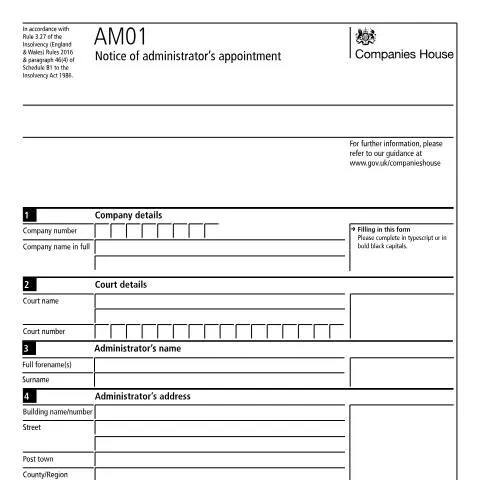
The appointment of an administrator to a struggling company represents one of the most significant corporate events in UK insolvency law, triggering immediate legal consequences and public disclosure obligations. Form AM01 serves as the crucial bridge between this appointment and the public record maintained by Companies House, ensuring transparency in what is often a complex and time-sensitive process.
This notice mechanism operates under the stringent requirements of Rule 3.27 of the Insolvency (England & Wales) Rules 2016 and paragraph 46(4) of Schedule B1 to the Insolvency Act 1986, creating a mandatory disclosure framework that affects creditors, shareholders, and the broader business community. The AM01 form captures not merely administrative details but establishes the legal foundation for an administrator's public authority to act on behalf of the company.
Unlike voluntary filings that companies might delay or defer, the submission of AM01 carries statutory urgency. The administrator's powers and the company's protected status under administration depend critically on this public notification being completed accurately and promptly, making the form's proper completion essential for the entire insolvency process to proceed lawfully.
Decoding the Administrator Appointment Landscape
The AM01 form operates within a sophisticated legal framework where different parties can appoint administrators under varying circumstances. Understanding these appointment routes proves crucial for interpreting the form's requirements and ensuring accurate completion.
Court-Appointed Administrators
When a court appoints an administrator following an application under paragraph 12 of Schedule B1 to the Insolvency Act 1986, the AM01 form must reflect the specific court details and reference the court order number. This scenario typically arises when creditors, directors, or the company itself seeks court protection, often in contested situations where stakeholder agreement cannot be reached through out-of-court processes.
The court appointment route requires particular attention to the timing requirements, as the administrator must file the AM01 notice as soon as reasonably practicable after appointment. Courts increasingly scrutinise compliance with these procedural requirements, making accurate form completion essential for maintaining the administration's validity.
Qualifying Floating Charge Holder Appointments
Under paragraph 14 of Schedule B1, qualifying floating charge holders possess the right to appoint administrators out of court, provided their security covers the whole or substantially the whole of the company's property. This appointment route, reflected in section 12 of the AM01 form, requires identification of the appointing charge holder rather than court details.
The form must clearly identify whether the appointment stems from an enforcement notice served under paragraph 15 or follows the more streamlined procedure available to qualifying charge holders. This distinction affects both the legal validity of the appointment and the administrator's subsequent powers.
Company and Director Appointments
Companies and their directors can appoint administrators under paragraph 22 of Schedule B1, subject to specific procedural requirements including notice to qualifying floating charge holders. The AM01 form must accurately reflect this appointment route, particularly where multiple parties might claim appointment rights over the same company.
| Appointment Route | Key AM01 Requirements | Critical Timing |
|---|---|---|
| Court Order | Court name, case number, order date | As soon as reasonably practicable |
| Floating Charge Holder | Charge holder identity, enforcement basis | Within prescribed notice periods |
| Company/Directors | Resolution details, notice compliance | After notice period expiry |
Insolvency Practitioner Credentials and Public Accountability
The AM01 form places significant emphasis on the administrator's professional credentials, reflecting the statutory requirement that only qualified insolvency practitioners can accept appointment as administrators. This credentialing system protects both the company and its stakeholders by ensuring appropriate expertise and regulatory oversight.
Insolvency Practitioner Authorisation Requirements
Section 6 and 10 of the AM01 form require disclosure of the administrator's insolvency practitioner number, linking the appointment to their authorisation by one of the recognised professional bodies: the Institute of Chartered Accountants in England and Wales, the Institute of Chartered Accountants of Scotland, the Association of Chartered Certified Accountants, the Insolvency Practitioners Association, or the Secretary of State directly.
This numbering system enables public verification of the administrator's qualifications and regulatory status, while also facilitating oversight by the appropriate professional body. The form's public nature means this information becomes immediately accessible to creditors and other stakeholders seeking to verify the administrator's credentials.
Joint Administrator Arrangements
The AM01 form accommodates joint administrator appointments through its multiple administrator sections, recognising that complex insolvencies often benefit from shared expertise or workload distribution. When multiple administrators are appointed, each must possess individual insolvency practitioner authorisation, and the form must capture complete details for all appointees.
Joint appointments create shared liability and authority, making accurate disclosure of all administrators essential for establishing their collective powers and individual accountability. The form ensures that creditors and other stakeholders can identify and contact any of the joint administrators as circumstances require.
Public Record Integration and Stakeholder Communication
The AM01 form's integration with the Companies House public record system creates immediate transparency around administrator appointments, enabling creditors, suppliers, customers, and other stakeholders to access current information about the company's status and management.
Mandatory Contact Information Disclosure
Sections 5 and 9 of the AM01 form require administrators to provide either email addresses or telephone numbers, ensuring stakeholder access while recognising practical communication preferences. This requirement reflects the administrator's duty to be accessible to creditors and other interested parties throughout the administration process.
The form's emphasis on contact information acknowledges that administration often involves urgent decisions affecting multiple stakeholders. By mandating public disclosure of communication channels, the AM01 system facilitates the timely stakeholder engagement that successful administrations require.
Address Publication and Professional Accessibility
The detailed address requirements in sections 4 and 8 serve multiple purposes beyond basic identification. These addresses typically represent the administrator's professional practice location, enabling formal legal service and establishing jurisdiction for various procedural requirements that may arise during the administration.
Professional addresses also provide creditors and other stakeholders with confidence in the administrator's established business presence, while enabling regulatory bodies to maintain effective oversight of insolvency practice standards and conduct.
Procedural Precision and Statutory Compliance
The AM01 form operates within strict procedural requirements that reflect the serious legal consequences of administrator appointments. Understanding these requirements proves essential for ensuring valid appointments and avoiding potential challenges to the administrator's authority.
Dating and Signature Requirements
Section 13 of the AM01 form requires administrator signature and dating, establishing personal accountability for the accuracy of disclosed information. This signature requirement creates legal liability for false or misleading statements, encouraging careful verification of all form details before submission.
The signature date establishes crucial timing for various statutory requirements, including creditor notification obligations and the commencement of the administrator's formal powers. Accurate dating therefore affects not only procedural compliance but also the substantive rights and obligations that flow from the appointment.
Company Identification Accuracy
Section 1 requires precise company identification using the exact registered name and Companies House number, reflecting the critical importance of accurate entity identification in insolvency proceedings. Errors in company identification can invalidate the entire appointment process, making careful verification essential.
The form's emphasis on matching information held on the public register acknowledges that companies sometimes trade under different names or have complex corporate structures. Administrators must ensure they identify the correct legal entity to avoid potential challenges to their appointment validity.
The AM01 checklist specifically warns that forms completed incorrectly or with missing information may be returned, potentially delaying the establishment of administration protection and the administrator's ability to act effectively.
Strategic Timing and Submission Considerations
The timing of AM01 submission carries significant strategic and legal implications that extend far beyond simple administrative compliance. Understanding these timing considerations enables administrators to optimise their appointment effectiveness while maintaining full statutory compliance.
Administration Protection Commencement
The administrator's statutory powers and the company's protection from creditor action take effect from appointment, but public awareness and third-party recognition often depend on the AM01 notice appearing on the public record. This creates a practical tension between legal effectiveness and commercial reality that administrators must navigate carefully.
Swift AM01 submission helps establish public recognition of the administration, potentially preventing creditor enforcement actions and facilitating stakeholder cooperation. Delays in filing may create uncertainty among suppliers, customers, and other commercial counterparties who rely on public record searches to understand the company's status.
Creditor and Stakeholder Expectations
Professional creditors and insolvency practitioners monitor Companies House filings closely, often treating AM01 submission as the definitive confirmation of administrator appointment. The form's appearance on the public record triggers various internal processes within creditor organisations, from debt recovery suspension to specialised insolvency team involvement.
Sophisticated stakeholders understand that AM01 filing represents more than administrative housekeeping—it signals the formal commencement of the statutory insolvency process with all its attendant legal protections and procedural requirements. This understanding makes prompt and accurate filing essential for maintaining stakeholder confidence and cooperation.
Document Lifecycle and Post-Submission Implications
The AM01 form's submission marks the beginning rather than the end of the administrator's public disclosure obligations, establishing a foundation for ongoing transparency throughout the administration process.
Public Record Permanence
Once filed, AM01 information becomes part of the permanent public record, remaining accessible long after the administration concludes. This permanence affects both the administrator's professional reputation and the company's corporate history, making accuracy essential for long-term as well as immediate purposes.
The public record serves as a historical reference for future insolvency appointments, corporate reconstructions, or legal proceedings that may reference the administration period. Administrators therefore bear responsibility for ensuring that public record accuracy reflects their professional standards and facilitates future reference needs.
Amendment and Correction Procedures
While the AM01 form itself cannot be amended once filed, administrators can submit additional forms or supporting documents to clarify or correct material errors that might affect stakeholder interests. Understanding when such corrections prove necessary helps administrators maintain public record integrity throughout the administration process.
Material errors in administrator contact details, for instance, might require prompt correction to ensure continued stakeholder access, while minor typographical errors may not warrant corrective action unless they create genuine confusion about the administrator's identity or authority.
Integration with Broader Insolvency Documentation
The AM01 form operates as part of a comprehensive documentation framework that governs administration proceedings, connecting with various other statutory filings and procedural requirements that administrators must navigate throughout the process.
Following AM01 submission, administrators typically face additional filing requirements including progress reports, receipts and payments accounts, and eventual conclusion notifications. Understanding how AM01 fits within this broader framework helps administrators plan their compliance obligations and maintain consistent public disclosure standards.
The form's role as the initial public notification also establishes baseline information that subsequent filings may reference or update, creating an interconnected disclosure system that serves both regulatory oversight and stakeholder information needs. This systematic approach reflects the UK's commitment to transparent and accountable insolvency procedures that balance commercial practicality with public interest protection.
Effective AM01 completion therefore represents not merely a standalone administrative task but the foundation for successful administration management that meets both immediate procedural requirements and longer-term transparency objectives essential for maintaining confidence in the UK's corporate insolvency framework.
Fill in your form directly online
No printing: type your details into the boxes of the official form, tick, then download the PDF ready to send.
- 1Type into the form boxes
- 2Tick in one click
- 3Save and download the PDF
Consequences and Obligations Following AM01 Submission
Once HMRC processes your AM01 form, the administrator assumes significant statutory duties that extend far beyond the initial appointment notification. The Insolvency Act 1986 creates a framework of ongoing obligations that administrators must navigate carefully to avoid personal liability and ensure compliance with their fiduciary duties.
The administrator's primary objective hierarchy becomes legally binding upon appointment confirmation. They must pursue the rescue of the company as a going concern wherever reasonably practicable. If this proves impossible, they must achieve a better result for creditors as a whole than would be achieved in immediate liquidation. Only as a final resort may they realise property to make distributions to secured or preferential creditors.
Within eight weeks of appointment, administrators must convene an initial creditors' meeting unless they reasonably believe the company has sufficient property to enable each creditor to be paid in full, or insufficient property to enable any distribution to unsecured creditors other than by virtue of section 176A(2)(a). This timeframe is strictly enforced, and failure to comply can result in court intervention and potential removal from office.
The administrator must also prepare detailed proposals outlining their intended strategy for achieving the statutory objectives. These proposals require approval by creditors and, in certain circumstances, by the court. The proposals must include comprehensive financial projections, asset realisations estimates, and projected outcomes for different creditor classes. Any material deviation from approved proposals typically requires further creditor consent or court sanction.
Statutory reporting obligations commence immediately upon appointment. Administrators must file progress reports with Companies House at six-monthly intervals, detailing receipts and payments, realisations achieved, and progress toward stated objectives. These reports become public documents, creating transparency for stakeholders whilst potentially affecting the company's commercial relationships and asset values.
The administrator's powers, whilst extensive, operate within defined parameters. They may dispose of charged property in the ordinary course of business, but disposal of assets subject to fixed charges typically requires consent from the charge holder or court permission. The power to dispose of floating charge assets is broader, though administrators must account to charge holders for any shortfall in realisations compared to the charged debt.
Variations in AM01 Requirements for Different Corporate Structures
The AM01 form requirements vary significantly depending on the corporate structure and circumstances of the company entering administration. Public limited companies face additional scrutiny and reporting requirements, particularly where shares are traded on recognised investment exchanges. The administrator must immediately notify the relevant exchange and may need to request suspension of trading to prevent market disruption and protect investor interests.
For subsidiary companies within larger corporate groups, administrators must carefully consider cross-guarantees, intercompany loans, and shared service arrangements that may complicate the administration process. The AM01 form should identify parent companies and significant subsidiaries, as these relationships often create complex creditor dynamics and potential conflicts of interest that require early identification and management.
Companies with overseas operations present particular challenges for AM01 completion and subsequent administration management. Administrators must identify foreign assets, subsidiaries, and operations that may be subject to different insolvency regimes. The EU Insolvency Regulation (as retained in UK law post-Brexit) and other international agreements may affect recognition of the UK administration in foreign jurisdictions, potentially impacting asset recovery and creditor treatment.
Where companies operate under specific regulatory frameworks – such as financial services firms regulated by the FCA or PRA, or energy companies under Ofgem oversight – additional notifications and approvals may be required beyond the standard AM01 submission. These regulators often maintain their own insolvency procedures and may need to approve the administrator's appointment or impose additional conditions on the administration process.
Charitable companies require notification to the Charity Commission alongside the AM01 filing. The Commission's consent may be necessary for certain actions during administration, particularly regarding disposal of charitable assets or changes to charitable objects. Administrators of charitable companies must balance their statutory duties under insolvency law with their obligations to preserve charitable purposes and protect charitable assets.
Companies with employee share ownership schemes or significant employee pension obligations create additional complications for AM01 preparation and administration conduct. The Pensions Regulator must be notified of the appointment, and administrators may face immediate demands from the Pension Protection Fund regarding scheme deficits. These obligations can significantly impact the administrator's strategy and available options for achieving statutory objectives.
Strategic Considerations and Alternative Procedures
Before completing the AM01 form, directors and their advisers should carefully evaluate whether administration represents the optimal insolvency procedure for their specific circumstances. Company Voluntary Arrangements (CVAs) may offer superior outcomes where the company remains viable but requires breathing space to restructure debts or operations. CVAs allow directors to retain control whilst implementing court-sanctioned arrangements with creditors, potentially avoiding the stigma and operational disruption associated with formal insolvency procedures.
The Corporate Insolvency and Governance Act 2020 introduced additional restructuring tools that may provide alternatives to administration. The new restructuring plan procedure enables companies to impose arrangements on dissenting creditor classes where certain conditions are met, potentially offering more flexible solutions than traditional administration or CVA procedures. These mechanisms require careful evaluation against the company's specific circumstances and creditor composition.
Pre-packaged sales represent a increasingly common strategy where administrators are appointed specifically to effect immediate asset sales to predetermined purchasers. Whilst legally permissible, pre-packs face heightened scrutiny from creditors and regulatory bodies. The Statement of Insolvency Practice 16 requires detailed justification and independent valuations to demonstrate that pre-pack sales achieve better outcomes than alternative disposal methods.
Administrators must also consider the timing implications of their appointment relative to the company's financial calendar and operational cycles. Appointments during critical trading periods may maximise realisations but could disrupt customer relationships and supplier arrangements. Conversely, appointments during quieter periods may facilitate orderly wind-downs but might miss opportunities for going concern sales or seasonal trading benefits.
The moratorium provisions available to companies under the Corporate Insolvency and Governance Act provide an alternative breathing space mechanism that may be preferable to administration in certain circumstances. Moratoriums allow companies to continue trading under existing management whilst preventing creditor enforcement actions, potentially facilitating restructuring without the formality and costs associated with administration procedures.
Cross-border insolvency considerations become particularly complex where companies have significant international operations or assets. The Model Law on Cross-Border Insolvency, implemented in the UK through the Cross-Border Insolvency Regulations 2006, provides mechanisms for cooperation between different jurisdictions' insolvency proceedings. However, securing recognition and assistance from foreign courts requires careful planning and early engagement with local counsel in relevant jurisdictions.
Administrators appointed via AM01 must also navigate the complex landscape of preference and transaction avoidance powers available under the Insolvency Act 1986. The ability to challenge antecedent transactions, preferences, and undervalue disposals can significantly impact the administration's success and creditor returns. However, these powers must be exercised judiciously, considering the costs of litigation against the prospects of recovery and the potential impact on ongoing trading relationships essential for business rescue scenarios.