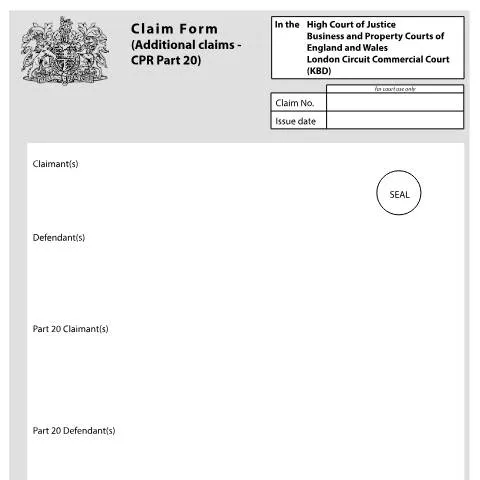
Navigating the Complexities of Form N211(LCC) in the London Commercial Court
For those engaged in commercial litigation in London, understanding and properly utilizing Form N211(LCC) is crucial. This document serves as a formal avenue for making additional claims under Part 20 of the Civil Procedure Rules (CPR), allowing claimants to extend their legal actions. The implications of this form can significantly affect the course of legal disputes, making mastery of its nuances essential for effective legal representation.
Understanding the Role of Form N211(LCC) within Legal Proceedings
Within the framework of the CPR, Form N211(LCC) facilitates the initiation of additional claims against parties who may not have been the original defendants in the case. This process is particularly relevant in instances where a claimant seeks to involve third parties or cross-claim against co-defendants.
Implications of Filing Form N211(LCC)
The filing of Form N211(LCC) can introduce significant shifts in a case. For instance, it may compel the original defendant to confront new claims or even lead to a re-evaluation of the legal strategies employed by all parties involved. As such, understanding the strategic reasons behind filing this form can be just as important as knowing how to complete it accurately.
Example Scenario: The Impact of an Additional Claim
Consider a scenario where a claimant successfully sues a contractor for breach of contract. If the contractor asserts that a supplier was responsible for the failure to deliver materials, the claimant can file Form N211(LCC) to bring the supplier into the proceedings. This not only broadens the scope of the litigation but can also influence settlement negotiations and the eventual outcome of the case.
Critical Timelines: When and How to Submit Form N211(LCC)
The timing of filing Form N211(LCC) is governed by the rules set forth in the CPR. Understanding these timelines is essential to prevent complications that could jeopardize a case.
Deadlines for Submission
- The claim must typically be filed within 14 days of the original claim if the additional claim arises from the same circumstances.
- If the additional claim is based on different facts, the claimant must ensure to file as soon as practicable, adhering to any court directions issued.
- In all cases, it is advisable to consult with legal counsel to confirm the specific deadlines applicable to your situation.
Post-Submission Process: What Happens Next?
After Form N211(LCC) is filed, the court will issue a claim number. The parties involved will then receive notification, and the additional defendants are required to respond to the claim within a designated period. This response is critical, as failing to engage with the claim can result in default judgments or other serious implications.
Addressing Potential Issues: What to Do in Case of Refusal or Errors
Filing Form N211(LCC) is not without its challenges. Errors in submission or refusals by the court can complicate proceedings and delay resolution.
Handling Rejections of Your Claim
If the court rejects your claim based on procedural issues, it is vital to address these concerns promptly:
- Review the court's feedback to understand the basis for the rejection.
- Consult with legal counsel to determine if a revised claim can be resubmitted.
- Consider whether there are grounds for appeal if the rejection is based on a legal interpretation.
Correcting Errors in Form Submission
Errors such as missing information or inaccuracies can lead to delays. If you realize an error post-filing:
- Prepare a corrected version of the form, including a covering letter explaining the amendments.
- Submit the correction through the court office, making sure to reference the original claim number.
- Keep a record of all communications and submissions for future reference.
Decoding Form N211(LCC): A Section-by-Section Breakdown
The structure of Form N211(LCC) is designed to gather specific information from claimants and defendants, but each section poses its own challenges. Understanding these intricacies can help in avoiding common pitfalls.
Key Sections of Form N211(LCC)
| Section | Description | Common Pitfalls |
|---|---|---|
| Claimant and Defendant Details | Information about all parties involved in the claim. | Incorrect names or addresses can lead to service issues. |
| Brief Details of Claim | A succinct overview of the claim being made. | Vagueness or lack of clarity can result in claims being dismissed. |
| Particulars of Claim | A detailed explanation of the grounds for the additional claim. | Omitting essential facts or evidence may weaken the claim. |
| Statement of Truth | A declaration affirming the truthfulness of the information provided. | False statements can lead to serious legal penalties. |
Common Errors by Section
Attention to detail is paramount. Here are frequent errors that claimants encounter:
- Failure to sign the Statement of Truth, rendering the claim invalid.
- Inaccurate claim amounts, which could lead to a miscalculation of court fees.
- Submitting incomplete attachments for the Particulars of Claim.
Historical and Regulatory Context: The Framework Surrounding Form N211(LCC)
Form N211(LCC) exists within a larger legal framework established by the CPR and other regulatory documents specific to commercial disputes.
The Evolution of CPR Part 20
The Civil Procedure Rules aim to ensure that all parties have an equal opportunity to present their case. Part 20 specifically addresses the circumstances under which claims may be expanded to include additional parties, reflecting the dynamic nature of commercial relationships.
Legal Foundations and Key Precedents
Several landmark cases have shaped the application and interpretation of Part 20, impacting how Form N211(LCC) is utilized:
- Black v. NCB (1993): Established guidelines for when additional parties can be brought into litigation.
- Primera (UK) Ltd v. O’Connell (2012): Clarified the burden of proof in additional claims.
Who Needs to Pay Attention? Identifying Key Stakeholders
Understanding which individuals or entities are most affected by Form N211(LCC) can streamline the preparation process.
Typical Profiles of Claimants and Defendants
Generally, the following groups are involved:
- Original claimants looking to broaden their claims against additional parties.
- Existing defendants who may have counterclaims against other parties.
- Third parties who are being implicated in ongoing litigation.
Special Cases: Exceptions and Unique Situations
There are scenarios where the standard filing of Form N211(LCC) might not apply:
- In cases involving minors or protected parties, additional safeguards and legal representations are necessary.
- Complex corporate disputes may require specific considerations based on corporate law.
Preparing Supporting Documentation: Essential Steps
Submitting Form N211(LCC) isn't merely a matter of filling in blanks; it requires thorough preparation of supporting documents.
Diverse Documentation Requirements by Claim Type
The nature of the claim dictates the types of documents needed. Here’s a brief overview:
- For breach of contract claims, include contracts, correspondence, and records of agreements.
- In negligence claims, gather evidence of duty of care and how it was breached.
- For claims involving multiple defendants, detailed communication exchanges can provide critical context.
Ensuring Document Accuracy and Completeness
Each document submitted alongside Form N211(LCC) must be thoroughly reviewed for accuracy. Common points of oversight include:
- Missing signatures on contracts or agreements.
- Outdated or incorrect contact details for parties involved.
- Failure to include essential evidence that supports the claims being made.
Distinguishing Form N211(LCC) from Similar Court Forms
In the legal landscape, it's easy to confuse Form N211(LCC) with other forms designed for similar purposes. Understanding these distinctions is critical for ensuring the proper application of the law.
Key Differences Between N211(LCC) and Other Court Forms
| Form | Purpose | Applicable Rules |
|---|---|---|
| N211(LCC) | Additional claims under CPR Part 20 | CPR Part 20 |
| N1 | Initial claim form for starting a case | CPR Part 7 |
| Part 18 Request | Request for clarification of particulars | CPR Part 18 |
Clarifying Misconceptions about Related Forms
Many may assume that filing a general claim form (like N1) suffices for all claims, but this is a misconception. Form N211(LCC) is tailored for specific cases where additional defendants or claims are required, and failing to use the correct form can lead to procedural complications.
In the intricate world of commercial litigation in the UK, Form N211(LCC) is a fundamental document that enables further claims against additional parties. By thoroughly understanding how to complete and submit this form correctly—and the implications of doing so—claimants can navigate the complexities of the legal system more effectively.
For anyone involved in commercial litigation, ensuring that you have a comprehensive grasp of Form N211(LCC) and its broader legal context could be the difference between a successful claim and a procedural misstep. Always consult legal expertise when in doubt, as the nuances of legal claims can often be intricate and require professional insight.
Understanding the Grounds for a Part 20 Claim
When making a claim under CPR Part 20 in the London Commercial Court, it’s vital to grasp the specific grounds on which such claims can be made. Part 20 is designed to facilitate the inclusion of additional parties and claims that are connected to the original dispute. This allows for a more comprehensive resolution of all related issues within a single proceeding.
A Part 20 claim can be made either as a counterclaim against an existing claimant or to add a new party as a defendant to the existing claim. Some common grounds for a Part 20 claim include:
Contribution or Indemnity: A defendant may seek to claim against another party who is partly responsible for the same damages being claimed by the original claimant. This typically arises in cases involving joint tortfeasors where liability may be shared.
Dissenting Claims: If the additional party has a separate claim against the claimant or another defendant that arises from the same or closely related facts, a Part 20 claim allows for efficiency in adjudicating these overlapping matters.
Cross-Claims: These arise when a defendant believes that the original claimant is liable to them, and they wish to pursue this claim within the same proceedings instead of initiating a separate lawsuit.
It is essential to include a robust statement of case that clearly outlines the basis for your Part 20 claim. Ensure that you refer to the relevant rules in the CPR, particularly CPR 20.4 regarding the matters arising from the same facts.
Procedural Steps for Filing Form N211(LCC) in the London Commercial Court
Navigating through the procedural requirements for filing a Form N211(LCC) can be daunting, but understanding the steps involved can facilitate a smoother process. While every case may have its unique elements, the following standard procedural steps are generally applicable:
Fill in your form directly online
No printing: type your details into the boxes of the official form, tick, then download the PDF ready to send.
- 1Type into the form boxes
- 2Tick in one click
- 3Save and download the PDF
Preparation of the Claim Form: Ensure that you provide all necessary details, including the parties involved, the nature of the dispute, and the particulars of the claim. The form should be completed accurately, reflecting the correct information about the existing claim and the nature of your Part 20 claim.
Supporting Documents: Along with your Form N211(LCC), include supporting documents that substantiate your claim. This may consist of contracts, correspondence, or any evidence that is pertinent to your case. Ensure that these documents are in accordance with the requirements stipulated in CPR Part 20.
Filing with the Court: Submit your completed Form N211(LCC) and accompanying documents to the London Commercial Court. Verify the method of submission, as courts may accept electronic submissions or require physical copies. Be mindful of any specific filing fees associated with your claim under CPR Part 20, and ensure that payment is made in accordance with the court’s specified payment methods.
Serving the Claim: Once filed, it is crucial to serve the claim on all parties involved in the original claim, as well as the new parties being added via the Part 20 claim. The rules regarding service can be found in CPR Part 6, and adhering to these is essential to avoid any issues with the validity of your claim.
Response Timeframes: Be cognizant of the time frames for responses set out in the CPR. The defendant to your Part 20 claim typically has 14 days to acknowledge service and 28 days to file a defence. Failure to adhere to these deadlines may affect your case adversely.
Case Management Directions: After filing your claim and serving it on the relevant parties, the court will issue case management directions. These will outline the procedure following your claim, including any hearings or further submissions required. Be prepared to adhere to the timetable stipulated by the court.
By familiarising yourself with these procedural steps, you can ensure that your claim under CPR Part 20 is properly lodged and has the best chance of success.
Potential Challenges and Legal Considerations in Part 20 Claims
When pursuing a claim under CPR Part 20 in the London Commercial Court, it's important to be aware of the various challenges and legal considerations that may arise. Understanding these can help you address potential hurdles effectively.
Jurisdictional Issues: Before initiating a Part 20 claim, ascertain whether the London Commercial Court has jurisdiction over both the original claim and the proposed Part 20 claim. If the additional party is based outside of England and Wales, consider the implications of jurisdiction and the applicable law. The court will generally require that there is a sufficient connection between the parties and the claim to establish jurisdiction.
Procedural Complexity: Part 20 claims can complicate existing proceedings, introducing new parties and claims that may require additional evidence and legal arguments. This complexity may lead to increased litigation costs and extended timelines. Preparing for these complexities can involve detailed pre-emptive strategy sessions with legal counsel to map out the implications of your claim.
Opposition from Other Parties: Existing parties in the original claim may oppose the addition of new parties or new claims under Part 20. This opposition could involve arguments concerning the relevance and necessity of the Part 20 claim. Be prepared to defend the rationale for your claim and demonstrate its relevance to the existing legal dispute.
Costs Implications: Adding a Part 20 claim can raise questions about costs recovery and liability. The general rule is that the losing party pays the costs of the winning party, but in complex multi-party proceedings, this can lead to disputes regarding who bears the costs. Consider discussing costs implications with your legal advisor, including the possibility of making a costs application to the court.
Data Protection Concerns: Under the Data Protection Act 2018 and UK GDPR, ensure that you handle any personal data responsibly when making a Part 20 claim. This includes being mindful of how you collect, process, and share personal information regarding all parties involved. Failure to comply with these regulations can lead to legal repercussions and affect the integrity of your claim.
By carefully considering these potential challenges and legal implications before proceeding with a Part 20 claim, you can strategically navigate the process and enhance your chances of achieving a successful outcome.