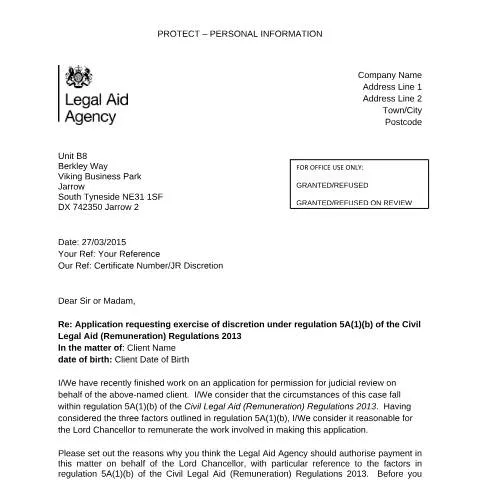
Navigating the Judicial Review Discretion Pro Forma: Unlocking Legal Aid Potential
When faced with the complexities of judicial review, legal practitioners must ensure they navigate the system effectively to secure necessary funding for their clients. The Judicial Review Discretion Pro Forma, administered by the Legal Aid Agency (LAA), is a critical tool in this process. For solicitors and barristers working on behalf of clients seeking judicial review, understanding this document’s nuances can be the difference between successful funding approval or denial.
The Critical Window: Timing Your Application
Timing is paramount when it comes to submitting the Judicial Review Discretion Pro Forma. Applications must be made promptly once all substantive issues in the proceedings have been resolved. This means you cannot jump the gun by providing detailed costs before a decision on discretion is reached. Understanding the timeline for submission can significantly impact your case.
Key Dates to Remember
- Application Submission: As soon as substantive issues are settled.
- Decisions on Applications: Typically communicated within weeks, but may vary based on case complexity.
- Judicial Review Duration: The judicial review process can take several months; hence, early action is crucial.
Once you submit your application, the LAA will review the pro forma against the criteria set forth in regulation 5A(1)(b) of the Civil Legal Aid (Remuneration) Regulations 2013. If the LAA grants discretion, the next steps involve discussing remuneration for the judicial review work completed.
Understanding the Regulation: Specific Circumstances for Discretion
Regulation 5A(1)(b) outlines specific scenarios in which the Lord Chancellor may exercise discretion to pay for judicial review-related work. Awareness of these circumstances can enhance the chances of a successful application.
Key Scenarios for Discretion
| Scenario | Description |
|---|---|
| Court Permission Granted | If the court allows the judicial review to proceed, remuneration is typically approved. |
| Withdrawal of Defendant’s Decision | If the defendant retracts their decision, resulting in the court being unable to provide permission, it may still qualify for remuneration. |
| Oral Hearing Ordered | Should the court order a hearing to determine permission or a relevant appeal, this can also lead to successful payment. |
| Rolled-Up Hearing | If the court combines hearings for efficiency, remuneration may be granted. |
When preparing your application, ensure that the circumstances reflect the outlined scenarios. A clear connection between the situation and regulation 5A(1)(b) enhances the strength of your application.
A Closer Look at the Pro Forma: Section by Section Breakdown
The Judicial Review Discretion Pro Forma is structured to capture essential information that will substantiate your application for funding. Each section is designed to aid the LAA in making an informed decision, so it’s vital to approach each part with precision.
Essential Sections to Complete
- Applicant Details: Provide your name, contact information, and the client's details. Ensure the accuracy of the client's date of birth and reference number, as discrepancies may delay processing.
- Case Details: Describe the case, including the background and any relevant legal points. This information lays the foundation for understanding the necessity of your application.
- Reasons for Discretion: This is perhaps the most critical section. Clearly articulate why discretion should be exercised, addressing each of the factors in regulation 5A(1)(b). Include specific details on the strength of the application, outcome sought, and reasons for not obtaining a costs order.
- Supporting Evidence: Attach any additional documents that support your claims. This could include correspondence or prior case outcomes that reinforce your position.
Completing each section accurately and thoroughly cannot be overstated. The LAA relies on the information provided to make a decision, and omissions or inaccuracies can lead to delays or refusals.
Common Pitfalls: Avoiding Mistakes that Lead to Denials
While filling out the pro forma, several common pitfalls can hinder your application’s success. Awareness of these issues can help streamline the process and enhance your application’s likelihood of approval.
Frequent Errors to Avoid
- Incomplete Information: Omitting essential details or failing to provide necessary context will likely result in a rejection.
- Insufficient Justification: When explaining why discretion should be granted, vague or weak justifications can weaken your case.
- Misunderstanding Regulatory Requirements: Not aligning your application with the specific criteria set out in regulation 5A(1)(b) could lead to an outright denial.
To ensure your application shines, double-check each section before submission and seek peer review if possible. Having another set of eyes can help identify overlooked errors or unclear language.
Comparative Analysis: Distinguishing This Form from Similar Documents
In the realm of legal aid, there are several forms that solicitors encounter, leading to confusion regarding their purposes. Understanding what sets the Judicial Review Discretion Pro Forma apart ensures that legal practitioners submit the correct document for the appropriate situation.
Key Differentiators
| Form | Purpose | Key Features |
|---|---|---|
| Judicial Review Discretion Pro Forma | Request for remuneration related to judicial review work under discretion. | Focuses on specific discretion scenarios as outlined in regulation 5A(1)(b). |
| Application for Legal Aid | Initial request for legal aid funding. | Broad application process for various types of cases beyond judicial review. |
| Cost Assessment Request | Request for assessment and payment of costs incurred. | Typically follows after work completion, whereas the pro forma is preventative. |
Understanding these distinctions is crucial for legal practitioners to ensure they are utilizing the correct forms at the right stages of their cases. Improper submissions can lead to delays or even legal aid refusals, complicating the pursuit of justice for clients.
Fill in your form directly online
No printing: type your details into the boxes of the official form, tick, then download the PDF ready to send.
- 1Type into the form boxes
- 2Tick in one click
- 3Save and download the PDF
Broader Context: The Role of the Judicial Review Discretion Pro Forma in Legal Aid
The Judicial Review Discretion Pro Forma does not exist in isolation. It plays a crucial role within the larger framework of legal aid and judicial review processes. Recognizing this context is vital for effective legal planning.
Interconnected Legal Processes
- Initial Legal Aid Application: The journey typically begins with a legal aid application, which sets the foundation for funding.
- Judicial Review Proceedings: If the case necessitates a judicial review, practitioners must prepare to utilize the pro forma to secure additional funding for related work.
- Cost Recovery: Post-judicial review, practitioners may need to submit a cost assessment request to recover expenses incurred during the process.
By understanding the interconnected nature of these processes, practitioners can effectively strategize their approach, ensuring that they adhere to the legal aid requirements while maximizing funding opportunities for their clients.
Final Thoughts on the Importance of Diligent Completion
Success in securing remuneration for judicial review work hinges on the details captured in the Judicial Review Discretion Pro Forma. Legal practitioners must prioritize diligence in completing this form, as its purpose is not merely administrative; it directly impacts the ability to obtain necessary funds for clients facing judicial review.
By being proactive, informed about the regulations, and meticulous in completing each section, solicitors and barristers can significantly enhance their chances of not only securing funding but also supporting their clients through often complex and challenging legal landscapes.