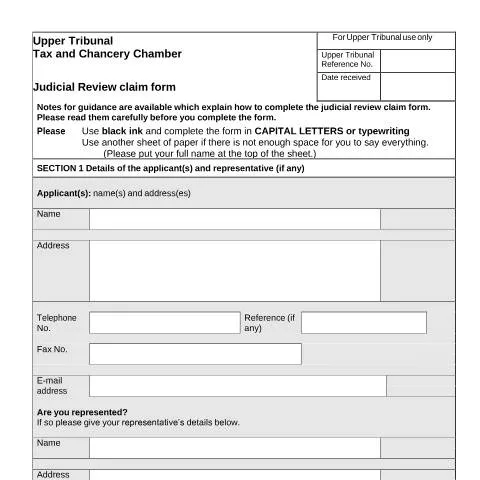
Understanding the Judicial Review Claim Form (Form JR1) for the Upper Tribunal
The Form JR1 is the official document used to initiate a judicial review of a decision made by the Upper Tribunal’s Tax and Chancery Chamber or the General Regulatory Chamber. This form is a crucial step for individuals or entities seeking to challenge the legality of a tribunal decision in England or Wales. It ensures that the process is formal, transparent, and aligned with the procedural rules set out by the HM Courts & Tribunals Service.
Purpose and Scope of the Form JR1
The primary purpose of the Form JR1 is to provide a structured means for applicants to formally request a review of a specific decision issued by the Upper Tribunal. This process is essential when an applicant believes that the decision was unlawful, irrational, or made with procedural errors. The form covers various grounds for judicial review, including challenges to the decision’s legality, fairness, or reasoning.
It is important to note that the form is applicable only for proceedings concerning decisions made in the context of the First-tier Tribunal in England or Wales. For cases originating in Scotland or Northern Ireland, different legal routes and forms are applicable, such as applications to the Court of Session or the High Court.
Key Sections and Their Significance
Section 1: Applicant and Representation Details
This section gathers essential information about the individual or organisation seeking to challenge the decision. It includes the applicant’s name, address, contact details, and information about any legal or professional representative acting on their behalf. Accurate and complete details are vital to ensure proper correspondence and case management.
Section 2: Respondent Information
This part specifies which chamber of the Upper Tribunal made the decision under review. Applicants must tick the appropriate box to indicate whether the decision originated from the Tax Chamber or the General Regulatory Chamber. Precise identification of the respondent helps streamline the review process.
Section 4: Details of the Decision Under Challenge
Here, the applicant must specify the date and reference number of the decision they seek to review. Clear identification of the decision is crucial for the tribunal to locate the relevant case file and understand the context of the challenge.
Section 5: Grounds for Judicial Review
This section requires a detailed statement outlining the specific legal or procedural grounds on which the applicant bases their challenge. It is advisable to attach a comprehensive explanation, including relevant facts and legal arguments, to support the application.
Section 6: Requested Outcomes
The applicant indicates what remedies they are seeking, such as quashing the decision, issuing a declaration, or other interim measures. Clearly stating the desired outcome helps the tribunal understand the applicant’s objectives and consider appropriate remedies.
Section 8: Supporting Documentation
Applicants must enclose the full reasons for the challenged decision, along with any additional evidence supporting their claim. If certain documents are not yet available, the form provides space to explain when they will be obtained and why they are currently unavailable.
Procedural Considerations and Submission
Once completed, the form can be submitted either online via the HM Courts & Tribunals Service E-Filing portal or by post to the designated address at the Rolls Building in London. The tribunal advises applicants to keep copies of all documents submitted and to ensure that the form is filled out in capital letters or typed to facilitate processing.
Fill in your form directly online
No printing: type your details into the boxes of the official form, tick, then download the PDF ready to send.
- 1Type into the form boxes
- 2Tick in one click
- 3Save and download the PDF
Applicants should be aware of the strict deadlines associated with judicial review applications. Typically, an application must be made promptly and within a specific period after the decision, often within 28 days, unless an extension is granted.
Legal and Data Protection Considerations
The processing of personal data involved in judicial review proceedings is governed by the Data Protection Act 2018 and the UK GDPR. Applicants are encouraged to review the privacy notices provided by the tribunal to understand how their information will be used and safeguarded throughout the process.
In summary, the Form JR1 is a fundamental document that enables individuals and organisations to challenge tribunal decisions through the judicial review process. Its structured format ensures clarity and consistency, facilitating fair and efficient adjudication of disputes within the UK tribunal system.