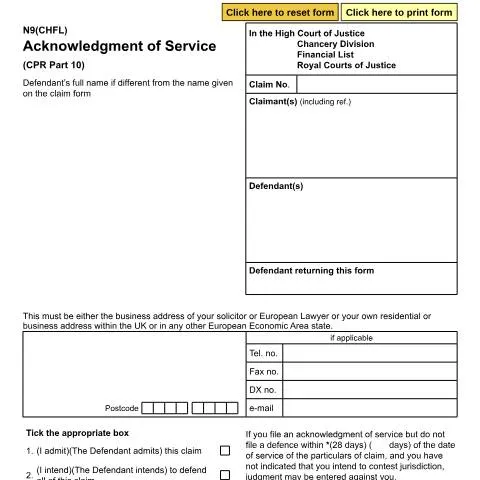
Navigating the Acknowledgment of Service: The N9(CHFL) Form in Detail
In the realm of legal proceedings within the United Kingdom, the N9(CHFL) form, known as the Acknowledgment of Service, plays a critical role, particularly in the Chancery Division Financial List. This document serves as a formal response from a defendant once they are served with a claim. Understanding the intricacies of this form not only aids in compliance with court procedures but also minimizes the risk of default judgments, which can have significant repercussions for defendants. Let’s delve deeper into the specifics surrounding this essential component of the legal process.
The Timeline of the N9(CHFL) Form: Key Deadlines and Next Steps
Timeliness is crucial when dealing with legal matters. Upon receiving the claim form, defendants must act swiftly. Here’s a breakdown of the timeline:
Initial Service and Response Timeframe
- The claim form is served to the defendant.
- The defendant has 14 days from the date of service to submit the N9(CHFL) form.
Once the acknowledgment is filed, if the defendant does not proceed with a full defence within 28 days, the court may enter a judgment against them. This rule underscores the importance of proactive engagement with the court process.
Subsequent Actions Following Acknowledgment
After submitting the N9(CHFL), the defendant must consider the next steps:
- If intending to defend the claim fully, a detailed defence must be filed within the stipulated timeframe.
- If the intention is to contest jurisdiction, an application must be made simultaneously with the acknowledgment. Failure to do this within 28 days implies acceptance of the court's jurisdiction.
Different Channels for Submitting the N9(CHFL): Digital vs. Traditional
In today's digital age, understanding the various methods of submission for the N9(CHFL) form is essential. Defendants have several options:
Online Submission
Filing the N9(CHFL) online offers a convenient and efficient method:
- Access to the online service is available via the official court website, allowing users to complete and submit the form electronically.
- Online submissions typically offer instant confirmation, which can provide peace of mind compared to traditional methods.
Paper Submission
For those who prefer or require the traditional route:
- The form can be printed, completed, and then sent by post to the relevant court.
- Ensure that you send it to the correct court address to avoid delays.
In-Person Submission
For urgent matters, defendants might opt to submit the N9(CHFL) directly at the court:
- This method allows for immediate processing but may require waiting in line.
- Bringing a copy for personal records is advisable, as it can serve as proof of submission.
The Legal Framework: Understanding the Role of the N9(CHFL)
The N9(CHFL) form is anchored in the Civil Procedure Rules (CPR), particularly Part 10, which governs acknowledgment of service:
- These rules highlight the importance of timely responses to avoid default judgments.
- Each section of the form is designed to ensure that the defendant's intentions are explicitly stated, covering all bases regarding admission, intention to defend, and jurisdictional challenges.
Understanding the legal context of the N9(CHFL) emphasizes its significance in the wider judicial framework, ensuring that defendants are afforded their rights within the UK legal system.
Addressing Refusals, Errors, and Missing Information
Errors in the N9(CHFL) can lead to complications and potential refusals, which is why being meticulous in its completion is vital:
What Happens in Case of Errors?
- Should an error occur, the court may reject the acknowledgment, necessitating resubmission.
- Defendants must ensure that all provided information is accurate, particularly details like the defendant’s name and contact information.
Handling Missing Information
If required fields are left blank or crucial information is missing:
- The court may request additional information before processing the acknowledgment, which could delay proceedings.
- In such scenarios, it is prudent to respond swiftly to requests from the court to maintain your position.
A Chronological Walkthrough: From Claim to Decision
Understanding the procedural flow can demystify the legal process. Here’s a step-by-step journey from receiving a claim to the court’s final decision:
- Receipt of Claim: The defendant receives the claim form, outlining the nature of the dispute.
- Submission of N9(CHFL): The defendant completes and files the N9(CHFL) within 14 days.
- Filing a Defence: If intending to contest the claim, the defendant must file a defence within 28 days of acknowledgment.
- Court Review: The court reviews the filed documents and may request further information or clarification.
- Hearing Scheduled: If the case proceeds, a hearing will be scheduled where both parties can present their arguments.
- Decision Issued: The court delivers its judgment, which can be appealed depending on the circumstances.
Special Circumstances: Navigating Complex Cases Involving the N9(CHFL)
Some defendants may face unique situations that require additional consideration:
Foreign Defendants
For defendants located outside the UK, special rules apply:
- Service of the claim must adhere to international rules, and defendants must ensure they meet UK jurisdictional standards.
- Using the N9(CHFL) while residing abroad may involve additional steps regarding the acknowledgment of service.
Minors and Vulnerable Individuals
Cases involving minors or individuals deemed vulnerable may necessitate additional protections:
- Legal representatives often must act on behalf of these individuals, ensuring that their rights and interests are safeguarded throughout the process.
- Acknowledgments in such cases may require additional forms or considerations regarding the representation.
The Broader Context: Interplay of the N9(CHFL) with Other Legal Processes
The N9(CHFL) form does not exist in isolation. Its submission often triggers or is part of a larger legal process:
Linking to Other Forms and Procedures
Defendants may need to engage with various other documents, including but not limited to:
- Defence Forms: Required if the defendant intends to contest the claim.
- Application Forms: For those choosing to contest jurisdiction, specific applications must be filed.
Integration with Court Proceedings
The Acknowledgment of Service is integral to the court's ability to manage cases effectively, ensuring that:
- The court is made aware of the defendant's stance promptly.
- It assists in scheduling hearings and managing court resources efficiently.
Ultimately, being well-informed about the nuances of the N9(CHFL) form enhances a defendant’s ability to navigate the complexities of the UK judicial system effectively.
Understanding the Role of Form N9(CHFL) in the Chancery Division Financial List
The Form N9(CHFL), known as the Acknowledgment of Service, plays a crucial role in the proceedings within the Chancery Division Financial List. This form is primarily used by defendants in civil claims that are being heard in the Chancery Division, particularly those involving financial matters. It is important to grasp the context and significance of this form within the legal framework to navigate the process effectively.
When a claim is issued, the defendant must respond by filing the N9(CHFL) within a specified timeframe, typically 14 days from the date of service. By submitting this acknowledgment, the defendant not only confirms receipt of the claim but also provides the court with their intention to either contest or admit the claim. This initial response can set the stage for either a swift resolution or a lengthy court process, depending on the nature of the acknowledgment.
One critical aspect to note is that filing the N9(CHFL) does not equate to submitting a full defence. It merely serves as a preliminary acknowledgment, and the defendant will still need to prepare a detailed response later on. It is also important for defendants to be aware that if they fail to file the N9(CHFL) within the required timeframe, the claimant may apply for a default judgment, which could have significant financial implications.
Furthermore, the completion of Form N9(CHFL) requires careful attention to detail, including accurately stating the name of the court, the claim number, and the parties involved. Failing to provide accurate information may lead to delays or complications in the proceedings. It is also essential to keep in mind that personal data provided on this form is subject to the Data Protection Act 2018 and UK GDPR, so users should ensure that any sensitive information is handled appropriately.
Common Mistakes to Avoid When Completing Form N9(CHFL)
Completing the Form N9(CHFL) can seem straightforward, but several common pitfalls can hinder the process. Being aware of these mistakes can save time and potentially avoid unnecessary legal complications.
Fill in your form directly online
No printing: type your details into the boxes of the official form, tick, then download the PDF ready to send.
- 1Type into the form boxes
- 2Tick in one click
- 3Save and download the PDF
Firstly, one of the most frequent errors is not submitting the form on time. As previously mentioned, defendants have 14 days to acknowledge receipt of the claim. Missing this deadline can lead to default judgments, which are difficult to overturn. Hence, it's advisable to set reminders and plan ahead to ensure timely submission.
Another common mistake is failing to provide accurate contact details. The defendant's address must be correct, as this is where all further court communications will be sent. If the address is incorrect, it may cause delays in receiving important court documents or notices, leading to missed deadlines.
Moreover, defendants sometimes underestimate the importance of providing a clear statement of their intention regarding the claim. It's critical to indicate whether the claim is being contested or admitted. A vague or ambiguous acknowledgment can lead to confusion and might affect the court's subsequent decisions.
Additionally, individuals often overlook the necessity of keeping a copy of the completed form for their records. This copy serves as proof of submission and provides a reference for any future communications regarding the case. Losing track of this document can result in complications if questions arise later about the acknowledgment.
Lastly, defendants should carefully consider seeking legal advice before completing the N9(CHFL), especially if the claim involves complex financial issues or legal principles. Professional guidance can help clarify the implications of contesting versus admitting the claim and ensure the form is filled out correctly.
The Aftermath of Filing Form N9(CHFL): Next Steps in the Process
Once Form N9(CHFL) has been submitted, the defendant must understand the subsequent steps in the legal process. Acknowledging the claim is just the beginning, and the next phases are crucial in shaping the outcome of the proceedings.
If the defendant contests the claim, they will be required to file a detailed defence. This document must be submitted within the timeframe specified by the court, which is typically 28 days from the date of filing the N9(CHFL). In the defence, defendants should comprehensively address each point made in the original claim, presenting any relevant evidence or arguments that support their position.
Should the defendant choose to admit the claim entirely or in part, they will need to communicate this to the court and may be required to propose a settlement or payment plan. Admitting a claim can lead to quicker resolutions, but it may also involve agreeing to financial obligations that must be fulfilled within specified timeframes.
It is also important for defendants to be prepared for potential mediation sessions or court hearings that may be scheduled following the filing of the N9(CHFL). Mediation offers an opportunity for parties to reach an agreement outside of court, which can save time and costs. However, if mediation is unsuccessful or not pursued, the case will progress through the court system, where further hearings and possibly a trial will take place.
Throughout this process, maintaining open lines of communication with the court and the opposing party is essential. Defendants should respond promptly to any court notifications and keep track of all deadlines to avoid any disadvantages in their case.
Ultimately, the filing of Form N9(CHFL) is a pivotal moment in the legal proceedings within the Chancery Division. Understanding the form's implications and the subsequent steps can greatly enhance a defendant's ability to navigate the complexities of the financial claims process.