When Family Court Proceedings Meet Domestic Violence Allegations
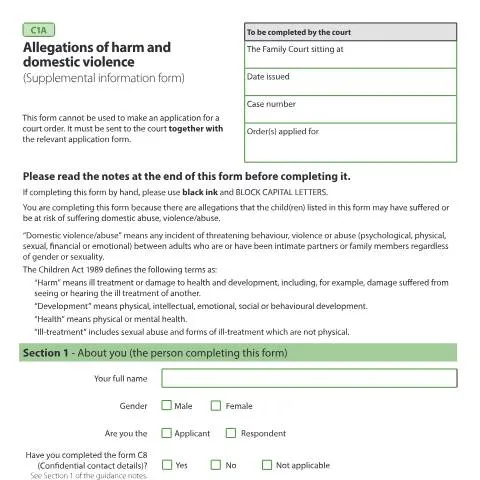
When children become caught in the crossfire of family disputes involving allegations of domestic violence or harm, the Family Court requires detailed supplementary information to make informed decisions about their welfare and safety. Form C1A serves as this crucial bridge between standard family proceedings and the complex realities of domestic abuse situations. This supplemental information form cannot initiate court proceedings independently but must accompany relevant application forms when domestic violence allegations surface in child arrangement cases, residence disputes, or contact applications.
The form's significance extends beyond mere bureaucracy. It represents the court's recognition that domestic violence cases require specialised assessment protocols under the Children Act 1989, where the paramount consideration remains the child's welfare. Unlike standard family forms that focus on arrangements and logistics, Form C1A delves into patterns of behaviour, risk assessments, and protective measures that could fundamentally shape how contact arrangements unfold.
Completing this form triggers specific court procedures designed to safeguard vulnerable parties. The information provided influences whether supervised contact centres become necessary, whether non-molestation orders should be considered, and how quickly emergency protective measures might be implemented. For many families, Form C1A represents their first formal opportunity to document patterns of abuse that may have remained hidden within private family relationships.
Distinguishing C1A from Related Family Court Documentation
The family court system employs numerous forms for different circumstances, and understanding where Form C1A fits within this ecosystem prevents confusion and delays. While Form C100 initiates applications for child arrangements orders, and Form C1 covers general applications to family courts, Form C1A exclusively handles supplemental information regarding domestic violence allegations.
Key distinctions become apparent when examining their purposes:
| Form | Primary Function | When Used | Relationship to C1A |
|---|---|---|---|
| C100 | Apply for child arrangements order | Starting proceedings | C1A accompanies when domestic violence alleged |
| C1 | General family court applications | Varying existing orders | C1A may supplement if new allegations arise |
| C8 | Confidential contact details | When address secrecy needed | Often completed alongside C1A |
| FL401 | Non-molestation/occupation orders | Seeking protective orders | C1A provides supporting evidence |
Form C8 frequently accompanies C1A submissions, as domestic violence survivors often require address confidentiality. The interplay between these forms reflects the court's understanding that domestic abuse cases involve multiple layers of risk requiring coordinated protective responses. Unlike divorce proceedings where Form D8 handles dissolution matters, family court forms like C1A focus specifically on child welfare within abusive family dynamics.
The timing of C1A completion also differs significantly from other family forms. While C100 applications follow standard court fee structures and processing timelines, C1A submissions can trigger urgent case management directions where immediate risk to children is identified. This expedited handling distinguishes domestic violence cases from routine family disputes, potentially leading to emergency hearings within days rather than weeks.
Navigating the Five-Section Structure: From Personal Details to Protection Orders
Form C1A follows a carefully structured progression designed to build a comprehensive picture of risk and required interventions. Each section serves specific evidential purposes that influence judicial decision-making processes.
Section 1: Establishing Your Position and Representation
The opening section identifies whether you're the applicant or respondent in proceedings, establishing your relationship to the children concerned. This seemingly basic information carries significant implications for how allegations are assessed. Applicant status often correlates with the person raising domestic violence concerns, though respondents may also complete C1A to counter-allege or provide context.
Solicitor details become particularly crucial in domestic violence cases, as legal representation helps navigate complex evidential requirements and ensures appropriate protective measures are requested. The form specifically asks about Form C8 completion, highlighting the interconnected nature of domestic violence documentation where address confidentiality frequently becomes necessary.
Child relationship details require careful attention, as courts assess risk differently depending on whether abuse allegations concern biological parents, step-parents, or other family members. The gender and age information requested helps courts apply appropriate safeguarding frameworks, with younger children and female victims often requiring enhanced protective considerations under established risk assessment protocols.
Section 2: Documenting Patterns of Abuse
This section represents the form's analytical core, requiring detailed categorisation of abuse types experienced by both adult parties and children. The checkbox system covering physical, emotional, psychological, sexual, and financial abuse enables courts to understand the scope and severity of alleged domestic violence patterns.
The distinction between adult and child experiences of abuse proves crucial for judicial assessment. Children who witness domestic violence suffer recognised developmental harm under the Children Act 1989, even without direct physical abuse. Courts increasingly recognise that exposure to domestic violence constitutes a form of emotional abuse requiring protective intervention.
Existing court orders require documentation with specific details including issue dates, duration, and current status. This information helps courts understand whether previous legal interventions have proved effective or require strengthening. Non-molestation orders, occupation orders, and restraining orders each carry different legal weights and enforcement mechanisms that influence future protective strategies.
The narrative section allows detailed incident description while noting that full statements will be required later. This balance acknowledges the need for immediate risk assessment while recognising that comprehensive evidence gathering takes time. Effective completion focuses on clear chronological patterns rather than exhaustive incident catalogues.
Section 3: Addressing Abduction Risks
International child abduction represents a specific risk category requiring specialist assessment and intervention. This section activates when geographical separation threats emerge, particularly in cases involving parents with overseas connections or previous abduction attempts.
Passport control becomes a critical protective mechanism, with the Identity and Passport Service maintaining alert systems for at-risk children. Courts can impose passport surrender requirements or port alert notices preventing unauthorised international travel. The form's questions about multiple passports reflect modern realities where children may hold dual nationality, creating additional abduction vulnerabilities.
Police involvement in previous incidents provides courts with independent verification of abduction risks and established enforcement relationships. International cases may involve Interpol coordination or liaison with overseas authorities, particularly in Hague Convention countries where established return procedures exist.
Sections 4 and 5: Additional Concerns and Protective Measures
The final sections address broader welfare concerns and specific court orders being sought. Section 4 captures issues beyond direct domestic violence, such as substance abuse, mental health concerns, or child neglect allegations that compound risk factors.
Section 5's focus on protective orders reflects the court's need to understand what interventions are being sought. Non-molestation orders provide civil protection against harassment and violence, while prohibited steps orders prevent specific actions like school collection or medical decisions without court permission. The distinction between supervised and unsupervised contact arrangements often hinges on information provided in earlier sections.
Evidence Gathering and Documentation Strategies
Successful Form C1A completion requires systematic evidence collection that supports allegations while meeting legal admissibility standards. The court's emphasis on factual accuracy and corroboration means that contemporaneous records carry significantly more weight than retrospective accounts.
Medical evidence provides crucial objective documentation of physical injuries or psychological impact. GP records, hospital attendance notes, and specialist reports from counsellors or therapists create an independent evidence trail supporting domestic violence allegations. Photographs of injuries, property damage, or threatening messages offer visual evidence that can be powerful in court hearings.
Police involvement generates official incident reports that courts treat as reliable evidence sources. Even where no charges were brought, police attendance records document the seriousness of incidents and provide independent witness accounts. Crime reference numbers should be recorded for all reported incidents, as these enable court staff to obtain police disclosure if required.
Social services involvement often provides comprehensive risk assessments and child welfare evaluations. Child protection conference minutes, core group meeting records, and social worker reports offer professional perspectives on family dynamics and child safety concerns. These agencies maintain detailed case files that can provide extensive supporting evidence for Form C1A submissions.
Witness statements from family members, friends, neighbours, or professionals who observed incidents or their aftermath strengthen case presentations. However, witnesses must be prepared to attend court hearings and face cross-examination, so their reliability and availability should be confirmed before including their accounts in C1A submissions.
Digital Evidence Considerations
Modern domestic abuse increasingly involves digital elements requiring careful preservation and presentation. Text messages, social media posts, emails, and voicemails can provide compelling evidence of threatening behaviour or harassment patterns. However, digital evidence must be properly authenticated to meet court standards.
Screenshots should include timestamps, sender details, and context information. Phone records can corroborate the frequency and timing of unwanted contact, while social media monitoring may reveal breaches of existing court orders or continued harassment attempts. Dating apps, online banking records, and location tracking data may also provide relevant evidence in specific cases.
The Data Protection Act 2018 and UK GDPR govern how personal digital information can be collected and presented in court. Legal advice may be necessary to ensure evidence gathering methods comply with privacy laws while maintaining admissibility in family proceedings.
Court Submission Procedures and Timing Considerations
Form C1A submission follows specific procedural requirements that differ from standard family court filings due to the urgent nature of domestic violence cases. The form must accompany relevant application forms rather than being filed independently, creating coordination requirements between different legal documents.
Filing locations depend on existing case allocation or the geographical area where applications are being made. The Family Court operates across multiple hearing centres, with domestic violence cases often allocated to courts with specialist domestic abuse expertise and appropriate security arrangements. Some courts maintain dedicated domestic violence court lists with enhanced safety protocols.
Paper filing remains common for domestic violence cases where electronic submission might compromise safety through digital monitoring or control by abusive partners. Court offices accept hand-delivered forms during business hours, with staff trained to handle sensitive domestic abuse documentation confidentially.
Postal submission requires recorded delivery to ensure receipt confirmation and prevent documents being intercepted. The court's postal address should be verified directly with the relevant hearing centre, as generic addresses may cause delays in urgent cases requiring immediate judicial attention.
Emergency Applications and Expedited Processing
Where immediate risk to children or adults is identified, Form C1A can support emergency applications for protective orders. Without notice applications allow courts to impose immediate protective measures before respondents are formally served with proceedings, though such orders typically require swift follow-up hearings where all parties can participate.
Emergency applications often require telephone contact with court offices to arrange urgent hearings outside standard listing procedures. Duty judges may be available for genuine emergencies involving immediate physical danger or child abduction risks. However, emergency status requires clear evidence of imminent risk rather than general domestic violence concerns.
The court's case management powers enable expedited processing where Form C1A reveals serious safeguarding concerns. Standard case progression timescales may be compressed, with first hearings scheduled within days rather than weeks. This acceleration requires all parties to prepare quickly for court appearances, making early legal representation particularly valuable.
Understanding Court Responses and Case Management Directions
Once Form C1A is received, courts implement specific case management protocols designed for domestic violence cases. The information provided influences how proceedings are conducted, what safeguarding measures are imposed, and which specialist resources become involved in case resolution.
Initial case management hearings focus on immediate safety arrangements and evidence gathering directions. Courts may order specialist domestic violence risk assessments, child welfare reports from Cafcass officers, or psychiatric evaluations where mental health concerns are identified. These directions create structured processes for investigating allegations while protecting vulnerable parties.
Contact arrangements during proceedings reflect the risk levels identified through Form C1A submissions. Supervised contact at specialist centres becomes common where safety concerns exist, with gradual progression toward unsupervised arrangements only after risk factors are addressed. Contact suspension may occur in cases involving serious physical violence or child abuse allegations.
Non-molestation orders represent common protective measures arising from C1A submissions, creating criminal sanctions for harassment, violence, or unwanted contact. These orders typically remain in force throughout proceedings and may be extended indefinitely where ongoing risks are identified. Breach of such orders constitutes contempt of court with potential imprisonment consequences.
Specialist Court Procedures
Domestic violence cases trigger enhanced court security arrangements and modified hearing procedures designed to protect vulnerable participants. Separate waiting areas, staggered arrival times, and video link facilities may be arranged to prevent direct contact between parties where safety concerns exist.
Special measures directions can modify how evidence is given, including screens to prevent direct eye contact, separate entrances to courtrooms, or testimony via video link from remote locations. These arrangements recognise that domestic violence survivors may find court attendance traumatic or dangerous, requiring procedural adaptations to enable effective participation.
Judicial continuity becomes important in domestic violence cases, with the same judge ideally managing cases from initial hearings through final orders. This consistency enables judges to develop detailed understanding of family dynamics and risk factors, leading to more informed decision-making about protective measures and contact arrangements.
Long-term Implications and Post-Order Considerations
Form C1A submissions create lasting impacts on family court proceedings that extend far beyond initial protective measures. The allegations documented influence long-term contact arrangements, parental responsibility decisions, and ongoing court supervision requirements that may persist for years.
Child arrangement orders emerging from domestic violence cases often include specific conditions reflecting identified risk factors. Geographic restrictions may prevent children being taken to certain areas, while communication methods may be regulated to prevent harassment opportunities. School pickup arrangements, holiday contacts, and special occasion access frequently require detailed specification to maintain safety while preserving parent-child relationships where appropriate.
Ongoing monitoring mechanisms may include regular court reviews, social services involvement, or mandatory domestic violence intervention programmes for alleged perpetrators. These requirements create structured frameworks for assessing whether risk factors diminish over time, enabling gradual relaxation of protective measures where genuine behaviour change occurs.
Breach reporting procedures become crucial for maintaining protective order effectiveness. Form C1A establishes baseline risk assessments that help courts evaluate the seriousness of subsequent violations and determine appropriate enforcement responses. Escalating breach patterns may lead to contact suspension or criminal prosecution under harassment legislation.
The children's voices gain increasing significance as they mature, with courts considering their expressed wishes about contact arrangements alongside ongoing risk assessments. However, domestic violence cases require careful evaluation of whether children's preferences reflect genuine desires or result from manipulation, fear, or loyalty conflicts arising from abusive family dynamics.
Appeal procedures remain available where parties disagree with court decisions arising from Form C1A submissions, though appellate courts typically defer to first instance findings on factual matters involving domestic violence allegations. Fresh evidence of changed circumstances or new incidents may justify applications to vary existing orders, requiring updated risk assessments and potentially fresh C1A submissions.
The lasting significance of Form C1A lies in its role establishing formal recognition of domestic violence within family proceedings, creating legal frameworks that prioritise safety while seeking to preserve beneficial family relationships where possible. This balance reflects evolving understanding of domestic abuse impacts on child development and the importance of protective measures in enabling healthy family functioning post-separation.